Differences in Sex Development (aka "intersex")

Akshooallie...

You wouldn't see a spectrum, nor would you see any normal distributions along each karyotype combination. Karyotype, as with sex, is a categorical variable, not an ordered variable. You can get a bar graph out of it... and depending on how you decide to arrange the karyotypes, you can make it superficially look like a bimodal distribution - or even a trimodal if you rearrange them enough times! But at the end of the day, there is no innate order to karyotypes, so the entire concept of a bimodal distribution doesn't even compute. Same thing with sex - it's a strictly binary categorical variable... associated with several correlated characteristics which can be measured in an orderly fashion.

Sure, karyotypes are "categorical variables". Doesn't mean one can't order them - many different ways of doing so, some better than others.

Consider this "joint-probability distribution" by karyotype and heights that I'd posted here - somewhere - earlier; see below.

As I had mentioned, if you mentally rotate the 3D graph so that you're facing the karyotype-percentage face then you'd see 6 discrete peaks - corresponding to the height means for each of the karyotypes - with nothing in between, i.e., no karyotypes "between", say XX & XY. A multi-modal distribution.

And if you deleted all of the karyotype plots except the XX and the XY, and then call them "female" and "male" then I suppose you'd get a "bimodal" distribution though I'm not entirely sure that the term is entirely accurate.

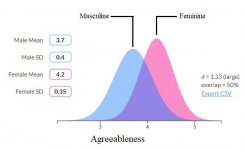
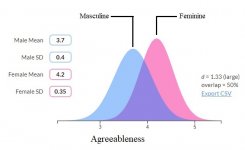
But since there are only two probability distributions to consider then it's reasonable to show them as overlays as is typical. As in this joint-probability distribution by "sex" and "agreeableness"; women tend to score higher in agreeableness than do men.

Where Novella went off the rails and into the weeds was in claiming - with diddly-squat in the way of credible evidence - that that "paradigmatic" case of continuous distributions also characterized sex. But, of course, sex is, by definition, binary; there are NO sexes between male and female or on either side of those "categories" as with the XX & XY karyotypes:
 

Attachments

  • SexSpectrum_KaryotypeVsHeights2B.jpg
    SexSpectrum_KaryotypeVsHeights2B.jpg
    61.8 KB · Views: 2
  • SexDifferences_Agreeableness2A.jpg
    SexDifferences_Agreeableness2A.jpg
    31.3 KB · Views: 2
  • CadeHildebreth_BimodalSex_1B.jpg
    CadeHildebreth_BimodalSex_1B.jpg
    34.7 KB · Views: 2
I'd just like to point out that you're promoting a view of reproductive biological categories from a psychologists and a philosopher, over the view of evolutionary and developmental biologists.

Not at all the case. You might take a gander at a fairly recent post of mine here where I linked to a 1972 article by Geoff Parker (FRS), biologist extraordinaire, who apparently started the ball rolling on those standard biological definitions:

https://www.sciencedirect.com/science/article/abs/pii/0022519372900070

Now behind a paywall, but from my copy of the article; I may be able to upload it if anyone is interested:

... these two genotypes are JJ (sperm producers, i.e. males) and AJ (ovum producers, i.e. females). ...


Wikipedia's bio; the guy is hardly chopped liver:
Professor Geoffrey Alan Parker FRS (born 24 May 1944) is an emeritus professor of biology at the University of Liverpool[1] and the 2008 recipient of the Darwin Medal. Parker has been called “the professional’s professional”.

https://en.wikipedia.org/wiki/Geoff_Parker

See also a 2014 article by Parker and Lehtonen, another fairly well-regarded biologist, on Gamete competition, gamete limitation, and the evolution of the two sexes:

https://academic.oup.com/molehr/article/20/12/1161/1062990

See their Glossary for the definitions for "male" and "female" - pretty much identical to those in various dictionaries (below).

See this also for some stats on that paper of theirs:

https://oxfordjournals.altmetric.com/details/2802153/twitter

"In the top 5% of all research outputs scored by Altmetric"
 

Attachments

  • MolecularReproduction_Lehtonen_Parker_DefinitionProduces_2A.jpg
    MolecularReproduction_Lehtonen_Parker_DefinitionProduces_2A.jpg
    35.7 KB · Views: 3
  • Oxford_Definitions_FemaleMale1B.jpg
    Oxford_Definitions_FemaleMale1B.jpg
    76.5 KB · Views: 2
What's your beef with Hilton, anyway?
:)

I actually appreciate that she went to bat for me on Twitter some time back - before I was defenestrated for running afoul of the Tranish Inquisition.

And I've been quite impressed with many of her earlier tweets, particular this series where she emphasized "makes large gametes" as the defining trait of females - of all sexually-reproducing species:

https://twitter.com/FondOfBeetles/status/1133120326844506112

Why I was rather disappointed to see her being "point-man" for that "past-present-future" definition which is profoundly unscientific (below).

Although I think that letter helpfully draws attention to the profound differences between the "patchwork definitions of the social-sciences" and the standard biological ones.
 

Attachments

  • Tweets_DrEmmaHilton_FondOfBeetles_TimesLetter1A.jpg
    Tweets_DrEmmaHilton_FondOfBeetles_TimesLetter1A.jpg
    143.6 KB · Views: 7
Sure, karyotypes are "categorical variables". Doesn't mean one can't order them - many different ways of doing so, some better than others.

You're missing the point. This is how statistics actually works, in the real world that I'm talking about. In order to get a bimodal distribution, the variable on your x-axis must be Ordinal. That means you MUST be able to say that x1 < x2 < x3 < x4 and so on. They must be innately ordered so that values extending to the left are increasingly smaller and values extending to the right are increasingly larger. Most of the time, those variables are continuous - meaning that they are Real Numbers, but Integer Numbers also work.

Karyotypes are not Ordinal. Neither is sex. It has no inherent order. Thus, you CANNOT get a bimodal distribution, no matter what you do.

For your karyotype example, it's even less reasonable. You're showing each karyotypes as if it has a probability density function of its own, but it doesn't. For each individual karyotpye, the person either has that karytoype or they do not - it's a strict Yes/No. If you were to plot each karyotype on it's own... all you would have is single bars. If you stuck them on the same graph, you would have a frequency distribution of the various karyotypes. A frequency distribution is NOT a histogram, and it is definitely not a probability density function.

Your entire approach is not even wrong.
 
:)

I actually appreciate that she went to bat for me on Twitter some time back - before I was defenestrated for running afoul of the Tranish Inquisition.

And I've been quite impressed with many of her earlier tweets, particular this series where she emphasized "makes large gametes" as the defining trait of females - of all sexually-reproducing species:

https://twitter.com/FondOfBeetles/status/1133120326844506112

Why I was rather disappointed to see her being "point-man" for that "past-present-future" definition which is profoundly unscientific (below).

Although I think that letter helpfully draws attention to the profound differences between the "patchwork definitions of the social-sciences" and the standard biological ones.

Just so we're clear... you're of the opinion that my sibling, who has had a hysterectomy, is neither male nor female? That pre-pubertal children are neither male nor female?

You are incorrect, and you are out of sync with any biologist worth their salt, and you seem to be basing your view on a rather narrow interpretation of a work from 40 years ago, from a single person. It seems that this specific short excerpt lacking context is the cherry-picked definition that supports your personal take on sex class definitions in mammals.
 
Just so we're clear... you're of the opinion that my sibling, who has had a hysterectomy, is neither male nor female? That pre-pubertal children are neither male nor female?

Yup. Sorry to burst your bubbles; suck it up, buttercups.

The names for the sexes are just labels that denote transitory reproductive abilities; they're not any sort of "immutable identities" based on some "mythic essences". Those ARE the definitions, and those are the logical consequences. If you don't like the latter then you have to give some justification for replacing them.

Not rely on being "offended": :rolleyes:

https://www.goodreads.com/quotes/706825-it-s-now-very-common-to-hear-people-say-i-m-rather

You are incorrect, and you are out of sync with any biologist worth their salt, and you seem to be basing your view on a rather narrow interpretation of a work from 40 years ago, from a single person. It seems that this specific short excerpt lacking context is the cherry-picked definition that supports your personal take on sex class definitions in mammals.

You think Geoff Parker (FRS) is not "worth his salt"?

This evolutionary biology paper on the evolution of two sexes, by Lehtonen & Parker, is the gold standard for explaining why there’s only two sexes in anisogamous species.

https://twitter.com/zaelefty/status/1459925709426728961

And hardly my "personal take" when Lexico, Google/OED, Wikipedia, and various journals - and many of the sources they cite - say virtually if not exactly the same as what Parker and Lehtonen have been saying for 50 years.
 
Yup. Sorry to burst your bubbles; suck it up, buttercups.

The names for the sexes are just labels that denote transitory reproductive abilities; they're not any sort of "immutable identities" based on some "mythic essences". Those ARE the definitions, and those are the logical consequences. If you don't like the latter then you have to give some justification for replacing them.

Not rely on being "offended": :rolleyes:

https://www.goodreads.com/quotes/706825-it-s-now-very-common-to-hear-people-say-i-m-rather


You think Geoff Parker (FRS) is not "worth his salt"?


https://twitter.com/zaelefty/status/1459925709426728961

And hardly my "personal take" when Lexico, Google/OED, Wikipedia, and various journals - and many of the sources they cite - say virtually if not exactly the same as what Parker and Lehtonen have been saying for 50 years.

Just so we're clear... Zach Elliot doesn't share your view of what defines sex.
 
Just so we're clear... Zach Elliot doesn't share your view of what defines sex.
I know. That's why I find it rather amusing and quite ironic that he's been championing that paper of Parker's & Lehtonen's.

Rather doubt he ever got as far into it as the Glossary and its definitions for "male" and "female". Or thought closely about their logical consequences.

Been meaning to go over to his blog and pour a bit of salt on his tail. Although I see now that his recent post - January this year - quotes those same definitions - he can't have much of a clue about the logical and epistemological principles behind such definitions:

https://theparadoxinstitute.com/blog/2022/01/15/defining-sex-vs-determining-sex/

If you're on Twitter then you might ask him about that "discrepancy" ... ;)
 
I think he probably did. If one is trying to analyze and model the development of anisogamy it seems crucial to differentiate between those individuals which actually produce gametes and those which don't.

My understanding is that he was exploring the evolution of sexual dimorphism. So he's talking about the evolution from isogamy to anisogomy. He's talking about the origin of different gamete types. His definitions are provided with that context in mind.

His paper, as I read the abstract, is not about different gamete types or different sexes. It's about the development of the two sex system of reproduction.

Without seeing the actual article, I suspect that sterility is not particularly relevant to his context. Applying the definition beyond the scope of that particular paper is questionable at best.

I can verify that when I was in school in the late 80s (B.S. Biology) there were only two sexes discussed. Sterility was never considered to be an absence of sex. I believe in my radiation biology class we talked about males being infertile due to radiation effects. Still males.
 
My understanding is that he was exploring the evolution of sexual dimorphism. So he's talking about the evolution from isogamy to anisogamy. He's talking about the origin of different gamete types. His definitions are provided with that context in mind.

Sure. But those definitions are what are now more or less standard:

male (adjective): Of or denoting the sex that produces gametes, especially spermatozoa, with which a female may be fertilized or inseminated to produce offspring.

https://www.lexico.com/definition/male

His paper, as I read the abstract, is not about different gamete types or different sexes. It's about the development of the two sex system of reproduction.

As I mentioned, Parker's 1972 article is at Science Direct behind a paywall:

https://www.sciencedirect.com/science/article/abs/pii/0022519372900070

I got a copy before that happened which I could probably put on Google Drive if anyone was interested.

But the 2014 article by him and Lehtonen that followed along from it is readily available:

https://academic.oup.com/molehr/article/20/12/1161/1062990

Without seeing the actual article, I suspect that sterility is not particularly relevant to his context. Applying the definition beyond the scope of that particular paper is questionable at best.

Don't see that any of the other definitions I've quoted - more or less identical to those in the 2014 article linked above - give any indication of them pertaining only to a discussion of anisogamy.

I can verify that when I was in school in the late 80s (B.S. Biology) there were only two sexes discussed. Sterility was never considered to be an absence of sex. I believe in my radiation biology class we talked about males being infertile due to radiation effects. Still males.

"Still males" - by a rather unscientific definition that is not at all supported by credible dictionaries, encyclopedias, journals, and biologists (FRS).
 
"Still males" - by a rather unscientific definition that is not at all supported by credible dictionaries, encyclopedias, journals, and biologists (FRS).

You mean like the credible published biologist who taught the class?

If you do a search, you will find tons of biological journal articles of which the topic is "male infertility" or in which such a phrase is used. These are credible, peer-reviewed and mainstream.

I think the term that comes to mind is "cherry picking."

By the way, mules are infertile hybrids that can be either male or female:
https://academic.oup.com/jas/article-abstract/1933/1/283/4771605

Many hybrids are sterile, but biologists still consider them to have sexes.

Here's an article I found discusing why male hybrids are more likely to be infertile than female hybrids.
https://www.nature.com/scitable/topicpage/haldane-s-rule-the-heterogametic-sex-1144/

I find your judgment of "unscientific" to be...well...unscientific.
 
Steersman: Sure, karyotypes are "categorical variables". Doesn't mean one can't order them - many different ways of doing so, some better than others.
You're missing the point. This is how statistics actually works, in the real world that I'm talking about. In order to get a bimodal distribution, the variable on your x-axis must be Ordinal.

What horse crap. That karyotype-height example I gave was a case of a joint probability distribution - heights on the X-axis (to the right), karyotypes on the Y-axis (to the left):

https://en.wikipedia.org/wiki/Joint_probability_distribution

There's no magic involved that says only one of the horizontal axes can give a bimodal or multimodal distribution when the whole distribution is projected on the corresponding vertical face. Either variable can do so. That one of them happens to be discrete means diddly-squat - as you more or less conceded later on.

That means you MUST be able to say that x1 < x2 < x3 < x4 and so on. They must be innately ordered so that values extending to the left are increasingly smaller and values extending to the right are increasingly larger. Most of the time, those variables are continuous - meaning that they are Real Numbers, but Integer Numbers also work.

Karyotypes are not Ordinal. Neither is sex. It has no inherent order. Thus, you CANNOT get a bimodal distribution, no matter what you do.

Pray tell, where does The Statistics Bible say anything of the sort?

It's entirely possible to map the categorical variable to monotonically increasing integers - either arbitrarily or with some method. As I more or less did by saying that the absence of a sex chromosome (X, Y) was an oh, that X was a 1, and Y was a 2:

  1. O-O-X = 001
  2. O-X-X = 011
  3. O-X-Y = 012
  4. X-X-X = 111
  5. X-X-Y = 112
  6. X-Y-Y = 122
And here's a Wikimedia picture saying pretty much the same thing, a "bivariate, multimodal distribution:

https://commons.wikimedia.org/wiki/File:Bimodal-bivariate-small.png

You may well get different arrangements of the peaks depending on how you order those karyotypes in that Mathematica plot of mine - which I had created years ago for a Medium article. But there will still be two peaks. At least if one assumes that spaces between the individual karyotypes qualify as valleys.

For your karyotype example, it's even less reasonable. You're showing each karyotypes as if it has a probability density function of its own, but it doesn't.

What the hell do you think a comparison of the probability density functions for the two sexes is if not a "bivariate multimodal [probability] distribution" with one axis having two values? See the Agreeableness graph below which is a typical format.

See also the raw format that I had uploaded to Wikimedia from a Journal article (Frontiers in Psychology):

https://commons.wikimedia.org/wiki/File:Joint_probability_distribution_by_sex_and_agreeablenes.jpg

For each individual karyotype, the person either has that karyotype or they do not - it's a strict Yes/No. If you were to plot each karyotype on it's own... all you would have is single bars. If you stuck them on the same graph, you would have a frequency distribution of the various karyotypes. A frequency distribution is NOT a histogram, and it is definitely not a probability density function.

Yes, and for each of those 6 karyotypes there's a population of individuals with a range of heights that follows something of a normal distribution, each of which extends on a line from the bottom-left to top-right (more or less).

Seems like a perfectly reasonable study to me: put everyone into one of 6 karyotype bins and then measure their heights, and plot the individual distributions.

Your entire approach is not even wrong.

You may wish to take a close look at that multimodal distribution article and get back to me. Of particular note from Figure 1:

Figure 1. A simple bimodal distribution, in this case a mixture of two normal distributions with the same variance but different means. The figure shows the probability density function (p.d.f.), which is an equally-weighted average of the bell-shaped p.d.f.s of the two normal distributions.

Each of those normal distributions is a different value in some categorical variable - typically the two sexes as with the Agreeableness plot, but 6 karyotypes in my elaboration.

https://en.wikipedia.org/wiki/Multimodal_distribution
 

Attachments

  • SexDifferences_Agreeableness2A.jpg
    SexDifferences_Agreeableness2A.jpg
    31.3 KB · Views: 1
You mean like the credible published biologist who taught the class?

If you do a search, you will find tons of biological journal articles of which the topic is "male infertility" or in which such a phrase is used. These are credible, peer-reviewed and mainstream.

Not sure that "peer-reviewed" is all that it's cracked-up to be, particularly these days ...

On the importance of using the trans concept to understand practice of walking. http://journals.sagepub.com/doi/full/10.1177/1357034X17732626

https://twitter.com/RealPeerReview/status/929362909007896576

I find your judgment of "unscientific" to be...well...unscientific.

Still waiting for someone here - or at Novella's misnamed blog or that of Andy Lewis to provide evidence in reputable journals of that structure-absent-function definition that they've been peddling. Particularly at SBM - one would think I was demanding their first-born or their souls ...

Seems to me that no one really wants to accurately define those terms out of of a fear of "offending" someone by depriving them of their sex-category membership cards.

https://www.goodreads.com/quotes/889423-he-who-dares-not-offend-cannot-be-honest
 
Present tense. I suppose being in the middle of a fairly intensive language course concentrates the mind (this morning starts in 10 minutes), but has nobody here even heard of the present habitual tense?

The reason my mind is concentrated on it is that this works differently in Gaelic. If I wanted to talk about my membership of the Linton Singers I would say, in English, "I sing in a choir". Present tense. That doesn't mean I'm actually in the hall belting out Vivaldi's Gloria as I type, in fact the choir is currently on its summer break. It means that is a thing I do habitually. I have done it in the past, frequently, and I intend to do more of it in the future, frequently.

In Gaelic, however, I'd have to use one of the future-tense constructions to get this over. "Bidh mi a' seinn ann an còisir" (literally "I will be singing in a choir") or "Seinnidh mi ann an còisir" (literally "I will sing in a choir") both work to indicate my habitual turning up at the village hall on Sunday evenings. For native English speakers this is unnatural and needs to be learned, but it makes you think.

But in another context, Gaelic works exactly like English. "Tha mi a' dol a Ghlaschu." "I am going to Glasgow." That could be followed by the words "a-màireach" ("tomorrow") or "Disathairne" ("Saturday") in either language and it would mean the same thing. Not that I'm currently speeding along the A721, but that I will be doing it tomorrow, or on Saturday. A present-tense verb is being used to indicate a future action.

So don't be so quick to say that the use of a present-tense verb in English means that that action has to be occurring right this minute. It doesn't.

Jeez, the way this is going, people and animals are only going to be able to be described as male and female when they are in the actual act of releasing fertile gametes. Why is an unvasectomised man who is sitting quietly watching the TV any more fertile than a vasectomised man doing the same thing? Come to that, what about releasing infertile gametes? If a woman ovulates but that particular ovum has a defect that means it can't develop, is she not a woman that month?

This is absolutely nuts and heading in some very silly reductio ad absurdum directions.
 
Many dictionaries (and Wikipedia) define "teacup" as a cup for drinking tea.

Here's a conversation that didn't happen in my house yesterday:

Me: Damn, I was reaching for the remote and I've spilled my tea.
My wife: Here are some towels to mop it up with.
Me: Thanks.
My wife: Hand me the teacup and I'll refill it.
Me: What teacup?
My wife: The one you spilled. It's not broken, is it?
Me: No, nothing broke, but there's no teacup to hand you any more.
My wife: Nonsense, it's right there.
Me: No, you see, a teacup is a cup for drinking tea. But because of the spill, there's no tea in this cup any more. So I certainly can't be drinking tea from it, so by definition it's not a teacup. It might not be a cup at all, I'll have to check some more definitions...
My wife: Oh, forget it, get your own tea.
Me: ...so you have to understand that the very definition of teacup is based upon the act of drinking tea, and if there's no tea and no drinking going on, calling it a teacup is as ignorant as saying the sun rises. There might be a case for calling it a former teacup or a potential teacup, but the ontological implications...
My wife: *fills her teacup with vodka and drinks it, with no philosophical difficulty whatsoever*

I tried to make up an example that would exaggerate the silliness of this kind of definitional argument, but I failed. The infertile-people-have-no-sex one is sillier.
 
If we're carrying on with the reductio ad absurdum, female mammals are only fertile for a very short period during their oestrus/menstrual cycle. In most species of mammal the female isn't even interested in the male during her non-fertile periods, in fact she's likely to give him a kick in the teeth if he tries anything. Which he probably won't, because the lack of interest tends to work both ways.

So is a mare, say, only female when she's actually releasing that fertile ovum? That's generally seasonal, too. Bitches usually only ovulate twice a year. Are they only female during these times? Suppose the ovum that was released on this particular occasion wasn't fertile for some reason. Is she not female at all on that occasion?

Is a stag, or a stallion, or a bull only male when he's actually mating with a female? What about bulls standing in AI studs?

You could salami-slice this forever and decide that mammals are only male or female for an inordinately small part of their lives. What are they the rest of the time? Because I think we need to know? I call stags and bulls and stallions and indeed men "he", but what should I be calling them at the times they're not actively fertilising females? I call mares and bitches and ewes and indeed women "she", but what should I be calling them when they're not actually ovulating? How do I possibly know which ones to call she and which ones to call he?

True story. I went to the post office.
Me: Do you have any belated birthday cards, I forgot my cousin's birthday yesterday.
Gillian the postmistress: Hmm, let me see, is that for male or female?
Me: female, please.

Gillian did not ask me whether my cousin was of childbearing age (she isn't) or whether she was proven fertile (she isn't, she has no children) or whether she was ovulating at this precise moment. Gosh, I wonder why not? How could we have chosen the correct card?
 
Last edited:
I still don't agree with you, but I'll think about it.


Well, I did think about it. I don't like to adopt an entrenched position in relation to a novel proposition, no matter how ludicrous it seems at first blush. Now I've thought about it, I still think it's ludicrous. Noting the fervent zeal with which Steersman is putting forward his interpretation I see little to no chance of a meeting of minds, but here goes.

There are a number of reasons for needing to define words, but the most common are the dictionary compiler trying to find a way to describe actual usage for the benefit of learner and native speaker alike, and the taxonomist trying to find language to describe new categories or objects. I think we're conflating the two here.

The words male and female, when we're dealing with mammals (so let's leave clownfish out of it, I think Emma has dealt pretty well with the wider ramifications in non-mammalian life anyway), have been used for a very long time indeed to refer to the two sexes. There has never been any requirement for a specific individual to be fertile, either at the time of speaking or indeed ever - past or future - to be referred to as male or female. We commonly talk about pre-pubescent males and post-menopausal females. In my profession, when registering a new patient, we first ask the sex, male or female, then we ask if the animal has been neutered. The answer to the second question does not negate the answer to the first question. A castrated male is still considered male and a spayed female is still considered female. The difference is important for all sorts of medical reasons, but somehow we don't have words for these individuals that don't still include "male" and "female" - because they have always been regarded as male and female, not as something else.

The binary male/female distinction is paramount and fundamental, and it extends to abnormal individuals also. A freemartin heifer is still female - indeed, if she had not been conceived as a female embryo she could not have become a freemartin. We've discussed various human DSDs here and I have pointed out that most DSD conditions are sex-specific. Klinefelter's occurs only in males, Turner's occurs only in females, and so on. This is accepted as a given in any clinic dealing with these conditions.

Most chimeras and mosaics are similarly easy to classify, as pretty much always (really, always - every time someone thinks they have a gotcha, they haven't) one sex is dominant and there are only remnants of tissue that are classifiable as the other sex. The individual as a whole organism is clearly male or female. Fertile or not.

(CAIS is only an argument about taxonomy. We know what CAIS is. We're only arguing about which box to put CAIS into. CAIS individuals aren't a third box, nor do they negate the integrity of the two boxes we have.)

This is how the words male and female are normally used, not just in common parlance, but in medicine and biology. Just to take one example from the medical field; in embryology, it's normal to refer to male and female embryos. We don't have other words to refer to embryos which have the potential to become female as opposed to embryos which have the potential to become male. We don't need them.

So if you're writing a dictionary definition and you come up with something that doesn't match this common usage, you're doing it wrong. The dictionary-compiler doesn't create the usage, it's the other way round.

On the other hand, you may be a taxonomist looking for a name for a new category in order to discuss it. That's different, because in this case your definition will create the usage.

One thing you should really try to do here is avoid words that are already in common usage meaning something else. So if I'm a biologist who has found a new species of rodent in the jungle, it's a good idea not to give it a name that's already in use for a different species of rodent. That's likely to cause confusion and get push-back.

Closer to home, maybe a word is needed for men who think they're women, or who want to be women. "Transwomen" might work well enough. However, if you insist on appropriating the word "women" for these people and that the beings formerly known as women are now to be called cervix-havers or menstruators, you will get pushback.

So how did this "only currently fertile individuals are male or female, everything else is something which is neither but which we unaccountably don't have any words for" thing happen? Was it a dictionary compiler or a taxonomist?

It seems to me that this has originated as an attempt at dictionary compilation. I see no reason to believe that the 1972 definition that is being relied on here was an attempt to re-purpose the words male and female to refer only to fertile individuals. This was not accepted usage at the time, and there was (and is) no requirement for such usage. We don't need words that only refer to fertile individuals, we're doing just grand with "fertile male" and "fertile female" and similar constructions. The guy who wrote that definition was not trying to name new concepts that needed naming. He was trying for a definition that described existing usage.

We seem to be the victims of an over-literal interpretation of wording which at the time was entirely unexceptional, using the present habitual tense in English. The sex that produces small motile gametes, the sex that produces large immobile gametes. Produces, in the same sense that I sing in a choir, even when I'm at choir practice but not actually singing at that moment, even when I'm not at choir practice right now, and even when the choir is on its summer break.

Also, "the sex that..." does not mean that every single member of that class has to do this thing. It was absolutely accepted in 1972 that there were two sexes. I look at a freemartin. What sex is she? She is obviously a member of the class of which (normally) produces large immobile gametes. She was conceived as an embryo with XX chromosomes and developed along the pathway to produce large immobile gametes, until her twin brother screwed all this up by handing her a dose of androgens. If she had not been female, her brother's androgens could not have had this affect on her. There is no farmer, vet or biologist (outwith the few who are infected with this crazy pedantry) who wouldn't agree that a freemartin is female. Lots of things don't conform to the strict dictionary definition that describes their normal condition, but they still belong to that class of things. A hand affected by polydactyly, or paralysis, or which has lost several fingers, is still a hand.

As far as I can see, the 1972 definition was an attempt to describe the two boxes, male and female, only two of them, in a rather more scientific way than had been done before. It was not an attempt to re-define the words into new definitions at odds with long-standing and common usage. In 1972 it wasn't usual to add extra verbiage (and make dictionaries twice as long) to point out that what is being referred to is the class of individuals which typically does this, or presents like that, or looks like the other. People were normally considered to be bright enough to understand that that was what was meant.

Then we get people in non-jobs such as "philosophy of biology" who have to justify their salaries somehow and enjoy verbal fencing and salami-slicing, taking this perfectly unremarkable definition, not understanding the present habitual tense, and not understanding the concept of categories.

And we end up with people who really should have better things to do with their time actually assisting the agenda of the vested interests that are trying to muddy the waters by claiming that only a tiny proportion of mammals are actually male or female. As opposed to, you know, all of them.

 
Oh, and another thing. We already have way too much "argument from authority" going on in this general area of discussion - to the point where Emily's Cat is complaining about the fallacy of sophisticated theology.

In my opinion we do not need any more of that. "I have found this guy with an impressive-looking degree or academic appointment, are you really disagreeing with him?" Well, yes actually. I've got a reasonably impressive degree or two myself, and did have reasonably impressive academic appointments, and these things don't cause me to genuflect. I've seen my share of absolute idiots spouting nonsense who have been able to put the title "Professor" in front of their names. Sheesh. I have also been a scrutineer for academic journals, and the amount of utter dreck that has got past the peer-review process pretty much bends space.

This is a sceptics forum. We make our own arguments.
 
Snip lots of good stuff...

Then we get people in non-jobs such as "philosophy of biology" who have to justify their salaries somehow and enjoy verbal fencing and salami-slicing, taking this perfectly unremarkable definition, not understanding the present habitual tense, and not understanding the concept of categories.
And we end up with people who really should have better things to do with their time actually assisting the agenda of the vested interests that are trying to muddy the waters by claiming that only a tiny proportion of mammals are actually male or female. As opposed to, you know, all of them.

I feel sure they fully understand the tense and the concept of categories, but there's no kudos in simply agreeing with previous analysis.
 
I should maybe describe what a freemartin is, because it impinges on more than one aspect of this discussion.

When (fraternal) twin calves are in utero, in probably 90% of cases the foetal circulations become conjoined in the placentae, leading to both calves becoming chimeras - they have cells from their twin. If both calves are the same sex this doesn't even trouble the scorer. You'd have to do genetic analysis of their blood cells compared to the rest of their cells to notice it. If the calves are of opposite sexes, the male calf will have female blood cells in circulation, and the female calf will have male blood cells in circulation. (Thankfully this doesn't happen in sheep, where twinning is a lot more common, or indeed in man.)

This has pretty much zero effect on the male calf. A colleague of mine is currently selling a breeding bull (name of Cardhu) of proven fertility as a star sire for his breed, citing his pedigree with rare and derirable blood lines in it. I'm not sure if she has even bothered telling prospective purchasers that Cardhu is a twin to a freemartin heifer. Sure, if you take a blood sample from him you'll find a lot of female cells there, but he's not female, don't be ridiculous. He's a male who got some female blood cells when he was a foetus, which established themselves in his bone marrow and went on propagating. These XX cells don't make a damn bit of difference. He's still male.

On the other hand the heifer twin (whose name I forget) is more seriously affected. If you sample her blood you'll find lots of male cells, so she does have an SRY gene on board - but it's not functional. The SRY gene does not express in blood cells in any way that affects the sex of the individual. If it was only these cells, she'd be a normal female in the same way her brother is a normal male. The problem is that when the twins' placental circulations became conjoined, she didn't just get blood cells, she got plasma from her brother, plasma containing male hormones. Depending on how soon that started, this affected her development to a greater or lesser extent.

She's still female. The cells that matter, the cells where the expression of an SRY gene would cause an embryo to head down the male pathway, are still on the female pathway because they do not have an SRY gene. But the development of her sexual organs has been interfered with by being exposed to hormones they shouldn't have been exposed to. She is infertile. She has a short vagina among other abnormalities. And I'm sure she'll be very tasty.

This situation is commonplace. Farmers know about it and vets know about it and we actually have a specific word for the condition. But we all know that freemartinism is a condition that occurs only in females.

Unless we're a philosopher of biology who is trying to carve out a career by being too clever by half.
 
Last edited:

Back
Top Bottom