Desperation fuels belief in the supernatural

I think the idea that superstition or belief in the supernatural correlates with lower socio-economic status is factually not true.

Ever visited a psychic fair? Do you know about the weird beliefs of Prince Charles, Ronald Reagan, and the like? The U.S. is one of the wealthiest nations, yet we are among the most religious/superstitious.

Don't misunderstand me--I'm all for improving living conditions world wide. I think that should be a goal for its own sake. I disagree with the prediction that as these conditions improve, supernatural beliefs will disappear.
.
From this month's "Free Inquiry
"The Big Religion Questions Finally Solved"/ by Gregory S. Paul
"Democrary, middle-class security and a scientific outlook constitute a triple threat to faith so powerful that across the first world it is inflicting severe damage upon popular religiosity, except where economic tribullations perpetuate the dysfunction milieu that popular religion must enjoy if it is to thrive."
"Across the first world, lower income inequality correlates with lower religiosity."
"With its low taxes, relatively high rate of poverty and huge disparity between incomes of the poor and rich, the United States displays greater income disparity than any other industrialized democracy."
"It is no coincidence that religiosity is low in every first-world nation with universal health coverage and high in the only one without it."
"Religion, then, has proved able to thrive only in populations where living conditions are sufficiently defective to cause the majority to resort to petioning speculative supernatural power for aid."
It's a good compilation of data with charts as the the state of religion.
 
The children might not be able to convince the kinds of parents who are actually prepared to do the killing, but the children of parents who might otherwise believe false accusers and so ignore their crimes might be able to convince their parents not to, so the parents will be more likely to report them to the police.

Hopefully witch-hunts will become less and less acceptable in communities where children have passed on information to their parents about the real causes of the things people are being accused of causing by witchcraft. Fear might drive a lot of the tolerance of such behaviour. Hopefully that will be eliminated by education.

It is not my goal to simply be a contrarian. I do wish for better conditions in these places. That being said, I think that the scenario you describe is not likely to happen. If a teacher in a village of one or two thousand people begins telling students that there is no such thing as witchcraft, the kind of people who use lethal force to attack alleged witches will beat the crap out of the teacher. Desperation and ignorance are powerful forces in third world countries. A concerted and organized effort may eventually reduce or eliminate the murder of accused witches, but it will take years, probably decades of work.
 
It is not my goal to simply be a contrarian. I do wish for better conditions in these places. That being said, I think that the scenario you describe is not likely to happen. If a teacher in a village of one or two thousand people begins telling students that there is no such thing as witchcraft, the kind of people who use lethal force to attack alleged witches will beat the crap out of the teacher. Desperation and ignorance are powerful forces in third world countries. A concerted and organized effort may eventually reduce or eliminate the murder of accused witches, but it will take years, probably decades of work.

You're probably right.

There are small humanist/rationalist efforts now to teach children that things commonly attributed to witchcraft have natural causes. They hope to do more of it. I don't know how they're avoiding being beaten to death by people who don't want that kind of information being taught to children, when so many other people who are standing up against other oppressive traditions are being harmed. And I suppose if parents start opposing people like witchdoctors who declare people witches and make money from such things, they themselves might be in danger of being accused and harmed. I don't know how that could be got around.

Maybe the only thing that'll really help is if large projects happen all at once, such as if big government hospitals are built that have so much prestige that witchdoctors can't discredit them with propaganda because they're worried about losing business, and where people are treated successfully so they realise there are modern scientific treatments and scientific explanations for their problems so they can tell they're not being caused by witches.
 
Maybe the only thing that'll really help is if large projects happen all at once, such as if big government hospitals are built that have so much prestige that witchdoctors can't discredit them with propaganda because they're worried about losing business, and where people are treated successfully so they realise there are modern scientific treatments and scientific explanations for their problems so they can tell they're not being caused by witches.

I can agree with that. When a country has a functioning health care system, a non-corrupt and widely situated police force, and a non-corrupt military to support the police, then the government can make significant progress when working with outside and domestic rationalist/humanist organizations to focus the public school system and private entities (television stations) on the goal of eliminating superstition-based violence.

Progress can be made before all that happens, but one has to be careful given that some people may have a vested interest in perpetuating the ignorance that leads to these crimes. I agree with you that this is a laudable activity and it deserves our support.
 
Last edited:
Just to add a small point to Ladewig's post. You also need lots of outside contact. It does not matter if people go outside the community and see people having different beliefs or people with different beliefs coming into the community or both. Once that happens people will start questioning their own beliefs.

Things will change when the things ladewig has mentioned has happened.
 
Just to add a small point to Ladewig's post. You also need lots of outside contact. It does not matter if people go outside the community and see people having different beliefs or people with different beliefs coming into the community or both. Once that happens people will start questioning their own beliefs.

I suspect, but cannot prove, that unfettered internet access will help as well.

ETA: Increases in literacy rates are also useful in fighting this type of ignorance.
 
Last edited:
.
From this month's "Free Inquiry
"The Big Religion Questions Finally Solved"/ by Gregory S. Paul
"Democrary, middle-class security and a scientific outlook constitute a triple threat to faith so powerful that across the first world it is inflicting severe damage upon popular religiosity, except where economic tribullations perpetuate the dysfunction milieu that popular religion must enjoy if it is to thrive."
"Across the first world, lower income inequality correlates with lower religiosity."
"With its low taxes, relatively high rate of poverty and huge disparity between incomes of the poor and rich, the United States displays greater income disparity than any other industrialized democracy."
"It is no coincidence that religiosity is low in every first-world nation with universal health coverage and high in the only one without it."
"Religion, then, has proved able to thrive only in populations where living conditions are sufficiently defective to cause the majority to resort to petioning speculative supernatural power for aid."
It's a good compilation of data with charts as the the state of religion.

So the sort of nonsense people with plenty of disposable income engage in (New Age, Astrology, Feng Shui, etc.) is less supernatural than "religion"?


I still don't buy the central thesis that better living conditions leads to less belief in the supernatural.
 
Joe, it's a multi-page article, well worth the reading, but in essence its premise is security in life; economic and physical, leads to a lessened need to invoke the supernatural for assistance with reality.
All the first world nations except the US are for all intents non-theistic. The standards of living there have brought this about.
The US "anomaly" is due mostly to the large gap between the haves and the have-nots. This gap isn't as great in the other first world nations.
 
Joe, it's true that some wealthy and influential people rely far too much on astrologers and people like that. But you never hear of things like this happening in the developed world:

Planetary Panic Leaves Town Deserted.

Thousands of workers have fled India's largest ship-breaking yard, after rumours predicting large-scale destruction as a result of a peculiar planetary
formation.

More than 60,000 workers have left the port town of Alang, in the belief that the town will be devastated by a cyclone and flooding on Saturday 8 May.

And here's another story about the influence of astrology in India. The link's broken now, but it was called Why Jupiter Lies Behind Thousands of Cancelled Indian Hindu Weddings, from the Sunday Herald:

... Astrology is nothing short of a national obsession in India, where many people consult an astrologer over every important decision in their life, from when and whom to marry to which subject to study at university, when to buy a house or change job. Their pronouncements are treated with the utmost seriousness.
The rich often employ their own personal astrologer to be on hand at all times.

Bombay astrologer Dharshi Gajaria is warning against all marriages between now and next April but says it is particularly important for anyone living between two Indian rivers - the Ganges and the Godavari. ...

In the Gujarat city of Ahmedabad, astrologer Bhupendra Soni has alarmed many couples with his dire warnings. Marriages entered into at this time, he says, could be troubled, barren or fail to produce a son. “The effect of this constellation is that those marrying in this period won’t have a male child or
could have children with physical problems,” he said. ...

For now, the confusion looks set to keep Bhushan’s phone ringing day and night. “Some people who are phoning me are in a terrible panic,” he added. ...

I've heard that the children of Indians who've moved to the UK are on the whole less inclined to follow the beliefs of their parents.
 
Well desperation is a step beyond being not being completely secure...

It's not exactly uncommon knowledge that when people are in desperate situations and in dire straits they often choose to engage in wishful thinking and believe in a world where the laws are a little more flexible...


INRM
 
Indeed. This thread's about what can be done about the direst of such consequences. You can find out examples of what those are by reading the thread.
 
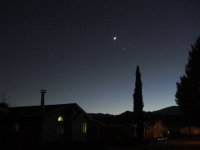
Did everyone feel a strong desire to go west last night?
With the Moon, Venus and Jupiter this "close" to each other, just imagine the forces on your Chi!
 

Attachments

  • jrConjunction.jpg
    jrConjunction.jpg
    92.5 KB · Views: 1
I suspect, but cannot prove, that unfettered internet access will help as well.

ETA: Increases in literacy rates are also useful in fighting this type of ignorance.

I will agree with this. When people are exposed to conflicting point of view to their own they may start questioning their own point of view. The internet is one way to get other points of view. Of course you need to be able to read to use the internet or books.

Cheap printed books were the one of the first ways used to combat woo (I am think of fighting the Catholic church as my example).
 
Might as well throw people who go to church or believe in god/relegion into the premise as well.
 
.
From this month's "Free Inquiry
"The Big Religion Questions Finally Solved"/ by Gregory S. Paul
"Democrary, middle-class security and a scientific outlook constitute a triple threat to faith so powerful that across the first world it is inflicting severe damage upon popular religiosity, except where economic tribullations perpetuate the dysfunction milieu that popular religion must enjoy if it is to thrive."
"Across the first world, lower income inequality correlates with lower religiosity."
"With its low taxes, relatively high rate of poverty and huge disparity between incomes of the poor and rich, the United States displays greater income disparity than any other industrialized democracy."
"It is no coincidence that religiosity is low in every first-world nation with universal health coverage and high in the only one without it."
"Religion, then, has proved able to thrive only in populations where living conditions are sufficiently defective to cause the majority to resort to petioning speculative supernatural power for aid."
It's a good compilation of data with charts as the the state of religion.

There's an interesting article called Rapture and Renewal in Latin America which says there's been a huge rise in Pentecostalism there in the past sevearal years, and talks about the benefits and drawbacks of it from a social point of view.

Pentecostals are generally credited with providing a sense of community to the masses migrating from the countryside to the cities and with preaching a message that concentrates on the power of God not only to comfort spiritually but also to help materially. The British sociologist David Martin has studied the impact of Pentecostalism in Tongues of Fire: The Explosion of Protestantism in Latin America, arguing that the Pentecostals have created “free spaces”
where a new ethos can develop. Former prostitutes, drunkards, and adulterers freely testify to their conversions. Finding a sense of purpose in their new beliefs, many have developed abilities within the church (leadership, organization, public speaking, etc.) that have improved their daily work and helped them rise economically. Pentecostal men are found to be more sensitive and dedicated to their families. More of their family income is spent on children’s education, while a recent poll of two thousand Brazilians found that they “see themselves as more optimistic and hard working than in the past” as a result of their conversion. ...

One might conclude that the “Pentecostalization” of Latin America promises a bright and prosperous future. Undeniably, several Pentecostal churches and leaders, offering a positive and integrated view of faith and the world, have had an impact felt in all areas of life. About whether the explosive growth of Pentecostalism will bring forth the long awaited and much needed economic and social transformation of Latin America, however, serious doubts and uncertainties remain. ...

The pattern of Pentecostals despising or at least minimizing their studies or professions and the value of their work has caused an ecclesiastical atrophy and a lack of growth beyond church activities. It has also diminished other areas of life, such as education, business, and especially politics (seen largely as Satan’s domain). ...

One Pentecostal pastor, learning about my legal work on behalf of religious liberty and human life, remarked, “That is good, and I hope one day God will use you in His work.” Well-known Latin American evangelists repeat over and over that they would not “lower themselves” to become presidents of a republic.
The emphasis on the end of the world has added a sense of urgency to evangelism, which at least partially accounts for the rapid Pentecostal growth in Latin America—particularly when joined to the comfort it gives the poor and downtrodden in the midst of dismal economic conditions. But a constant emphasis on the end of the world can also sap the will of believers to work to improve their lot, and it may even provide a sense of vengeance at the injustices of this world. ...

I read an article that said something similar about the USA once - that some people are attracted to "end of the world" preaching, because it gives them consolation amid economic hardship, and even satisfies them that people they resent, like people who earn much more than them and have job security and access to good healthcare and things, will be punished for not caring about those worse off than them. But it said apocalyptic preaching can be damaging, because it saps people's motivation to improve things, since they're just waiting for the end of the world and happiness in the after-life. I tried to find that article, but I couldn't.
 
Consider this. A belief in the supernatural cuts across virtually all of human existence. But it was perhaps strongest in Hunter Gathering times. If desperation fuels a belief in the supernatural then we must assume that our ancient ancestors were mired in desperation. I don't believe this is the case at all. I am of the opinion that there is far more desperation in the modern world than in ancient times (read pre agriculture). Was life ever easy? No and I don't imply that it was. However basic needs were met directly which if nothing else adds to a sense of satisfaction and accomplishment. Furthermore its been speculated that humans spent only about 4 hours in the day meeting their basic needs. Compare that stress level with modern times and expectations. So within the construct of ancient culture there arose a belief in the supernatural. Why? As a means to explain existence and as a means to enrich the open time after basic needs were met. After all what were they supposed to be doing in their free time? Washing the car, mowing the lawn, or fixing the lawn mower? I do not believe that the roots of belief in the supernatural stemmed from desperation and there are many many non desperate people who believe in the supernatural.
 
Well, perhaps this thread could be more accurately titled "Desperation fuels belief in the most harmful aspects of the supernatural".

People in those days may well in part have developed beliefs in the supernatural to explain all the things they couldn't understand. Supernatural explanations might have seemed the only logical ones for things like why the seasons changed, why it rained, why plants grew, and so on. But there was more to it than that. In the absence of effective medical care for a lot of things, when they got ill, feeling otherwise helpless to do anything about it, they would want to appease the forces that seemed beyond their understanding that were harming them, and control them. When there wasn't much food around and they were going hungry, instead of just feeling helpless about the situation, they'd want to try to ingratiate themselves to forces that seemed beyond their control, who might be able to improve their food supply.

In fact, sacrificing things, including humans, sometimes children, was apparently well-known in a lot of ancient cultures, and sacrifices apparently increased in times of hardship, like when harvests failed.

Human sacrifice still goes on today in some places. See, for instance: Indian couple sacrifice boy, 7, to ward off evil spirits.

... The faith healer had recommended the human sacrifice to the couple to ward off "evil spirits" which were making it difficult for them to find marriage partners for their five sons, the news agency said. ...

Human sacrifices are reported occasionally in rural India where many people put faith in occult practices to ward off evil or gain prosperity.

There are cultures even today where the majority of people believe illnesses and misfortunes are often caused by evil spirits. See this Wikipedia article, for instance:

The Yi believe in numerous evil spirits. They believe that spirits cause illness, poor harvests and other misfortunes and inhabit all material things.

Where modern healthcare and security from starvation etc. are lacking, and so is knowledge about what causes illness and the conditions that lead to harvest failure, and how to improve living standards in those respects, the supernatural will often be blamed, and invoked for help.
 
Of human sacrafice it still goes on even without supernatural reasoning. We're sacraficing lives at the moment in the middle east and it doesn't need a supernatural reason to go on. Lives will always be sacraficed lives are expendable like it or not. Take a look around and look at the expendability of lives, the human condition reeks of it.
 

ISF - Join now!

Every member here is approved by hand. No bots, no spam, just people who care about evidence and honest debate.

Membership is free!

Create your free account

Back
Top Bottom