Debunk Alert: Experiment to Test for Eutectic Reaction

How did the sulfur invade the grain boundary if not in a thermate reaction?
.
You first (it is *your* claim, right?) How would sulfur invade the grain boundary in a therm*te reaction.

Don't forget to show your work.

And what *is* your training and experience in this area again?
.
The WPI experiment used compacted powder and heated the beam to 1100oC. That is totally unrealistic.
.
....because?

On what expertise or training do you base this assertion?
.
The fires would have been put out in the collapse. The 727oC [1340oF] temperatures on the surface a few days later indicate much higher temperatures under the rubble. They had been pouring water on the pile all that time and it had rained. The supposition that smoldering debris could reach those temperatures in that time is far fetched.
.
How long does therm*te burn?

On what expertise or training do you base your assertion that the fires would have been put out?
.
 
Answering that question would mean committing to a claim, something a truther is scared to death of, unless he's batcrap insane, which quite a few are. Committing to a claim means you can be proven wrong, as we have seen in this thread. It is much better for a truther to bounce from one position to another, no matter how mutually exclusive. As we all know, trutherism has nothing to do with any quest for truth, so dishonesty becomes the best tool for a truther in debates.

Besides, they're all Just Asking Questions anyway, right?

Exactly the same as the Apollo Hoax crowd. 'Just asking questions' and pointing out 'anomolies' They haven't come up with a coherent story after 40 years.
 
Interesting paradox.

JREFers say that it would take a huge amount of explosives the pulverize the concrete.

JREFers say it didn't take any explosives at all.
 
Interesting paradox.

JREFers say that it would take a huge amount of explosives the pulverize the concrete.

JREFers say it didn't take any explosives at all.

Maybe because the concrete didn't 'pulverize' like truthers like to suggest. There is NOTHING suspicious about what the WTC did. You disagree?

Talk somebody who can actually DO something about into it.
 
First of all, define sealed.

Second of all, any blast powerful enough to sever any steel structural members would have blown out windows of the WTC towers, and likely any nearby buildings, which didn't happen.

Plus, how the hell could anything disprove a fantasy that has no evidence to support it in the first place?
You are assuming they made no attempt to minimize the sound.

You are wrong about the the windows. I guess you missed this:

"[FONT=&quot]There was far less window breakage in adjacent buildings than glass company crews were prepared to handle. Many of the broken windows appeared to have been those which were cracked before the implosion, according to Dave Miller of Schnabel Engineering,[/FONT]"
http://www.controlled-demolition.com/jl-hudson-department-store
 
You are assuming they made no attempt to minimize the sound.

You are wrong about the the windows. I guess you missed this:

"[FONT=&quot]There was far less window breakage in adjacent buildings than glass company crews were prepared to handle. Many of the broken windows appeared to have been those which were cracked before the implosion, according to Dave Miller of Schnabel Engineering,[/FONT]"
http://www.controlled-demolition.com/jl-hudson-department-store

I guess you missed this...

"adjacent..."
 
You are assuming they made no attempt to minimize the sound.

You are wrong about the the windows. I guess you missed this:

"[FONT=&quot]There was far less window breakage in adjacent buildings than glass company crews were prepared to handle. Many of the broken windows appeared to have been those which were cracked before the implosion, according to Dave Miller of Schnabel Engineering,[/FONT]"
http://www.controlled-demolition.com/jl-hudson-department-store


Tell me, what exactly did they use to minimize the sound? Some of the best silencers that I have ever seen can only take the sound of a gunshot down around 35 dB (from ~140 to around ~110) which is still very loud. What type of material can you use to silence an explosive so that it goes from "fatal injuries at close range and hearing damage for a significant distance from close ranges" to "indistinguishable from background noise"?
 
There was far less window breakage in adjacent buildings than glass company crews were prepared to handle.
.
And how much breakage were they prepared to handle? "Far less" is meaningless without knowing this...
.
Many of the broken windows appeared to have been those which were cracked before the implosion, according to Dave Miller of Schnabel Engineering,
.
How many is "many," and how many others broke? This, again, is meaningless absent the context.
.
 
I've cleaned out a number of bickering posts. Cut out the personal attacks, everyone, or it's going to get bloody here.
Replying to this modbox in thread will be off topic  Posted By: Tricky
 
So what? I made a claim. You said it was wrong. It is in fact true. You are incorrect. Learn to read.

so your making a claim that this is a steel column that is in the nist report?

http://www.nytimes.com/2001/10/02/science/scarred-steel-holds-clues-and-remedies.html

One piece Dr. Astaneh-Asl saw was a charred horizontal I-beam from 7 World Trade Center, a 47-story skyscraper that collapsed from fire eight hours after the attacks. The beam, so named because its cross-section looks like a capital I, had clearly endured searing temperatures. Parts of the flat top of the I, once five-eighths of an inch thick, had vaporized.

Less clear was whether the beam had been charred after the collapse, as it lay in the pile of burning rubble, or whether it had been engulfed in the fire that led to the building's collapse, which would provide a more telling clue.

The answer lay in the beam's twisted shape. As weight pushed down, the center portion had buckled outward.

''This tells me it buckled while it was attached to the column,'' not as it fell, Dr. Astaneh-Asl said, adding, ''It had burned first, then buckled.''
 
How did the sulfur invade the grain boundary if not in a thermate reaction?

The WPI experiment used compacted powder and heated the beam to 1100oC. That is totally unrealistic.

The fires would have been put out in the collapse. The 727oC [1340oF] temperatures on the surface a few days later indicate much higher temperatures under the rubble. They had been pouring water on the pile all that time and it had rained. The supposition that smoldering debris could reach those temperatures in that time is far fetched.

No, not really. Every try to extinguish a muck fire? Yeah, I have. Same basic concept.

BTW, who says that the collapse should have, or would have, extinguished the fire? You? Laughable.

In fact, someone nvented a tool for extinguishing fires in rubble piles. Their inspiration? 9/11.

Here it is.
http://firechief.com/mag/firefighting_waterjet_technology_cuts/
 
At 2:15 "The concrete was pulverized"
.
About half way down the page: "All That Dust."
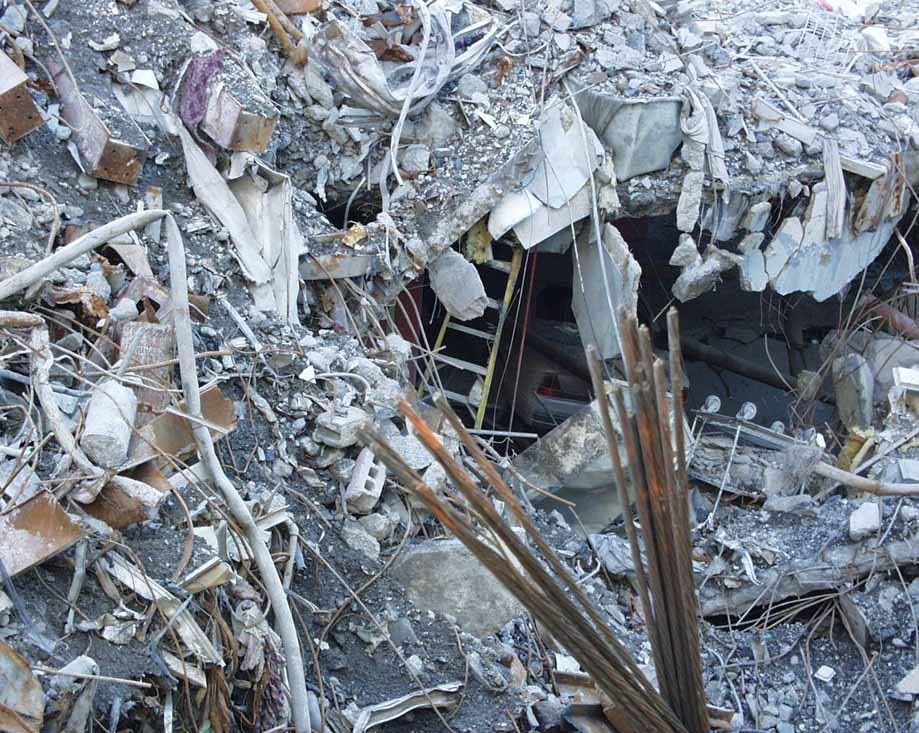
So, want photographic proof that the concrete wasn't all pulverized to microscopic fragments? Here it is. Not only are there chunks, but the rest looks more like sand than fine dust. Note the absence of suspended dust in the air.
.
 

Gravity. What's the problem?

An acquaintance was a retired fireman who started to work on the GZ pile starting the afternoon of 9/11. One of the things he described to me (unasked) was the nature of the concrete rubble. What struck him was the chunks that had been exposed to protracted heat. It cooks the water out and the chunks become the weight and strength of Styrofoam. It didn't surprise him one but because he knew the characteristics of concrete.
 

So, is it your claim that all the the concrete was pulverized?

Because that would be a lie.

How about that the majority of concrete was pulverized?

Yeah, lie also.

concreteremains2.jpg
 

Back
Top Bottom