ThinAirDesigns
Graduate Poster
- Joined
- Nov 10, 2008
- Messages
- 1,058
Switching between the two "at will" will lead to incorrect conclusions.
Bingo.
JB

Switching between the two "at will" will lead to incorrect conclusions.
The usual way to deal with this, is to use instantaneous quantities like power (instead of work done over a certain time period). This allows you to use instantaneous inertial rest frames of accelerated objects, where the conservation laws hold.
I'm not sure what you mean. But it sounds interesting. Can you give a simple example, maybe? Thanks.
At the beginning of the analysis we're told the wheels draw 1kW, for a drag force of 111N. Why are we then adding further rolling resistance, and where does the 174N figure come from?Here is one from TR where he proves the cart must work with his force balance. His energy balance also shows the cart works as long as you correct his same old mistake. Uncool and Lyricist both corrected it for him already.
No.
Momentum is conserved only in a closed system. Closed systems are finite; if the earth has infinite mass it cannot be part of a closed system.
Example: I sit on the cart and push myself along with a stick. I impart momentum to the cart. Where does that come from? Two answers, either of which are acceptable (but you can't mix-and-match)
EITHER: The earth is finite and the momentum that the cart-and-I gain is cancelled by an equal and opposite change of momentum of the earth.
OR: The earth has infinite mass, cannot accelerate when pushed against, and remains an inertial frame (all three exactly equivalent conditions) and functions as infinite source/sink for momentum which I transfer to the cart by pushing with the stick. Momentum is not conserved in this view but there is no violation of the "Law of Conservation of Momentum" because this system is not closed.
Either viewpoint is fine; either leads to good physics when used consistently. Switching between the two "at will" will lead to incorrect conclusions.
Well it may be that he does, and it may be that he doesn't. I'd like to read his line of reasoning, so I can see for myself.jduffy77 said:Which is exactly what he does.
That's not going to be here.
At the beginning of the analysis we're told the wheels draw 1kW, for a drag force of 111N. Why are we then adding further rolling resistance, and where does the 174N figure come from?
At the beginning of the analysis we're told the wheels draw 1kW, for a drag force of 111N. Why are we then adding further rolling resistance, and where does the 174N figure come from?
I think the 1 kW, and consequent 111 N, is just what's required to spin the propeller. Then, in addition, there's rolling resistance of 53 N and air resistance of 10 N, for a total of 174 N.
Why are we then adding further rolling resistance, ...
It doesn't seem clear to me.I think the 1 kW, and consequent 111 N, is just what's required to spin the propeller. Then, in addition, there's rolling resistance of 53 N and air resistance of 10 N, for a total of 174 N.
What's the error that Uncool and Lyricist (think they) found in the energy analysis?His energy balance also shows the cart works as long as you correct his same old mistake. Uncool and Lyricist both corrected it for him already.
To show energy conservation and steady state you can use a power balance calculation. Power is the time derivate of work, so you need to show that power_input < useable_power_output for any time point that is of interest.
You can do this in any inertial frame. But conveniently you would choose an inertial frame, where one of the interacting (and thus potentially accelerating) objects is at rest at the analyzed time point (the object's instantaneous inertial rest frame).
As an example you can look at the DDWFTTW analyses which usually use the instantaneous inertial rest frame of the cart:

Drela, Mark. "Dead-Downwind Faster Than The Wind (DFTTW) Analysis".
http://www.boatdesign.net/forums/at...w-directly-downwind-faster-than-wind-ddw2.pdf
Gaunaa, Mac; Øye, Stig; Mikkelsen, Robert (2009). "Theory and Design of Flow Driven Vehicles Using Rotors for Energy Conversion". Marseille, France: Proceedings EWEC 2009.
http://orbit.dtu.dk/getResource?recordId=241183&objectId=2&versionId=1
Bauer, Andrew (1969). "Faster Than The Wind". Marina del Rey, California: First AIAA. Symposium on Sailing.
http://projects.m-qp-m.us/donkeypus...aster-Than-The-Wind-The-Ancient-Interface.pdf
Further rolling resistance is added willy nilly until it's large enough to show that it's "impossible".
JB
It doesn't seem clear to me. What's the error that Uncool and Lyricist (think they) found in the energy analysis?
I'm not being judgemental either way, btw.
This says fraud. Carry on bluffing. There is more to come.
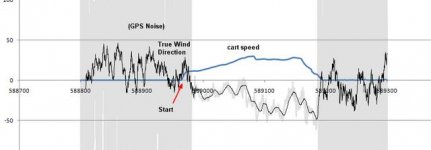
[qimg]http://www.internationalskeptics.com/forums/attachment.php?attachmentid=22187&stc=1&d=1305477894[/qimg]
Its always a variation on the same theme which you have already identified. He chooses and mixes up frames at will depending on how he wants the answer to come out.
In this case I believe Uncool pointed out that in the frame of the ground the work done at the prop disappears into the ether.
An ideal proof (that it can't work) is one with no friction and 100% efficiency, where the only rolling drag comes from the power needed to drive the propeller.Further rolling resistance is added willy nilly until it's large enough to show that it's "impossible".
An ideal proof (that it can't work) is one with no friction and 100% efficiency, where the only rolling drag comes from the power needed to drive the propeller.
Otherwise it's really only a proof that the bearings/tyres/propeller design won't support ddwftw, not a proof that the concept is unphysical.
I understand the nay-sayers to believe that the entire concept is unphysical, not simply impractcal.
I'm still (just) looking for a simple re-statement of the argument that it can't work so I can judge for myself!They were granted 85% overall efficiency ( including the prop), aero drag was ignored and the rolling losses were minimal. It failed.
Spork posted an electrical model that fails in principle, so there is another black mark, and that will withstand attack, no problem.