• Security incident: ISF was recently accessed by intruders. Please change your password, and change it anywhere else you used it. Read more

Merged DDWFTTW in a “Real” Wind

Status
Not open for further replies.
I had toy airplanes when I was a kid whose props were not driven by an engine. They used a rubber band. They flew.
.
Without a freewheeler, the glide on those things is plummetish. :)
Folding props are even better.
For the performance inclined. ;)
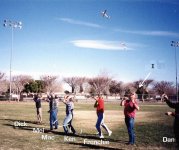
1997.. buncha us old guys competing for the Christmas trophy.
 

Attachments

  • jrGumbandPlanes.jpg
    jrGumbandPlanes.jpg
    140.9 KB · Views: 3
Still later, but still the same day..
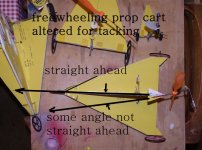
Extensive mod to the freewheeling propellor cart to try different angles for the propellor for "tacking".
 

Attachments

  • jrTackingProp-06.jpg
    jrTackingProp-06.jpg
    110.2 KB · Views: 3
My comment is that, as mentioned a couple of pages back, your maths may well tell you the truth, but you asked it the wrong question.

The above equation does not tell you postive thrust "is not possible without an engine"
Yes it does.
Latex a hassle

When;
Delta v = 0
T = 0

x * 0 = 0

You may say that it tells you positive thrust may only be obtained if the propeller is driven by something, but that is not the same thing, and it's very sloppy thinking for you to declare an engine is required, particularly when it's been explained to you uncounted times over the years that the wheels drive the prop round, the energy to turn the wheels comes from the cart's KE and the KE is provided by the forward component of the thrust of the wind on the prop.

Delta v = additional velocity, acceleration by propeller.
Cart loses KE to power the prop, so cart slows.
Prop thrust generated by the prop, must put that KE back in, by driving the wheel...
...which drives the prop, to put the KE back again.
Perpetual motion.
 
Last edited:
Delta v = additional velocity, acceleration by propeller.
Cart loses KE to power the prop, so cart slows.
Prop thrust generated by the prop, must put that KE back in.
Which drives the prop, to put the KE back again.
Perpetual motion.

If the cart was an aeroplane, you would have a point. As it is running in contact with the ground, you are applying the wrong maths to the problem.

Your argument would equally "prove" that a yacht cannot outpace the wind by tacking. (Yacht loses KE to drag as it moves across the wind, so yacht slows. Sail thrust generated by moving the sail must put that KE back in. Which moves the yacht, to put that KE back again. Perpetual motion.)

I believe you do at least recognise that tacking yachts can outpace the wind. Therefore your argument must be invalid. So where does it break down? You assume that, like an aeroplane, the power which thrusts the craft forward must be a portion of the power used to turn the prop. That is why you are wrong. It's the other way round: A portion of the thrust the wind generates on the prop blades is used to turn the prop to keep the blades "tacking" in the wind.
 
Yes it does.
Cart loses KE to power the prop, so cart slows.
Prop thrust generated by the prop, must put that KE back in,
...unless it takes KE from the wind. Has Harold been coaching you again?

Don't believe everything you write, Booger.
 
Last edited:
The freewheeling propellor cart, with three (3) shaft offsets, released from the same point, heading downwind.
No real control over the wind direction, have to wait for gusts to come by.
There is almost no difference in the end positions.
The wind curves around the building to the right, and the cart more or less went the same way all three times.
If it misses the telescope mount, it can do about a 100 degree turn to the right.


.ETA: more consistent images.
 

Attachments

  • 20110403_27.jpg
    20110403_27.jpg
    78.4 KB · Views: 1
  • 20110403_29.jpg
    20110403_29.jpg
    83.2 KB · Views: 1
  • 20110403_31.jpg
    20110403_31.jpg
    75.4 KB · Views: 1
Last edited:
If the cart was an aeroplane, you would have a point. As it is running in contact with the ground, you are applying the wrong maths to the problem.
Now you are doing what I said. If "all things are relative" and there is no preferred frame, then what would the absence of one make?
The point about the engine is that it burns fuel. That contains energy that has nothing to do with the air or ground.
A plane can taxi with its wheels on the ground, and the difference is the drag of the wheels.
I have said this before: The objection about the ground is the same made by those who said a plane can't take off from a belt.

Your argument would equally "prove" that a yacht cannot outpace the wind by tacking. (Yacht loses KE to drag as it moves across the wind, so yacht slows. Sail thrust generated by moving the sail must put that KE back in. Which moves the yacht, to put that KE back again. Perpetual motion.)
I believe you do at least recognise that tacking yachts can outpace the wind. Therefore your argument must be invalid. So where does it break down?
No, the wind is constantly supplying energy because the cart tacks. Above WS, there is no energy from the wind. Big difference.
A sail can't travel ddw. The wind comes from the rear, gives up energy to the sail and slows. It limits, because that slowed air is before it. That it a rough outline of Betz's limit
A tacking boat is always moving into fresh air that comes indirectly.

I believe you do at least recognise that tacking yachts can outpace the wind. Therefore your argument must be invalid. So where does it break down? You assume that, like an aeroplane, the power which thrusts the craft forward must be a portion of the power used to turn the prop.
That is not an assumption but a fact. The energy comes from the fuel.

That is why you are wrong. It's the other way round: A portion of the thrust the wind generates on the prop blades is used to turn the prop to keep the blades "tacking" in the wind.
No tacking. Power is power.
1) The wheel drives the prop. The cart loses KE to that work
2) The thrust then drives the wheel to replace that KE
3) Which then drives the prop to drive the wheel
PM.

TM is BS. Trial is BS. Theory is BS. Cart is a forced goal. An ambition.
 
Last edited:
Now you are doing what I said. If "all things are relative" and there is no preferred frame, then what would the absence of one make?
The ground is not necessary as a frame of reference, it is necessary as a mechanical component of the system.
A plane can taxi, with its wheels on the ground, and the difference is the drag of the wheels.
A plane's wheels are free to spin. Different scenario.
No, the wind is constantly supplying energy because the cart tacks. Above WS, there is no energy from the wind. Big difference.
For clarity - are you declaring that a tacking yacht cannot exceed windspeed in its downwind component of velocity?
A sail can't travel ddw.
Not faster than the wind - agreed. It constantly travels across the wind with a large component of its velocity at right angles to DDW. Just like the blade of a spinning propeller.
That is not an assumption but a fact. The energy comes from the fuel.
In an aeroplane it does. This is not an aeroplane.
No tacking. Power is power.
1) The wheel drives the prop. The cart loses KE to that work
2) The thrust then drives the wheel to replace that KE
3) Which then drives the prop to drive the wheel
PM.

TM is BS. Trial is BS. Theory is BS. Cart is a forced goal. An ambition.
You love to wave your maths at us. Can you produce the maths which shows that the power required to turn the prop exceeds the power gained from the forward thrust of the prop?
 
Last edited:
Some posts moved to AAH.

Keep it civil and on-topic from now on please.

Remember to address the argument, not the arguer.
Replying to this modbox in thread will be off topic  Posted By: Gaspode
 
In an aeroplane it does. This is not an aeroplane.
Correct, so you won't be making any more references to them?

You love to wave your maths at us. Can you produce the maths which shows that the power required to turn the prop exceeds the power gained from the forward thrust of the prop?

w = shaft speed.

Power available from wheel = E*I = T*w
Power demand prop = T*w^3
Demand outstrips supply

Charles Dickens: the name conjures up visions of plum pudding and Christmas punch, quaint coaching inns and cozy firesides, but also of orphaned and starving children, misers, murderers, and abusive schoolmasters. Dickens was 19th century London personified, he survived its mean streets as a child and, largely self-educated, possessed the genius to become the greatest writer of his age.
 
Last edited:
Correct, so you won't be making any more references to them?
Not if you can avoid describing the cart's behaviour as if it was one.
w = shaft speed.

Power available from wheel = E*I = T*w
Power demand prop = T*w^3

Nice. Maybe we're getting somewhere. Can you justify any of that, or are you just going to stick with declaring it's true because you say so?

I perhaps ought to point out that if it were quite so simple as declaring that the wheel can supply (T*w) power and the prop consumes (T*w3) power, then it would be impossible to push or tow the cart as the power needed to move it would always exceed the power used to move it.
 
Last edited:
w = shaft speed.

Power available from wheel = E*I = T*w
Power demand prop = T*w^3
Demand outstrips supply

ROFL

Power available from wheel = (2/) g(x) sin(xt) dt
Power demand prop = f1(x,y) cos(a) + f2(x,y) sin(a)
Humber is a kook
 
Yes it does.
Latex a hassle

When;
Delta v = 0
T = 0

x * 0 = 0


Delta v = additional velocity, acceleration by propeller.
Cart loses KE to power the prop, so cart slows.
Prop thrust generated by the prop, must put that KE back in, by driving the wheel...
...which drives the prop, to put the KE back again.
Perpetual motion.

It's only perpetual motion if there's no wind. Try to understand that.
 
Not if you can avoid describing the cart's behaviour as if it was one.
The point is that I can. "Frames of Reference" are not magic, and neither are they necessary, and certainly not the only means of analyzing motion.

The motor and generator are oblivious to the cart's motion, and see only the force applied to the shaft. A refrigerator motor is no different from any Spork motor in any other application.

The "stick" propeller reference shows that the motor power is proportional to the cube of the angular velocity. It is not an effective propeller, but a mimic of the load a propeller presents.
Drag = 1/2.Cd.A.V^2.
Power = f*v
So, drag power is proportional to V^3 and that applies to angular velocity w^3. Real props show the same characteristic. A generator's power output is related to w, that too applies to real motors.

That is a big problem, because simply expressed, Thrust = P/v where v is the airspeed, but that is martinet fixed to the cart's speed by the gearing.
It's wrong in principle and hampered mechanically. There is good reason why it is so slow.

You may say that the cart is not electrical, but the same argument applies mechanically, and Spork's submission is offered as proof of concept, yet is fatally flawed. If that's wrong, then what else is wrong? The TM? Indeed.

Nice. Maybe we're getting somewhere. Can you justify any of that, or are you just going to stick with declaring it's true because you say so?
By what other means would you like? It's not I who says it's true, but Newton. If you disagree, then surely you will find that formula contradicted in text books. It's not a random wiki. I checked it by working it against first principles. There are other means of determining thrust based on pressure models for example and they can be found at NASA's web site. Cross check that, and the common factor is Newton's impact theorem. Solid.

Despite the position you may still hold on cotton reels, I bet there is more to them than you thought. There is less to the TM than you think.

I perhaps ought to point out that if it were quite so simple as declaring that the wheel can supply (T*w) power and the prop consumes (T*w3) power, then it would be impossible to push or tow the cart as the power needed to move it would always exceed the power used to move it.
Well, I'm saying it can't.
But the power to tow, comes from the towing vehicle. Not the cart itself.
The towing vehicle will have an engine and fuel. Apples and pears.

 
It's only perpetual motion if there's no wind. Try to understand that.

The wind ( headwind) is the term 'v'.
The entire point of the claim, and the primary objection to it, is that there is no tailwind above WS, yet it is always insinuated by some other means.
There is no wind power above WS, ddw. That is why boats tack to achieve >WS.
 
The wind ( headwind) is the term 'v'.
The entire point of the claim, and the primary objection to it, is that there is no tailwind above WS, yet it is always insinuated by some other means.
There is no wind power above WS, ddw. That is why boats tack to achieve >WS.

Explain how a tacking sail works, and why a propeller blade can't work the same way.
 
Last edited:
Explain how a tacking sail works, and why a propeller blade can't work the same way.

His explanation will be just word salad. He will never prove his point with vectors. Strange, since he loves math so much.

downwindvectorsen3.png


propellervectors.png
 
The wind ( headwind) is the term 'v'.
The entire point of the claim, and the primary objection to it, is that there is no tailwind above WS, yet it is always insinuated by some other means.
There is no wind power above WS, ddw. That is why boats tack to achieve >WS.

This is your most fundamental error. You simply do not understand the momentum exchange mechanism, nor can you analyze the energy exchange. It would seem the reasons for this are your fundamental inability to comprehend motion and rejection of successful methods.
 
How it can't? I don't understand the question. Do you think non-zero acceleration implies non-zero velocity?

He does seem to believe that if two things are travelling at different velocities, then at least one of them is accelerating, so I wouldn't be surprised.
 
Status
Not open for further replies.

ISF - Join now!

Every member here is approved by hand. No bots, no spam, just people who care about evidence and honest debate.

Membership is free!

Create your free account

Back
Top Bottom