• Security incident: ISF was recently accessed by intruders. Please change your password, and change it anywhere else you used it. Read more

Merged DDWFTTW in a “Real” Wind

Status
Not open for further replies.
Building what?

Because Michael C's responses are usually so accurate (and always of the highest caliber), I feel that I must respond to this one:

The discussion as to the veracity of the event is akin to the discussion of whether the twin towers of the WTC were really destroyed by being hit by a plane. ...

Actually, this is not a good analogy. You do realize that there were three massive buildings that went down that day - right? There are many conservative architects and engineers (i.e. "reasonable persons" - myself included) who have serious (and well founded) scientific doubts about the explanation of what really happened that day. Yes, two buildings were hit by planes, but why did building 7 come down? (and in a very conspicuously "controlled-demolition" kind of way?)

See: rememberbuilding7.org - A real "head-scratcher", that.

As anyone who has followed DDWFTTW knows: "Things are not always as they seem to be!"

Just sayin'...

p.s. I do apologize for sidetracking the intelligent, enlightening, civilized and purely science-based discussion going on here. ;)
 
(and well founded) scientific doubts
...
very conspicuously "controlled-demolition" kind of way?
You know that arguments are well founded scientifically, when you hear things like "conspicuously ... kind-of-way".
 
Last edited:
Motion has been achieved!

A little more fiddling ingenious adaptations of found material, with the wind coming up nicely.
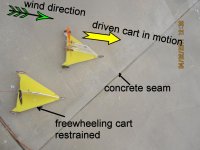
Both carts, the freewheeling propellor and the driven propellor cart, starting from the same location (note the concrete seam).
The freewheeling propellor cart needed a hold-back fitting, otherwise it would just run away, that scamp! :) CartVsCart-01
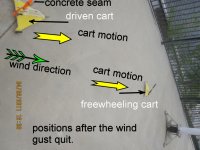
Waiting until the driven propellor cart began to move -downwind- on its own.. CartVsCart -02.. then stepped off the hold back fitting..
The freewheeling propellor cart overtook the driven prop cart and hauled ass until the wind gust quit. CartVsCart-03.
Should try a rigorous testing venue less subject to building turbulence.:rolleyes:
 

Attachments

  • CartVsCart-01.jpg
    CartVsCart-01.jpg
    117.1 KB · Views: 0
  • CartVsCart-02.jpg
    CartVsCart-02.jpg
    96 KB · Views: 0
  • CartVsCart-03.jpg
    CartVsCart-03.jpg
    101.5 KB · Views: 0
No. I have an analogy in mind, which demonstrates a particular point. Like most analogies, this one eventually breaks down. If you run out of string or if the dog eats the reel the analogy ceases to be an analogy. Do you find this concept confusing?

<edit> You could, of course, use a long loop of string and keep pulling and recycling it over and over. You'd have to swap hands every so often as the reel caught up, but there's no reason this wouldn't work.

Nah. Just use 200m of PowerProtm 50lb braid* on a motor-drive retrieve, very slow. Video with many checkpoints to confirm constant speed and that the reel is tracking at 2x (or whatever) the retriever retrieve speed.

*most excellent fishing line. Good value, all told.
 
There is no escaping the fact that if the reel is traveling twice as fast it will overtake the hand, so is utterly useless in practice.
It's an analogy. It doesn't matter if it is useless in practice. It is not going to be used in practice. It is a mere illustrative experiment, which demonstrates a principle. The end.

But, if both you and the reel start from a standstill, then both you and the reel will accelerate. Correct?
That is a different scenario from the steady state which demonstrates the principle but, if you want to consider that too, then yes, both will accelerate.
If at any instant the reel is traveling at twice your speed, it must be accelerating at twice what you are.
Correct
Assuming steady state for one, and not the other is a mistake, and the source of the illusion.
Your illusion. Yes. That was my point, and I am truly relieved if you have now grasped it. The reel does not accelerate towards your hand unless your hand is also accelerating.
 
And when a=0?

But when the hand is at a constant velocity, 2*0 is still 0.

Then the reel is not moving. Not the right solution, unless you hope to have a turning reel that does not turn.

Vreel = 2*Vhand

dv/dt reel = 2dv/dt hand.

Hand accelerates dv/dt = a
Reel accelerates 2(dv/dt) = 2a

But 2:1 gearing of reel means the 2F over a simple mass.

Fnet = 2F - Fdrag.
When a = 0
Fhand - Fdrag = 0
Drag = 2F.

Well done. To achieve constant speed, you need twice the drag to stop the acceleration.
Better to put the mass on small wheels and pull with F.

Really. It's and ancient mistake. A folly tried by many.
 
Now I understand. If I'm not accelerating then I'm not moving at all. I shall be sure to keep changing speed whenever I wish to go anywhere.

doh.

Have at it...

Vreel = 2*Vhand

dv/dt reel = 2dv/dt hand.

Hand accelerates dv/dt = a
Reel accelerates 2(dv/dt) = 2a

But 2:1 gearing of reel means the 2F over a simple mass.

Fnet = 2F - Fdrag.
When a = 0
Fhand - Fdrag = 0
Drag = 2F.

Well done. To achieve constant speed, you need twice the drag to stop the acceleration.
Better to put the mass on small wheels and pull with F.

Really. It's and ancient mistake. A folly tried by many.
 
Well done. To achieve constant speed, you need twice the drag to stop the acceleration.
Better to put the mass on small wheels and pull with F.

Really. It's and ancient mistake. A folly tried by many.

You do realise, I hope, that what you are saying is that to go twice as fast you have to pull twice as hard. Why would anyone be surprised?

If you "put the mass on small wheels and pull with F" it will be easier to pull, but there is a slight downside. Can you guess what it is?

Here is a clue: The string in our little experiment is analogous to the wind and the reel is analogous to the cart. The purpose of the exercise is for the cart to go faster than the wind.

Have you guessed why your solution doesn't help, yet?

The mistakes and follies are your own, I'm afraid.
 
Last edited:
A little more fiddling ingenious adaptations of found material, with the wind coming up nicely.
Both carts, the freewheeling propellor and the driven propellor cart, starting from the same location (note the concrete seam).
The freewheeling propellor cart needed a hold-back fitting, otherwise it would just run away, that scamp! :) CartVsCart-01
Waiting until the driven propellor cart began to move -downwind- on its own.. CartVsCart -02.. then stepped off the hold back fitting..
The freewheeling propellor cart overtook the driven prop cart and hauled ass until the wind gust quit. CartVsCart-03.
Should try a rigorous testing venue less subject to building turbulence.:rolleyes:

Somehow...I just knew that putting a brake on the cart in the from of a prop forced to rotate against the wind, may slow it.

All that remains is what happens above WS. No thrust, because there is no energy.

Drela is championed by the Carteers, but in his paper, rather internet note, he does not use calculus, but algebra, and then plots the result against the variables. A dubious technique that can result in a banana getting to the moon. Guanna does the same.

Drela starts with a boat model, with a wind rotor and a water rotor.
When converted to a cart, the water rotor becomes the wheels, and the hull drag, rolling resistance, which he says can be "arbitrarily low"
Needs to be. When at WS, his rotor stops turning, just as freewheeling turbine would. If the rotor is connected to the wheels, they also stop, and the cart slides on the "arbitrarilty low" friction. Funny.
 
Got it. You don't know the difference between speed and acceleration.

It's quite amazing. Humber knows the words, and he knows quite a few of the formulas, but he seems to have absolutely no grasp of the concepts behind them, and consistently makes silly mistakes. The mind boggles at how he could have been exposed to so much physics, and till manage to get it so wrong.
 
It's quite amazing. Humber knows the words, and he knows quite a few of the formulas, but he seems to have absolutely no grasp of the concepts behind them, and consistently makes silly mistakes. The mind boggles at how he could have been exposed to so much physics, and till manage to get it so wrong.

Another valuable contribution. It's algebra, but still too much. A Carteer to the bone.
There's a really good reason why cars are boxes on wheels, and not themselves wheels.

All the videos and the trial data show the cart is a slug. Just like I Ratant's carts. The free-prop version is way ahead.
In the Jenkins' video, the cart moves at a snail-like 2m/s - below walking pace - until the wind changes and it tacks.
Same with the trial.
 
Last edited:
Somehow...I just knew that putting a brake on the cart in the from of a prop forced to rotate against the wind, may slow it.

All that remains is what happens above WS. No thrust, because there is no energy.

Drela is championed by the Carteers, but in his paper, rather internet note, he does not use calculus, but algebra, and then plots the result against the variables. A dubious technique that can result in a banana getting to the moon. Guanna does the same.

Drela starts with a boat model, with a wind rotor and a water rotor.
When converted to a cart, the water rotor becomes the wheels, and the hull drag, rolling resistance, which he says can be "arbitrarily low"
Needs to be. When at WS, his rotor stops turning, just as freewheeling turbine would. If the rotor is connected to the wheels, they also stop, and the cart slides on the "arbitrarilty low" friction. Funny.

Yes it is funny. But not for the reason you probably think it is.

ETA: So tell us humber, what force stops the rotor, and therefore the wheels, at wind speed. I'm having a little trouble figuring out this aspect of the humberverse.

ETA:
Spork, JB, obviously you did your tests wrong. The BB should have come to a dead stop as soon as it reached windspeed.
 
Last edited:
A little more fiddling ingenious adaptations of found material, with the wind coming up nicely.
Both carts, the freewheeling propellor and the driven propellor cart, starting from the same location (note the concrete seam).
The freewheeling propellor cart needed a hold-back fitting, otherwise it would just run away, that scamp! :) CartVsCart-01
Waiting until the driven propellor cart began to move -downwind- on its own.. CartVsCart -02.. then stepped off the hold back fitting..
The freewheeling propellor cart overtook the driven prop cart and hauled ass until the wind gust quit. CartVsCart-03.
Should try a rigorous testing venue less subject to building turbulence.:rolleyes:

This is real ground-breaking stuff here - and not at all pointless like the project we did. I'm on the edge of my seat waiting for the next installment of "REAL SCIENCE!"
 
It's quite amazing. Humber knows the words, and he knows quite a few of the formulas, but he seems to have absolutely no grasp of the concepts behind them, and consistently makes silly mistakes. The mind boggles at how he could have been exposed to so much physics, and till manage to get it so wrong.

And the math. Do you think...wait....do you even give a thought, that it may be you?
And what do you say about Drela's paper? He never bothered to finish it.
 
Last edited:
humber knows that we never denied knowing Steve Smith. He can not and will not find a quote that shows we ever denied it. Instead he will insist that we have to find the quote that shows we never denied it. That's how logic works in the humberverse.


It's always hard to know when humber is lying and when he's delusional. I suspect he's just confused on this point (which is his normal state). But I did not meet Steve through flying.


More lecturing on stuff that he's gotten wrong before and still has wrong now.


Sorry my man - but that's the rule. If humber agrees with you - you're wrong.

I don't think it's an absolute rule, but it's definitely the way to bet.
 
Got it. You don't know the difference between speed and acceleration.

Oh, I thought you may fault the math, which is as basic as it gets, but I see that it is no match for your opinion.

No math required in this case. A speed difference between hand and spool does not imply that there's any acceleration happening. Zooterkin was right, you were wrong. If a=0, it does *not* mean the spool is stationary, as you claimed, just that its speed isn't changing. Sir Isaac worked this out centuries ago.

How more basic can your errors become?
 
Status
Not open for further replies.

ISF - Join now!

Every member here is approved by hand. No bots, no spam, just people who care about evidence and honest debate.

Membership is free!

Create your free account

Back
Top Bottom