• Security incident: ISF was recently accessed by intruders. Please change your password, and change it anywhere else you used it. Read more

Merged DDWFTTW in a “Real” Wind

Status
Not open for further replies.
I just came to this thread after reading the account in Wired magazine of the Blackbird trials. I will confess to still not quite understanding how the craft works, but I'm prepared to believe that it does. I am confused by humber's responses; does he believe that the Blackbird did not go downwind faster than the wind? If so, what does he believe did happen?
 
I just came to this thread after reading the account in Wired magazine of the Blackbird trials. I will confess to still not quite understanding how the craft works, but I'm prepared to believe that it does. I am confused by humber's responses; does he believe that the Blackbird did not go downwind faster than the wind? If so, what does he believe did happen?

Sometimes he explains the 2.8xwindspeed record by claiming the BB experienced short gusts above the average windspeed measured. That none of these approached 2.8 average windspeed makes it a mysterious claim.

Other times he says that the wind veered away from the line of the track, and that the BB harnessed this to tack downwind up to 2.8 windspeed. That the BB is in no way designed (or able) to accomplish this makes it a mysterious claim.

He then goes on to deny various real-life experiments, ones easily repeated by anyone with a spool of cotton and a kitchen table, by denying that gears can exist on the same spindle and by producing 'math' and 'vector diagrams' full of proofs that real life doesn't work. These are mysterious claims.

He is a man of mystery and moves in mysterious ways. We have no idea what he believes, apart from the fact that everything he says is correct even when he contradicts himself from moment-to-moment.

Hope that helps! :)
 
I just came to this thread after reading the account in Wired magazine of the Blackbird trials. I will confess to still not quite understanding how the craft works, but I'm prepared to believe that it does. I am confused by humber's responses; does he believe that the Blackbird did not go downwind faster than the wind? If so, what does he believe did happen?

Oh, it went ~27mph all right, but not ddw. It tacks. There is nothing magical about that. There are also gusts and wind gradients that can add to that.

There are the towers, and even the prop itself to act as sails. Props have been used or proposed as sails in the past. The idea of coupling that to a wheel or water prop goes back to at least 1882. Didn't work then, doesn't work now.
attachment.php


Measurement error and selective outcome account for the rest.
Things like the cotton reel show that the fundamental claims on which the cart is based are wrong, so that would make one wonder how it worked if it were ddw.

The most blinding trail error is to average the wind direction. Being symmetrical, a solid-sail cart, such as Greenbird will benefit from a tailwind coming from 20 degrees to the left of its ddw trajectory, just as well, as one coming 20 degrees from the right.
According to NALSA's calculation, a wind blowing for 20 degrees for 10 seconds from the right, followed by 20 degrees for 10 seconds from the left, averages to zero = No wind change. Doh.
 

Attachments

  • sailboat2.jpg
    sailboat2.jpg
    43.6 KB · Views: 69
Last edited:
Being symmetrical, a solid-sail cart, such as Greenbird will benefit from a tailwind coming from 20 degrees to the left of its ddw trajectory, just as well, as one coming 20 degrees from the right.

See how it works for humber, Zooterkin? Greenbird can use a sidewind, and that counts as DDW. Blackbird doesn't care much either way about slight wind shifts from DDW (having a prop) but that doesn't count as DDW, therefore Blackbird failed even though everyone saw it work.

Welcome to hell, kid :D
 
Hmmm, could Humber be right about something, even by mistake?

Oh, it went ~27mph all right, but not ddw. It tacks. There is nothing magical about that. There are also gusts and wind gradients that can add to that.

It was ddw. The cart is hindered by gusts and wind gradients, not helped. Of course in the real world there is no such thing as perfect wind so NALSA set the definition of ddw as being within 10 degrees. They chose this number because they are sailing experts and they know there is no such thing as a craft which can tack at an angle so acute, even if it had sails, which the Blackbird does not. During the record run the cart accelerated the most when it was 0 degrees off the wind but it continued to accelerate even when it was 4 degrees off the wind, just not as quickly.

There are the towers, and even the prop itself to act as sails. Props have been used or proposed as sails in the past. The idea of coupling that to a wheel or water prop goes back to at least 1882. Didn't work then, doesn't work now.

There are obviously no sails. No expertise is required to look at the cart and conclude that any airfoil the structure presents cannot possibly provide lift which assists in the direction of travel. If there were enough wind angle (which there was not) the wind would try and tip the cart over.

Humber is also conveniently forgetting that his whole argument depends on the fact that the prop is not a prop but a turbine which would like to drive the cart upwind. Sail or turbine Humber? Don't you even want to be consistent with your absurdities? I know its too much to believe that when you call the prop a sail you actually understand that the props airfoils are continuously tacking downwind in a spiral.


Measurement error and selective outcome account for the rest.

There was no meaningful measurement error or selecting outcomes. That is what NALSA is asserting when it ratified the world record.

Things like the cotton reel show that the fundamental claims on which the cart is based are wrong, so that would make one wonder how it worked if it were ddw.

No they were meant to help you understand. People keep trying to give you the benefit of the doubt and believe that one example, one thought experiment, the next simple analogy, will help you see what is so obvious to everyone else.

The most blinding trail error is to average the wind direction. Being symmetrical, a solid-sail cart, such as Greenbird will benefit from a tailwind coming from 20 degrees to the left of its ddw trajectory, just as well, as one coming 20 degrees from the right.

The wind was not at 20 degrees from the left or right. If it were it would hinder the cart not help it.

Was the mention of Greenbird a typo? The cart was called Blackbird. The Greenbird actually is a sail cart; although it could not do much at 20 degrees off the wind.

According to NALSA's calculation, a wind blowing for 20 degrees for 10 seconds from the right, followed by 20 degrees for 10 seconds from the left, averages to zero = No wind change. Doh.

A wind blowing at 20 degrees for 10 seconds from the right or left would have immediately disqualified the run, so what are you talking about averaging it for?

No. Sorry. Nothing at all correct.
 
I just came to this thread after reading the account in Wired magazine of the Blackbird trials. I will confess to still not quite understanding how the craft works, but I'm prepared to believe that it does. I am confused by humber's responses; does he believe that the Blackbird did not go downwind faster than the wind? If so, what does he believe did happen?


Sometimes he explains the 2.8xwindspeed record by claiming the BB experienced short gusts above the average windspeed measured. That none of these approached 2.8 average windspeed makes it a mysterious claim.

Other times he says that the wind veered away from the line of the track, and that the BB harnessed this to tack downwind up to 2.8 windspeed. That the BB is in no way designed (or able) to accomplish this makes it a mysterious claim.

He then goes on to deny various real-life experiments, ones easily repeated by anyone with a spool of cotton and a kitchen table, by denying that gears can exist on the same spindle and by producing 'math' and 'vector diagrams' full of proofs that real life doesn't work. These are mysterious claims.

He is a man of mystery and moves in mysterious ways. We have no idea what he believes, apart from the fact that everything he says is correct even when he contradicts himself from moment-to-moment.

Hope that helps! :)

In trying to help Humber (orHprang) understand I think just about everyone goes through the same cycle. First they think that he will understand if only it is explained with enough patience. As things progress an understanding develops that he will not accept arguments which contradict his preconceived conclusion regardless of how logically they are presented. For many the final step is to sit back and enjoy the absurdities his counter arguments inevitably give birth too. I say inevitable because arguments which contradict reality by definition require absurdities.

These are the same sort of people (I am one) who can be entertained by stories of dinosaurs being packed on boats during a big flood a few thousand years ago. I actually enjoy reading the next Humber story, like vibrating carts motoring up treadmills, or carts with magic, invisible sails, as much as I enjoy reading about young earth craziness. Its fun.

Something else you will notice about his explanations, if you stick around, is that although Humber is constantly trying to demean the builders of the cart he actually gives them far more credit than anyone else. If the cart worked as he says it would revolutionize whole industries, including power generation and shipping, instead of just being an interesting diversion.
 
Hmmm, could Humber be right about something, even by mistake?
It was ddw. The cart is hindered by gusts and wind gradients, not helped. Of course in the real world there is no such thing as perfect wind so NALSA set the definition of ddw as being within 10 degrees.
Setting and measuring are not the same thing.

They chose this number because they are sailing experts and they know there is no such thing as a craft which can tack at an angle so acute, even if it had sails, which the Blackbird does not
In one passage, they note that the cart's acceleration rises when the wind speed falls. "As experts sailors" they should agree that something is not right. They talk of momentum being able to account for that, but dismiss it because they say the BB has no stored momentum.

All the while, the answer is there in black and white: the wind is changing direction. Later, when the wind changes direction to 25 degrees South, the cart still accelerate as when said to be ddw. Given that they call the cart "unconventional" and have no sound theory, they really have no expertise specific to the cart, and it is illogical if not arrogant to use data from existing sail carts to justify that hole in their knowledge,.

. During the record run the cart accelerated the most when it was 0 degrees off the wind but it continued to accelerate even when it was 4 degrees off the wind, just not as quickly.
It is 15 degrees RMS. Wind direction can not be averaged. That is a fact.
Spork has no means of knowing the ddw path. No van or tell tale. The van is on the cart, and any error in tracking the cart will influence the result.
They would find it impossible to justify that number. Much smaller than the error margin.

There are obviously no sails. No expertise is required to look at the cart and conclude that any airfoil the structure presents cannot possibly provide lift which assists in the direction of travel. If there were enough wind angle (which there was not) the wind would try and tip the cart over.

Paper planes, gliders made from flat balsa. Not a "profile" in sight.

"Yet...how you say..she flies" Galileo Galilei

Humber is also conveniently forgetting that his whole argument depends on the fact that the prop is not a prop but a turbine which would like to drive the cart upwind.
And? It's a botched upwind turbine, with a prop so impotent, it produces the thrust of a gnat's belch. Its main function seems to be to operate as a governor. Somewhat like those found on steam engines. That accounts for its tendency to accelerate at a constant rate.

Sail or turbine Humber?

Turban.

attachment.php


Don't you even want to be consistent with your absurdities? I know its too much to believe that when you call the prop a sail you actually understand that the props airfoils are continuously tacking downwind in a spiral.
Tacking props are a figment. Find one reference text that supports your claim. I would expect that designers of turbine engines would need to account for that force. It seems they don't.

There was no meaningful measurement error or selecting outcomes. That is what NALSA is asserting when it ratified the world record.
Not even close. They are a sailing club, and ratified themselves.
They are not a registered lab or testing authority of any sort, and do not have traceability on anything.

No they were meant to help you understand. People keep trying to give you the benefit of the doubt and believe that one example, one thought experiment, the next simple analogy, will help you see what is so obvious to everyone else.
The cup of human kindness does not run that deep. It's all in defense of the precious things.

The wind was not at 20 degrees from the left or right. If it were it would hinder the cart not help it.
Then why does it accelerate when 25 degrees off ddw? That is then "better" than "best", is it? Averaging the wind direction is an embarrassing schoolboy error.

Was the mention of Greenbird a typo? The cart was called Blackbird. The Greenbird actually is a sail cart; although it could not do much at 20 degrees off the wind.
Not a typo. Both are solid sail and symmetrical. The trial run of that cart says that jibing works, and that is the same relative to the cart, as a change in the wind direction itself.

A wind blowing at 20 degrees for 10 seconds from the right or left would have immediately disqualified the run, so what are you talking about averaging it for?
No. Sorry. Nothing at all correct.

If bet that it does. It need not be 10 seconds but 2 or whatever the sum is.
RMS has no limit on the number of samples.
If you are so sure, then you won't mind asking Spork to post the raw data, will you?

 

Attachments

  • turban.jpg
    turban.jpg
    9.1 KB · Views: 64
I
These are the same sort of people (I am one) who can be entertained by stories of dinosaurs being packed on boats during a big flood a few thousand years ago. I actually enjoy reading the next Humber story, like vibrating carts motoring up treadmills, or carts with magic, invisible sails, as much as I enjoy reading about young earth craziness. Its fun.

I don't need a gang of followers to hopefully stop The Ark from sinking.
 
Thank you Humber, you have posted and made my point better than I ever could. Most of the absurdity stands on its own, I will just point out the factual errors.

In one passage, they note that the cart's acceleration rises when the wind speed falls. "As experts sailors" they should agree that something is not right. They talk of momentum being able to account for that, but dismiss it because they say the BB has no stored momentum.

There is no such passage. If you are going to lie you should at least lie about something that is harder to check.

All the while, the answer is there in black and white: the wind is changing direction. Later, when the wind changes direction to 25 degrees South, the cart still accelerate as when said to be ddw.

Nothing of this sort is in black and white, which makes sense as it did not happen. If you are going to lie you should at least lie about something that is harder to check.

It is 15 degrees RMS. Wind direction can not be averaged. That is a fact.

It was not 15 degrees RMS. Wind direction not only can be averaged it must be. Instantaneous wind direction is a meaningless concept.

Paper planes, gliders made from flat balsa. Not a "profile" in sight.

Obviously wrong. A young child could point out the airfoil on a glider and relate it to lift vector. They could do the same with the cart. Hint: it is not in the direction of travel.

And? It's a botched upwind turbine, with a prop so impotent, it produces the thrust of a gnat's belch. Its main function seems to be to operate as a governor. Somewhat like those found on steam engines. That accounts for its tendency to accelerate at a constant rate.

This is vintage Humber hilarity, thank you. A turbine so botched it is not even a turbine but a prop which enables the cart to set a world record in the wrong direction!

Tacking props are a figment. Find one reference text that supports your claim. I would expect that designers of turbine engines would need to account for that force. It seems they don't.

Actually they are an obviousity. The "tacking prop" language is an attempt to explain to folks with a sailing background what is happening. But the fact that a prop always has a surface at 45 degrees or so to the wind is obvious to everyone but you.


Then why does it accelerate when 25 degrees off ddw?

The wind was never 25 degrees during the record but if it were the cart might accelerate, just not as fast as when 0 degrees.


Not a typo. Both are solid sail and symmetrical. The trial run of that cart says that jibing works, and that is the same relative to the cart, as a change in the wind direction itself.

Comparing the Greenbird to the Blackbird is the type of post I was talking to the newcomer about. I find them a source of great entertainment. Thank you Humber.
 
Could well be true, but supporters of Boeing's effort say theirs is more capable than Lockheed's X35, but the latter looks cooler. Either way, the "Blackbird"
is form over function.
.
It goes downwind faster than the wind.
That's what it was intended to do, but.... BFD.. that's -all- it can do.
Like the Boing, configuration changes are needed to come back home.
Looking at one of the videos, with the land sailers flitting back and forth behind this one-hit wonder, and considering the expense differential...
BFD.
 
I just came to this thread after reading the account in Wired magazine of the Blackbird trials. I will confess to still not quite understanding how the craft works, but I'm prepared to believe that it does. I am confused by humber's responses; does he believe that the Blackbird did not go downwind faster than the wind? If so, what does he believe did happen?
.
It is a puzzlement.
Too much armchair philosophizing, not enough real-world experience. ?
 
.
We have a history.

Are you suggesting that you and I have a history? If you show up with a new name to insult us, you might guess why we're not excited to have a lively and positive exchange with you.
 
.
It goes downwind faster than the wind.
That's what it was intended to do, but.... BFD.. that's -all- it can do.
Like the Boing, configuration changes are needed to come back home.
Looking at one of the videos, with the land sailers flitting back and forth behind this one-hit wonder, and considering the expense differential...
BFD.

Well, no ski-jumper will ever climb back up that slope, on skis anyway. The configuration is all wrong. But I'm sure they and the spectators have huge fun, just as I (any many others) have had huge fun watching our 'intuition' blown to shreds by a very nice machine.

Bottom line - I have no idea what you're complaining about.
 
Thank you Humber, you have posted and made my point better than I ever could. Most of the absurdity stands on its own, I will just point out the factual errors.
There is no such passage. If you are going to lie you should at least lie about something that is harder to check.

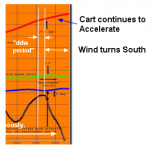
One of the reviewers of this report pointed out that the true wind speed (black line in separation graph) was 4-5 mph faster a few seconds before the measurement period(MP) than the speeds during the period
yet it continued to accelerate in the lighter winds present in the MP . This brings up the question if there is some way the energy associated with the higher wind can provide acceleration during the measurement
period. The observers see no meaningful way this could happen without using stored energy. Blackbird has no such capabilit

Some Voodoo of an explanation follows.


Nothing of this sort is in black and white, which makes sense as it did not happen. If you are going to lie you should at least lie about something that is harder to check.

Uh huh...

attachment.php


It was not 15 degrees RMS. Wind direction not only can be averaged it must be. Instantaneous wind direction is a meaningless concept.
Obviously wrong. A young child could point out the airfoil on a glider and relate it to lift vector. They could do the same with the cart. Hint: it is not in the direction of travel.
It it obviously wrong.


This is vintage Humber hilarity, thank you. A turbine so botched it is not even a turbine but a prop which enables the cart to set a world record in the wrong direction!

Not a record. The World's Largest Pizza measured with a short ruler.

Actually they are an obviousity. The "tacking prop" language is an attempt to explain to folks with a sailing background what is happening. But the fact that a prop always has a surface at 45 degrees or so to the wind is obvious to everyone but you.

Them text books....they ain't no good at s'plainin stuff.

The wind was never 25 degrees during the record but if it were the cart might accelerate, just not as fast as when 0 degrees.

It does just as well. Maybe even a bit better. The highest rate of acceleration, four times the remainder, was achieved when it was pushed.

Comparing the Greenbird to the Blackbird is the type of post I was talking to the newcomer about. I find them a source of great entertainment. Thank you Humber.

Well, they are both portmanteaus of a color and the word "bird"
And symmetrical solid sail carts.
 

Attachments

  • wind_change.png
    wind_change.png
    51.5 KB · Views: 74
One of the reviewers of this report pointed out that the true wind speed (black line in separation graph) was 4-5 mph faster a few seconds before the measurement period(MP) than the speeds during the period
yet it continued to accelerate in the lighter winds present in the MP .

So? They don't say it accelerated quicker or even the same rate, just that it continued to accelerate.
 
So? They don't say it accelerated quicker or even the same rate, just that it continued to accelerate.

Funny how you pick at words, but bought Planet Oil Barrel without question.

But to nail the coffin lid shut real tight.

Spork NALSA Submission Report

Proof that the vehicle performs best Dead Downwind

As can readily be seen from the above analysis, the vehicle performance is
driven significantly by the prop efficiency. This of course is primarily a function of the Lift/Drag ratio of the propeller airfoil at its operating angle of attack. The propeller on the Blackbird is based on the NACA 6412 airfoil which has it’s maximum L/D at 4.0 degrees, and has a twist such that the airfoil at each panwise station is presented at that angle of attack (AOA). When the relative flow is aligned with the propeller axis, that AOA can be maintained at all spanwise stations throughout the complete rotation. As the prop rotates counter-clockwise when viewed from in front of the vehicle, any cross-wind component from the right will cause the AOA for the top blade to increase while the angle of attack of the bottom blade is decreased. A cross wind component from the left will have the same effect in the opposite direction. In both cases the AOA will depart from its optimum value to varying degrees over the full rotation of the prop in this case – reducing the propeller performance – and thus the overall performance of the cart. The cart employs no other aerodynamic surfaces that can take advantage of a cross-wind component.

1) Cart performance reduces when not ddw. IT DOES NOT
2) If you then say "it's the best tacking cart ever", then you have to agree
that has no reason to be in the ddw class, and should compete against the likes of Greenbird. There the rules are a tougher, and not made to pander to the special-guys of TAD.

3) The trail report say the cart continues to accelerate in lighter winds. There is not reason "theoretical" or otherwise to suggest that the cart should not slow when that happens. To claim that it accelerates as the wind falls in speed, leads to absurdity and a contradiction of the cart's claims.
 
Well, no ski-jumper will ever climb back up that slope, on skis anyway. The configuration is all wrong. But I'm sure they and the spectators have huge fun, just as I (any many others) have had huge fun watching our 'intuition' blown to shreds by a very nice machine.

Bottom line - I have no idea what you're complaining about.
.
I was thinking about that yesterday... :)
Downhill skiing... BFD!!!
Done that.
Now, uphill skiing... Wow!
Talk about the need to tack!
I thought up waffle-bottomed skies.. the waffling permits traction when going uphill, and lies flat on the bottom for the downhill. A ratcheting effect, as it were.
Like the free-wheeler in a bike wheel hub.
Would it work?
Dunno?
Just something to ponder very shallowly on.
Don't the guys that walk on water have something like this?;)
.
As for "complaining"..I'm not. I just don't get emotionally involved in any of this crap seeing as there are some over-inflated egos that must get the last word by bloviating endlessly on it; it just wastes energy that could be better used for thinking about uphill skiing, and other feats of skill.
It would eliminate long lines at the lift, and do wonders for the leg muscles!:p
 
One of the reviewers of this report pointed out that the true wind speed (black line in separation graph) was 4-5 mph faster a few seconds before the measurement period(MP) than the speeds during the period
yet it continued to accelerate in the lighter winds present in the MP . This brings up the question if there is some way the energy associated with the higher wind can provide acceleration during the measurement
period. The observers see no meaningful way this could happen without using stored energy. Blackbird has no such capabilit

For the Humber neophytes; you have just witnessed a perfect example of Humber in action. He is caught in a complete lie. He then posts the proof that he was lying as if it helps his case. By the way Humber, your quote from the NALSA observer above is trying to tell you how silly you are being about your quote below.

It does just as well. Maybe even a bit better. The highest rate of acceleration, four times the remainder, was achieved when it was pushed.

Wrong again Humber. By far the highest rate of acceleration was when it was being towed to the test site. Fortunately for those of us who play baseball objects do not become easier to accelerate the more they have been accelerated in the past.

Well, they are both portmanteaus of a color and the word "bird"
And symmetrical solid sail carts.

Well ok I guess; but there are some differences. One of the sails is huge and visible and its on a cart with a huge stabilizer so the cart doesn't tip over in the high 60 degree winds it requires to do its thing. The other has a big opposing turbine and the sails are invisible as well as magic. They are both relatively solid so you're only mostly wrong on this one.
 
Lets see, a couple of quick Humber lies to point out.

1) Cart performance reduces when not ddw. IT DOES NOT

Yes it does.

2) If you then say "it's the best tacking cart ever", then you have to agree
that has no reason to be in the ddw class, and should compete against the likes of Greenbird. There the rules are a tougher, and not made to pander to the special-guys of TAD.

Only you have ever said that it is a tacking cart. Everyone else knows that statement is absurd.

3) The trail report say the cart continues to accelerate in lighter winds. There is not reason "theoretical" or otherwise to suggest that the cart should not slow when that happens. To claim that it accelerates as the wind falls in speed, leads to absurdity and a contradiction of the cart's claims.

The only absurdity and contradiction here is coming from a familiar source; Humber. Where did you ever get the idea that the cart requires exactly 14 mph wind to accelerate, or 25 mph, or 6 mph? No one understands what you are talking about.
 
Status
Not open for further replies.

ISF - Join now!

Every member here is approved by hand. No bots, no spam, just people who care about evidence and honest debate.

Membership is free!

Create your free account

Back
Top Bottom