.
I knew an engineer who responded "Yes" to the statement that "heating up a car's brakes would cause it to move".... as they got hot slowing it down, the reverse should work.
And another who opined that a rocket, like a Saturn V left its c.g. on the launch pad.
.
But this downwind cart although it works, it has no use.
It does not work. Not as claimed. It is a sail cart, run under conditions and rules that allowed it to exploit changing winds and short term patterns.
.
Folks long ago fingered out how to extract energy from wind, and the extractor need have no more mobility than the ability to point into the wind.
The mountains north of me have 1000s of these, taking advantage of the favorable westwinds at that location. It's so windy up there there are few branches on the west sides of the trees.. they get blown off before they can grown. The cart merely keeps artificers off the streets and out of the bars and the clutches of loose women, and consume material and efforts, and Internet band width.
There is more to it than that. Google funding, SJSU and NASA time and resources; all wasted. Readers of magazines such as Wired, misled.
Students building TM's and learning nonsense. We don't need any more engineers who think that heating the brake will drive the car.
And there are plans to use the ideas to generate energy. Probably generators that drive themselves into the wind. We don't need that to waste even more time and effort. There are already enough energy scams.
.
And attracts the attention of those who tinker with collections of random parts and have in interest in assembling to do things with wind.
I have a house full of that crap.

And only occasional contact with loose women. (Sob!

)
Tinkering is harmless enough, but this is more than that.
I have pointed to the absurdity of the brake, but the one that always gets the Carteers is my claim that it is a failed up wind cart. They can not accept that they have been so fooled in such an embarrassing way.
There is ample evidence that the rotor spins CCW (from the rear) when in a tailwind. The rotor is then a turbine to that wind, and the gears are set to drive the wheels (CCW), so into the tailwind. An
upwind cart.
Yet, it goes forwards. That is simply the wind blowing directly on the cart's chassis and rotor as a sail. That force is larger, so the cart moves forwards. In other words, an upwind cart, with such appalling aerodynamic form, that it gets blown downwind.
The prop is all but useless. There is a video where the prop is spun by hand.
Every time a blade passes by the operator, he gives it a tug. The mass and size of the rotor are known, so it is possible to estimate its angular KE, at the indicated 15rpm.
By frame-stepping the video, the loss of that KE can be estimated from the fall in angular velocity between assisting effort from the operator. The loss of KE is a reflection of the work the prop does on the air. It is about
3W.
Of course that is a static case, but not unlike the cart when starting or at very slow speed ( 15 rpm represents about 5mph)
At the start. it's power is nugatory, so how can it possibly drive the cart?
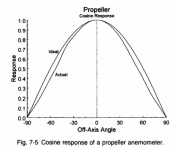
You have a propeller anemometer. They are called that, but are in fact a turbine - they are driven by the wind.
The angular velocity is related to the wind speed, but falls if not directly facing the wind. Like this;
Similarily, the force and power fall for a turbine when not directly facing the wind, and that applies to the cart. The power loss is the cube of that cosine.
That is why is is better
off wind that not, and is slow to start. The rotor opposes all forces that drive the cart as a sail.
I drew this some time ago