Merged DDWFTTW in a “Real” Wind

Status
Not open for further replies.
Buckets of data.
Which you don'[t understand.


So it brakes as it tries for record, does do before the wind changes, and then tracks it?
yep, who knows why, but that deceleration could have only occurred due to brakes.

Weren't you just claiming that was all due to pitch change?
nope, the acceleration pattern is a result of pitch pitch changes, hard deceleration is a result of brakes.


Too bad there are no accelerometers to prove this new claim - should it actually be any where near the truth - nor for any claims regarding pitch change.

Don't need accelerometers to calculate acceleration from speed change.
 
Last edited:
humber said:
The data is riddled with such anomalies, and for windspeed, WS ratio and direction.
Which you don'[t understand.

Doh.


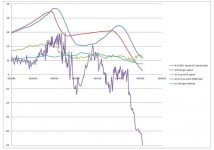
attachment.php
 

Attachments

  • jref_chart18.jpg
    jref_chart18.jpg
    24.2 KB · Views: 54
And then the blatant misrepresentations and non sequitor chart spam.

Sure. On of many examples where the CV's motion corrupts the data.

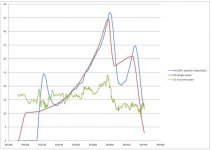
But, the average acceleration towards the peak in speed is .40ms-2, "braking" is .93ms-2. What makes you think that it can't decelerate at twice the rate it can accelerate?

What did Spork tell you?

Problems with the absurdly low rolling losses that deny the rapid slowing, so for some totally unsupported reason, you impute breaking? Why would Spork brake at that time?
Perhaps the brakes are applied to avoid showing that the cart responds to the large wind direction change that occurs at the same time. NALSA would be fooled into thinking the cart worked best ddw. Give that match up to win the game, when later selecting from the rest. All BS from beginning to end. A sham. A fraud.

Spork said:
"You just couldn't possibly steer the cart to follow the wind-shifts (never mind the noise resulting from the dynamics of the wind vane swinging around"
And how would you see them if the CV is behind? Brake a bit and the CV will pass so you can take a peek and then decide what to do.
Sometimes large southerly changes cause the cart to slow, sometimes to accelerate.
 
Last edited:
Yes, the wind data is "corrupted" every single time the CV accelerates or decelerates through wind speed.

And your math stinks, the deceleration from 399 to 403 was 1.44 m/s2. Which was higher than the deceleration when we (well most of us) know he was braking to a stop.

Not to mention that I originally ran the whole thing through my program and it just drifted slowly down during that period. So no, the theory doesn't predict that kind of retarding force without brakes.
 
And by the way, the cart speed peaked a full second AFTER the wind speed did, and it was yet another second before the hard deceleration was applied. 2 second reaction time to a rapid increase to the wind in his face? I think I know why he hit the brakes.
 
It bears repeating- having seen all the data, and after trying to discredit it any way he can, Humber now admits the cart goes considerably fttw. Now he is just quibbling like a typical sore loser about little details, like how long it took to accelerate, and whether he would have painted it a different color... His only remaining refuge to try to save face is that in real life, the wind varied a few degrees from side to side, in a manner that could only have slowed, not helped the cart. He can't even deal with the TM test, which confirms fttw in a true ddw context. He can't deal with the explanations of the wind vanes, or that changes in wind direction below or after the test don't count, or that the failure of another cart to succeed isn't relevant. Any sailor could explain to Humber the problems with his arguments.

Although I would like to think that Humber's admission of fttw will move the thread in a new direction, I regret that it is now probably time for Humber to post either a long series of equations describing (incorrectly) the orbital mechanics of the Jovian rings, or a snappy line like, "Cartiers have nothing; I win!"
 
Yes, the wind data is "corrupted" every single time the CV accelerates or decelerates through wind speed.
The anemometer change is not related to the passing through WS, and they always turns the same way.

And your math stinks, the deceleration from 399 to 403 was 1.44 m/s2. Which was higher than the deceleration when we (well most of us) know he was braking to a stop.

up
T1 = 593393 V= 40.5mph
T2 = 593729 V = 29.5mph
a = 4.0ms-2/14s = 0.35ms-2

down
T1 = 593393 V= 40.5mph
T2 = 593403 V =29.9mph
a = -10.6ms-1/10 = -.94ms-2

Your programme is not the data, not theoretically sound.

Braking is to avoid showing that it accelerates as the wind changes. The other option, shown in another run, was to change direction to follow the wind. Contrary to NALSA's orders claimed by Spork.
If NALSA see too often that the cart responds to wind change, the game is up.

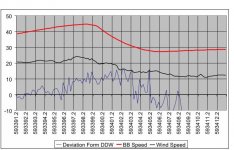
attachment.php
 

Attachments

  • jref_chart19.jpg
    jref_chart19.jpg
    26.4 KB · Views: 52
Last edited:
It bears repeating- having seen all the data, and after trying to discredit it any way he can, Humber now admits the cart goes considerably fttw.

Although I would like to think that Humber's admission of fttw will move the thread in a new direction, I regret that it is now probably time for Humber to post either a long series of equations describing (incorrectly) the orbital mechanics of the Jovian rings, or a snappy line like, "Cartiers have nothing; I win!"

Why don't you go away. Take the precious thing back to your lair, where you may coset it?
Oh, haven't you heard? Sails can go faster than the wind, but not ddw.
And your silly claim of "admission" is both lame and rather late, considering the calculations I have done on the cart's speed.
 
And by the way, the cart speed peaked a full second AFTER the wind speed did, and it was yet another second before the hard deceleration was applied. 2 second reaction time to a rapid increase to the wind in his face? I think I know why he hit the brakes.

The cart continued to accelerate after the wind had fallen?
One of the NALSA reviewers noted that, and that problem was dismissed because it was said the data contained information that occurred after that time.
But not if the average is not moved back. There are many cases of cart prescience in the data.
 
The anemometer change is not related to the passing through WS,
Right, that one is due to the rapid acceleration as I said.
and they always turns the same way.
What? You mean the vane? If so, no it doesn't.

up
T1 = 593393 V= 40.5mph
T2 = 593729 V = 29.5mph
a = 4.0ms-2/14s = 0.35ms-2

down
T1 = 593393 V= 40.5mph
T2 = 593403 V =29.9mph
a = -10.6ms-1/10 = -.94ms-2

Brilliant, you calculated the deceleration from 5 seconds before the cart speed stopped increasing!

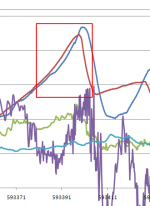
attachment.php


Your programme is not the data,
duh
not theoretically sound.

Wrong
Braking is to avoid showing that it accelerates as the wind changes.
wrong, it was to take another run in the lower wind. Same as it was in run 1.
 

Attachments

  • Run 5 - Peak Closeup.jpg
    Run 5 - Peak Closeup.jpg
    48.3 KB · Views: 59
Last edited:
Right, that one is due to the rapid acceleration as I said.

What? You mean the vane? If so, no it doesn't.

The anemometer measures the wind speed.

Brilliant, you calculated the deceleration from 5 seconds before the cart speed stopped increasing!

This bit. Allows the CV to get ahead a bit, and then see what next to do. As, you have shown, turning into the wind was the other option.

attachment.php


Really don't care how many guesses you want to throw. Even a chimp could learn the wind patterns in a short time. If changing North, it won't be long before it turns South. But sometimes, that's not the case, and continues to 100 degrees. Better hedge the bet.

One has to wonder why NALSA would test for ddw in winds they knew were changing so much

"Well, you see, Bob, the cart is best ddw, so those changes will only be harmful to the cart. When the cart is ddw, it really won't matter what happened before, will it?"

So make sure that the cart does not do so well in changing winds, as long as you can keep it within the supposed 10 degree limit.
 

Attachments

  • jref_chart20.png
    jref_chart20.png
    23.3 KB · Views: 50
Last edited:
The cart continued to accelerate after the wind had fallen?
One of the NALSA reviewers noted that, and that problem was dismissed because it was said the data contained information that occurred after that time.
Wow, how garbled can you possibly get it? It was not dismissed for that reason. That was the explanation of the average wind direction veering off before the wind actually veered off.

And the reviewer didn't note that the cart continued to accelerate after the wind dropped, They simply noted that the wind dropped and gave an advantage to the cart reaching that multiple of wind speed. And it was dismissed because it continued accelerating.


Jeez.
 
And the reviewer didn't note that the cart continued to accelerate after the wind dropped, They simply noted that the wind dropped and gave an advantage to the cart reaching that multiple of wind speed. And it was dismissed because it continued accelerating.

Sadly humber will not understand the importance of your statement Llyricist. All that matters to him is that the wind was once blowing faster and the cart can somehow remember that.
 
Sadly humber will not understand the importance of your statement Llyricist. All that matters to him is that the wind was once blowing faster and the cart can somehow remember that.

I get the impression he knows what he is doing on some level, in response to my closeup chart that shows very clearly what happened when, he posted a chart that was even more compressed and harder to pick out than before to hide his "error".
 
I get the impression he knows what he is doing on some level, in response to my closeup chart that shows very clearly what happened when, he posted a chart that was even more compressed and harder to pick out than before to hide his "error".

There are no errors other than those you have incorrectly claimed I made.

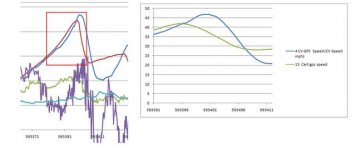
The "close up" chart is the one on the right, and a stretched version of the one on the left, and still shows that cart decelerating faster than accelerating.

The pilot has many means of seeing that the cart does not do so well when not ddw, so that in comparison, ddw looks "better".
When braked, the prop will free-wheel. That would tell on the cart, so there were no indicators of force or tachometers on the shafts as promised. The first was also suggested by Steve Smith.

The cart got nothing but GPS.

attachment.php
 

Attachments

  • jref_chart21.jpg
    jref_chart21.jpg
    18.9 KB · Views: 50
Last edited:
LMAO, now you are just throwing feces. Your error was calculating the deceleration from a point in time 5 seconds before the cart stopped accelerating.

Now you are trying to change what I was disputing as well, I was NOT disputing the fact that the cart decelerated faster than it accelerated. I was disputing your level of deceleration. I said it was even higher, and indicated braking rather than any performance issue. And I said he applied the brakes because the wind speed dropped. Since the strong deceleration started a full 2 seconds after the wind speed started decreasing.
 
LMAO, now you are just throwing feces. Your error was calculating the deceleration from a point in time 5 seconds before the cart stopped accelerating.
It was taken from the time the cart crosses the 30mph line when accelerating, to when it gets back to that speed from decelerating, with the peak being at 593393/40.5mph. That is how it was done.
Typos in the numbersI can't be bothered to re-check. Look at the relative slopes instead
And then decelerating is different because?

Llyricist;7275576 Now you are trying to change what I was disputing as well said:
he applied the brakes because the wind speed dropped.[/B] Since the strong deceleration started a full 2 seconds after the wind speed started decreasing.

It is not any different from what I had calculated.

He applied the brakes because the windspeed dropped?

Because the wind changed, and the cart could not be seen to excel. The other methods were to change direction, or abort for some reason.
"I adjusted the pitch too far, and the advance ratio to ground speed exceeded the limit of the vermiculator"

Pull the other one.
The record run was very early on, so in the bag. No need to risk that.
 
Last edited:
It was taken from the time the cart crosses the 30mph line when accelerating, to when it gets back to that speed from decelerating, with the peak being at 593393/40.5mph. That is how it was done.
Right, that was how it was done wrong, the peak was not at 593393. It continued accelerating for 5 more seconds. As the closeup I posted clearly shows.

It is not any different from what I had calculated.
Of course it is, because you calculated it wrong.
 
Status
Not open for further replies.

ISF - Join now!

Every member here is approved by hand. No bots, no spam, just people who care about evidence and honest debate.

Membership is free!

Create your free account

Back
Top Bottom