
Merged DDWFTTW in a “Real” Wind

Status
Not open for further replies.
So if someone put a few million or so into a next gen cart the next step would be to tie an auto pitch adjuster to real-time wind data.

Have you come up with your prediction for the current BB's absolute top WS multiple?

When faced with inconsistencies in the data, introduce a new and unmeasured variable, and one where Spork can say " I can't remember if I did, but probably did, or may have done, but may have overshot a bit or not"
Fortunately, the idea introduces as many problems as it solves. It's logic, again.
 
Surprise surprise: That is if my calculations are true, and rest assure that I am and will double checking them for a while.
The propeller wind car can do extremely well in side winds. Assuming that the propeller shaft can be rotated sideways, (which is not possible in the current ThinAirDesigns car), a car that can do 3XW down the wind can do more than 4XW with 90 degrees wind, the propeller will be swayed about 70 degrees sideways to 20 degrees off the wind. Moreover, the calculations show that even with the fix front thrust propeller, the aforementioned car capable of 3XW down the wind will do still better than 2XW at 45 degrees to the wind. This part of my calculation should be able to be confirmed or rejected by the experience of ThiAirDesigns, I am sure that they took some runs with angle to the wind. Ziploc what say you?"

In other words the cart will perform better DDW than with the wind off beam.
Assuming his calculations are correct.
 
In other words the cart will perform better DDW than with the wind off beam.
Assuming his calculations are correct.

I'm pretty sure he's wrong about that first claim, simply on the basis that the cart would only get about 34% of the propeller's thrust as a forward component, while having the full ground speed's worth of aerodynamic drag and the full power demand for the full amount of thrust.

The second one has more merit, but that's still a fairly close thing, when considering the reduced tailwind component alone, it works out, but I imagine the AOA problem spork brings up in the submission report would be pretty significant at that angle as well.
 
When faced with inconsistencies in the data, introduce a new and unmeasured variable, and one where Spork can say " I can't remember if I did, but probably did, or may have done, but may have overshot a bit or not"
Fortunately, the idea introduces as many problems as it solves. It's logic, again.

Previous approaches use the Gibbs sampler to generate the indicator variables conditional on the states. In many problems, however, there is a strong dependence between the indicator variables and the states causing the Gibbs sampler to converge unacceptably slowly, or even not to converge at all.
 
One thing I'm quite certain of is that I did overshoot on pitch more than once. Considering how little time I had in that cart, and the varying conditions, it would be hard to imagine not being somewhat sloppy. Ultimately the objective was to get to the highest wind multiple AND to increase speed through the 10 second window. For that reason I dropped pitch on a few runs to give myself a crack at a best run accelerating through the course.

With a whole lot more practice, and better instrumentation, I'm sure I could improve somewhat. If we were trying to better the existing DDWFTTW record, perhaps we would have done all of that.

I'm frankly very impressed with your analyses and how well your sim matches the recorded data.

I'm noticing the top end is lower than actual at lower wind speeds, but higher than actual in higher wind speeds.

Seems to be something to do with the rpm / airspeed ratio. I'm thinking the blade element theory produces slightly lower than actual efficiencies at lower ratios, but slightly higher than actual with higher ratios.
 
Okay, I've spent the last couple weeks learning Java so I could re-do my spreadsheet and incorporate JavaProp within the program. So I could in turn, automate the process of doing many successive instantaneous analyses, much like AT has already done. I can also adapt the program for the up wind cart, since the propeller object in JavaProp doubles as a turbine, which I have started doing.

Cool stuff! I thought of doing the same, but thought it wouldn't match anyway because of the unknown pitch.

Meanwhile I simulated the BB with a turbine of equal size as the prop and same transmission ratio. I used similar parameters that worked in your match:

transmission eff: 0.92
aero drag coefficient: 0.28
rolling drag coefficient: 0.01
frontal area[m^2]: 1.86
mass[kg]: 295

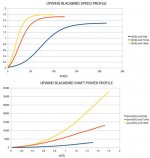
Here the results for three different windspeeds:

attachment.php


I will check bigger rotors and different transmissions later. If the parameters are in fact better (I estimated the frontal area as only 1.6m2 from a picture for example) they could reach 2xWS.
 

Attachments

  • 212_plots_upwind.jpg
    212_plots_upwind.jpg
    22.7 KB · Views: 69
In other words the cart will perform better DDW than with the wind off beam.
Assuming his calculations are correct.

And that's why he says 4X at 90 degrees?
But have you read the paper? If so, then you may take anything he says with a great deal of skepticism. It's that Spork can't answer, that is the point, and he never does answer anything is more difficult than saying "two ice boats". There are as many ddw theories, as there are ddw claimants, and this one is no different.

Smith's "(obvious) harnessing the energy from slowing the headwind" has been shown the door, so all that remains are the other effects. Spork and JB did everything to see those resources were present and exploited, but nothing to ensure that the "obvious" could be demonstrated to be the principle at work.
The prop is largely useless, but works fine as a sail. Cross-winds at that wind speed are enough for a cart that only achieved 1.8WS. The 2.8WS is because the wind speed fell from 15mph to 10mph for a few seconds, and Spork and JB shop-lifted it while nobody was looking.
 
Last edited:
Previous approaches use the Gibbs sampler to generate the indicator variables conditional on the states. In many problems, however, there is a strong dependence between the indicator variables and the states causing the Gibbs sampler to converge unacceptably slowly, or even not to converge at all.

And what do you know of the Gibb's phenomenon? Nothing, so you assumed nobody else would.
 
And what do you know of the Gibb's phenomenon? Nothing, so you assumed nobody else would.

Bayesian reasoning is very counterintuitive. People do not employ Bayesian reasoning intuitively, find it very difficult to learn Bayesian reasoning when tutored, and rapidly forget Bayesian methods once the tutoring is over. This holds equally true for novice students and highly trained professionals in a field.
 
Humber,

Which will happen first:-

You completing your report to NALSA, or posting your video of the propless cart?
 
So if someone put a few million or so into a next gen cart the next step would be to tie an auto pitch adjuster to real-time wind data.
Not wind speed, but rpm vs airspeed. And a method to translate the inputs to an accurate mechanical output within a fraction of a second.
Have you come up with your prediction for the current BB's absolute top WS multiple?
Nope, as I noted, the program doesn't work too well at the margins, I'm guessing it is most accurate at wind speeds in the 16 to 18 MPH range. And I haven't made an algorithm to solve that particular question anyway. I may just do that next in between adding the code for the upwind cart.

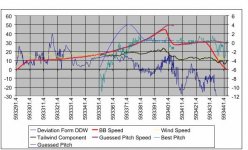
Anyhow here is run 5 with a similar pitch profile to the one I guessed for run 1 (in the first half anyway, since the second half was pretty much the same as constant design pitch):

attachment.php
 

Attachments

  • Run 5 - Guessed Pitch.jpg
    Run 5 - Guessed Pitch.jpg
    46.9 KB · Views: 69
Humber,

Which will happen first:-

You completing your report to NALSA, or posting your video of the propless cart?

Although I believe he is already a full Operating Thetan he is waiting for confirmation of "Cleared Theta Clear" status which is basically a godlike state before releasing the video.

ETA: Some more info direct from The Book in case any need a refresher on CTC status:

"A thetan who is completely rehabilitated and can do everything a thetan should do, such as move MEST and control others from a distance, or create his own universe; a person who is able to create his own universe or, living in the MEST universe is able to create illusions perceivable by others at will, to handle MEST universe objects without mechanical means and to have and feel no need of bodies or even the MEST universe to keep himself and his friends interested in existence."

Hmmm, who does that sound like to you? If I had a vote I would nominate Humber for CTC status, today, without hesitation.
 
Last edited:
Humber,

Which will happen first:-

You completing your report to NALSA, or posting your video of the propless cart?

Propless cart.
That will really undermine the claim at its source, so casting doubt on the rest. Spork plans to use copious BS to talk his way around any math.
 
Last edited:
Hmmm, who does that sound like to you? If I had a vote I would nominate Humber for CTC status, today, without hesitation.

You need to better educate yourself, so you won't so easily fall prey to all sorts of nescience.
 
Last edited:
Not wind speed, but rpm vs airspeed.
Which is land speed by proxy. Rpm is directly related to land speed. I said you had done that. Related everything to land speed.

Nope, as I noted, the program doesn't work too well at the margins, I'm guessing it is most accurate at wind speeds in the 16 to 18 MPH range. And I haven't made an algorithm to solve that particular question anyway. I may just do that next in between adding the code for the upwind cart.
That's because of the non-linearity of relating the change to rpm-windspeed and no the land speed. You fitted it over the expected range, so the margins show errors.

But, it's way better than Spork could do, and you managed to learn some Java in the process.
 
One thing I'm quite certain of is that I did overshoot on pitch more than once. Considering how little time I had in that cart, and the varying conditions, it would be hard to imagine not being somewhat sloppy. Ultimately the objective was to get to the highest wind multiple AND to increase speed through the 10 second window. For that reason I dropped pitch on a few runs to give myself a crack at a best run accelerating through the course.

With a whole lot more practice, and better instrumentation, I'm sure I could improve somewhat. If we were trying to better the existing DDWFTTW record, perhaps we would have done all of that.

And btw, I did not mean that as a criticism in any way. I was just refuting humber's contention that you had to be prescient to do the pitch change I guessed at.
 
Which is land speed by proxy. Rpm is directly related to land speed. I said you had done that. Related everything to land speed.
You did? I must have missed it. Or ignored it, because it doesn't matter.


That's because of the non-linearity of relating the change to rpm-windspeed
not wind speed, airspeed. The propeller doesn't "care" about the wind speed, Just the airspeed and rpm. Yes they are dependent on each other, but that is incredibly irrelevant.

and no the land speed. You fitted it over the expected range, so the margins show errors.

I didn't fit, I guessed at the numbers for Cd, crr and drive train efficiency, and took whatever javaprop calculated with the actual geometries and airfoils, and got that first curve right off the bat. Then I guessed at what a non prescient human that knew that in general, the pitch needs to be lower at first and gradually increased, might have done in the given situation. And the graph fit almost perfectly.
 
Last edited:
And that's why he says 4X at 90 degrees?

4X at 90 degrees if the propellor can be turned to face towards the wind.

The propeller wind car can do extremely well in side winds. Assuming that the propeller shaft can be rotated sideways, (which is not possible in the current ThinAirDesigns car), a car that can do 3XW down the wind can do more than 4XW with 90 degrees wind, the propeller will be swayed about 70 degrees sideways to 20 degrees off the wind.

Do you not actually read what you quote?
 
Last edited:
You did? I must have missed it. Or ignored it, because it doesn't matter.
not wind speed, airspeed. The propeller doesn't "care" about the wind speed, Just the airspeed and rpm. Yes they are dependent on each other, but that is incredibly irrelevant.
Airspeed = Windspeed - Cartspeed
Cartspeed is directly related to rpm.


I didn't fit, I guessed at the numbers for Cd, crr and drive train efficiency, and took whatever javaprop calculated with the actual geometries and airfoils, and got that first curve right off the bat. Then I guessed at what a non prescient human that knew that in general, the pitch needs to be lower at first and gradually increased, might have done in the given situation. And the graph fit almost perfectly.

You made the assumption that J = V/nD. Given that the cart's speed is related to the AV and acceleration is essentially constant, then it will fit. It tells you nothing about the power that is needed, or the crosswinds you ignore.
The acceleraton fo the record run is 0.1ms-2. You have a prop change that tracks a less than 50% change in that s0 .05ms-2 = 0.5% of g. It is very unlikely that would be sensed.
The advance ratio is said to stay fixed and the prop rate increases. Now you have another totally unsupported modification. So like woo.
 
Last edited:
Status
Not open for further replies.

ISF - Join now!

Every member here is approved by hand. No bots, no spam, just people who care about evidence and honest debate.

Membership is free!

Create your free account

Back
Top Bottom