Merged DDWFTTW in a “Real” Wind

Status
Not open for further replies.
If you paint a dot on the treadmill, you will see that dot pass by over and over again when the treadmill is running. It is an idiot-proof way to demonstrate that the tread is rotating, and a rotating thread is periodic motion. Periodic motion will have a fundamental frequency (the frequency of rotation of the thread as in how many time that dot passes by in a fixed period of time) The frequency can be easily measured at slow speeds with a stop watch, and at higher speeds with a strobe light. The point is, the frequency is present!
I see I'm hardly the first to point out that this is true but irrelevant. The portion of the treadmill belt in contact with the cart is always travelling in a simple straight line, which happens to match our inertial frame of reference.
The wheels, on the cart, regardless of their circumference relative to the tread circumference, will be forced to rotate at some harmonic of the belt frequency when the cart is held and the wheels are spun up to speed.
Wrong. There is no mechanism which tends the wheels' rotation to synchronise with the belt's rotation.

Holding the cart will automatically force the cart into harmonic resonance with the fundamental frequency of the belt rotation. The propeller that is geared to the wheels will also be forced to rotate at some frequency which is a harmonic of the belt frequency. No special tuning is required as this is a forced resonance condition and does not depend on any natural resonant frequency of the cart.
Again, this is not true. There is nothing in the system which causes this to happen.
When a piece of rotary machinery is in a forced resonance such as this, and there is positive feedback present, the operating mode is completely different that if it were allowed to respond to natural stimuli. For example, if the cart is not held to spin the wheels up, but instead it is allowed to go back with the tread, it would be responding to the natural stimuli of the belt and the air. It would reach some equilibrium with these natural stimuli that is less than the belt speed. In that case, the cart on the treadmill would be equivalent to a cart on a road in a tailwind, moving at less than wind speed.
It's not at all clear what positive feedback you are referring to. Maybe you can explain. Maybe not. In any case, your assumption that the cart's natural behaviour would be to reach the same equilibrium speed relative to the wind on the belt as it does on the road is fine, but to assume that this must be below windspeed is simply begging the question.
Only when the cart is held on the belt, and placed in the forced resonance situation with positive feedback from the belt, can it move forward on the belt. The positive feedback is evident from the relationships I have given earlier:

The energy available from the tread will be functionally related to the difference in velocities between the cart and the tread. And since they are moving in opposite directions, that difference is mathematically expressed as Vc – (-Vt) and this will always be a positive value. It is abundantly clear that even if the cart is going faster than the tread, there is always energy available to it from the tread. This is a clear case of positive feedback.
Nonsense. The interaction between the belt and the wheels is a force which opposes their relative motion.
In the case of pushing the cart and having it powered by the wind, the energy available is as before, functionally related to the difference in velocities between the cart and the wind. Since they are moving in the same direction, Vc – Vw will go towards zero as the cart velocity goes towards wind speed. At wind speed the energy available from the wind is zero. This is obviously not the same situation as on the treadmill and is a clear case of negative feedback.
Closer, but not quite. The wind does not push the cart, it pushes the propeller, and the force between the prop blades and the air does not tend to zero as the cart approaches windspeed. In fact it does so at a considerably higher speed.
 
Last edited:
If you paint a dot on the treadmill, you will see that dot pass by over and over again when the treadmill is running. It is an idiot-proof way to demonstrate that the tread is rotating, and a rotating thread is periodic motion. Periodic motion will have a fundamental frequency (the frequency of rotation of the thread as in how many time that dot passes by in a fixed period of time) The frequency can be easily measured at slow speeds with a stop watch, and at higher speeds with a strobe light. The point is, the frequency is present! The wheels, on the cart, regardless of their circumference relative to the tread circumference, will be forced to rotate at some harmonic of the belt frequency when the cart is held and the wheels are spun up to speed. Holding the cart will automatically force the cart into harmonic resonance with the fundamental frequency of the belt rotation. The propeller that is geared to the wheels will also be forced to rotate at some frequency which is a harmonic of the belt frequency. No special tuning is required as this is a forced resonance condition and does not depend on any natural resonant frequency of the cart. When a piece of rotary machinery is in a forced resonance such as this, and there is positive feedback present, the operating mode is completely different that if it were allowed to respond to natural stimuli. For example, if the cart is not held to spin the wheels up, but instead it is allowed to go back with the tread, it would be responding to the natural stimuli of the belt and the air. It would reach some equilibrium with these natural stimuli that is less than the belt speed. In that case, the cart on the treadmill would be equivalent to a cart on a road in a tailwind, moving at less than wind speed.

Only when the cart is held on the belt, and placed in the forced resonance situation with positive feedback from the belt, can it move forward on the belt. The positive feedback is evident from the relationships I have given earlier:

The energy available from the tread will be functionally related to the difference in velocities between the cart and the tread. And since they are moving in opposite directions, that difference is mathematically expressed as Vc – (-Vt) and this will always be a positive value. It is abundantly clear that even if the cart is going faster than the tread, there is always energy available to it from the tread. This is a clear case of positive feedback.

In the case of pushing the cart and having it powered by the wind, the energy available is as before, functionally related to the difference in velocities between the cart and the wind. Since they are moving in the same direction, Vc – Vw will go towards zero as the cart velocity goes towards wind speed. At wind speed the energy available from the wind is zero. This is obviously not the same situation as on the treadmill and is a clear case of negative feedback.

Because the cart on the road in the tailwind is in a negative feedback situation, it cannot be forced into resonance with either the wind (which is its source of energy) or the ground (which is the energy sink).

There is no mode of operation available to the cart on the road in the tailwind, to allow it to go faster than the wind, directly down wind. Referring to the treadmill as an example of a DDWFTTW example is entirely incorrect and misleading.
Based on this, you will never see any real verifiable evidence presented of a cart outdoors in a tailwind exceeding wind speed directly down wind.

You will never see such a cart outrunning foam popcorn in the wind!

There's really not much point in reading all this nonsense if you're unwilling to discuss it.
 
Inertia is a funny phenomenon. So much depends of your reference frame. :D

I do not know what you mean.

How does inertia depend on one's reference frame?

Objects have inertia in every reference frame.

Are you aware that the carteers use feedback loops in their arguments?

Yes.

Of course they do so correctly. ;)

Yes.

Wouldn't you say it matters whether concepts are used correctly or incorrectly?
 
Inertia is a funny phenomenon. So much depends of your reference frame.

Wrong rp. Inertia is the same as mass. An objects mass is the same regardless of reference frame, unless you are talking about relativistic velocities. The problem is that neither you nor the H's understand what inertia is. If you heard someone talking about an objects mass building up I would hope that you would realize that was a nonsensical statement. You should be able to see that if someone is talking about inertia building up (ppg used that term) that that was also a nonsensical statement.
 
Rp, without having the opportunity to examine and test his cart, it's impossible to say exactly.

Several possible reasons have been suggested, but without knowing the details of construction, all we can do is guess. It's possible, though I would say not too likely, that I Ratant's cart was capable of ddwfttw, but the wind it was tested in wasn't strong enough, or he didn't allow sufficient distance for it to get past wind speed. The fact that somebody who was not willing to listen to any advice on how to do it managed to make a cart that looks sorta lie a ddwfttw cart but doesn't quite work right is hardly surprising, and is not any indication that ddwfttw is not possible.
 
Several possible reasons have been suggested, but without knowing the details of construction, all we can do is guess. It's possible, though I would say not too likely, that I Ratant's cart was capable of ddwfttw, but the wind it was tested in wasn't strong enough, or he didn't allow sufficient distance for it to get past wind speed. The fact that somebody who was not willing to listen to any advice on how to do it managed to make a cart that looks sorta lie a ddwfttw cart but doesn't quite work right is hardly surprising, and is not any indication that ddwfttw is not possible.

I remember there were one or two obvious things from the pics he posted. We told him so, but he was too proud to even ask us what they were. I don't recall what they were right now; but if someone posts a link to his pics I'm pretty sure we can identify them. For starters I think I recall he had his prop backward.

On a related note, a buddy of mine called this weekend to tell me his powered paraglider was running terribly. It turns out he had his prop on backward. He managed about a 30 minute flight that way.
 
RP-Some more thoughts.

Inertia is a funny phenomenon. So much depends of your reference frame. :D Are you aware that the carteers use feedback loops in their arguments?
Of course they do so correctly. ;)

RP,

Unless one gets very philosophical and deeply into physics, Inertia (mass and it properties) is not dependent upon a reference frame. Unless you delve into relativistic physics, this is not at all dependent upon reference frames.

I am very aware that carteers use the concept of a feedback loop in the explanation of the cart as it is critical to the functioning of the cart. One needs to understand the mechanism of the feedback loop to make this all make sense. PPG is very confused about feedback loops in general and how they work in particular with these machines. There are lots of different types of feedback loops that are important for the correct functioning of all kinds of machines. I mentioned your cars alternator (assuming you have a car), as a great example of a classic controlled feedback loop for correct functioning. It turns out that it is almost a perfect example of the electrical equivalent of the cart (but not quite!). Feedback loops aren't hard to describe. They are relatively complex to analyze correctly. Very little of that has been used here, as feedback and control theory with the associated Laplace transforms, would go over most peoples heads in a hurry. It is a tribute that the central ideas here, have for the most part, avoided esoteric math and engineering descriptions which would make the arguments very terse but would not enlighten many. It would be a bit much for the general audience. Also, it is not really necessary for the fundamentals of this discussion. The cogent points seem to have been described correctly by the Carteers.

I did respond in detail to your proposed test and am interested in your feedback.

WindGrins:D
 
Last edited:
Burden of proof has now shifted!

There's really not much point in reading all this nonsense if you're unwilling to discuss it.
That about sums it up.
I'm losing patience with profpangloss.

I'm at the place personally that any criticism put forward by the dynamic due should be vetted as stated earlier:

In a nutshell, you have not shown in any credible, believable, or verifiable way that the TM is any different for minor variations in speed above or below WS for the carts. If you believe otherwise, propose an experiment, execute it, and show us the consistent results. From my perspective, the burden of proof is now upon the proposer of alternative mechanisms. Would you like to propose some experiments you would like to show to demonstrate your assertions? We'll be happy to critique those proposed tests for you.

Regards,

WindGrins:D
 
You keep hammering the contrast between the dust and popcorn. So dust will go closer to ws than popcorn. So what? You can't see it very well can you?

Now, what's the point of racing something that is going slower than wind speed in an attempt to show it is going faster than wind speed?

BRILLIANT!!! -- it's a pointless test, but at least it can be seen. :rolleyes:

BTW, not a soul has had any problem seeing the dust the cart blasts by in the blowup video.

JB
 
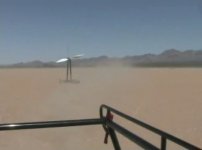
Yeah, here is the BUFC blasting through the dust that RCP somehow thinks isn't visible enough. :rolleyes:

attachment.php
 

Attachments

  • dust.jpg
    dust.jpg
    22.5 KB · Views: 66
JB, you are so right. If you ever did the popcorn test the vowels would find some bogus reason to object to it. And I think the reason that he does not understand the test of blowing some dust off of a table and popcorn at the same time is that he seems to think there is some intrinsic difference between "moving air" and "still air". rp, no matter what, will always pretend to be a "reasonable" fence sitter.
 
Now, what's the point of racing something that is going slower than wind speed in an attempt to show it is going faster than wind speed?

BRILLIANT!!! -- it's a pointless test, but at least it can be seen.

:id: And don't forget the irony! We'll never see it done anyway!! Because it may not go ws, but it goes close enough. Or isn't motion relative any more?

If the cart just leaves the foam in the dust, that will clearly demonstrate it is exceeding ws and also indicate the wind direction. Unless you think the popcorn would only go say 70% of ws? Just how much slower do you think it goes? Seems this popcorn has really struck a nerve. Blasphemy? :eek:

Show me the popcorn or it will look like you're just blowing smoke again. Remember when that was discussed? Yet for the record, there was no visual component to convince the peanut gallery. By throwing in some mirrors, you guys could have been NALSA's answer to Penn and Teller. :p

popc1[1].gif
 
Show me that it really really really works and I promise to believe you this time spork. It won't be like all of the other times I told you to do a test and you succeeded. This time I mean it!!
 
Show me that it really really really works and I promise to believe you this time spork. It won't be like all of the other times I told you to do a test and you succeeded. This time I mean it!!


Here's a link to my post yesterday sz. It has what your false insinuation lacks; evidence. Lots of links to my statements before and after the turbine/prop race. Now show me just one that backs your assertion. http://www.internationalskeptics.com/forums/showpost.php?p=7236301&postcount=8485

popc1[1].gif
Show me the popcorn. :)
 
That dog don't hunt rp. There is no point to run another test when an even better one that uses the exact same principles exists. If you can't see why dust is even better than popcorn then there is no hope for you.
 
:id: And don't forget the irony! We'll never see it done anyway!! Because it may not go ws, but it goes close enough. Or isn't motion relative any more?

If the cart just leaves the foam in the dust, that will clearly demonstrate it is exceeding ws and also indicate the wind direction. Unless you think the popcorn would only go say 70% of ws? Just how much slower do you think it goes? Seems this popcorn has really struck a nerve. Blasphemy? :eek:

Show me the popcorn or it will look like you're just blowing smoke again. Remember when that was discussed? Yet for the record, there was no visual component to convince the peanut gallery. By throwing in some mirrors, you guys could have been NALSA's answer to Penn and Teller. :p

[qimg]http://www.internationalskeptics.com/forums/images/smilies/popc1[1].gif[/qimg]

The reason we will never see it done is that fact that the cart cannot beat the foam popcorn in the wind. The fact the foam popcorn does not even reach wind speed, and it flies past the cart as if the cart was standing still ( as we have seen), is damning evidence against the claim of DDWFTTW. So, rather than do this test to refute the damning evidence, the carteers respond by denigrating the one person who did perform such a test, making disparaging remarks about the cart that was used, and finally saying the test is not relevant anyway! All of this is very telling; it reveals a great deal about the mindset of this cart cult, and opens up grave doubts about the "evidence" so far presented that supposedly proves something about DDWFTTW.

Evidence that includes:
1) A cart that is driven along a nearly straight path while the wind travels at an angle to that path of +/- 50 degrees. Is this supposed to be DDW?
2) A cart on a treadmill that is travelling through still air. The still air is not a source of energy for the cart, all the energy comes from the belt, yet this is claimed to be an "instance" of a wind-powered cart going DDWFTTW!:eye-poppi
3). A small model cart that is allowed to run outside in the wind, but in the video some wind-borne debris can be seen passing by the cart with ease, just as the popcorn in IRatant's video does!
4) No conclusive mathematical analysis to show this is possible. The only analysis published in a peer-reviewed journal, (Blackford's analysis) concludes such a cart would reach about 56% of wind speed.

And now the carteers balk at a simple "popcorn" test.
 
Status
Not open for further replies.

ISF - Join now!

Every member here is approved by hand. No bots, no spam, just people who care about evidence and honest debate.

Membership is free!

Create your free account

Back
Top Bottom