Merged DDWFTTW in a “Real” Wind

Status
Not open for further replies.
So do you suppose the cart's relative headwind drives the propeller?

No. I explained it here as clearly as I know how.

It still boils down to the question: What is the instantaneous thrust of a propeller that's spinning at a given angular speed?

You keep replying that the thrust of an unpowered propeller decreases over time, which is true but answers a different question. I'm not asking about what the thrust will be in the future; I want to know what it is right now.

The reason I want to know this is that, if the propeller does produce thrust, the propeller can be powered mostly by that thrust itself, with some help from the wind, and the thrust will therefore not decrease over time, because the propeller is powered.
 
But with a torque difference. You failed to mention that. 800W power deficit. You failed to mention that.
You wanted the change, so answer to it.

Look, it took you some time to get from negative net force to negligible net force to strongly positive net force.

I'm sure if we give you some more time you will solve the torque issue, too.

Do you want me to pester you about it or do you think you can do it on your own this time?
 
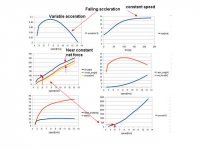
Also see red(Cd=0.6) and blue(Cd=0.2) speed profile. The acceleration just above WS is almost identical:

[qimg]http://www.internationalskeptics.com/forums/attachment.php?attachmentid=22351&stc=1&d=1306366452[/qimg]

attachment.php
 

Attachments

  • at2.jpg
    at2.jpg
    32.6 KB · Views: 40
[qimg]http://www.internationalskeptics.com/forums/attachment.php?attachmentid=22357&stc=1&d=1306426734[/qimg]

And your point is? I mean aside from confusing net force and net thrust.
 
Last edited:
And your point is? I mean aside from confusing net force and net thrust.

Net force = thrust - wheel drag - aero drag.
Power at 6m/s = 6m/s*100n = 600W
Power chart 6m/s says 250W

Power at 10m/s = 10m/s*225N = 2300W
Power chart 10m/s says 1750W

At 10m/s
Thrust = 230N
Wheel drag =175N
Aero drag = 7.5N
Net = 47.5
a = f/m = 47.5/295kg = 0.16ms-2
Chart says a =~0.07ms-2

etc etc...
 
It was to simply for your benefit.

OK, I asked about your silly looking Net Force equation and your answer "for my benefit" is to simply take out the silliness? Is this as close as you come to saying "sorry, I was wrong"?

If not, I expect some support for that silliness that has now disappeared from your "original maths."

Once you admit your mistake or provide support I'll move on to the problems with your torque. You don't seem capable of focusing on more than one issue at a time. Evidence: you've already confused me with tobermoryphil. His questions are quite distinct from mine.
 
Last edited:
Net force = thrust - wheel drag - aero drag
You forgot rolling resistance. Wheel drag in my charts is only the part that turns the prop.

Power at 6m/s = 6m/s*100n = 600W
Power chart 6m/s says 250W
The power chart shows the shaft_power = shaft_torque * omega

At 10m/s
Thrust = 230N
Wheel drag =175N
Aero drag = 7.5N
Net = 47.5
a = f/m = 47.5/295kg = 0.16ms-2
Chart says a =~0.07ms-2
You forgot rolling resistance.
 
Last edited:
You forgot rolling resistance. Wheel drag in my charts is only the part that turns the prop.
That's right, so you forgot Frr.
Frr constant, but aero drag is quadratic. Frr is small relative to aero drag, so that dominates at 10m/s

The power chart shows the shaft_power = shaft_torque * omega
Power = force*velocity.
P = T*omega
Gears directly relate wheel drag to torque and omega.
The torque is all but the same as the wheel drag, except for when the drag exceeds the torque. Totally inconsistent.

You forgot rolling resistance.
Which will further lower your incorrect acceleration figures.
 
That's right, so you forgot Frr.
No, you forgot it, and therefore got different (higher) acceleration than me.

The torque is all but the same as the wheel drag,
No, they don't even have the same units.

Which will further lower your incorrect acceleration figures.
No, it will lower your incorrect acceleration figures so they match my charts.
 
No, you forgot it, and therefore got different (higher) acceleration than me.
Let me see. You say I did not allow for the Frr that you did not include?
a = 0.16ms-2
chart says .07ms-2
difference .09ms-2
F = 26N.
Your Aero drag at 10m/s is 7.5N, so the Frr is 3.5 times that?

No, they don't even have the same units.
They do if they are plotted with the same units on the y axis....
F = T/r. r =1

No, it will lower your incorrect acceleration figures so they match my charts.
Well no, because of the above, and the acceleration is not consistently related to the net force.
 
humber says 0.16ms-2
chart says .07ms-2
The acceleration in the chart includes rolling friction. Yours doesn't.

Try this: net_force = thrust - wheel_drag - aero_drag - rolling_friction
 
Last edited:
The acceleration in the chart includes rolling friction. Yours doesn't.

Try this: net_force = thrust - wheel_drag - aero_drag - rolling_friction

Yes, I know that, so now you have...

Thrust = 230N
Wheel drag =175N
Aero drag = 7.5N
Wheel drag = 26N

Thrust = 230N -175 - 7.5N - 26N = 21.5
a = f/m
21.5/295
= .072ms-2
So now agrees with the chart.

At 12m/s
Thrust = 240N
Wheel drag =275N
Aero drag = 13N
Frr = 26N
Net = 240 - 275 -13 -26 = -59N

At 6m/s
Thrust = 100N
Wheel drag =50N
Aero drag = 1N
Frr = 26N
Net = 100 - 50 -1 -26 = 23N


The reason is that the net force depends on the ratio of wind speed to cart speed. It will work for one value where the numbers are plugged in, and then fails for another.
Prop power is not linear, but the "wheel power" is. Wheel Frr is linear, aero is quadratic. Gearing is a fundamental error, because it does not allow independent omegas for the wheel and prop.

ETA;
Use Javaprop or whatever you use to get the prop data.
Plot the shaft torque against AV
Use the gearing ratio to plot the wheel torque
Then compare the wheel drag and thrust. It will fail at some point, even if the parasitic drag is ignored.
 
Last edited:
What, you can't google "push me pull you boat". The link you provided isn't even the top one.

JB

I did not post any link other than to Ruina's set of stuff.

I asked about the Neumeier article. "A Wind Powered, Turbine-Propeller Driven Car"
Y. Neumeier

Where is that posted?
 
Last edited:
Nope. Still positive net force at 12m/s. You swapped thrust and wheel_drag to get that negative number.

You have a near constant Thrust - Wheel drag. Oppsing forces rise

At 12m/s
Thrust = 275N
Wheel drag =240N
Aero drag = 13N
Frr = 26N
Net = 240 - 275 -13 -26 = -4N ( or -10N if I want to nit pick the chart...)
chart says
a = 0.03ms-2 Fnet ~9N

at 13m/s Fnet = -3.5N

at 8m/s Fnet = 11N
a = 0.09. F = 26.5N


Happy? It takes a 100 iterations to make an obvious point.
You have a near constant Thrust - Wheel drag. Opposing forces rises, so it will fail, no matter what you do. Trial says constant net force.

But there are losses you have obviously not included as the torque to force ratio shows. So, do it the plodding way, rather than seeing the logic.

Plot the prop shaft torque against AV, using the propcalc/Whatever data.
Add the chain losses.
Calculate the wheel torque from the gearing
Calculate the wheel drag using the wheel radius.
Add all drag forces. Aero, Frr, tyre internal losses.
Now see what you net is over the range of AV.
 
Last edited:
Status
Not open for further replies.

ISF - Join now!

Every member here is approved by hand. No bots, no spam, just people who care about evidence and honest debate.

Membership is free!

Create your free account

Back
Top Bottom