Merged DDWFTTW in a “Real” Wind

Status
Not open for further replies.
Before you roll your eyes do a little science at home. Take a pinch of dust and a few packing popcorn pieces and set them on the edge of a table. Then, in one big breath blow them off the table. See if the cloud of dust lingers longer than the packing popcorn stays airborne.

When was the last time you (RCP) saw popcorn floating in the air as a shaft of sunlight brightens a darkened room through a window. :rolleyes:

Unless in a HEPA filtered clean room, dust is always floating in the air. There's a reason for that -- it stays in the air much easier and longer than popcorn.

But you (RCP) will ignore this bit of easily demonstrated basic science just like all the rest of basic science.

JB
 
Last edited:
So you are saying the surface area for the wind to act on for a given unit of weight with a piece of the popcorn and that of a dust particle is the same? :rolleyes:

Roll your eyes all you want, but the surface area to weight ratio of objects get higher and higher (in favor of the area) as the object gets smaller. that's why the dust continues to float while popcorn sits on the floor.

http://en.wikipedia.org/wiki/Surface-area-to-volume_ratio

Now go ahead and take this opportunity to learn a little rather than continuing to use your seriously flawed intuition.

JB
 
Last edited:
There is way more to it than that. A whole set of equations that are statistical. Large surface area to mass ratio, but small mass, makes them different from larger objects. Some suspensions take years to settle. Air will rise over air that is denser or spinning.

The dust is following the wake of the truck, and is not much slower than the truck, and comes towards the camera. So what?
The speed of the cart can be determined from the prop rate so that is not disputed, but the dust says nothing about the wind speed or direction. A sail cart would also show the same result.


It is both, but but the heat accelerates the vapour, and the wheel accelerates the dust. Energy is spread by dispersion.
The air is not a stick, and behaves in a complex way that denies simple ideas of this goes faster than that. The drag on a particle is large, and the net force will be small. You can be assured that some dust will be moving upwind, and some downwind and all other possible directions.
It can say a lot of things, but nothing definitive.
The wake of the truck will be there for quite a while.
If the wind were driving it, the tail would be to the right, because there has been more time to accelerate it. Like the steam.

Hmm. So you feel that since the dust particles disperse through the air in all directions, the dust can tell us nothing about the the wind speed and direction. Interesting.

I suppose it is possible that almost all the dust particles just randomly happen to disperse downwind, or upwind, for example. Not actually likely in the sense of being likely to happen in the entire lifetime of the planet, yet not physically impossible.

Maybe it would be safer not to rely on dust suspended in the air to tell us which way the air's moving then. There's a chance in a bazillion we might be misled.
 
Bulls*** -- humber will explain how mender did it wrong (no matter how mender does it) and you will keep your nonsense up forever. It's what you do rather than contemplate the actual evidence.

JB

Tie the cart to the chassis using a fine thread. See how much difference in the force there is, if the prop is there or not.

You won't find dust used in meteorology.
 
Last edited:
What if we aren't trying to solve for the exact motion of the cart over an extended period of time? What if we're just trying to determine whether it will speed up or slow down from a given speed?
Well, if you know the acceleration for any given speed, you can integrate to get the speed over a period of time. Of course only numerically because you don't have an analytical function that describes thrust at different speeds for a specific propeller.

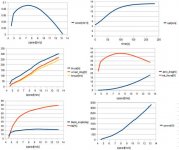
I did it using JavaProp for the following values that gave me 2.9WS in 10mph(4.5m/s) wind:

Blackbird propeller geometry
airfoil:MH 114 13% Re=500'000
transmission eff:0.93
aero drag coefficient:0.2
rolling drag coefficient:0.0050
frontal area:2.0
mass:295.0

attachment.php


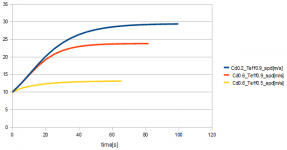
And for those who think that it is a PMM if it requires 93% transmission efficency to work: It stays above windspeed even with only 50% transmission efficiency and a ridiculously high Cd of 0.6. You just need more wind (here 10m/s):

attachment.php
 

Attachments

  • 152_BB_ws4.5_af12_teff0.93_cd0.2_crr0.005_plots.jpg
    152_BB_ws4.5_af12_teff0.93_cd0.2_crr0.005_plots.jpg
    35.8 KB · Views: 61
  • eff_compare.png
    eff_compare.png
    10.4 KB · Views: 81
Last edited:
Sometime you feel like you need a packing peanut, sometime you don't...

Well of course: Any observation of dust that supports ddwfttw is of no importance, whereas any observation of dust that could be interpreted as refuting ddwfttw is absolute proof.

Someone needs to video a cart going faster than packing peanuts so we can listen to Humber tell us how wonderful they are as wind indicators for carts going slower than the wind but just terrible for carts going DDWFFTW. I can see it now:

"Just look at them, they are bouncing all over the place and scattering! The wind must be totally gusting. The carts are tacking, the packing peanuts don't tell you anything!

But for slower than the wind carts:

"Those peanuts are outrunning the cart. Any idiot can see that the cart is slower than the wind. They tell you everything you need to know." You are all deceived.

Regards,

WindGrins:D
 
Well, if you know the acceleration for any given speed, you can integrate to get the speed over a period of time.
And the integral of the momentum, wrt V, will be KE. All you need to do now is show that you have the energy. There are many more simpler ways than that of finding a net force without consideration of the power.
 
Someone needs to video a cart going faster than packing peanuts so we can listen to Humber tell us how wonderful they are as wind indicators for carts going slower than the wind but just terrible for carts going DDWFFTW. I can see it now:

"Just look at them, they are bouncing all over the place and scattering! The wind must be totally gusting. The carts are tacking, the packing peanuts don't tell you anything!

But for slower than the wind carts:

"Those peanuts are outrunning the cart. Any idiot can see that the cart is slower than the wind. They tell you everything you need to know." You are all deceived.

Regards,

WindGrins:D

You will still be left to explain why the sluggish popcorn will still beat the cart. Unless you think the wind can blow the popcorn faster than the wind?
I have the advantage of knowing that in the TM, you are worshiping a toy.
 
Last edited:
Or when in a complicated discussion? So you are saying the surface area for the wind to act on for a given unit of weight with a piece of the popcorn and that of a dust particle is the same? :rolleyes:

Here's another article for your eye rolling pleasure RCP: In it, the magazine Scientific American explains how small particles fall slower than larger particles and even relate it to the 'dust in the shaft of sunlight' that I referred to earlier (emphasis mine).

"The vast majority of clouds you see contain droplets and/or crystals that are too small to have any appreciable fall velocity. So the particles continue to float with the surrounding air. For an analogy closer to the ground, think of tiny dust particles that, when viewed against a shaft of sunlight, appear to float in the air.

Indeed, the distance from the center of a typical water droplet to its edge--its radius--ranges from a few microns (thousandths of a millimeter) to a few tens of microns (ice crystals are often a bit larger). And the speed with which any object falls is related to its mass and surface area--which is why a feather falls more slowly than a pebble of the same weight. For particles that are roughly spherical, mass is proportional to the radius cubed (r3); the downward-facing surface area of such a particle is proportional to the radius squared (r2). Thus, as a tiny water droplet grows, its mass becomes more important than its shape and the droplet falls faster. Even a large droplet having a radius of 100 microns has a fall velocity of only about 27 centimeters per second (cm/s). And because ice crystals have more irregular shapes, their fall velocities are relatively smaller.

http://www.scientificamerican.com/article.cfm?id=why-do-clouds-float-when

Now go and sin no more.

You're welcome.
JB
 
Last edited:
Here's another article for your eye rolling pleasure RCP: In it, the magazine Scientific American explains how small particles fall slower than larger particles and even relate it to the 'dust in the shaft of sunlight' that I referred to earlier (emphasis mine).

"The vast majority of clouds you see contain droplets and/or crystals that are too small to have any appreciable fall velocity. So the particles continue to float with the surrounding air. For an analogy closer to the ground, think of tiny dust particles that, when viewed against a shaft of sunlight, appear to float in the air.

Indeed, the distance from the center of a typical water droplet to its edge--its radius--ranges from a few microns (thousandths of a millimeter) to a few tens of microns (ice crystals are often a bit larger). And the speed with which any object falls is related to its mass and surface area--which is why a feather falls more slowly than a pebble of the same weight. For particles that are roughly spherical, mass is proportional to the radius cubed (r3); the downward-facing surface area of such a particle is proportional to the radius squared (r2). Thus, as a tiny water droplet grows, its mass becomes more important than its shape and the droplet falls faster. Even a large droplet having a radius of 100 microns has a fall velocity of only about 27 centimeters per second (cm/s). And because ice crystals have more irregular shapes, their fall velocities are relatively smaller.

http://www.scientificamerican.com/article.cfm?id=why-do-clouds-float-when

Now go and sin no more.

You're welcome.
JB

Sediment in rivers flows according to shape and buoyancy. The water in an open channel does not flow uniformly with depth, because the drag at the surface is less than the drag with the bed, and the fastest water is generally found 1/3 of the depth below the surface. Dyes are used to time the distance traveled so measure the speed of the river, but not sediment, because they all travel slower than the water and not predictably.
Small animals have a high metabolic rate, because they have a large surface area to mass ratio, so cool fast. On the other hand, trucks create a wake.


"Dust sometimes settles quickly on surfaces, but vast quantities are carried to the upper layers of the air and suspended there for long periods of time. The effects of a volcanic eruption such as that of Krakatoa in Indonesia have been observed three years after its occurrence. Large seasonal dust storms occur in the Sahara and neighboring W Africa and in the Taklimakan and Gobi deserts and neighboring NE Asia; Beijing is annually affected by such storms. Dust from large storms in Africa often travels as far as the S United States and the Caribbean, where it can affect air quality, and dust from the Gobi Desert in Asia has been carried as far east as Minnesota. Such dust storms, which are aggravated by desertification, can have negative health and economic effects; in addition to potentially harmful mineral particles, the dust may include bacteria, fungi, viruses, and various pollutants"

Perhaps popcorn may give a result within a minute.

ETA:
Do you plan to throw a handful of dust, or a truck load? It seems to me that the dust must distribute itself along the run, so will soon be invisible unless an enormous quantity is released. That would require a lot of KE from the air, and most will hit the ground some short distance away.
Have you thought this through?

 
Last edited:
Well, if you know the acceleration for any given speed, you can integrate to get the speed over a period of time. Of course only numerically because you don't have an analytical function that describes thrust at different speeds for a specific propeller.

Try it for 10.5mph in a 10mph wind.

ETA:
I see some problems. If the thrust is multiplied by the velocity, that is more than the "power" chart yields, while at 6m/s the former is 600W, and the latter 250W.
 
Last edited:
On the other hand, trucks create a wake.

That is correct humber. Which shows that you were wrong earlier when you said that the dust from the truck would not go faster than the wind. The dust that the truck raises is actually, at first, traveling faster than the wind. Which makes the BUFC's charge through it even more impressive. Thanks humber for even more evidence that the cart was moving faster than the wind.
 
... I still don’t understand why the dust wouldn’t be blowing past BB if it was going below ws.

Through willful ignorance, RCP still can't believe that a vehicle driving slow wakes up almost no dust while a vehicle driving faster does. Through additional willful ignorance he can't believe that much of this dust kicking behavior is related to how fast the vehicle is moving relative to the surrounding air.

All this in spite of videos of vehicles driving slow on El Mirage lakebed sans dust cloud available on the Youtube (and posted here).

JB
 
Last edited:
Here are a bunch of combinations that work. Take your pick. (I'm ignoring A.T.'s comment that 56 mph wasn't really the top speed. Because otherwise I don't know what to do. :D)

efficiency | rolling resistance / N | CdA / m 2 0.73|9.7|0.058
0.74|11.2|0.107
0.75|12.7|0.167
0.76|14.3|0.236
0.77|15.9|0.316
0.78|17.5|0.405
0.79|19.2|0.504
0.80|20.9|0.613
0.81|22.6|0.731
0.82|24.4|0.858
0.83|26.2|0.994
0.84|28.0|1.14
0.85|29.8|1.29
0.86|31.7|1.46
0.87|33.6|1.63
0.88|35.6|1.81
0.89|37.6|2.00
0.90|39.6|2.20
0.91|41.6|2.40
0.92|43.7|2.62
0.93|45.8|2.84
0.94|48.0|3.07
0.95|50.1|3.31

Here's what the numbers look like if we suppose that it could have gotten up to 60 mph in the 18 mph wind.

efficiency | rolling resistance / N | CdA / m 2 0.75 | 16.2 | 0.006
0.76 | 18.5 | 0.046
0.77 | 20.7 | 0.095
0.78 | 23.0 | 0.153
0.79 | 25.4 | 0.220
0.80 | 27.8 | 0.296
0.81 | 30.3 | 0.381
0.82 | 32.7 | 0.475
0.83 | 35.3 | 0.577
0.84 | 37.9 | 0.688
0.85 | 40.5 | 0.807
0.86 | 43.2 | 0.935
0.87 | 45.9 | 1.07
0.88 | 48.7 | 1.21
0.89 | 51.5 | 1.37
0.90 | 54.3 | 1.52
0.91 | 57.2 | 1.69
0.92 | 60.1 | 1.87
0.93 | 63.1 | 2.05
0.94 | 66.2 | 2.24
0.95 | 69.3 | 2.44
 
That is correct humber. Which shows that you were wrong earlier when you said that the dust from the truck would not go faster than the wind. The dust that the truck raises is actually, at first, traveling faster than the wind. Which makes the BUFC's charge through it even more impressive. Thanks humber for even more evidence that the cart was moving faster than the wind.

Sure. It says something about the truck, but nothing about the wind.
 
Through willful ignorance, RCP still can't believe that a vehicle driving slow wakes up almost no dust while a vehicle driving faster does. Through additional willful ignorance he can't believe that much of this dust kicking behavior is related to how fast the vehicle is moving relative to the surrounding air.
More like how much the cart is sliding on its tyres. The pneumatic knobbies wore out.
If puzzles me that two clincher type tyres can support such a load.
90psi pressure is often used, so the contact patch will be 650lb/90lb = 7.2sq inches.
Perhaps the balance is 2/3 over the rear wheels, so each tyre will have 2.3sq inches. That is a lot, and will produce a lot of tyre loss. That is why soft tyres are inefficient, and make it harder to ride when on a bike. The flexure is large. How have you overcome that, while maintaining the traction that can sustain the cart ( or a Corvette|)?
 
The truck makes that dust trail, and that is the dominant factor. The dust ejected from the BB, says nothing about the wind that is 5m above, but perhaps only about the near stationary air close to the ground. That makes me wonder why it would rise, if not for ejection by the tyre or vehicle wake.
 
Status
Not open for further replies.

ISF - Join now!

Every member here is approved by hand. No bots, no spam, just people who care about evidence and honest debate.

Membership is free!

Create your free account

Back
Top Bottom