Well, I just read that last exchange. It's perfectly clear to me: windgrins's methods are neither desperate nor devious, but the methods of profpangloss certainly are.
But.....
Attachments
Last edited:

Well, I just read that last exchange. It's perfectly clear to me: windgrins's methods are neither desperate nor devious, but the methods of profpangloss certainly are.
Nonsense! Almost none of those red arrows are aligned with the centre of the cart,
All of your colorful font does not change the meanings of my words. It is clear I am talking about Power from the wind to turn the propeller, and there is no power from the wind at wind speed, directly down wind. Again, for your edification: No Power = No Thrust.
This says absolutely nothing at all about a powered propeller in still air, which develops high static thrust.
Your ability to mangle and intentionally misinterpret my meanings is limited, as my meaning is clear. This only shows the readers how desperate and devious your methods are.

Jesus H Christ -- could you be any thicker? Only ONE of them is *supposed* to be aligned with the cart. The other two are to show the dust trail is to the left when the shot is from the right and that the trail is to the right when the shot it taken from the left.
You know what that means? -- that the dust trail will be centered when the shot is centered. Just as shown.
JB

You are posting on an engineering forum-words matter:
your same post (read it) says:
BUT, at exactly wind speed, the power at the propeller drops off to zero! And the Power provided to the propeller is also 0.
You clearly wanted to distinguish the two cases.
If this is not what you intended and you would like to admit this as poorly worded and in error, fine!
Otherwise, I stand completely by my post.
Never underestimate Humber's ability to miss the obvious!
A simple "Whoops, I screwed that one up. Sorry guys, not at all what I meant to say!" would go a long way ...
He knows he doesn't dare say that because then someone would just find the other dozen+ places he has said the same thing and prove that it wasn't an oversight or accident.
JB
He knows he doesn't dare say that because then someone would just find the other dozen+ places he has said the same thing and prove that it wasn't an oversight or accident.
JB
The argument that he wants to deny is that the prop is being "powered" by the wheels rolling over the ground and that this is indeed delivering torque and power to the prop at WS. Since the prop is being powered and the calculations show that it is producing more thrust than the retarding force due to the wheels + losses, that the cart has an excess force to accelerate it.
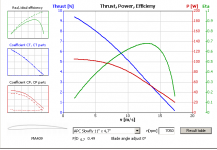
tobermoryphil said:Firstly, if we want 222 N thrust from the prop, Javaprop (4.85 m dia., 0.3 spinner, 120 rpm, 8.046 airspeed, MH116 airfoil) requires an input of 2160 W . This results in 222.34 N thrust, with the prop being 82.82% efficient.
Now we need to obtain 2160 W power via the wheels. We assume 93% transmission efficiency, so we are in fact looking for 2322.5 W. Over 12.516 m, this equates to a 185.5 N retarding force.
Provide data for that. Ask Spork for all the data. Guessing is not good enough. The Frr is too low to support the load and the cart will slide.Tobermoryphil said:Now add in the CALCULATED rolling resistance, as noted previously, of 15.91 N, and the air drag, 17.5 N for a very realistic Cd of 0.25, and we get 218.91N.
Prop thrust is 222.34 N.
Then you are short of the recorded net force: 32N - 3.43N - 3.5N = -25NTobermoryphil said:We therefore have 3.43 N left over for acceleration. Not a lot, admittedly, but the cart is already running at 2.8 times wind speed, very near to its theoretical steady state maximum. If the Cd is only 0.2, which I believe it is, we get a further 3.5 N.
All of your colorful font does not change the meanings of my words. It is clear I am talking about Power from the wind to turn the propeller, and there is no power from the wind at wind speed, directly down wind. Again, for your edification: No Power = No Thrust.
Obviously, simply repeating 'No Power = No Thrust' over and over again isn't convincing us. Why not try a different approach? For example, if we make comments or ask questions about it, you might try answering.
It's hard for me to have a discussion with someone who won't address what I say.
All taken directly from me, so you may expect that I know what the game is.
Humber, nothing was "taken" from you. I rarely read your "maths" as they always contain errors or unwarranted assumptions or gibberish.
The condition I stated was obvious and I stated the same thing very close to when I made my first post-that if there is excess thrust above retarding forces that the cart will accelerate at that point.
As I recall, you pooh-poohed the idea at the time and wrote something about what naive physics it was.
Your trash, in general is not worth reading, so don't worry a lot about anything being "taken" from you!
WindGrins

... I am talking about Power from the wind to turn the propeller, and there is no power from the wind at wind speed, directly down wind. Again, for your edification: No Power = No Thrust.
This says absolutely nothing at all about a powered propeller in still air, which develops high static thrust.
******-- could you be any *****? Only ONE of them is *supposed* to be aligned with the cart. The other two are to show the dust trail is to the left when the shot is from the right and that the trail is to the right when the shot it taken from the left.
You know what that means? -- that the dust trail will be centered when the shot is centered. Just as shown.
JB
Obviously, simply repeating 'No Power = No Thrust' over and over again isn't convincing us. Why not try a different approach? For example, if we make comments or ask questions about it, you might try answering.
It's hard for me to have a discussion with someone who won't address what I say.
The power from the wind does not directly turn the propeller. In fact it opposes the turning of the propeller. It's the propeller's (static) axial thrust which pushes the cart which makes the wheels turn which turns the propeller.
The prop, travelling at windspeed, is in still air, and its power to generate static thrust comes from the fact that it is travelling over the ground at the same speed as the wind.