Merged DDWFTTW in a “Real” Wind

Status
Not open for further replies.
Why do we never hear from the claimant? Oh, I know why...
Spork: Submission report.
Given our vehicle gross weight of 650 lbs and coefficient of rolling resistance of 0.02, we can calculate that we’ll lose 13 lbs of thrust to rolling resistance.

13lb = 57N.


Spork has three efficiency of 85% ( again in the Submission: READ IT)
92% is totally unrealistic, and there is an abundance of evidence that can be called upon if necessary, including several papers I have from various sources and authorities, other than the internet.
The power calculation is from Javaprop, and the 2108W is the engine power demanded at the shaft. That is Dr Hepperle's calculated value, and stays.


Not according to the video, but you can have the 120 if you like.*
The numbers do suggest 120, but the video says otherwise. No TAD number is stable, reliable or verified.

It still fails, and will worsen when losses are added.

1) *Unless contradicted by Spork or JB, that number will be regarded as being factual.
2) The wheel diameter has been given as 27", without any reference to the type of rim or tyre, so is taken to be the OD of the wheel
3) The cart's weight is taken to be 295kg including pilot, as stated by TAD.

Four points here:
I am saying Spork's figure for rolling resistance is wrong.
The worked example in Wiki is for a 1000 kg car, tyre Crr 0.01, rolling resistance 98 N.
We have a 295 kg cart, tyre Crr 0.0055- rolling resistance has to be vastly lower than 57 N! Work it out for yourself. 15.9?

Secondly- I am glad your calculations now show the prop rpm to be in the 120-130 range. I am puzzled how you think can estimate prop rpm from a video- we all know that props and wheels can appear to rotate backwards at certain rpm's!

Thirdly- 92% is an entirely possible transmission figure for chain drive. I am sure you can dig up lower percentages, for worn unlubricated chains; the cart's chain was neither.

Finally, we are arguing, I hope, whether or not the cart works. Arguing about whether Spork's submission figures are accurate is a separate topic; please keep separate.

Addendum: If you want to keep your 2108 W at the prop, fine. For 92% transmission efficiency, we need to take, at 12.5 m/sec, 183 N drag force from the wheels. Add rolling resistance, 16 N (My figure), and air drag, 21 N (Your figure, but I believe could be nearer 14), we get a total drag force of 220 N.
Back to Javaprop, with 2108 W input, 120 rpm, MH 116 airfoil. Thrust = 222N.

Your argument can now only hinge on whether or not my rolling resistance calculation is correct.
 
Last edited:
Four points here:
I am saying Spork's figure for rolling resistance is wrong.
The worked example in Wiki is for a 1000 kg car, tyre Crr 0.01, rolling resistance 98 N.
We have a 295 kg cart, tyre Crr 0.0055- rolling resistance has to be vastly lower than 57 N! Work it out for yourself. 15.9?
Wrong, but it's not your cart, nor what is in the submission.

Secondly- I am glad your calculations now show the prop rpm to be in the 120-130 range. I am puzzled how you think can estimate prop rpm from a video- we all know that props and wheels can appear to rotate backwards at certain rpm's!
So you say. Spork once said something like "nobody knows more than me about getting an image from a camera sensor". I will see how well that claim stacks up.

Thirdly- 92% is an entirely possible transmission figure for chain drive. I am sure you can dig up lower percentages, for worn unlubricated chains; the cart's chain was neither.
So you say. You will need the data for the chain employed, and then the references that support any claims made from that.

Finally, we are arguing, I hope, whether or not the cart works. Arguing about whether Spork's submission figures are accurate is a separate topic; please keep separate.
No it is not, and both are wrong. But, the calculation I derived from Spork's data is favorable to the cart, and does not include the transmission or actual tyre losses, so will be even less so after that is done.

Addendum: If you want to keep your 2108 W at the prop, fine. For 92% transmission efficiency, we need to take, at 12.5 m/sec, 183 N drag force from the wheels. Add rolling resistance, 16 n (My figure), and air drag, 21 N (Your figure), we get a total drag force of 220 N.
Back to Javaprop, with 2108 W input, 120 rpm. Thrust = 222N.

Thus betraying that you have no idea how to calculate the actual figure, and it is Spork's cart. Darts thrown at a board by others are not a substitute.

If you get the actual wheel and tyre data from Spork, then you can post your figure based on that.
 
Last edited:
Your argument can now only hinge on whether or not my rolling resistance calculation is correct.
So much discussion about numbers for something that allegedly has no power at all above windspeed. If that was true, the math should yield a negative acceleration for any non-zero resistance.
 
So much discussion about numbers for something that allegedly has no power at all above windspeed. If that was true, the math should yield a negative acceleration for any non-zero resistance.

If fails on the assumption that power is available, so will do worse when that is shown not to be the case.

There are some who are still waiting on a definitive answer to the question as to who made the calculations, - -particularly those of the true wind speed and direction - found in the conflated_5 file, and repeated in
NALSA's record-period data.
 
Last edited:
My reply mocks the suggestion that it matters who does mathmatical calculations -- they are either right or not.

JB

That is not an answer to the question.
1) Did NALSA prepare those calculations?
2) Did Spork prepare those calculations?

And this time, your reply suggests you have no reason not to answer.
 
Last edited:
Data Suggestion!

Four points here:
I am saying Spork's figure for rolling resistance is wrong.
The worked example in Wiki is for a 1000 kg car, tyre Crr 0.01, rolling resistance 98 N.
We have a 295 kg cart, tyre Crr 0.0055- rolling resistance has to be vastly lower than 57 N! Work it out for yourself. 15.9?

Secondly- I am glad your calculations now show the prop rpm to be in the 120-130 range. I am puzzled how you think can estimate prop rpm from a video- we all know that props and wheels can appear to rotate backwards at certain rpm's!

Thirdly- 92% is an entirely possible transmission figure for chain drive. I am sure you can dig up lower percentages, for worn unlubricated chains; the cart's chain was neither.

Finally, we are arguing, I hope, whether or not the cart works. Arguing about whether Spork's submission figures are accurate is a separate topic; please keep separate.

Addendum: If you want to keep your 2108 W at the prop, fine. For 92% transmission efficiency, we need to take, at 12.5 m/sec, 183 N drag force from the wheels. Add rolling resistance, 16 N (My figure), and air drag, 21 N (Your figure, but I believe could be nearer 14), we get a total drag force of 220 N.
Back to Javaprop, with 2108 W input, 120 rpm, MH 116 airfoil. Thrust = 222N.

Your argument can now only hinge on whether or not my rolling resistance calculation is correct.

Tober,

I have a suggestion if you want to verify your rolling resistance numbers. Look at the carts acceleration values at wind speed in the various runs. All of the aerodynamic drag factors are 0 at this point so the only remaining variables are transmission loss, prop thrust, and rolling resistance. It is not obvious that the cart was always accelerating at its max capabilities at this point but its at least an initial good working assumption.

Let me know if I missed anything.

Regards,

WindGrins
 
ThinAirDesigns said:
My reply mocks the suggestion that it matters who does mathmatical calculations -- they are either right or not.

That is not an answer to the question.
1) Did NALSA prepare those calculations?
2) Did Spork prepare those calculations?

And this time, your reply suggests you have no reason not to answer.

From NALSA:
"As you know, I plan to stay out of the debate on the randi.org forum. In light of that, answers to the questions asked below should be available from people who are active on the forum or from information on the NALSA website.
I will take a look at the report on the forum after it is published. Depending on what the report says and how the debate evolves, NALSA may or may not choose to respond. "

The above may be interpreted as evasion or confident expression that you will answer the questions alluded to. One of those questions concerns who prepared the calculations
 
I have no desire to belabour this point, because it only came about in response to spork's improper thrust calculation in the NALSA submission report. You do recall that in that report he was calculating thrust as Power / Velocity and his Velocity did not account for the acceleration of the air mass by the propeller? I can post a link to my post where I made the correction that he should be using thrust = Power / V + ∆v but I'm sure you recall it.

Yes, I recall it. It's here. You said that he should use power / (v + ∆v/2), by the way.

I also recall this post by Jack by the hedge and this post by Llyricist, which point out that your correction is itself incorrect.

It is quite a big mistake on his part, and would lead to the ridicullous position that when the cart is at wind speed, the airspeed, v = 0 and the thrust would tend towards infinity!

That is a ridiculous position, but spork's calculation would not lead to it because when v = 0, the efficiency of any propeller is zero.

It is here that I mentioned that it is really the power that will go to zero, and the thrust would tend to zero, not infinity.

You are correct about the thrust power being zero, but you are incorrect about the thrust being zero.

The reason the thrust power is zero is that the velocity is zero. If the velocity is zero, the thrust doesn't also need to be zero. It can be anything, and the thrust power will still be zero, because thrust power = (velocity)(thrust) = (0)(thrust) = 0 regardless of what the thrust is.

I see that rather than focus on spork's glaring error, you choose to continue to attack that idea that no power = no thrust, with your game of divide by zero.

I don't focus on what you call "spork's glaring error" because I don't agree that it was an error. Llyricist pointed out, in the post referred to above, that spork made a different error, and I agree, but I didn't see a great need to say so, as he had already said it.

Very well! Do you agree that anything multiplied by zero = zero?

Any real number multiplied by zero equals zero, yes.

That is an axiom and you can hardly deny it!

So, 0/0 = 0 x 0^-1 = 0

That is nothing more than multiplying anything by zero = zero.

And what does 0-1 mean, exactly?

The definition of x-1 is that it is that number y which satisfies xy = 1. There is no number y which satisfies 0y = 1. So 0-1 is meaningless. In particular, it is not a real number.

But I am done with this game as it no longer amuses me and I have already won, after all!

You can obviously stop if you want to. I don't think you have won, though.

Now I will return to showing you why the cart cannot work, even though that has already been shown also.

I don't think you're shown that, either.
 
I have no desire to belabour this point, because it only came about in response to spork's improper thrust calculation in the NALSA submission report. You do recall that in that report he was calculating thrust as Power / Velocity and his Velocity did not account for the acceleration of the air mass by the propeller? I can post a link to my post where I made the correction that he should be using thrust = Power / V + ∆v but I'm sure you recall it. It is quite a big mistake on his part, and would lead to the ridicullous position that when the cart is at wind speed, the airspeed, v = 0 and the thrust would tend towards infinity! It is here that I mentioned that it is really the power that will go to zero, and the thrust would tend to zero, not infinity.

I see that rather than focus on spork's glaring error, you choose to continue to attack that idea that no power = no thrust, with your game of divide by zero.

Very well! Do you agree that anything multiplied by zero = zero?

That is an axiom and you can hardly deny it!

So, 0/0 = 0 x 0^-1 = 0

No. 0^-1 is undefined, so 0 multiplied by it is also undefined. I don't know why you keep repeating the error, since the answer is to be found in countless mathematics textbooks, and of course in Wikipedia:

"The expression

0/0 = ?

requires a value to be found for the unknown quantity in

? x 0 = 0

Again, any number multiplied by 0 is 0 and so this time every number solves the equation instead of there being a single number that can be taken as the value of 0/0."

​

See http://en.wikipedia.org/wiki/Division_by_zero#Division_as_the_inverse_of_multiplication

But I am done with this game as it no longer amuses me and I have already won, after all!

No, you haven't won. You don't want to discuss it any more because you're wrong and you don't want to admit it.
 
Subtle idea!

As I suspected, this is a pretty sharp crowd! Even physics forums have more dissension than you guys! Actually not that hard but you know how intuition works ...

Windgrins, I knew you had the correct answers from your questions but wanted to let others play too! Apart from the springiness of the balloon, there will also be a slight redistribution of the air when the box is in free fall. Even if the balloon is inflexible and is resting very lightly against the box, the change in the air density gradient will still cause the balloon to shift slightly.

Now what happens when the box hits the floor?

Assuming a sealed box and an NB balloon with a non-elastic envelope, generally nothing will happen. The NB balloon doesn't change.

Here's a subtlety however, if the inertia of the air causes it to compress slightly in the box, a gradient will be generated and the constant volume NB balloon will shift to the place which matches its density.

If its elastic, the balloon envelope (assuming it is heavier than air) will move towards the floor and the gas inside will seek the ceiling so I think there would be a deformation of the envelope slightly. (a minor elongation).

These are awfully subtle changes and interacting transient effects so I would have to see an experiment to really believe everything I just said. Its easy to miss things without a real world verification.

Regards,

WindGrins:)
 
No. 0^-1 is undefined, so 0 multiplied by it is also undefined. I don't know why you keep repeating the error, since the answer is to be found in countless mathematics textbooks, and of course in Wikipedia:
"The expression
0/0 = ?
requires a value to be found for the unknown quantity in
? x 0 = 0
Again, any number multiplied by 0 is 0 and so this time every number solves the equation instead of there being a single number that can be taken as the value of 0/0."

​
See http://en.wikipedia.org/wiki/Division_by_zero#Division_as_the_inverse_of_multiplication
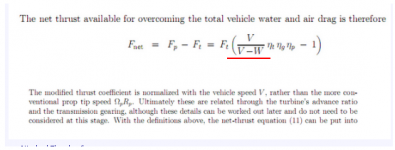
Dr Mark Drela's ddw paper. A divide by zero. Now see if you can find his response.

attachment.php
 

Attachments

  • dividebyzero.png
    dividebyzero.png
    60.5 KB · Views: 68
ThinAirDesigns said:
My reply mocks the suggestion that it matters who does mathmatical calculations -- they are either right or not.

That is not an answer to the question.
1) Did NALSA prepare those calculations?
2) Did Spork prepare those calculations?

And this time, your reply suggests you have no reason not to answer.

From NALSA:
"As you know, I plan to stay out of the debate on the randi.org forum. In light of that, answers to the questions asked below should be available from people who are active on the forum or from information on the NALSA website.
I will take a look at the report on the forum after it is published. Depending on what the report says and how the debate evolves, NALSA may or may not choose to respond. "

The above may be interpreted as evasion or confident expression that you will answer the questions alluded to. One of those questions concerns who prepared the calculations.
 
Last edited:
PPG is on my "Don't bother with list."

I have no desire to belabour this point, because it only came about in response to spork's improper thrust calculation in the NALSA submission report. You do recall that in that report he was calculating thrust as Power / Velocity and his Velocity did not account for the acceleration of the air mass by the propeller? I can post a link to my post where I made the correction that he should be using thrust = Power / V + ∆v but I'm sure you recall it. It is quite a big mistake on his part, and would lead to the ridicullous position that when the cart is at wind speed, the airspeed, v = 0 and the thrust would tend towards infinity! It is here that I mentioned that it is really the power that will go to zero, and the thrust would tend to zero, not infinity.

I see that rather than focus on spork's glaring error, you choose to continue to attack that idea that no power = no thrust, with your game of divide by zero.

Very well! Do you agree that anything multiplied by zero = zero?

That is an axiom and you can hardly deny it!

So, 0/0 = 0 x 0^-1 = 0

That is nothing more than multiplying anything by zero = zero.

You see this does nothing to invalidate the divide by zero rule as long as there is no zero in the numerator.

5/0 = 5 x 0^-1 is still indefinite as there is no multiplication by 0.

But I am done with this game as it no longer amuses me and I have already won, after all!

Now I will return to showing you why the cart cannot work, even though that has already been shown also.

Nope, you lost both the arguments (about props and arithmetic) and and any residual credibility you may have had by being a little boy. Not man enough to admit you were wrong and hiding behind a squirming twist of your original arguments. (Hint for the future-we can actually read what you originally posted long after you write it.)

You, like Humber, are no longer worth responding to as your whining little evasions demonstrate.

I've lost respect for your positions,

WindGrins.
 
Talk to the hand.


ThinAirDesigns said:
My reply mocks the suggestion that it matters who does mathmatical calculations -- they are either right or not.

That is not an answer to the question.
1) Did NALSA prepare those calculations?
2) Did Spork prepare those calculations?

And this time, your reply suggests you have no reason not to answer.

From NALSA:
"As you know, I plan to stay out of the debate on the randi.org forum. In light of that, answers to the questions asked below should be available from people who are active on the forum or from information on the NALSA website.
I will take a look at the report on the forum after it is published. Depending on what the report says and how the debate evolves, NALSA may or may not choose to respond. "

The above may be interpreted as evasion or confident expression that you will answer the questions alluded to. One of those questions concerns who prepared the calculations.
 
Last edited:
Dr Mark Drela's ddw paper. A divide by zero. Now see if you can find his response.

[qimg]http://www.internationalskeptics.com/forums/attachment.php?attachmentid=22269&stc=1&d=1305894167[/qimg]

It's not hard to find his response, since it's on the next page of his paper:

"The relation (8) above is not useful for initial-design estimation, since V −W and ηp are both close to zero near the static-thrust condition, and their ratio is crucial. To resolve this problem, the air prop efficiency is broken down into a viscous (profile-drag) efficiency ηv, and an inviscid (or induced) efficiency ηi taken from actuator-disk theory. The latter is modified by including a swirl efficiency ηswirl which accounts for non-axial velocities in the slipstream."​

Yes, not acceptable, and I asked you for his response. Do YOU have that?

ETA:
TAD is not on line again. Having to ask many times for a direct answer to a simple question puts NALSA in a bad light. Perhaps that bad light is a reflection.
 
Last edited:
Status
Not open for further replies.

ISF - Join now!

Every member here is approved by hand. No bots, no spam, just people who care about evidence and honest debate.

Membership is free!

Create your free account

Back
Top Bottom