profpangloss
Critical Thinker
- Joined
- May 1, 2011
- Messages
- 391
That happens because no prop remains static when taxiing.
That, and the fact that airplanes have engines!

That happens because no prop remains static when taxiing.

That happens because no prop remains static when taxiing.
Well, when the cart is travelling at windspeed, what speed is the prop spinning? It can't not turn at that speed, as it's geared to the wheels.
The power to the wheels is provided by the axial thrust of the prop pushing the cart forwards.
That you leap to assuming there is zero thrust is very odd. There is whatever amount of static thrust the prop produces at that speed.
It rather depends on what your definition of the "efficiency" of a propeller is. If your definition is power extracted in forward thrust divided by shaft power input then yes, I'm afraid it is > 100% in this case. The extra energy comes from the wind blowing into the blades.Oh here we go! Just make the efficiency greater than 100% and the loosses arbritraily small, and it works! Every perpetual motion crank sings the exact same refrain whenever cornered by the facts!
That, and the fact that airplanes have engines!
Well, we agree on what it's doing, anyway!OK, you should better say "it opposes the rotation of the propeller".

BUT, at exactly wind speed, the power at the propeller drops off to zero! And the Power provided to the propeller is also 0.
Here look: Thrust = Power / velocity
where velocity is the velocity through the air, and at WS that velocity = 0
There is NO thrust at exactly WS.
It rather depends on what your definition of the "efficiency" of a propeller is. If your definition is power extracted in forward thrust divided by shaft power input then yes, I'm afraid it is > 100% in this case. The extra energy comes from the wind blowing into the blades.
That's really why it's so hard to decide whether it's a propeller, or a turbine. It's taking energy from both the wind, and the shaft, and converting them both to useable thrust.
I don't consider myself to be a crank, and I don't consider this to be a perpetual motion machine. The source of the energy is well defined.
Where is Drela? The way spork and company throw his name around, you would think he really supports this nonsense but I have not seen a single post from him. Why is that?
Surely you realize that is incorrect? It's a prop spinning in still air, which obviously generates thrust.
Your own formalism says otherwise. You used T=P/(v+∆v/2), not T=P/v. In this case, v+∆v/2 = ∆v/2 which is not zero.
Again, surely you realize that is wrong. The prop is spinning and creating a breeze just like a fan. By conservation of momentum (Newton's third law) that must generate a thrust on the fan.
I calculated the thrust in at least three different ways, including the change in momentum of the air. If you have a vlaid mathematical argument to make against the value of 150 Newtons, then please make it. Otherwise please stop saying I did it wrong. Thanks.
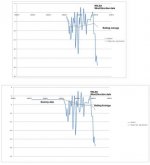
There is a correlation between the rate of change of the wind, and the cart's acceleration. That is demonstrably so.
I corrected that to say no useful thrust, in that static thrust does no work. BUT, when you consider that at WS there is no force from the wind, the power from the wind must fall off to zero. With no power in the numerator, the expression collapses to zero. Yes I know, the cart is still moving, but drive a motorized propeller cart up to any desired velocity and cut the motor. There is still movement, as there is when you turn off a fan. Nothing stops instantaneously. But would you call that residual movement Thrust? I would not.
I calculated the thrust in at least three different ways, including the change in momentum of the air. If you have a vlaid mathematical argument to make against the value of 150 Newtons, then please make it. Otherwise please stop saying I did it wrong. Thanks.
I did, you used the wrong power. T*(v+Δv/2) is Minimum engine power, not thrust power.
That is a good question, and deserves an answer.How does a helicopter hover if static thrust produces no power?
It was, the sadness coming from the fact that you thought it said anything relevant.Oh, I was told that my wind change plots were "now, that's sad"
LMAO, Like I said, I am only going to produce charts when you produce one that is presented dishonestly, and not utterly transparently so, like the ones you produce next in your post.When cornered into producing them himself, and Llyricst found they my charts were correct, I was asked rhetorical questions around NALSA knowing that or not.
And yet, it has not been demonstrated.

I corrected that to say no useful thrust, in that static thrust does no work.
BUT, when you consider that at WS there is no force from the wind, the power from the wind must fall off to zero. With no power in the numerator, the expression collapses to zero. Yes I know, the cart is still moving, but drive a motorized propeller cart up to any desired velocity and cut the motor. There is still movement, as there is when you turn off a fan. Nothing stops instantaneously. But would you call that residual movement Thrust? I would not.