Jack by the hedge
Safely Ignored

You have been told and proven to be wrong. End.
This sounds like dialogue from Downfall. You're not typing from the humberbunker, are you?

You have been told and proven to be wrong. End.
I guess I can't see what you can see that makes it wrong.
It doesn't specify that the objects need to be the same objects in each scenario. Maybe that's too obvious. All he's saying is that it's the closing speed between the two objects that matters, and the relative velocities compared to some other frame of reference don't matter. If you don't change the speed of impact (and you don't change the objects) the result will be the same.
You forgot your relative motion and made downwind absolute, so things never come the other way.
The problem is that a closing speed of 1200mph, can't be mimicked by having one object stationary and the other moving at 600mph. Want to make that bird travel at 1200mph?
I doubt that the total KE of the plane and the bird will be the same, as when both are traveling at 600mph but in opposite directions.
If there is a closing speed of 1200 mph, any combination of speeds that add up to 1200 will produce exactly the same effect on the objects when the objects collide. 600 + 600, 0 + 1200, 376.9 + 823.1, etc; every one is the same to the objects, the only thing changing is the speed of the observer relative to the objects and since the observer isn't involved, that can't affect what happens to the objects.
Are your imaginary divisions of humbercarts sweeping to victory?I have won the balloon matter, hands down. Spork has not been able to defend it, just floated it.
He has lost that one.
You should definitely get that on a tee shirt.You may carry on believing what you like.
I have won the balloon matter, hands down.
Spork has not been able to defend it, just floated it.
He has lost that one.
You may carry on believing what you like.
Well it was intended to help you, as it seemed to me you were right, but I hadn't seen mender make a mistake. I didn't think that was what you'd been saying all along, as you originally questioned mender's assertion that a 600 + 600 mph impact would have the same effect as a 0 + 1200 mph impact or any other combination that added up to 1200 mph. Maybe I need to go back and read what everyone said again.
Above, I said that a 60 + 60 mph impact would be the same as a 120 + 0 impact. That appears to be stating the same principle, doesn't it?
(I also said that a 60 + 0 impact could mimic it if one of the objects was not a car at all but rather a perfectly rigid, immovable barrier. That makes it a different case from two identical objects impacting.)
Of course except that was not what was being discussed in the original context where I found myself in the terrifying position of agreeing with Humber.
Actually you have not said a single coherent thing about the balloon matter.
Adding the dressing of coherent, doesn't "cut it"
I would win the argument hands down, but there appears to be a sudden case of stage fright.
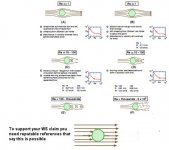
If any of you want to carry one anyway, then you need to show that the
drawing at the bottom is physically possible.
http://www.internationalskeptics.com/forums/attachment.php?attachmentid=21890&stc=1&d=1303335207
Hence humber's rockets with 10,000J each make the same size of bang as his 40,000J rocket hitting a static rocket, because half of the fast rocket's energy remains at the end as KE, simply moving the debris relative to your frame of reference.
From what you quoted it appears that your concern is with the discrepancy in kinetic energy with different frames of reference.
That issue was addressed by ArmillarySphere and essentially the answer is that (despite humbers protests) KE is relative.
If you consider two objects moving on a collision course, then you can do so from any frame of reference you like, and their velocities will be some arbitrary value plus and minus half their closing speed. If you consider them together as a closed system, then the velocity of the centre of mass of the whole system means the system has an amount of KE relative to your frame of reference. That amount of KE will remain as KE after the collision too, due to conservation of momentum. So that "excess" KE is not available to do other work.
Hence humber's rockets with 10,000J each make the same size of bang as his 40,000J rocket hitting a static rocket, because half of the fast rocket's energy remains at the end as KE, simply moving the debris relative to your frame of reference.
(Is that on the right track now?)
The drawing is incomplete. You need to put one of your little arrows on the balloon too, as it's moving at the same speed as the air.If any of you want to carry one anyway, then you need to show that the
drawing at the bottom is physically possible.
Errr,,,Possible or not, the drawing at the bottom is irrelevant. it doesn't depict what happens when the balloon is drifiting at the same speed as the wind.
So there is a vacuum to the front? The diagram represents what would be necessary.At windspeed, the air doesn't flow around the balloon - the balloon is not moving releative to the air and the air is not moving relative to the balloon. It's equivalent to the balloon floating in still air.
The drawing is incomplete. You need to put one of your little arrows on the balloon too, as it's moving at the same speed as the air.
(QED)
Still no good. The total momentum is the same mv + mv = 2mv, but the KE is not; 10000 + 10000 = 20000, but 40000 for the 2V missile.
Momentum is conserved, energy is conserved. KE is not, but may be.
KE + Heat = Total energy.
40000J is more than 20000J, no matter how you try to work around that.
None of the references supportive or not, have even mentioned frames of reference, because there is no relevance.
So there is a vacuum to the front? The diagram represents what would be necessary.
WS balloons would mean the air must get to the front without passing over the balloon, or not change velocity. A physical impossibility that any one who has walked around an obstacle knows.

Errr,,,
So there is a vacuum to the front? The diagram represents what would be necessary.
WS balloons would mean the air must get to the front without passing over the balloon, or not change velocity. A physical impossibility that any one who has walked around an obstacle knows.
For some reason I am having trouble communicating with you on this issue so I will stop after this post....None of this was ever on the wrong track as far as I am concerned.
Adding the dressing of coherent, doesn't "cut it"
I would win the argument hands down, but there appears to be a sudden case of stage fright.
If any of you want to carry one anyway, then you need to show that the
drawing at the bottom is physically possible.
So there is a vacuum to the front? The diagram represents what would be necessary.
WS balloons would mean the air must get to the front without passing over the balloon, or not change velocity. A physical impossibility that any one who has walked around an obstacle knows.
I hadn't asked spork about this. Only you. It is not a competition, I am merely asking for clarification of your position.