Merged DDWFTTW in a “Real” Wind

Status
Not open for further replies.
I can’t find any other post where I asked them to do the demonstration I suggested.

You always did have problems finding things - including your honesty.

Remember how you dishonestly posted the results of on of your early experiements in an effort to show how you were right and we were wrong? Remember how you got busted? Remember how you went with the childish "', I was just testing y'all to see if you could catch what was missing' routine rather than admit your lack of honesty?

Yeah, didn't think you could find that one either although the old timers will remember it well.

JB
 
Text about balloons, sailing in media etc.

Hi all,

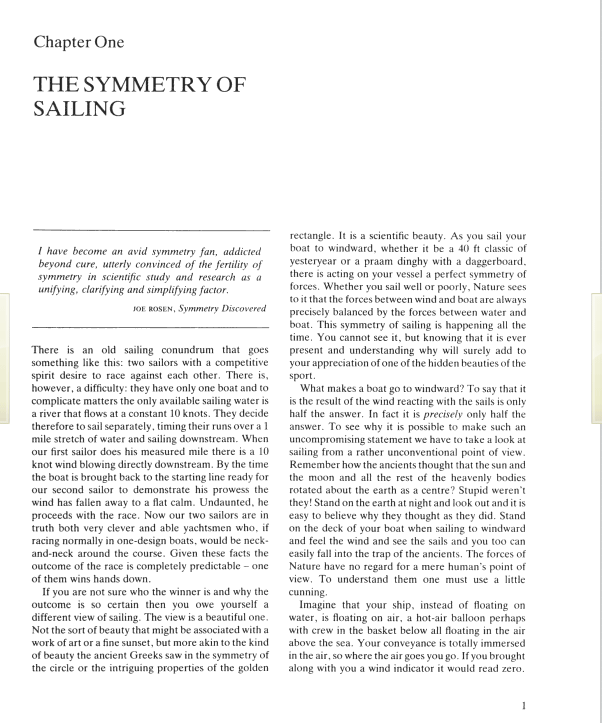
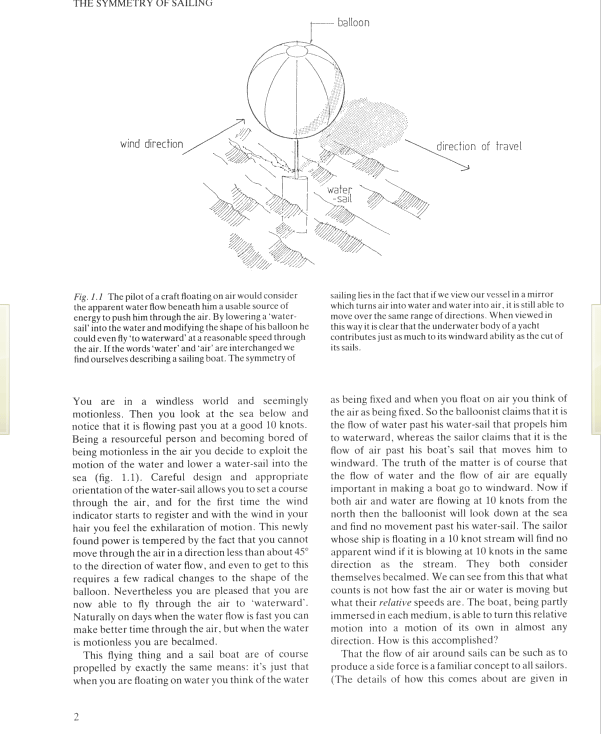
A lot of you are familiar with this but for those that aren't, I highly recommend it. A lot has been discussed about how no texts discuss balloons behaviour in the wind, sailing in no wind, and DDWFTTW.

Here's one that does. It was written in 1987 by Ross Garrett who at the time was in the physics dept at the Univ. of Aukland-NZ. (They take their sailing pretty seriously there!)

If one follows this link to amazon.com and clicks on the look inside link on the cover, one will find in the first 10 pages just about all the topics (except DDWFTTW-that comes later on page 83-87.) One can read this much absolutely free and I recommend this book for any of you sailors who are this interested in this topic.

Link to look inside:

http://www.amazon.com/gp/product/15...1&pf_rd_p=470938631&pf_rd_i=507846&tag=vig-20

Once here just click on the "first pages" link and read those first 5 free pages.

I think you will enjoy it. The pages shown have almost no math. The remainder is half text, half math so be aware of this.

I'm not trying to promote the book but I think it has a lot to say about current topics or if you are seriously interested in the physics of any kind of sailing. (downwind balloons and other stuff argued here).

Spoiler Alert: Humber's going to hate this book but the rest of you may love it. He describes it as "somewhat mystical" and I think you'll see why.

Cheers,

WindGrins :D
 
..l, or where Humber initiated the ad homs before him back at the start. No links;

Unequivocal lie.

Over the last two years he has post those links repeatedly at your request. Your addled brain simply can't remember half of what happens so like humber you keep asking for the same things over and over.

At some point people just go 'I'm not going to get you those links *again*'.

JB
 
Hi all,

A lot of you are familiar with this but for those that aren't, I highly recommend it. A lot has been discussed about how no texts discuss balloons behaviour in the wind, sailing in no wind, and DDWFTTW.

Here's one that does. It was written in 1987 by Ross Garrett who at the time was in the physics dept at the Univ. of Aukland-NZ. (They take their sailing pretty seriously there!)

If one follows this link to amazon.com and clicks on the look inside link on the cover, one will find in the first 10 pages just about all the topics (except DDWFTTW-that comes later on page 83-87.) One can read this much absolutely free and I recommend this book for any of you sailors who are this interested in this topic.

Link to look inside:

http://www.amazon.com/gp/product/15...1&pf_rd_p=470938631&pf_rd_i=507846&tag=vig-20

Once here just click on the "first pages" link and read those first 5 free pages.

I think you will enjoy it. The pages shown have almost no math. The remainder is half text, half math so be aware of this.

I'm not trying to promote the book but I think it has a lot to say about current topics or if you are seriously interested in the physics of any kind of sailing. (downwind balloons and other stuff argued here).

Spoiler Alert: Humber's going to hate this book but the rest of you may love it. He describes it as "somewhat mystical" and I think you'll see why.

Cheers,

WindGrins :D

Here are the first two pages:
166124dac46c0965ba.png

166124dac46c0c2667.png
 
Jack by the hedge said:
When the balloon moves at the same speed as the air around it, it is not travelling relative to the air.

Except that it can't do that. Do you really think that everyone else can't "imagine" your utterly banal claim?

Okay ... I'll play along ...

Humber, where does the balloon get the energy it needs to continually push against the air so that it can move slower than the wind? Also, how does it know which way the wind is blowing so that it can push in the right direction?

-- Roger
 
Last edited:
Here are the first two pages:
[qimg]http://www.internationalskeptics.com/forums/imagehosting/166124dac46c0965ba.png[/qimg]
[qimg]http://www.internationalskeptics.com/forums/imagehosting/166124dac46c0c2667.png[/qimg]

Thanks Michael C. I didn't want to potentially violate any copyright restrictions and didn't know the rules. Thanks for all your great "creature shows". I've especially enjoyed your civility throughout the discussions.:)

Respectfully,

WindGrins:D
 
Humber physics absolute motion detector

Internet warning for future quoters:

"The following is supposed to be humor by poking a bit of fun and is not intended to be taken seriously"::)

I'm sure many of you remember the debate about how you can tell if an aircraft carrier is a anchor in a 10 Knot wind or steaming at 10 Knots in still air.

To give Humber credit for consistency, You can use a Humber balloon to achieve what he stated you could do-tell if the carrier is at absolute rest or steaming.:jaw-dropp

If you take a Humber balloon and release it and it lags behind the speed of the wind, then the carrier is at anchor since the wind is what's moving.

If you launch it and it goes right to windspeed, then it must be the carrier moving since there is no "wind" and since the balloon is aware of this and can tell the difference between "real" wind and "fake" wind caused by carrier motion. It will just stay still and match the speed of the apparent wind. (Still air). "I've actually tested this portion. Every time I release a balloon in my living room, it justs stays still so I'm sure this will work! I don't have a carrier handy so I haven't tested the other part mentioned above but I'm willing to believe all the scientific papers on this especially if the US weather Bureau endorses it!

So when the crewperson releases the balloon, all they need to do is to walk up to windspeed (they could tell that by no wind on their face) and check the balloon to see if it keeps up. One might could even automate this with sensitive instruments. (But not the kind used to measure the BB's run because it is clear from the posts those are grossly inaccurate.) I'm not up on this part of the theory so it would take a better man than I to work out all the details and make this practical.

If I understood some of the earlier posts, there might be a slight issue though. I remember that if you move the balloon faster than the wind (boat steaming) then the balloon would slow below windspeed but this should produce even more of a difference!! I'm not quite clear on the details but I'm sure we can work this out

This concept should be patented! Since I don't want any royalties from this, anyone else is welcome to the idea. If indeed this has been classified by the various Navy's you may never actually see this post. I'm just unaware if it is. As John Hodgeman of the Daily Show would say "You're welcome."

Some relevant comedy here for our forum:

http://www.thedailyshow.com/watch/wed-march-30-2011/you-re-welcome---internet-history

Humber-yes I realize that this is at your expense but its a little comedic relief. You are welcome to tell me that I'm awful-as per John Hodgeman in the video!

Hope you don't take too much offense!

Not nearly as respectful as I should be,

Windgrins :D
 
Last edited:
The laughing stock is you. After accepting that motion is relative, you then contradict that, by insisting that it isn't by making reference to the ground.

So you're saying the ground is not a valid frame of reference for relative motion?
 
To give Humber credit for consistency, You can use a Humber balloon to achieve what he stated you could do-tell if the carrier is at absolute rest or steaming.:jaw-dropp

It's even more jawdropping than that -- Humber has stated repeatedly that there is even no need for a 'humber balloon' to solve your 'aircraft carrier' problem.

He claims he can tell you the answer merely by standing on the deck and jumping up into the air and marking where he lands relative to where he took off. He actually produced a set of diagrams "explaining" it all.

JB
 
A person as a short term Humber Balloon in wind

It's even more jawdropping than that -- Humber has stated repeatedly that there is even no need for a 'humber balloon' to solve your 'aircraft carrier' problem.

He claims he can tell you the answer merely by standing on the deck and jumping up into the air and marking where he lands relative to where he took off. He actually produced a set of diagrams "explaining" it all.

JB

This is consistent since when one jumps up in the air, for a short time one acts as a Humber balloon.

If nothing else, in physics we should ensure all our theory maintains consistency!

I was concerned that the measuring equipment may not be sensitive enough to detect this difference but you have the entire length of the carrier to chase the balloon. Any thing better than BB measurement instruments should be able to detect that large difference.

I'm surprised you didn't see this obvious logical extension to the concept, JB.;)

Windgrins:D
 
Last edited:
windgrins, back when I was a skeptic, and new nothing of sailing or aeronautics, that example of the boat sailing faster with no wind than a boat traveling on a river with wind at the speed of the river was one of the first educational tools that spork and JB used on me. I don't think humber ever got that one. That is another subject that causes him to sit in the corner and mumble. The other item they showed me was several independent sources that showed an iceboat can go much faster than the wind on a velocity made good course.
 
Last edited:
Many reasons. The balloon will never reach that WS state. All sorts of effects will prevent that.

I'm sure it's a very nice diagram, but it doesn't explain (to me, at least) what the force is (or forces) that counters the force of the wind on the balloon and prevents it achieving WS.

Do please explain, I just can't see how it works. I'm also thinking about a neutrally boyant item in a river, and it seems to me that this too will move at the speed of the water...
 
I was just pointing out that in the Humberverse his imaginary wind/balloon speed differential could be used to do what he says is impossible.
Yes quite, it was this that made me wonder how such a differential could be maintained - in the Humberverse.

The convoluted part of this which is only of interest to the Humber connoisseur is that his wrongness re the balloon would negate his argument re the cart which itself is wrong. Headache yet?

Ha! I popped a couple of Ibuprofen earlier. I followed a couple of the earlier DDWFTTW threads a year or two ago, and found them fascinating and ultimately convincing (I was initially sceptical). Humber's arguments puzzled me then. Plus ca change...
 
windgrins, back when I was a skeptic, and new nothing of sailing or aeronautics, that example of the boat sailing faster with no wind than a boat traveling on a river with wind at the speed of the river was one of the first educational tools that spork and JB used on me. I don't think humber ever got that one. That is another subject that causes him to sit in the corner and mumble. The other item they showed me was several independent sources that showed an iceboat can go much faster than the wind on a velocity made good course.

I'm pretty sure no progress is being made here. I'm confident this will never change any minds any further but the forum does shed light on unclear thinking.

Maybe some one else will get the benefit!

Windgrins :D
 
I'm surprised you didn't see this obvious logical extension to the concept, JB.;)

As you're aware, this is one of the key aspects of the treadmill that we often bring up. *IF* there were a detectable difference between the way the DDWFTTW carts act on a sufficiently large treadmill and the ground, then we would have discovered the holy grail -- a way to detect absolute motion.

We didn't.

JB

I was under the impression that some new discoveries had been made in Galilean and Einsteinian Relativity since I took my physics courses. You mean to say those silly laws still hold?!!!;)

WindGrins:D
 
Status
Not open for further replies.

ISF - Join now!

Every member here is approved by hand. No bots, no spam, just people who care about evidence and honest debate.

Membership is free!

Create your free account

Back
Top Bottom