Merged DDWFTTW in a “Real” Wind

Status
Not open for further replies.
The wind tunnel test strikes me as especially ingenious. Thanks :)

Did Humber ever notice that the streamers in the 2nd BUFC run totally destroy his 'wind gradient' nonsense?

How about the vortex that will be created? Engineers use that technique to filter particles from exhausts of all sorts, before releasing them to the air.

You have no hope of rescuing the TM. Consider it already buried.
 
Humber dismissed it as "mystical". I can only assume this is because it actually contains lots of real world physics associated with sailing and aerodynamics. After looking at his replies to my former post about energy flow, I can understand that real physics must appear "mystical".

It has many errors, but even then, no support for ddwfttw. However, it does explain why sail boats can't do it. To the alert mind, that should also explain why balloons can't reach WS. Carteers insist it's because the ground or water prevents that, yet somehow, not for the cart.


The ddwfttw prop boat failed, and was never re-tried. Long time ago too.


I guess we are all entitled to "our own private Idahos"

There it is. Like the first groundhog...
 
More humber lies.

Produce evidence that a ddwfttw boat (air prop, water turbine) has even been attempted.

JB

Actually, I think a ddwfttw boat would be an interesting challenge, assuming the Thin Air Designs folks or somebody else has enough time and money on their hands. It's certainly possible in theory, but, I suspect would be a lot more difficult in practice than a ddwfttw land cart, due to higher drag of a boat hull in water compared to wheels on the ground, and lower efficiency of a water turbine in harvesting energy than a wheel.
 
Last edited:
More humber lies.

Produce evidence that a ddwfttw boat (air prop, water turbine) has even been attempted.

JB

Lovely stuff. So A^3.

It's in the book "The Symmetry of Sailing"
If I correctly recall, it was built 9 years before publication of the book. It failed.

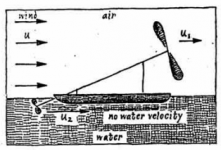
And there is this small model from Scientific American. 1975. Found that amongst Prof Ruina's collection.
Same 22 degree prop angle as Spork's cart

attachment.php


You two seem to think that if can invent the idea of poking a fire with a stick.
 

Attachments

  • copy.png
    copy.png
    53.5 KB · Views: 78
Last edited:
It's in the book "The Symmetry of Sailing"

No it's not. Lies.

If I correctly recall, ....

Not a recall problem -- just lies.

The boat in Symmetry of Sailing (called Te Waka) was clearly described as having a turbine in the air and a propeller in the water -- the *opposite* of what is required to build a DDWFTTW boat.

While they had the ability to adjust the pitch of the turbine, they state that they had no method of altering the pitch nor camber or the propeller which would have been required for the test you claim failed.

Just more humber lies.

JB
 
You can read all about Spork's "original" cart, right here. Scroll down.
Peter Kauffman and Eric Lindahl.

http://www.science-project.com/_members/science-projects/1975/12/1975-12-fs.html

All the buzzwords and explanations are there. It did not work very well and
a subsequent peer-reviewed paper by Blackford tells why.

Nope -- once again Kauffman and Lindahl clearly describe the rotor in the air acting as a turbine. This "push me - pull you" boat was not designed to go nor was capable of going DDWFTTW and the test was clearly described as directly (upwind).

More humber lies.

JB
 
No it's not. Lies.


Not a recall problem -- just lies.

The boat in Symmetry of Sailing (called Te Waka) was clearly described as having a turbine in the air and a propeller in the water -- the *opposite* of what is required to build a DDWFTTW boat.

While they had the ability to adjust the pitch of the turbine, they state that they had no method of altering the pitch nor camber or the propeller which would have been required for the test you claim failed.

Just more humber lies.

JB

It failed.

But what a joke your objection is. It's the same idea. "we don't poke the fire with a stick, but a pole"

That is so of the cart in the Scientific American article. You have taken that,
inverted it for downwind, but kept the same description of operation. doh.
All the rest comes from Ruina.
It won't work at all downwind, and Blackford provides the reason why.
Upwind is quite a different matter, because there is never a time when the cart and wind have zero relative velocity.

The author of the Scientific American article refers to both water and air velocities. Making the water zero, (or the road) is not the same thing. A total misunderstanding of Galilean Relativity.
 
Last edited:
humber still does not know the difference between a turbine and a propeller. All he sees is an object with blades that rotates.
 
Nope -- once again Kauffman and Lindahl clearly describe the rotor in the air acting as a turbine. This "push me - pull you" boat was not designed to go nor was capable of going DDWFTTW and the test was clearly described as directly (upwind).

More humber lies.

JB

Yes, but the same idea is employed. Do you want a Nobel Prize for changing the prefix of a word? Upwind to Downwind? I bet that occurred to nobody but y'all. The biggest and funniest error is that you have equated the moving mass of water, with the stationary ground, on some misbegotten ideas of Relative Motion. Oh, there is no "absolute motion" objects our Weekend Einstein, but can you tell me what the difference would be if there were?
It's by no means settled, and Coby and Hubble are still looking to see what may be what.
 
Lies.

A designed for ddwfttw boat (air prop, water turbine) has never been tried and thus it can't have possibly failed.

JB

It was an upwind boat that failed. Blackford's analysis of 1980, says that any such vehicle, water or land, will not exceed WS downwind or upwind. Thirty years, and technological change withstanding, have demonstrated that he remains correct. No upwind cart, built by University teams has exceeded 65% of WS upwind.
All but perhaps two ambiguous examples of other attempts or propositions, are upwind.

The constructors and originators of that Scientific American boat, are unlikely not to have thought about downwind. Perhaps they rejected it on the basis that it won't work, having accepted that Betz is right, for example.
On the other hand, you accept that nobody is right, and that all others lack your
"blue skies" imagination.
 
Last edited:
I went back and watched Ynot's circular turntable demo with the soap bubble's which clearly answered the reasonable objections about potential entrained flow and swirling turbulance-the soap bubbles clearly indicated there was none!

The only objection I think his demo did not clearly address (and let me make very clear that this is not my objection and I don't have any issue at all with his model!) is the slipping wheel nonsense objection. By painting index marks around the tread wheel and the cart wheel, and shooting a close up at fast speed, it would answer every single objection I've seen on any forum. I guess that's true with the exception that some of the posters don't get the equivalence of a treadmill. Ynot's infinite wind tunnel resolved that issue also.

Ynot, you are to be congratulated for a nice set of real world demonstrations of DDWFTTW. This is especially exemplary from an original non-believer. These are very clever demo machines

Good work!:)

Respectfully,

WindGrins :D
Thanks - The DDWFTTW equipment and demonstrations I produced weren’t intended to prove or disprove anything to anyone other than myself. If you read my posts on DDWFTTW JREF threads you will see I flip-flopped as to whether I thought it worked or not. I was originally biased more toward “non-belief” than “belief” however. As the demonstrations being offered at the time didn’t provide the level of evidence I required I produced and conducted my own. Being a compulsive backyard inventor I also enjoyed the challenge and exercise. If my purpose was to prove or disprove anything to others I would have produced better equipment and demonstrations. I published what I did merely to share with others.
 
Thanks - The DDWFTTW equipment and demonstrations I produced weren’t intended to prove or disprove anything to anyone other than myself. If you read my posts on DDWFTTW JREF threads you will see I flip-flopped as to whether I thought it worked or not. I was originally biased more toward “non-belief” than “belief” however. As the demonstrations being offered at the time didn’t provide the level of evidence I required I produced and conducted my own. Being a compulsive backyard inventor I also enjoyed the challenge and exercise. If my purpose was to prove or disprove anything to others I would have produced better equipment and demonstrations. I published what I did merely to share with others.

Hello, Ynot. The circular windtunnel will have so many secondary effects that it is difficult to tell one from the other, but still suffers from having the cart attached to a pivot.

When there is no pivot, the force on the wheel and prop are in series, and in opposition, as Newton says. When a pivot is employed, there is an additional force path to the pivot, and that allows the table to drive the cart. If the cart will not operate on the table when free, it won't work at all.
Have you tried replacing the rigid arm with a thread?

ETA: I have made a cart that travels up the belt without a prop. It is "slipping" but there isn't a wheel that does not do that to some degree. The trick is to divorce the force applied by the belt upon the cart, and the force driving the cart up the belt. Without giving the game away, that is done via time.
The prop cart does that, but some are blissfully unaware of it.
 
Last edited:
I just mined another gem from the endless source of hilarity that is Humber. If in the Humberverse a person floating in a balloon is not at WS then there should be a way to harness the Humbervese wind relative to the balloon as a power source.

I'm trying to think what force might act on the balloon to counter the force of the wind and prevent the balloon moving at wind-speed (once it reaches steady-state velocity). Because if it's not moving at wind-speed, the wind will exert a force on it that, unless opposed, will accelerate it, and which only becomes zero when it's moving at wind-speed.

And why do people who go up in balloon baskets always say the wind seems to drop and the air seems perfectly still, when the balloon is still clearly moving? If it wasn't moving at wind-speed, they'd feel a breeze.
 
Status
Not open for further replies.

ISF - Join now!

Every member here is approved by hand. No bots, no spam, just people who care about evidence and honest debate.

Membership is free!

Create your free account

Back
Top Bottom