Merged Continuation - 9/11 CT subforum General Discussion Thread

Status
Not open for further replies.
The girder was pushed off its seat after the beams failure by buckling.

"Axial compression then increased in the floor beams, and at a beam temperature of 436 °C, [1] the northmost beam began to buckle laterally. Buckling of other floor beams followed as shown in Figure 8–27 (a), leading to collapse of the floor system, [2] and rocking of the girder off its seat at Column 79 as shown in Figure 8–27 (b).
On page 33 is a graphic showing the beams pushing the girder off its seat to the west:
"Forces from thermal expansion failed the connection at Column 79, then pushed the girder off the seat."
http://wtc.nist.gov/media/WTC7_Technical_Briefing_082608.pdf

NCSTAR 1A pg 22 [pdf pg 64]
Fire-induced thermal expansion of the floor system surrounding Column 79 led to the collapse of Floor 13, which triggered a cascade of floor failures. In this case, the floor beams on the east side of the building expanded enough that they pushed the girder spanning between Columns 79 and 44 to the west on the 13th floor. This movement was enough for the girder to walk off of its support at Column 79.

[FONT=&quot]1-9 Vol.2 pg 488 [FONT=&quot][pdf pg 150][/FONT]
[/FONT] Walk-off failure of beams and girders was defined to occur when . . . . the beam or girder was pushed laterally until its web was no longer supported by the bearing seat. . . . . . When this occurred in the ANSYS analysis, the beam was removed. When a girder failed in this manner, the floor beams that it supported were removed at the same time.

The girder was removed at this point. The floor beams had elongated but they had not yet buckled. Page 354 has a graphic showing the girder being pushed to the west but not far enough to fail.

NCSTAR 1-9 Vol.1 pg 353 [pdf pg 397]
"Axial compression then increased in the floor beams, and at a beam temperature of 436 °C, the northmost beam began to buckle laterally. Buckling of other floor beams followed as shown in Figure 8–27 (a), leading to collapse of the floor system, and rocking of the girder off its seat at Column 79 as shown in Figure 8–27 [to the east]
 
Where were we? E=mgh? And if you jack the building onto stilts first, or push it into a hole, then h is bigger than it used to be. So?
 
Whether he has taken physics courses or not.....and no matter what his actual credentials are or are not, the fact remains that some people were using terms incorrectly.

I've been sucked into the "jump on the truther" thing before....and afterwards I realized that I was doing the very thing I have seen truthers do to non truthers.

The bottom line is that we should demand the same level of accuracy from fellow skeptics that we do from truthers (or any group for that matter).

Instead of semantic nitpicking about definitions femr2 should be telling us his theory about how the explosives were planted,who planted them,what kind were they,how did they rig the building without anyone noticing,were there passengers in the planes or not,the people on the passenger lists were not fictitious,did they voluntarily disappear and leave their families behind,was the entire NYFD in on it and sacrificed the lives of firemen,little details like that. He is accusing an unknown number of people with mass murder. I think that you need some proof before you do that. I have seen none yet.
 
Last edited:
Christopher7

My poit is:
The buckling beams occured before the girder walk-off, not after.

"Axial compression then increased in the floor beams, and at a beam temperature of 436 °C, [1] the northmost beam began to buckle laterally. Buckling of other floor beams followed as shown in Figure 8–27 (a), leading to collapse of the floor system, [2] and rocking of the girder off its seat at Column 79 as shown in Figure 8–27 (b).
 
Femr2 is correct Gravity is not equal to energy.

If truthers are corrected for using the term "free fall speed" instead of "free fall acceleration" then we should correct "debunkers" when they use inaccurate terms.

Using inaccurate terms is sometimes due to simple informalities in language.....other times it can be due to laziness....but often it shows someones lack of knowledge about a topic.

People who misuse technical terms often have only a very basic understanding of a concept with a lot of misunderstandings mixed in.

An example would be someone using "dB" instead of "dBm" to describe a signal level from a transmitter....I have heard fellow Engineers do this very thing and after talking about it the problem was not laziness or being informal....the problem was not understanding what those terms really meant.

We ask the truthers to be accurate, honest, and rigorous in their arguments and terms.

We should do the same.

:)


That's all well and good, but...

1. Truthers are rarely corrected for using "free fall speed," except when such usage occurs in the course of lecturing others on their lack of knowledge of the laws of physics (thus making authority the issue of discussion), or when it's actually ambiguous whether they actually mean speed or acceleration, which must be resolved in order to address a question or issue. Because otherwise, we know what they mean so it is pointless to raise the issue.

2. No one claimed that gravity is equal to energy. That anyone claimed that is a fabrication of femr2's. What was claimed is that "gravity" is a reasonable and clear enough answer to the question that was asked, which is where the energy to destroy the buildings "came from."

If asked where the energy to power my computer "comes from" I might, depending on context, answer "the outlet on the wall over there," "PECO" (the local power company), or "natural gas." Neither outlets, power companies, nor hydrocarbon gases are "equal to energy" or even "forms of energy" (natural gas is often loosely described as a "kind of energy" but that is not technically correct) but they are correct and valid answers to the question asked. Where does the power for my grandfather clock "come from"? "Gravity," "the weights," or "my arm when I wind it every week" are all reasonable and correct answers; none is equal to energy.

The trick femr2 has pulled on you, that you have fallen for, is his interpreting a valid but technically imprecise answer to reasonable but imprecisely and non-technically worded question (that is, where did the energy of a certain process "come from"?) as if it were intended as a technically precise but wrong answer to a different and more technically precise question that was not asked, such as "what exact form of energy powered the fracturing and comminution of the structural materials of the collapsing towers?"

Respectfully,
Myriad
 
Whether he has taken physics courses or not.....and no matter what his actual credentials are or are not, the fact remains that some people were using terms incorrectly.

I've been sucked into the "jump on the truther" thing before....and afterwards I realized that I was doing the very thing I have seen truthers do to non truthers.

The bottom line is that we should demand the same level of accuracy from fellow skeptics that we do from truthers (or any group for that matter).

Your concern is noted.
 
NIST doesn't claim that. Please feel free to read about it at www.wtc.nist.gov

Cheers!

PS. Welcome to 2011. Please remove your head from Loose Change, and out of 2006.
Umm... NIST admitted that WTC fell at free fall acceleration for 2.4 or 2.5 seconds, did it not?

Can you convert 2.4 seconds of free fall acceleration with an initial velocity of 0 m/s??

I'll help you out... 93 feet. 2.5 seconds is 100 feet.

9 to 10 floors. Support COLUMNS, all the way around, symmetrically, failing, almost instantaneously.

I think that you're imagining the columns should bow? What if they snapped like a twig under the weight of the building above it? Would that not account for zero resistance?
What if you don't know what you're talking about.

Explain what happened.

ALL the support Columns got hot. How hot did they get?? REALLY?! ALL of them?

Did they start to bend? Did the floors start to buckle? Why wouldn't the support Columns remain standing?

If only one corner column got hot "enough", as per NIST's report, then why would they ALL fail instantaneously?


See above
I see a whole bunch above, but not a single thing that refers to 2.4 or 2.5 seconds of uniform, free fall acceleration!!! Which translates to 90 to 100 feet of ALL support Columns just disappearing. Not getting weak -- gradually or rapidly; they just vanished.

So you're under the impression that every building that has collapsed all over the world did so because it was hit by a plane?
Was that the impression you got? Impressive.

Why? So you can nit-pick?
Well, this was in an entirely new thread, but it was merged here to obfuscate the crux of this issue -- ALL support COLUMNS not doing their job at the exact same time, for 9 to 10 floors, at least... and THEN reaching a kind of terminal velocity.

Did you read the NIST report, or did you get all your info from youtube like the rest of the truther crowd?
You missed the 2.4 seconds, as well, eh?

:yawn:

[qimg]http://img52.imageshack.us/img52/2853/nistani2.gif[/qimg]
That's just beautiful. Can you convert that to words?

How hot did those support Columns get?

How hot would each of the Columns need to get to reach a point where they disintegrate and offer no support at all??

Where the metals in the Columns not able to resist such temperatures?
 
What was claimed is that "gravity" is a reasonable and clear enough answer to the question that was asked, which is where the energy to destroy the buildings "came from."
Which, as I have said repeatedly, is a poor response.

"Gravity pulverised my building !"...it's nonsense.

The discussion went on for a while, with various bodies jumping in making varying poor, imprecise and badly termed responses. Additional prompting from me to add the terms required for them to make their point clearly were utterly ignored with the status-quo very clearly being "yeah, it's wrong, but we know what he meant to say, so shut up!". Double standards. I've had the likes of tfk have hissy fits because I've used a term (correctly I might add) in a context he thinks is incorrect.

Here's a gem from Beachnut...
The g thing, it is gravity, it is a part, it is the primary source in CD for the destruction of the building, and that is a fact.

Absolutely fabulous communication of the physical principles in action ! Not :)

Numerous other examples from others are present.

If you are happy to let them pass, because they are written by *your mates*, rather than me, that's your lookout. My initial comment was tounge-in-cheek by the way, suggesting that rather than "gwavity did it!" I suggested blaming plankton, but the natural *debunker* snarky responses followed with accusation of lack of knowledge, and so the irony began to mount.

It's very clear that numerous folk commenting really DON'T understand the principles they are talking about, so I'm glad to have highlighted that. I hope they take more care in future.

Have a nice day.
 
Instead of semantic nitpicking about definitions femr2 should be telling us his theory about how the explosives were planted,who planted them,what kind were they,how did they rig the building without anyone noticing,were there passengers in the planes or not,the people on the passenger lists were not fictitious,did they voluntarily disappear and leave their families behind,was the entire NYFD in on it and sacrificed the lives of firemen,little details like that. He is accusing an unknown number of people with mass murder. I think that you need some proof before you do that. I have seen none yet.

While I agree with what you are saying......that is a seperate issue.
 
The trick femr2 has pulled on you, that you have fallen for, is his interpreting a valid but technically imprecise answer to reasonable but imprecisely and non-technically worded question (that is, where did the energy of a certain process "come from"?) as if it were intended as a technically precise but wrong answer to a different and more technically precise question that was not asked, such as "what exact form of energy powered the fracturing and comminution of the structural materials of the collapsing towers?"

Respectfully,
Myriad

There was no trick pulled on me....I read through the posts myself and agreed with femr2 that a few people were using terms incorrectly.

Things like force, energy, and work are often misued terms just like gravitational potential and gravitational potential energy are often misused terms.

The point is that some of us debunkers get pedantic about the usage of terms when they are incorrectly used by truthers......our reaction should be the same if a debunker does something similar.
 
Christopher7

My poit is:
The buckling beams occured before the girder walk-off, not after.
Actually, you are right about that part. In fact, they couldn't buckle at all but we'll get to that in a minute.

Thank you for pressing the issue. I like to "test drive" my ideas here. If there is a problem, someone will find it. ;)

My original point is correct. They have the girder falling both ways but considering that they applied 4 hours of heat accumulation in 1.5 seconds, it all happened in that 1.5 seconds. What was I thinking? Oh yea, the real world. :D

Look at the graphic on pg 354. It shows the girder being pushed to the west at column 79 but not far enough to fail. And it does not mention the walk off described in 1A pg 22. But that is just one of many problems.

1) NIST lied about there being no shear studs on the girder. See: "NIST fraud - WTC 7 Shear Studs" near the bottom of the page:
http://truthphalanx.com/chris_sarns/

Recently, someone posted the original fabrication and construction aspects which show shear studs on the girders.
http://sites.google.com/site/wtc7lies/Salvarinas-1986.pdf

shearstudsonkeygirdercr.jpg


There is no reason not to make the girders composite with the slab.

2) Applying 4 hours of heat in 1.5 seconds is grossly unrealistic. This does not allow for heat dissipation or sagging which would counteract lineal expansion.

The fire only burned for 20 to 30 minutes in any location. There would be some pre heating because the area above the dropped ceiling was open [for duct work, electrical conduit, cables and the like] but they do not say how they calculated the "4 hours of heating".

3) They heated the entire area in that 1.5 seconds. The fire burned thru that area, moving from the south to the north, over a period of about one and one half to two hours.

4) They heated the beams but not the slab which is not what happens in the real world and gives an unrealistic result. [The length of the beam only matters in overall expansion. The distance between the studs determines the amount of stress they receive.]

5) They did not account for the short beam [with shear studs] on the west side of the girder which would have provided resistance.

6) They did not include the 3 short beams between the northmost beam and the north wall or the one on the other side. These would have prevented the northmost floor beam from buckling.

7) They say "Buckling of other floor beams followed" but the beams at the column 79 end had no axial restraint.

8) Even at 600oC the beams would not expand enough to push the girder off its seat.

9) The fire that supposedly caused the thermal expansion had gone out over one half hour before the collapse.

The whole set of parameters are unrealistic and based on false data.

In short the floor 13 collapse due to thermal expansion hypothesis is crap on a crumpet.
 
Last edited:
In the spirit of co-operation...

Umm... NIST admitted that WTC fell at free fall acceleration for 2.4 or 2.5 seconds, did it not?
They did indeed, and they were wrong, well, pretty inaccurate at least.

Portions of the facade of WTC 7 can be demonstrated to descend near to and above *freefall* for a couple of seconds.

The amount of time *at* freefall was likely nearly zero.

Here is the acceleration profile for the NW corner...
408829093.gif

Acceleration (ft/s^2)/Time (s)

Each frame shows the effect of increasing the poly-fit order on the underlying position/time and velocity/time data.

Can you convert 2.4 seconds of free fall acceleration with an initial velocity of 0 m/s??
A trivial calc, but pretty meaningless, bearing in mind...

a) The initial velocity of that period of time was not zero.

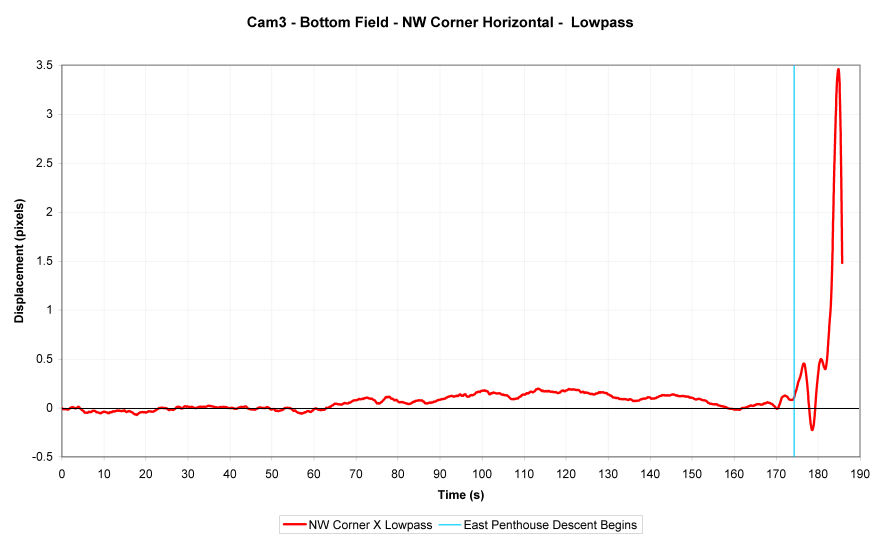
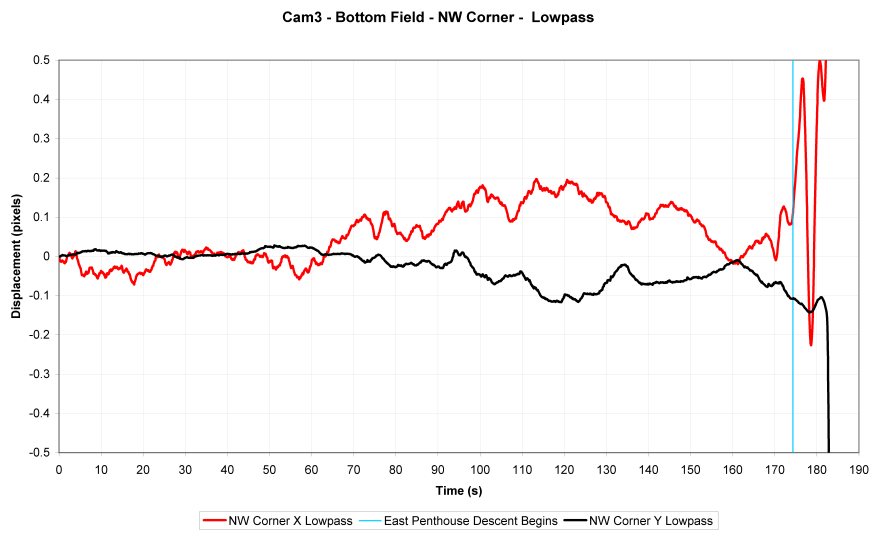
b) WTC7 was in motion well beforehand...
212241494.png

666377698.png


Perhaps you would like to explain how WTC7 was set in motion well over a minute before descent ?
 
I have asked femr2 to give us his full theory concerning the events of 911,but have received no reply.

It appears to me that femr2's full theory about 9/11 boils down to "I, femr2, am more intelligent, perceptive and diligent than NIST, and have discovered many details of the WTC7 collapse that NIST failed to discover." It's a step back from Major Tom's approach, which is to highlight insignificant details of the WTC collapses, assert that they are incompatible with models of the collapse which are too coarse to predict or rule out the aforementioned details, and further assert that these details therefore favour a different model which is no better able to predict the fine details but disagrees fundamentally with all the major observations. Femr2 appears to have seen some of the problems with parts 2 and 3 of this approach, and so is focussing exclusively on part 1.

Dave
 
femr2 said:
Hmm, howsabout...

Concrete Crush Energy = 3.75E+05/x J/Kg

Where x = scale of crush in microns.


What were you after exactly ?

Out of thin air?
No.

Per tower?
No. Per Kg, clearly.

Based on?
Based on...

a) Typical fracture energy of concrete: 100 J/m^2

Sources:
A. Hillerborg. “Results of Three Comparative Test Series for Determining the Fracture Energy Gf of Concrete” Materiaux et Constructions (Materials and Structures) Vol 18, No. 107, 407, (1985)
F.H. Wittmann et. al “Probabilistic Aspects of Fracture Energy of Concrete” Materials and Structures 27, 99, (1994)

b) Density of concrete used in WTC: 100PCF

Source:
NIST

As the end-result calculation is mass based, I've not specified a separate value for the higher density concrete in the core (150PCF), with the assumption that fracture energy per unit mass remains fairly constant. I don't have fracture energy details for the speciic concrete mixtures used, so it's fit for purpose imo.

c) Surface area of 1 micron cube: 6.00E-12 m^2

d) Linear relationship for increase in scale: 1/scale.

Etc... No credit when you don't show your work.
Credit ? Useful to you then ? :)
 
just ignore the fact that the red grey chips were found in the dust...ohhh, i know..no chain of custody even though mark basile got a sample from one of the museums in the area and found them there too!
How the hell do these words in any way relate to what you quote from me. Here it is again

So you are going to take a brittle 20µm layer with another 15-20µm layer and roll it up!

Do you not think that rolling such a thin and fragile material is going to be problematic or are you just going to babble randomly?

How can you possibly say I'm ignoring the fact that these chips were found in the dust? :boggled:

Have you ever seen me quibble over the chain of custody? I don't have a problem with the chain of custody, I have a problem with the incorrect interpretation of the data.


jwe dont know how many layers this stuff came in.
Yes we do. 1.


jthe point is that they found chips with multiple layers. how many layers was it before the towers collapsed....who knows.
OK, so lets do some analysis.

In the paper the words "multiple layers" occurs 3 times.

We have observed that some chips have additional elements such as potassium, lead, barium and copper. Are these significant, and why do such elements appear in some red chips and not others? An example is shown in Fig. (31) which shows significant Pb along with C, O, Fe, and Al and displays multiple red and gray layers.

Here is Fig 31.

picture.php


Significant Pb in this chip. Wow! Are you thinking what I'm thinking? Notice the scale in the picture? 500µm. Now measure the thickness of the red layer, the gray outer layer and the gray inner layer. Completely different to sampls a-d. Chalk and cheese yet they claim it's the same stuff. Notice how the outer gray layer has rusted. Now look at the EDX spectra (Fig 33) for what they call the gray layer (bit sandwiched inbetween) and then compare it with Fig 6. Different material. This is some sort of organic.

This chip is debris; a random piece of crap, but because it's magnetic,due to it's iron content, it was separated. They never characterised any of their samples removed by this method. You would expect random iron particles to be separated using the method but they never say "by the way the method also picked up random crap which we analysed and discarded as crap".

In addition, the gray-layer material demands further study. What is its purpose? Sometimes the gray material appears in multiple layers, as seen in Fig. (32).
These people are so blind. Henryco had some chips exhibiting 2 gray layers with corresponding EDX although I had difficulty due to the labelling - I'll have to go back and look at 2 year old data. The two gray layers are iron oxide and steel. You can clearly see this in fig 32. From left to right - paint > iron oxide > steel. If Harrit et al knew anything the would be able to see the difference between the two layers due to their appearance under the SEM. The gray layer has no purpose in the context of thermite. It's useless!


thats why i think it was probably pre fab stuff from a lab.
Right so you think that a highly engineered material from a lab contains such massive variation in composition?

So significant Pb doesn't send alarm bells ringing? Lead based paint? What about additions of potassium, barium and copper? All found in paint additives. From Fig 14.

Notice the presence of Zn and Cr, which are sometimes seen in the red layers.
Wow, it seems your lab doesn't have very good quality control. They seem to allow any element in it.

So now we have a highly engineered laboratory produced thermite that also contains Pb, Zn, Cr, P, Cu and Ba. Not to mention Si. Starting to look a bit silly now isn't it. Why if this was produced in a lab do we find such a large variation in composition? Maybe just maybe they are analysing materials which are different yet they can't see that. If it's red it's thermite!


why do you think it should be there? but thanks for showing everyone that those chips were thermitic.
Could you please comment in context. We are talking about reaction products of thermite in relation to the high temperature corrosion observed. If thermite was the cause then we would expect to see alumina or Al in the examination of the corroded steel. Al will readily dissolve into a liquid slag at 940°C We don't. Hence no thermite.


this is what jones said about those pesky iron microspheres produced by those red grey chips when questioned by frank greening:

prof jones: "Dr. Farrer and Danny and I have looked at many of these post-DSC spheres, many do NOT contain Al. See for example Fig 21 in our paper:

Look again at the data (above) -- there is no Al in evidence.

Well that proves my point doesn't it? Not the other way around. No Al no thermite. Look at Fig 20. Notice how the gray layer isn't present anymore. Where did it go? Yep that's right it's the gray layer that is predominantly forming the microspheres.

Furthermore, the amounts of Si and Ca and especially S here is trivial. The melting points of iron and of iron oxide are both above 1200 C, yet the DSC reached only 700 C, insufficient to cause melting of iron or iron oxide."
Jones doesn't know how a DSC works.

The DSC tests were conducted with a linear heating rate of 10 °C per minute up to a temperature of 700 °C.
The plot on the x-axis is the heating rate upto a certain point not temperature produced by an exothermic reaction.

The equipment was calibrated to display the data in watts per gram. The plots were set to display positive heat flow out of the sample such that exothermic behavior of the sample would yield a peak and endothermic behavior a trough.
He's confusing heat with temperature. Quite amazing bearing in mind his background.

Well after searching the article I couldn't find it - it was in the comment section from none other than a Prof Jones. Where is the data for this experiment? Just because Jones says it doesn't mean it's true. Now I'm not accusing him of lying but bearing in mind he doesn't have a bloody clue as evidenced time and time again I will take it with a pinch of salt until I see the data. Why does he not back his claim with data?


they wanted to bypass the actual office/debris fire causing the eutectic to form in the first place.
Ofcourse! Why would you do anything otherwise when you are looking to establish whether sulphur can do this to steel at those temperatures? Are you expecting them to burn a whole building and then keep the rubble hot for days to try to get the same effect? How can you control that? The whole point of control is so you can determine the outcome. Doing experiments with out control is pointless - you'll never get any meaningful data from it!


at least you didnt say wallboard! a fire with office supplies should suffice.
So no need for thermite then?


ps why mention co when that would carburize the steel when the fema report showed it was decarburized?
I mention it because burning things usually gives off CO/CO2 as a point to show that other gases maybe present. How much and at what partial pressure is not known.

Now be very careful - CO is carburising, CO2 is decarburising.

Yes a high partial pressure of CO will carburise steel. I will actually give you credit here because it looks like you learnt something.

 
Status
Not open for further replies.

Back
Top Bottom