I'm sorry to resurrect a week old post, but I sort of feel the need to highlight a facepalm-worthy statement by our resident truther here
Here's an IQ test for you: where does the energy come from for a progressive collapse? Remember all the GPE is used up for the free fall.
Thanks for further illustrating the violation of the LOCOE.
Insert Picard facepalm for cmatrix's statement here: --->*<---
Gravitational potential energy does not get "used up" when a body is falling; it gets converted to kinetic energy. The act of accelerating to the ground is
not a consumptive one. Do not mistake propulsion for gravitational acceleration.
Furthermore, you continually ignore the damage to the interior from the fires. Again: Columns on one side of the building were compromised by the fires, this lead to a series of floor failures ultimately leading to the buckling of many columns low in the building. And that's the reason the collapse happen to begin with: Those interior failures. The kinetic energy from the floors above those buckled columns is overcoming what little resistence is left after those columns buckle.
You continually cite the columns as if they were never 1. Part of a system that included floors and trusses, and 2. Weren't compromised by the fires and failures of the floors and trusses. You fail to understand the collapse progression, and you fail to recognize that fact. You
need to study the actual events, not the truther myths about them.
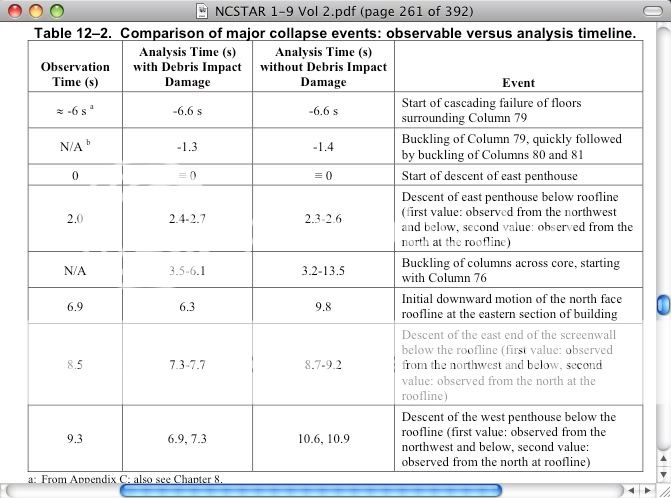
Only a segment of the building fell at g? That's complete hand waving BS.
No, it is what was
measured. Refer to NCSTAR 1-9, table 12-2. This was
measured during a study of the video.
You'd better bone up on the arguments before going anywhere and claiming they're false. You're showing you don't even know what the arguments are in the first place.
The NIST model raw data is not available to independents and the NIST reports do not contain it. So no one can confirm that NIST did not fudge the model to generate the conclusions they wanted. This is why "evidence" from private models is useless. Where are the peer-reviewed papers that validated the NIST claptrap?
You are failing to distinguish between what is actually "data", i.e. the parameters of the buildings, the timing of the fall, etc., with model parameters. Of couse they did not release the LS-Dyna parameters; that's nothing but databases of figures for a specific software app. NIST went one better: They release the
actual event's data. You can see what timing inputs they used. You can see what temperature inputs they used. You can see the load figures they used. NCSTAR 1-9A specifically exists to discuss all of that.
Furthermore, your complaint about "fudging" is empty. Ignoring the fact that
you wouldn't know what to do with the parameters, once again, the data regarding the event along with the modeling they used is published in the NIST reports. Go ahead and point out where a part of the NIST report on building 7 does not follow from the first principles and data given. If you can do
that, then you might have an argument. But not before.
On top of that, you truthers are hardly the ones in a position to legitimately complain about peer review. Your side has produced zero work that's undergone any (if you think the Bentham paper counts, you know nothing about peer review). That's the pot calling the kettle "black" in spades. You want formal peer review, submit work to an academic journal. But if you want real-world validation of the evidence - something that peer review processes are only the first step towards - go back to my posts where I point out the ASCE and ICC acceptance of the findings, and furthermore their use of the knowledge generated to modify building code. Some builders have already mounted a backlash
against the code modifications due to monetary cost, and this demonstrates that not only is the knowledge accepted by engineers and architects in the industry, but that it's
put to use. There's your validation. It can be found in the ASCE standards, the Eurocodes, and the ICC agenda for upcoming meetings. It can be found in Arup's designs and papers. Yes, a peer review would be nice; Dr. James Quintiere is one of the people who's suggested this. But it's not final validation; it's merely the
entry step to acceptance and use in scientific fields (which is probably why the conspiracy peddling side doesn't have any: They're not competent enough to even get their feet in the door, let alone withstand any legitimate reviews that would come their way). The knowledge NIST generated has already bypassed that and been put to use. Say what you will about the lack of peer review; from an academic standpoint, I'd probably agree with you. But don't even try to pretend that the absence of such invalidates the knowledge. The code changes alone demonstrates the bankruptcy of that stance.
------
Are you going to finally start studying the
real issues involved with understanding the collapses? Or are you going to simply retail the same old arguments that have been addressed time after time here? Read the NIST reports before you continue with your criticisms; you don't even have a basic understanding of the collapse progression, let alone the mechanism NIST provided. And learn something about the academic process while you're at it. You argue from extreme ignorance, and that's a terrible position to defend stances from.





 (think Poe's law)