Chemical Engineer Mark Basile confirms Harrit nano-thermite results

Mark Basile's analysis of his own dust sample can be seen in this video, of which I provide a summary now:

http://www.youtube.com/watch?v=AJ7hXrmMRPc#!

According to the presentation, between 30:00 and 31:26 minutes, he received a bag with "a few table-spoons" of dust collected by Janette MacKinlay in January 2008. Janette MacKinlay is one of the four contributors of dust samples to Harrit e.al.. The dust had been collected from
"her fourth-floor apartment at 113 Cedar St./110 Liberty St. in New York City, across the street from the WTC plaza. As the South Tower collapsed, the flowing cloud of dust and debris caused windows of her apartment to break inward and dust filled her apartment. She escaped by quickly wrapping a wet towel around her head and exiting the building. The building was closed for entry for about a week. As soon as Ms. MacKinlay was allowed to re-enter her apartment, she did so and began cleaning up. There was a thick layer of dust on the floor. She collected some of it into a large sealable plastic bag for possible later use in an art piece" (Bentham paper, page 9).​
Basile isolated various dust particles from the sample, using a magnet and a petri dish, among them “iron based microsperes, Red/gray chips, Red chips, Rust, Wire”, also “Silicate or glassy spheres”.
Basile_32_07_MagneticDustComponents.jpg

(screenshot taken at 32:07)

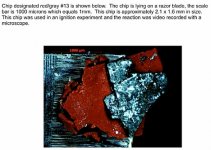
One particular red/gray flake, designated “#13”, was photographed through a microscope (at 39:00),
Basile_39_00_Chip13_Photo.jpg

and analysed using XEDS and then heated till ignition, and the burning recorded on video through a microspcope.

Here is the XEDS data, shown at 39:30 in the video:
Basile_39_30_Chip13_XEDS.jpg


This is how he describes the heating (40:17):
Basile_40_17_Chip13_HowToHeatIt-1.png


I am not showing the burn video sequence here. I don't think screenshots do it justice. It's at 41:42 - 41:59 in the video.

The XEDS graph resembles closely Fig. 7c in Harrit e.al., albeit with relatively less Fe or more Al and Si. While we have doubts about the precision of the Weight % listed in the table, we note that the weight proportion of Si : Al, 1.71% : 1.68%, translates to molar proportions of 98 : 100, in other words, according to Basile's calculation, there are only 2% fewer Si atoms in the red material than Al atoms.

We further note that about 73% carbon represents > 90% organic matrix. 2.63% Fe could represent 3.76% Fe2O3, binding 1.13% O. 1.71% Si could represent 7,86% aluminium silicate (kaolinite, Al2Si2O5(OH)4), binding 4.38% O. All other elements together are 1.8%.

If all the Al were elemental, and in a perfectly stoichiometric mix with Fe2O3 to form thermite, then 1.68% Al would require 3.48% Fe – Basile only found 2.63% Fe. Since Fe is 52.28% by weight of perfectly stoichiometric thermite, the red layer could at most contain 5.03% thermite. With ideal thermite having a theoretical maximum energy density of 3.9 kJ/g (see Harrit e.al., page 27), the red layer as a whole could at most inherit 5.03% of that, or about 196 J/g, from Fe-Al thermite. Most organic compounds have energy densities anywhere between 15 and 40 kJ/g. Assuming a reasonable average value of 20 kJ/g, and 90% organic matrix, the latter would add 18,000 J/g of energy density to the red material, or more than 90 times as much as the supposed thermite under the most ideal of circumstances.
 
Last edited:
Jones, Harrit and Farrer said that Tillotson used air atmosphrere for its tests in his paper... it's false !! :mad:

Tillotson and al. have done the tests under: "ultra pure nitrogen" :)
Why? Because their samples contained organic material. In the paper they give 10 % of mass for these impurities (epoxyde, solvent). So, they used logically "ultra pure nitrogen"...

;)

I had this question presented to Dr. Harrit and he clearly stated he contacted Tillotson about this point and was told that the DSC testing was done in an open air environment.

His statement can be found on YouTube during the Q&A at the end of his presentation at the 9/11 Hearings in Toronto.

If you have contradictory evidence, we need something more than just your say so to make it believable.

MM
 
One particular red/gray flake, designated “#13”,

Wow! This is the first time I have seen this chip photographed from the underside."(Grey.)

THis shot proves that the grey layer is not part of a thermite device as described in any twoofer spew of blather.

The grey layer is a bit of the steel element to which the red substance (It's actually paint.) was applied.

Look at the surface textrue of the grey layer.

Compare it to a polished and etched iron meteorite.

We have identified the substance forming the grey layer.
 
Sorry, but a picture failled to upload, so I shall try that again.

The grey layer is just a flake of the steel to which the paint was applied.
 

Attachments

  • Basile_39_00_Chip13_Photo.jpg
    Basile_39_00_Chip13_Photo.jpg
    59.1 KB · Views: 7
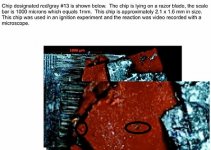
Okay. This just keeps getting better. What are those two round objects embedded into the paint?

Iron microspheres, maybe? Some bit of airborne residue that was not cleaned off the steel before the paint was applied?
 

Attachments

  • Basile_39_00_Chip13_Photo.jpg
    Basile_39_00_Chip13_Photo.jpg
    66.5 KB · Views: 11
I had this question presented to Dr. Harrit and he clearly stated he contacted Tillotson about this point and was told that the DSC testing was done in an open air environment.

His statement can be found on YouTube during the Q&A at the end of his presentation at the 9/11 Hearings in Toronto.

If you have contradictory evidence, we need something more than just your say so to make it believable.

MM
Said the man who just made a claim about a Youtube video without linking to it.
 
1) Linear Thermite Cutting Apparatus; US Patent 6183569, Linear Thermite Cutting Apparatus; US Patent Application No. 2006/0266204. Could have been used to cut resisting core and perimeter columns which would have stopped a fire-initiated gravity-driven collapse.
Highlight mine. Just because it could have been done (and no, it could not have) doesn't mean that it was. Where is the evidence that they were used or even existed?
cmatrix said:
2) The same way the Manhattan Project was kept secret for so long: need to know, compartmentalization, sworn to secrecy etc.
Difference here being that the Manhattan Project wasn't illegal. A 9/11 conspiracy, such as the one you and truthers suggest happened, would almost certainly would be. If it had been a conspiracy someone would have talked by now.
 
Wow! This is the first time I have seen this chip photographed from the underside."(Grey.)

THis shot proves that the grey layer is not part of a thermite device as described in any twoofer spew of blather.

The grey layer is a bit of the steel element to which the red substance (It's actually paint.) was applied.

Look at the surface textrue of the grey layer.

Compare it to a polished and etched iron meteorite.

We have identified the substance forming the grey layer.

In that image, the grey surface on the left, with the parallel horizontal stripes, does not belong to the chip. I think I remember it's a steel blade that Basile used to sort the dust or cut the chips.
 
Why, is it too difficult to find even though I gave you enough info that even a 5-year old old could google it?

MM
You decried someone for not presenting information, right after you failed to present it yourself. Like you said, a five year old could Google it. So why haven't you, and shown it to us?
 
In that image, the grey surface on the left, with the parallel horizontal stripes, does not belong to the chip. I think I remember it's a steel blade that Basile used to sort the dust or cut the chips.
I was referring to the area to the right of the screen. We can clearly see when we blow it up the the grey substance displays a cubical fracture pattern, as though it were composed of tightly-packed rectangular crystals.

That is slightly oxidized steel.

To the left of that, that round object that I circled looks like on of the much-ought-after steel microspheres.There also appear to be more-or-less spherical globs of iron at the top right of the red chip.

I see no way that the grey material is in any way a part of a thermitic device.

I don't think anyone, including Harrit e.al., has ever proposed anything about anything for the gray matter that somehow plays into any thermite theory. Harrit's data shows it's iron oxide, with possibly a tiny blip at 5.9keV for manganese in Fig. 6 a, b and d, which would point to regular A36 steel. So it this fits the LaClede theory well, since the majority of the steel LaClede used for the floor joists was a variety of A36 that contained a wee bit above 1% of manganese. Harrit and other truthes speculate that their "thermite" may have been "painted" or "sprayed" on strcutural steel, so really you are blowing everyone's horn.

As for the tiny specks that you circle - I think they are too small to be identified or properly described. Just a small number of pixels, and gone through several steps of deletrious image manipulation - not least of which are the steps
- Someone takes original photo, with all its limitations of focus and resolution
- Probably some "enhancing"
- Basile crops and resizes it to put into presentation
- Someone copies it into lower res video
- possible further video compression
- I make a screenshot
- and resize again
These specks look roundish, but you can't know if they are truly spheres or just small without pointed edges.
 
"I was referring to the area to the right of the screen. We can clearly see when we blow it up the the grey substance displays a cubical fracture pattern, as though it were composed of tightly-packed rectangular crystals.

That is slightly oxidized steel.

To the left of that, that round object that I circled looks like on of the much-ought-after steel microspheres.There also appear to be more-or-less spherical globs of iron at the top right of the red chip.

I see no way that the grey material is in any way a part of a thermitic device."
"I don't think anyone, including Harrit e.al., has ever proposed anything about anything for the gray matter that somehow plays into any thermite theory. Harrit's data shows it's iron oxide, with possibly a tiny blip at 5.9keV for manganese in Fig. 6 a, b and d, which would point to regular A36 steel. So it this fits the LaClede theory well, since the majority of the steel LaClede used for the floor joists was a variety of A36 that contained a wee bit above 1% of manganese. Harrit and other truthes speculate that their "thermite" may have been "painted" or "sprayed" on strcutural steel, so really you are blowing everyone's horn..."

Well rather than listen to what you think you recall Oystein, why not consult the source directly?

From the paper Active Thermitic Material Discovered in Dust from the 9/11 World Trade Center Catastrophe;

"The four spectra in Fig. (6) indicate that the gray layers are consistently characterized by high iron and oxygen content including a smaller amount of carbon."

"In addition, the gray-layer material demands further study. What is its purpose? Sometimes the gray material appears in multiple layers."


fig31.jpg

Fig. (31). Photomicrograph of a red/gray chip found in sample 3, showing multiple layers and an unusual light-gray layer between the red layers.

"...The gray layer in contact with the red layer has the XEDS spectrum shown in Fig.(33) in which iron is not seen, while the outer gray material had an XEDS spectrum just like those displayed in Fig. (6).
Thus, the middle-layer gray material contains carbon and oxygen and presumably also contains hydrogen, too light to be seen using this method. Since the gray inner layer appears between two other layers, it may be a type of adhesive, binding a red porous thermitic material to another, iron-rich material."


Dr. Steven Jones said:
"Dr. Steven Jones: There are a lot of questions that came up during the paper that have been left unanswered, or unanswered, but need to be answered. Just an example; what is the gray layer? What is the purpose of the gray layer?
We know it has a lot of iron, we know it has a lot of oxygen. We found that there is a hematite phase [reddish-black mineral consisting of ferric oxide] but there are other phases present in that gray layer and we don't quite know what that gray layer is and how it is adhered to the red layer. Certainly further study needs to be done.
Occasionally we would find an intermediate layer between the red layer and the gray layer which was rich in carbon. Perhaps a polymer type layer. But, again, we need to go further with that study to determine what those things are."

I see no pointed reference to manganese which suggests that "possibly tiny blip for manganese" you are weighing heavily on to bolster your Laclede primer paint hypothesis, is indeed nothing more than background noise.

You will milk the weakest evidence to support your failed primer paint hypothesis though.

MM
 
Originally Posted by Dr. Steven Jones
"Dr. Steven Jones: There are a lot of questions that came up during the paper that have been left unanswered, or unanswered, but need to be answered. Just an example; what is the gray layer? What is the purpose of the gray layer?
We know it has a lot of iron, we know it has a lot of oxygen. We found that there is a hematite phase [reddish-black mineral consisting of ferric oxide] but there are other phases present in that gray layer and we don't quite know what that gray layer is and how it is adhered to the red layer. Certainly further study needs to be done.
Occasionally we would find an intermediate layer between the red layer and the gray layer which was rich in carbon. Perhaps a polymer type layer. But, again, we need to go further with that study to determine what those things are."

Holy crap!!!!!!!! The steel was rusting and was contaminated with organic compounds. Never see that happen in nature.

(he's actually saying, he has no idea how paint would look on rusted metal)
:rolleyes:
 
Last edited:
Well rather than listen to what you think you recall Oystein, why not consult the source directly?

From the paper Active Thermitic Material Discovered in Dust from the 9/11 World Trade Center Catastrophe;

"The four spectra in Fig. (6) indicate that the gray layers are consistently characterized by high iron and oxygen content including a smaller amount of carbon."

"In addition, the gray-layer material demands further study. What is its purpose? Sometimes the gray material appears in multiple layers."


[qimg]http://img341.imageshack.us/img341/8637/fig31.jpg[/qimg]
Fig. (31). Photomicrograph of a red/gray chip found in sample 3, showing multiple layers and an unusual light-gray layer between the red layers.

"...The gray layer in contact with the red layer has the XEDS spectrum shown in Fig.(33) in which iron is not seen, while the outer gray material had an XEDS spectrum just like those displayed in Fig. (6).
Thus, the middle-layer gray material contains carbon and oxygen and presumably also contains hydrogen, too light to be seen using this method. Since the gray inner layer appears between two other layers, it may be a type of adhesive, binding a red porous thermitic material to another, iron-rich material."
Thanks for pulling up quotes that totally confirm how Harrit and Jones have no clue what role the iron oxide layers would play in their thermite fantasy and leave it to future research.
It was quite unnescessary. Every reader of this thread was probably already thoroughly aware of the fact that Harrit e.alk. never proposed anything about the gray matter that somehow plays into any thermite theory.

I see no pointed reference to manganese which suggests that "possibly tiny blip for manganese" you are weighing heavily on to bolster your Laclede primer paint hypothesis, is indeed nothing more than background noise.

You will milk the weakest evidence to support your failed primer paint hypothesis though.

MM

MM, it's in the data, simple. I am fully aware that Harrit e.al. did not mention the clear hump in the data at 5.9keV, the K-alpha level of manganese. You seem to think that something is not there just because some folks don't talk about it, but everyone can look at the data in Harrit e.al, figure 6 a, b and d, and see that hump. It's there. It's quite likely mangangese and not white noise.

You see, Harrit e.al.'s data is fairly good, has always been good. It's their faulty interpretation that obviously sucks.
 
"...Harrit's data shows it's iron oxide, with possibly a tiny blip at 5.9keV for manganese. So it this fits the LaClede theory well, since the majority of the steel LaClede used for the floor joists was a variety of A36 that contained a wee bit above 1% of manganese..."
"I see no pointed reference to manganese which suggests that "possibly tiny blip for manganese" you are weighing heavily on to bolster your Laclede primer paint hypothesis, is indeed nothing more than background noise.

You will milk the weakest evidence to support your failed primer paint hypothesis though."
"MM, it's in the data, simple. I am fully aware that Harrit e.al. did not mention the clear hump in the data at 5.9keV, the K-alpha level of manganese. You seem to think that something is not there just because some folks don't talk about it, but everyone can look at the data in Harrit e.al, figure 6 a, b and d, and see that hump. It's there. It's quite likely mangangese and not white noise.

You see, Harrit e.al.'s data is fairly good, has always been good. It's their faulty interpretation that obviously sucks."

So a possible tiny blip for manganese has now blossomed into a clear hump in the data.

And you have the mendacity to talk about faulty data interpretation and fantasy.

Too funny.

MM
 
So a possible tiny blip for manganese has now blossomed into a clear hump in the data.

And you have the mendacity to talk about faulty data interpretation and fantasy.

Too funny.

MM

As usual, you fail to think scientifically.

  1. There is a clear hump in the data at 5.9 keV, the K-alpha level of manganese, in fig. 6 a, b, and d.
    MM, please answer this, clearly and unambiguously: Do you clearly see a hump in the data at 5.9 keV in fig. 6 a, b, and d? YES or NO? Is 5.9 keV the K-Alpha-level of manganese? YES or NO?
  2. Is "There is possibly some manganese in the sample" a possible interpretation of this clear hump in the data at 5.9 keV, the K-alpha level of manganese? YES or NO?

These two questions are aimed at helping you understand the difference between data and interpretation. Maybe you will then understand why a clear hump in the data translates only to a possible interpretation of the hump as presence of manganese.


ETA: Here are cropped portions of 6a and 6d, including the aforementioned humps. Who can see them?
manganese_a.jpg

manganese_d.jpg
 
Last edited:

ISF - Join now!

Every member here is approved by hand. No bots, no spam, just people who care about evidence and honest debate.

Membership is free!

Create your free account

Back
Top Bottom