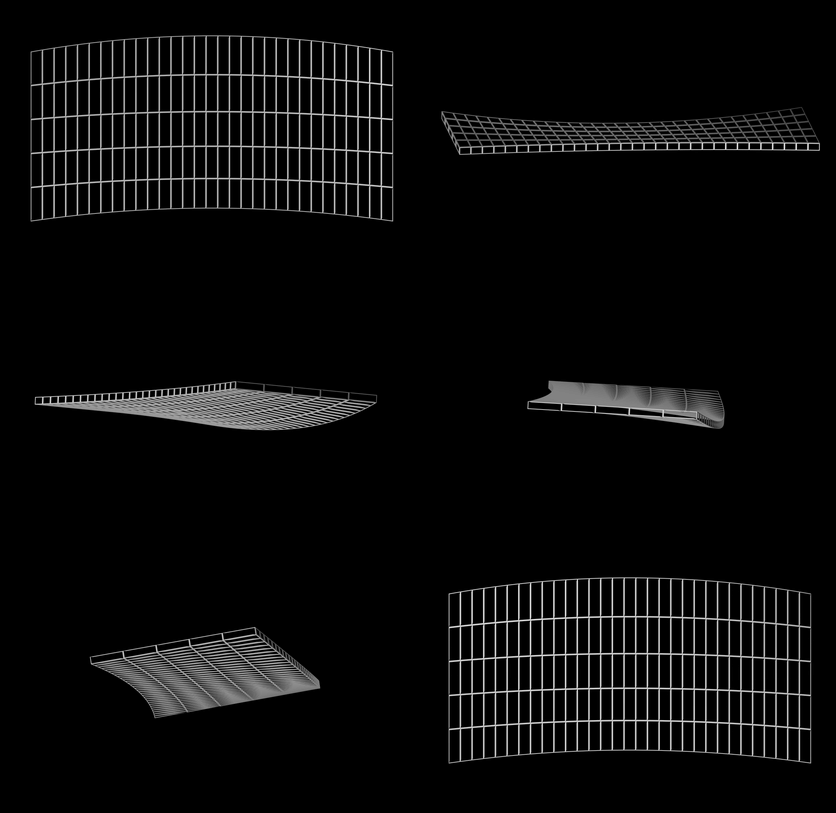
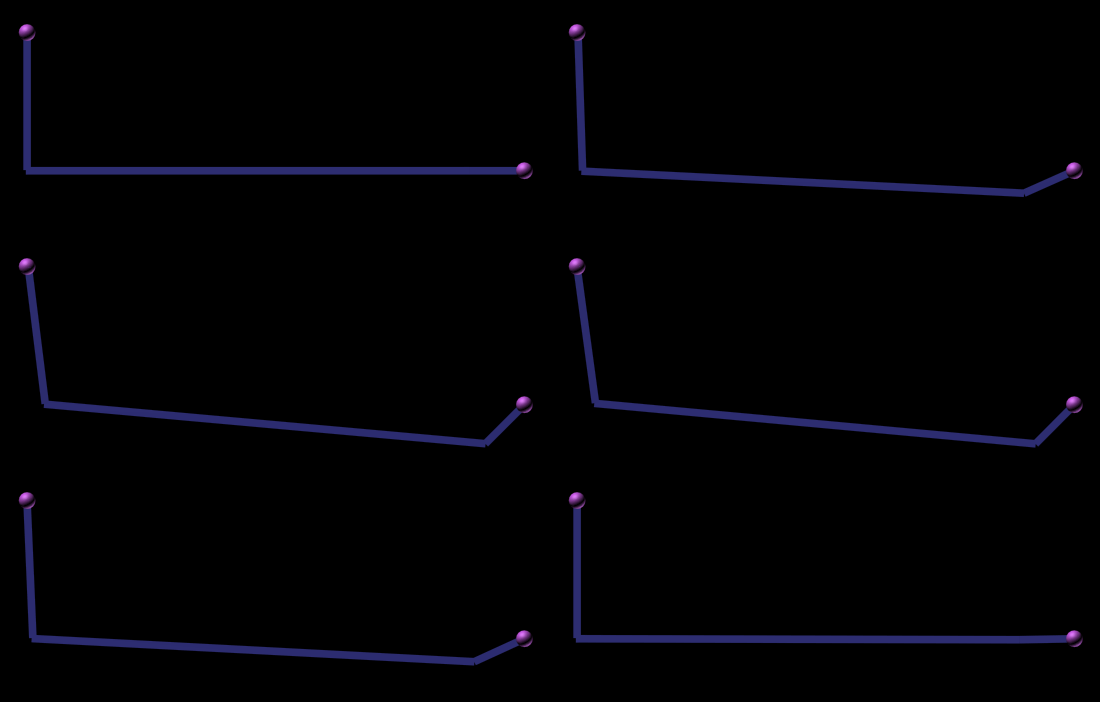
Challenge: Demonstrate Sagging floor Trusses Pulling in Perimeter Columns

Does the building movement during the collapse initiation sequence support what you claim?

What sources do you use to determine building movement and behavior during the collapse initiation sequence?

How do you know the argument is persuasive if you haven't bothered to look at it?

You won't find the collective arguments in that forum.


That leaves many of you in an interesting position. You are forced to guess or believe.

Interesting, you seem to argue against both core led and perimeter led collapse.
I did not take you for a space-a-beams led collapse guy TM.
 
How do you know the argument is persuasive if you haven't bothered to look at it?

You won't find the collective arguments in that forum.

That leaves many of you in an interesting position. You are forced to guess or believe.

Guess? lol
..., I'll offer an alternative solution based on detonations right along the welds of all 8 core columns in column row 500
Your "history", failed claims of CD. Is that a guess, or a believe kind of fantasy?

Your "history"...
JREF 9-11 Forum
http://www.sharpprintinginc.com/911...op=view_page&PAGE_id=103&MMN_position=235:235
Can be used as a research tool for studying just about every superficial, half-ass response to most any 9-11 question.
Not for the sqeamish, clear signs of pathological hatred toward all who question or doubt the official version events of 9-11-01.
How sqeamish? Or squeamish?

More "history"...
... , show that the supposed "gravity-driven collapse" is a mere illusion to mask an intentional act so barbaric, so inhumane and morally impoverished that the fabled characteristics of Satan come to mind. ...
Is your "book" a guess, or belief? How is your CD fantasy coming?

Is there some math to support the core stuff? Does it matter which failed first? Gravity collapse is gravity collapse, and the cause was fire; are you going to support the thermite fantasy.
 
Last edited:
That leaves many of you in an interesting position. You are forced to guess or believe.

Aircraft impact - check
Large area, multifloor offices fires as an almost immediate result of aircraft fuel dump - check
Observed perimeter column bowing shortly before collapse initiation- check
Two FEAs that offer persuasive modes by which perimeter columns were bowed- check (though not a detail that is required to prove inward bowing of course)

No persuasive evidence that the perimeter failure was the result of core failures.

So you can argue over minute detail for academic curiosity or in a quest to improve future design if you wish, but the known gross details favour a perimeter led collapse caused by a combination of impact damage and the heat of those fires.
 
Aircraft impact - check
Large area, multifloor offices fires as an almost immediate result of aircraft fuel dump - check
Observed perimeter column bowing shortly before collapse initiation- check
Two FEAs that offer persuasive modes by which perimeter columns were bowed- check (though not a detail that is required to prove inward bowing of course)

No persuasive evidence that the perimeter failure was the result of core failures.

Then I guess you have it all figured out.

You don't need to know much about the actual behavior of the building during the initiation sequence if you have so much proof.
 
I stated nothing at all about any structural movement prior to collapse OTHER than the demonstrated inward bowing of the impact/fire floor perimeter columns.

Perimeter column bowing is the ONLY docuementary clue we have to support and proposition as to what event came first, core failure or perimeter failure.

Perimeter inward bowing is docuemented fact TM. No building movement indicates a 20 foot plus core shortening.

That is the only documented clue? Interesting. WHat about the earliest movement of the antenna or NW corner? What about the tilt angles over which all core and perimeter columns failed? What about the earliest overpressurizations?

Like I said, without that information you are only guessing or believing.


Shown above is the calculation as to what it would take in the way of core shortening to be the cause of inward pulling on the perimeter, 23 feet of core shortening. Quite obvious there is nothing to support that.

Those are the calculations? Pythagorean theorem? And you just believe that?

The floor grilling would look something like this:

617303571.gif


A pull-in mechanism may take this form:

160048563.gif


How do you apply Pythagoreans theorem to that mechanism?


Maybe a pivot mechanism based on a simple geometry would be a bit more realistic, like this:

south_wall_pul_lin.gif
 
Last edited:
Aircraft impact - check
Large area, multifloor offices fires as an almost immediate result of aircraft fuel dump - check
Observed perimeter column bowing shortly before collapse initiation- check
Two FEAs that offer persuasive modes by which perimeter columns were bowed- check (though not a detail that is required to prove inward bowing of course)..
Yes; Yes; Yes and Yes twice.
...No persuasive evidence that the perimeter failure was the result of core failures...
Maybe BUT there is some persuasive evidence of core failing first>>>>core led failure. Done by M_T's colleagues over on the 9/11 Forum. Major_Tom could probably provide direct links - I would have to search.

HOWEVER that is not the "key question"

1)So what if core went first rather than perimeter went first?
2)What does it matter?
3) To whom?
4) Why?
5) etc etc.

Fact is the top part of tower still dropped and global collapse ensued AND there was no CD.

6) So who cares if column PQR went before Column XYZ??
7) Why...etc?

And you, JDH got the answer to that lot right:
So you can argue over minute detail for academic curiosity or in a quest to improve future design if you wish,....

And I know from long suffering patient experience that M_T will run away from answering those questions...won't you M_T? :)
 
Yee gads!
The whole arguement is moot.

The columns DID bow inwards
There WAS large area multifloor office fires that began within seconds of aircraft impact and continued throughout the time period between that event and collapse.
Therefore it is quite logical to assume that some mechanism driven by or initiated by the heat of those fires, with possible contribution from impact damage, is responsible for the inward bowing and eventual failure of the perimeter columns.

There is no evidence to support anything other than office fire heat being the driver of this bowing.

Yes, common sense!

Why look to explosives or nano-woo-mite when we can see all the evidence of column distortion and sagging floors?

I'm pretty sure somewhere in the NIST report it describes how as many as 1/3 of the core columns were damaged by the planes initial impacts, and the loss of their load bearing capability and the load being transferred to the remaining 2/3, actually caused half of those 2/3 to also lose their load bearing capability before even being heated.
I may have the details wrong but I'm pretty sure I got the gist of it right.
 
A pull-in mechanism may take this form:

160048563.gif

Please provide the following:
1) The mechanism for which a plastic hinge would develop at the indicated points. Please show why these points, locations of high shear strength and low moment demand, would exceed their yield capacities prior to other areas.
2) The reaction forces of the indicated yielded shape.

How do you apply Pythagoreans theorem to that mechanism?

Quite simply, it appears. The basic rules of Trigonometry hold true even when one has more than one triangle.

Maybe a pivot mechanism based on a simple geometry would be a bit more realistic, like this:

south_wall_pul_lin.gif

Please provide the following:

1) The mechanism for which a plastic hinge would develop at the indicated points. Please show why this point, a location of high shear strength and low moment demand, would exceed yield capacity prior to other areas.
3) A free-body diagram of the member.
2) The reaction forces of the indicated yielded member.
 
Then I guess you have it all figured out.

You don't need to know much about the actual behavior of the building during the initiation sequence if you have so much proof.

No I don't have all that would be required to figure it ALL out. Neither do you unless you have found video of the core columns and thus are certain about how they were affected by impact and fire damage.

What we DO ABSOLUTELY KNOW FOR CERTAIN AND IS DOCUEMENTED, is the perimeter inward, not outwrad, not random direction, bowing occuring up to collpase initiation.
 
Yes, common sense!

Why look to explosives or nano-woo-mite when we can see all the evidence of column distortion and sagging floors?

I'm pretty sure somewhere in the NIST report it describes how as many as 1/3 of the core columns were damaged by the planes initial impacts, and the loss of their load bearing capability and the load being transferred to the remaining 2/3, actually caused half of those 2/3 to also lose their load bearing capability before even being heated.
I may have the details wrong but I'm pretty sure I got the gist of it right.

This is pretty much what I am getting at. MT and others have heard hoofbeats and are scanning about for zebras and seem frustrated by the herd of horses that is in the way.


Is it possible that the trusses sagged at points other than close to their long axis center? Yes but since one would expect that a long truss will most likely bow downwards at its center then if you are to assume otherwise you should have a very good reason for it.

Is it possible as ozeco points out, that the core columns failed before the already distorted inwards perimeter columns? Yes but given abosolute knowledge of perimeter column bowing and having to only guess at core column creep, again its pretty safe to assume that the smaller perimeter columns, with bracing only in two direction (inwards and to each other. Core columns have both truss bracing as well as short beam bracing to core columns to the side and further in) failed first.

Then again as ozeco points out.
Other than for purposes of determining better future design, of what import is it which, perimeter or core, failed first?

In the context of the 911 truth movement it would be that explosives or therm?te charges on perimeter columns would be most likely observable whereas in the core they would be less likely to be visible and thus a core led collapse is usable in an arguement from ignorance contention of CD.

Unless someone has another take on it, I could be wrong. ozeco gets pedantic sometimes, me, sometimes its been known to happen that I'm wrong:D
 
As far as antenna movement goes, I would EXPECT it to move about quite a bit in a building in which significant perimeter columns have been severed and in which there is are multi level , large area office fires that over time are involving more of the office space and materials. I could also see a fairly good probability of some core column creep due to heating, but that would be on the order of inches rather than dozens of feet.
 
Has enik fled? Or is he just an infrequent poster?
Very infrequent over the weekends.

Now, by using your calculations, can you predict the deflection given in the following example image? One with 6 kips at two places, and the second with an additional 139 kips applied at the top. In other words, would the additional 139 kips cause the perimeter column to bow inward more or less than without the 139 kips?
 
Is it possible that the trusses sagged at points other than close to their long axis center? Yes but since one would expect that a long truss will most likely bow downwards at its center then if you are to assume otherwise you should have a very good reason for it.
You mean like this?

pgimeno-vigas-venezuela.jpg


No, everyone knows that that's not how trusses sag :rolleyes:

(That's the East Tower in Venezuela's Parque Central complex).
 
Very infrequent over the weekends.

Now, by using your calculations, can you predict the deflection given in the following example image?

Yes, I can.

One with 6 kips at two places, and the second with an additional 139 kips applied at the top. In other words, would the additional 139 kips cause the perimeter column to bow inward more or less than without the 139 kips?

Yes, including a compression force will result in a larger deflection than a case without a compression force.
 
Very infrequent over the weekends.

Now, by using your calculations, can you predict the deflection given in the following example image? One with 6 kips at two places, and the second with an additional 139 kips applied at the top. In other words, would the additional 139 kips cause the perimeter column to bow inward more or less than without the 139 kips?

http://s1.zetaboards.com/LooseChangeForums/topic/4724858/1/
Do all engineers make fun of models, or is this only a tactic of 911 truth followers of the inside job CD fantasy? Are you making fun of Bazant's model? What did Bazant say?


Is, as you put it, "Inside Job Evidence is in the Physics of WTC #1"?

What was the goal of your challenge? You have said, "Debunkers are not smart". Why are you making a challenge? Do you have a goal after 11 years of 911 truth CD failure? Do you have a goal, a final conclusion, a thesis? Anything? What is wrong with Newtons Bit's work?

What is the goal?

 
Just ran a quick analysis with RISA. It estimates P-delta behavior (but is still a linear analysis) and only does P-BigDelta.

Deflection without compression force is 4.6in.
Deflection with compression force is 15.0in.

With the compression force, the column is has exceeded yield capacity and would continue bending inwards until rupture.
 
Do you have a goal, a final conclusion, a thesis? Anything? What is wrong with Newtons Bit's work?

Based on his latest questions, I'd say he plugged some values into his FEA suite and got results indicating that there was no change in deflection based on the vertical compression force. Rather than immediately leap to the conclusion that I don't know what I'm talking about, he should instead ask himself if he knows what his analysis software is actually doing. I would wager that one of the following is wrong:

1) He pinned the bottom and top, which resulted in all of the compression force going into the top reaction.
2) He didn't turn p-delta on (it's not on by default in all software)
3) His suite only looks at P-BigDelta, and he needs to add structural joints along the length of his column to get the software to estimate P-Delta.
 
Just ran a quick analysis with RISA. It estimates P-delta behavior (but is still a linear analysis) and only does P-BigDelta.

Deflection without compression force is 4.6in.
Deflection with compression force is 15.0in.

With the compression force, the column is has exceeded yield capacity and would continue bending inwards until rupture.
clap.gif
clap.gif
clap.gif

Are hugs and kisses allowed?
..acceptable...?

OK - just accept my "thank you". I've lost track of how many times I have made that point over the years. And it can be professionally disappointing to see it ignored by engineers. :(

The number of times people have tried to show that floor joist sagging lacked the geometric capability of pulling in the perimeter by 50"+ whilst presuming that joist tension in catenary was the only factor.
 
Last edited:

Back
Top Bottom