Challenge: Demonstrate Sagging floor Trusses Pulling in Perimeter Columns

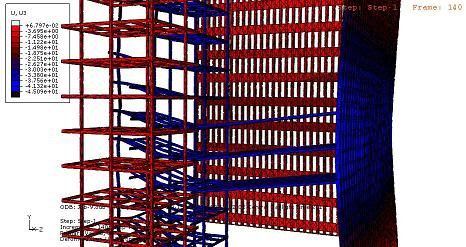
The perimeter columns did bow inward. The mechanism that could cause this and is supported by FEA is a downward displacement of the core.

A slow downward displacement of the core over the time it took to bend the columns inwards I suppose.


Then again ergo would have a problem with this of course.
Since it matters not what causes the trusses to pull on the perimeter he questions that the truss to column connection would survive it.

Originally Posted by ergo
Does that thread answer anywhere the question of how the truss-to-column connections can be so robust that the floor trusses, while sagging something like 40" (a feat in itself, without breaking) can pull in 14" steel box columns, causing them to break, but simultaneously be so flimsy as to then be unable to prevent rapid progressive floor collapse? Just curious.


How great a downward core movement was that again? Did it happen to be noticable at the roof level, the antenna for instance? I would think it would have to since we have according to you, both a perimeter bowing thus a shortening of the perimeter height, as well as a core shortening and since there is nothing else holding the roof up it all must have been moving downwards over this time period. Did it?
 
The perimeter columns did bow inward. The mechanism that could cause this and is supported by FEA is a downward displacement of the core.
A slow downward displacement of the core over the time it took to bend the columns inwards I suppose.
Just be cautioned about the loose logic - the unsupported exclusive claim "the mechanism". The argument actually supports "one of the possible mechanisms..."

That said there is persuasive argument in favour of 'core led' collapse over on the 911Forum. enik may be able to provide links - I would have to search. I have not examined it rigorously because no one has ever persuaded me - or even tried to persuade me - that the difference between the 'core led' explanation and NIST style perimeter led makes the slightest difference at anything but details level. Except for the obvious potential to support CD but no one (Except your distinguished self ;) ) has put forward a prima facie hypothesis for that either.

...Then again ergo would have a problem with this of course.
Since it matters not what causes the trusses to pull on the perimeter he questions that the truss to column connection would survive it...
Fact is the columns bowed inwards and ergo is playing "truther logic" - unqualified personal incredulity backed by reversing burden of proof and camouflaged as JAQing. If the floor joists did not start the inwards bowing what did? There is no alternate hypothesis on the table here.
 
Last edited:
A better thread would be "Challenge: Demonstrate anything BUT Sagging floor Trusses Pulling in Perimeter Columns"
 
A better thread would be "Challenge: Demonstrate anything BUT Sagging floor Trusses Pulling in Perimeter Columns"
Maybe - but it removes the alternates that depend on "Sagging floor Trusses" of which there are implicitly two before us viz:
1) The joists pulling in was the sole mechanism and caused the full 54"; AND
2) The joist pull in merely started bowing which then, after a critical stage, was self propagating.

Enik's OP allows for both - note the "up to":
...Show with your own FEA or calculations how the perimeter columns of WTC 1 were pulled in by up to 54” by sagging floor trusses.

There may even be others but I haven't thought of any. And the difference between those two would not be as black and white as I have stated them. I think enik has done the some FEA work which could clarify those two and any middle ground version.

Then the Newtons Bit's scenario is primarily a "core led" situation with perimeter pull in as a consequence.

And enik's final point:
...Bonus, demonstrate how this instability caused the initiation sequence for collapse of WTC 1.
1) It looks more like an additional challenge than a "bonus" :);
2) I'm not sure about "caused" in the setting of a cascade failure. "Earlier in sequence" possibly and if so "just happened to be the weaker member which failed first" rather than "initiated'. But that could be me getting a bit pedantic. It has been known to happen. :o
 
Then the Newtons Bit's scenario is primarily a "core led" situation with perimeter pull in as a consequence.

I suspect that the core columns severed by the plane impact (or failing subsequently to fire and damage) played a significant part, but I don't know if it is the primary cause. My thread was about confirming the NIST hypothesis, that a pull-in force of 6kip per column would be sufficient to cause a wall to fail. Which it is.
 
I suspect that the core columns severed by the plane impact (or failing subsequently to fire and damage) played a significant part, but I don't know if it is the primary cause...
Yes -- I understood that from previous posts and it is implicit in your recent references. My intention was to mention the relationship to the "core led" v "perimeter led" debate which has been one of the areas of speculation. Not an aspect of concern to me for several reasons. It is the cumulative effect of the cascade failure that matters in the "bigger picture".
My thread was about confirming the NIST hypothesis, that a pull-in force of 6kip per column would be sufficient to cause a wall to fail. Which it is.
Understood also.

Thanks for the confirmations.
 
The perimeter columns did bow inward. The mechanism that could cause this and is supported by FEA is a downward displacement of the core.


This is an example of core failure mechanism that pulls in the perimeter wall similar to what femr has shown.

tower_004a.jpg


tower_004a.jpg


It shows that in general there are ways to create IB by partial core failure rather than with long truss sagging as the NIST claims.

There are a number of observable features that are consistent with a core-led initiation mechanism for WTC1 and 2. I had shown them in the threads that were removed.

The downward displacement of the core causing the columns bowing 55" is impossible because:
1) So the south exterior core columns row “failure mechanism” pulled in the perimeter columns.
For WTC1
a2 +b2 =c2Solving for a (vertical drop of core columns) where b (horizontal distance from core to bowed perimeter = 55.4 feet for 55" inward bowing over 20 or so minutes ) and where c (hypotenuse, the length of the trusses = 60 feet) , a then (the core columns drop ) = 23 feet.

The outer core columns, at the south side of WTC1 suddenly dropped 23 feet in order to cause a gradual, over 20 minutes, 55" inward bow of some the perimeter columns, double the drop shown on the illustration.

2) The illustration shows only 3 floors dropping. The columns and floors above, attached to the dropped columns below, would also have dropped the same distance.

3) This failure mechanism would, at such severe angle, have severed the trusses at both ends and the first core bay for all the floors up to the roof leading to a collapse of these floors and antenna hat truss support. The handicap of not being a structural or mechanical engineer is evident.

4) I couldn’t find the observable of that failure mechanism in Major Tom's list of features. No, not the bowing of the perimeter columns, the failure mechanism for collapse of these core columns. Was it natural or demo?
There are no “measurables, observables” for the cause of this core columns collapse, just wishful speculation.


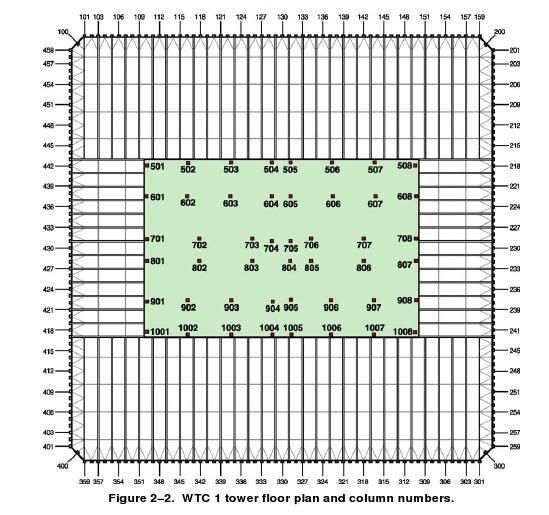
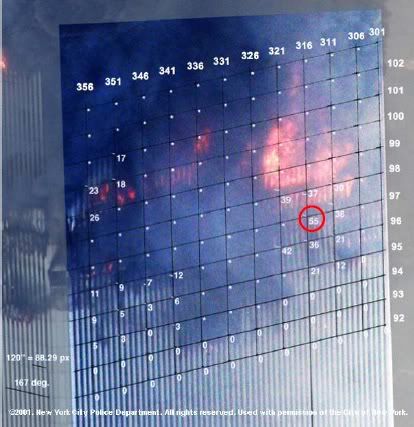
Also Column line 356 is attached to a truss girder not a core column, bows in more than Column line 351. Therefore core column drop is not necessary to cause perimeter column bowing.

nist_floor.jpg


Untitled-6.jpg
 
Last edited:
The downward displacement of the core causing the columns bowing 55" is impossible because:


Also Column line 356 is attached to a truss girder not a core column, bows in more than Column line 351. Therefore core column drop is not necessary to cause perimeter column bowing.

[qimg]http://i90.photobucket.com/albums/k252/lonwaters/wtcmodel/nist_floor.jpg[/qimg]

[qimg]http://i224.photobucket.com/albums/dd121/88Badmachine88/Untitled-6.jpg[/qimg]

What mechanism do they propose for a core column of three stories being severed top and bottom?
 
What mechanism do they propose for a core column of three stories being severed top and bottom?

I don't believe they propose creep or unbraced core columns length. Had to be CD, but they can't won't say so. The intent here is to pretend rational analysis reluctantly leads to CD.
 
Last edited:
What mechanism do they propose for a core column of three stories being severed top and bottom?

I exhausted the national stockpile of popcorn waiting for an answer to that question.
 
I exhausted the national stockpile of popcorn waiting for an answer to that question.

Right. MT never did answer this question -
4) I couldn’t find the observable of that failure mechanism in Major Tom's list of features. No, not the bowing of the perimeter columns, the failure mechanism for collapse of these core columns. Was it natural or demo?
Perhaps enik can answer this. He said he did an FEA about this drop.
 
I don't believe they propose creep or unbraced core columns length. Had to be CD, but they can't won't say so. The intent here is to pretend rational analysis reluctantly leads to CD.

"reluctantly",
Is it just me, or did that make anyone else laugh?

23 foot core column shortening!
It was obvious that a core column drop should be observable in its effect to all floors above the damaged core section and in movement of the roof, but 23 feet and no observed effect other than perimeter column bowing at a couple of impact level floors would seem to negate the propoisition of core failure as the cause of the IB
 
Last edited:
As far as perimeter bowing causing the initiating sequence of collapse;
Once again even without resort to engineering we see that the probability of core shortening causing the perimeter IB is quite low and that would then offer no support for a core failure leading to perimeter failure at the initiation of collapse.
Instead, we observe continueing perimeter deformation up to collapse, a situation that does suggest it led to perimeter column failure.
Perimeter column failures would require load redistribution mostly to already deformed adjacent perimeter columns which are quite likely to immediatly fail thus requiring more redistribution, thus causing a rapid failure of most if not all perimeter columns.
This was observed to occur at collapse initiation. Absent any other observed failure at collapse initiation nor any evidence of core shortening prior to collapse initiation , reason and logic would imply that perimeter bowing led to perimeter failure which led to several floors worth of loss of core column lateral support. This in turn leads to an immediate increase of something around 100% in the load on the core (assuming a near 50/50 split of flor loads being borne by each of core and perimeter)
Compounding this of course is the fact of at least some loss of capacity in the core due to aircraft impacts.

Although it may be possible to find technical solutions to the acedemic problem of what could cause such a collapse, unless some evidence is available to point that way then again , logic and reason would still dictate that perimeter led collapse was the sequence in effect on 9/11
 
...Although it may be possible to find technical solutions to the acedemic problem of what could cause such a collapse, unless some evidence is available to point that way then again , logic and reason would still dictate that perimeter led collapse was the sequence in effect on 9/11
There is also another issue:

"Leading" of necessity means "going before" BUT "going before" does not necessarily imply causality. ;)

(There - that should set off a bit of head scratching.....:boxedin:)

:runaway
 
There is also another issue:

"Leading" of necessity means "going before" BUT "going before" does not necessarily imply causality. ;)

(There - that should set off a bit of head scratching.....:boxedin:)

:runaway

You and your pedantry...:D

Change my sentence to;
".........then again, absent any other physical or docuementary evidence to the contrary, logic and reason would still dictate that perimeter failure was the precursor event that directly caused an overload condition on the core columns beginning the sequence of global collapse in effect, in the WTC towers, on 9/11 "


,, and while I'm at it , a similar statement can be made concerning WTC 7. That is to say that the docuementary evidence indicates that a failure of floors below the 12th caused faliure of column 79 which in turn caused progressive overloading of core columns and global collapse.
 
Last edited:
As far as perimeter bowing causing the initiating sequence of collapse;
Once again even without resort to engineering we see that the probability of core shortening causing the perimeter IB is quite low and that would then offer no support for a core failure leading to perimeter failure at the initiation of collapse.
Instead, we observe continueing perimeter deformation up to collapse, a situation that does suggest it led to perimeter column failure.

Does the building movement during the collapse initiation sequence support what you claim?

What sources do you use to determine building movement and behavior during the collapse initiation sequence?
 
That said there is persuasive argument in favour of 'core led' collapse over on the 911Forum. enik may be able to provide links - I would have to search.

How do you know the argument is persuasive if you haven't bothered to look at it?

You won't find the collective arguments in that forum.


That leaves many of you in an interesting position. You are forced to guess or believe.
 
Last edited:
Does the building movement during the collapse initiation sequence support what you claim?

What sources do you use to determine building movement and behavior during the collapse initiation sequence?

I stated nothing at all about any structural movement prior to collapse OTHER than the demonstrated inward bowing of the impact/fire floor perimeter columns.

Perimeter column bowing is the ONLY docuementary clue we have to support and proposition as to what event came first, core failure or perimeter failure.

Perimeter inward bowing is docuemented fact TM. No building movement indicates a 20 foot plus core shortening.


Shown above is the calculation as to what it would take in the way of core shortening to be the cause of inward pulling on the perimeter, 23 feet of core shortening. Quite obvious there is nothing to support that.

Absent any other physical or docuementary evidence then, it is only reasonable and logical to assume perimeter column failure was the result of continued inward bowing and global collapse was initiated when the perimeter failed.
 

Back
Top Bottom