Canada may exit Kyoto pact to save $$$$$

According to a report—commissioned by the federal government—climate change will cost Canada $5 billion per year by 2020 and between $21-$43 billion per year by the 2050s.

News article here.
Report web site here.
But think of all the new farm land that will open up, and lower heating bills! Beach resorts on Baffin Island! An end to the exodus of hockey teams to the US sun belt! Snow birds staying in Canada for the winter instead of going to Arizona with their money!
 
Last edited:
This river will not exist after the glacier is gone. It is a glacier meltwater river.

Note it for me too. I thought you were serious about the river thing.
I was serious about the river. The precipitation will still fall, and water will still run downhill. Why would the river dry up?
 
I call snow 'slow rain'. What would happen if rivers were no longer fed by snowmelt is they'd become flash-flood gullies, either filled with raging water or dry.
 
I call snow 'slow rain'. What would happen if rivers were no longer fed by snowmelt is they'd become flash-flood gullies, either filled with raging water or dry.
The Mississippi was once fed by glacial melt, it's not a gully today.
 
I was serious about the river. The precipitation will still fall, and water will still run downhill. Why would the river dry up?
Perhaps it wouldn't dry up entirely, but it certainly would be profoundly affected if the source of the river no longer exisited, don't you think?
 
Perhaps it wouldn't dry up entirely, but it certainly would be profoundly affected if the source of the river no longer exisited, don't you think?

True but there would still be afluent and other source. Remmember : the river don't start big and stay big, they usually start small and get bigger and bigger with afluent. For example the seine is barely a small rivulet of water when it starts (ETA: a few photo show it as barely something 60 centimeter wide and a few centimerter depth). Also many river do not starts with a glacier at all. And many river , whereas increasing in volume during rain, still flow while it is not raining. And that ain't because of glacier (there is none in my region of France... Still tehre are rivers and lakes).
 
Last edited:
Perhaps it wouldn't dry up entirely, but it certainly would be profoundly affected if the source of the river no longer exisited, don't you think?
The source of the river is precipitation upstream. The glacier itself is formed by precipitation, it's basically just a frozen river.
 
Perhaps it wouldn't dry up entirely, but it certainly would be profoundly affected if the source of the river no longer exisited, don't you think?

The source is precipitation over area that drains into that river. If the precipitation is snow, and that snow forms a glacier, all that process does is change WHEN the precipitation flows into the river. It doesn't change WHERE it eventually drains, or even how much. The only way it possibly could is if glaciers flowed uphill, so that they moved water from one watershed to another. But glaciers are notoriously loathe to flow uphill. This is really, really, REALLY basic stuff, it's surprising how many people don't figure it out on their own.

Now, this doesn't mean that there wouldn't be any downside in terms of the rivers. The time-shift in water flow that glaciers provide may be very useful. River flow volume can peak at different, and possibly better, times than precipitation does. It may also help to keep river flow volume steadier, which might mean less flooding. But drying up? Nope, that's not a risk. The glaciers could vanish entirely, and the rivers still won't go away, because they're still draining exactly the same land that they were draining before.
 
I call snow 'slow rain'. What would happen if rivers were no longer fed by snowmelt is they'd become flash-flood gullies, either filled with raging water or dry.

The glaciers could disappear without snow melt going away. There's very little glacial melt in the California Sierras, for example, but plenty of snow melt.
 
The glaciers could disappear without snow melt going away. There's very little glacial melt in the California Sierras, for example, but plenty of snow melt.
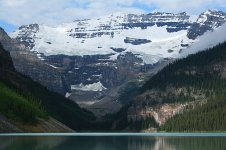
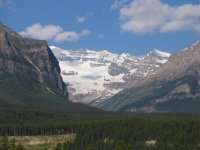
one glacier that is known to many is victoria glacier at lake louise alberta, in banff park.
in my lifetime, it has greatly diminshed in size.
it is probably one of the most photographed glaciers on the planet.
note the incredible difference in 5 years.
the pictures are from 2004 and 2009.
 

Attachments

  • ll2009a.jpg
    ll2009a.jpg
    75.5 KB · Views: 5
  • ll2004.JPG
    ll2004.JPG
    62.8 KB · Views: 3
The source of the river is precipitation upstream. The glacier itself is formed by precipitation, it's basically just a frozen river.

The source is precipitation over area that drains into that river. If the precipitation is snow, and that snow forms a glacier, all that process does is change WHEN the precipitation flows into the river. It doesn't change WHERE it eventually drains, or even how much. The only way it possibly could is if glaciers flowed uphill, so that they moved water from one watershed to another. But glaciers are notoriously loathe to flow uphill. This is really, really, REALLY basic stuff, it's surprising how many people don't figure it out on their own.

Now, this doesn't mean that there wouldn't be any downside in terms of the rivers. The time-shift in water flow that glaciers provide may be very useful. River flow volume can peak at different, and possibly better, times than precipitation does. It may also help to keep river flow volume steadier, which might mean less flooding. But drying up? Nope, that's not a risk. The glaciers could vanish entirely, and the rivers still won't go away, because they're still draining exactly the same land that they were draining before.
All right, I accept that this sounds reasonable.

Can we pipe our oil to Texas now please?
 
Can we pipe our oil to Texas now please?
Not until after the election, Obama needs the votes of the lunatic fringe environmentalists. He'll approve it soon after he plays them for suckers.
 
Canada has some of the greenest power generation on the planet. We get a sizable portion of our electricity from nuclear and have been curbing our use of coal for years. The problem is we have an energy intensive lifestyle, not because we want to because it's GD cold and everything is either spread out or deep in the ground.
In Canada Bob goes to work and turns 100 tons of ore into steel, Doug harvests 10 acres of land for wood. Bob and Doug make a decent living. In France, Robert makes cheese and Doug waits on tables at a Parisienne bistro. Robert and Doug both make a decent living, but in the course of a day they use a lot less energy than their Canadian counterparts. What that translates into is a lot less CO2 produced.
Is this too hard to understand? Maybe I can simplify it:

Kyoto: "Canadians you get 10 carbon credits every day"
Average Canadian: "It takes me 6 credits to heat my home, and I use 8 at work, even if I get a new furnace and be more efficient at work I need 12 to survive"
Kyoto: "Well the Peruvians can do it"

It's a basic equation, energy use=CO2 production. Kyoto limits CO2 so it essentially limits energy use. It doesn't work. If you were a telemarketer sitting on your ass all day you could probably survive on 2000 calories per day. If you were a bike messenger burning 2500 calories per day you'd be dead in weeks. That's what Kyoto is to our economy. Beyond the fractional gains do to improved efficiency, which won't cut it, we'd need to change our entire economy to accommodate the requirements of Kyoto. That just isn't possible.
 
kyoto: "canadians you get 10 carbon credits every day"
average canadian: "it takes me 6 credits to heat my home, and i use 8 at work, even if i get a new furnace and be more efficient at work i need 12 to survive"
kyoto: "well the peruvians can do it"

lol. :D
 
Last edited:
one glacier that is known to many is victoria glacier at lake louise alberta, in banff park.
in my lifetime, it has greatly diminshed in size.
it is probably one of the most photographed glaciers on the planet.
note the incredible difference in 5 years.
the pictures are from 2004 and 2009.

The pictures are taken from different angles. I really don't see what it is that you are trying to demonstrate. The amount of snow on the hills appears to be about the same.

V.
 
The pictures are taken from different angles. I really don't see what it is that you are trying to demonstrate. The amount of snow on the hills appears to be about the same.

V.

i searched for better pictures.
you don't see a huge chunk of glacier that is missing in the second picture?
the angles are not that different.
i can assure you, in the almost 50 years that i have known the glacier, it has lost the majority of its mass.
 
Not until after the election, Obama needs the votes of the lunatic fringe environmentalists. He'll approve it soon after he plays them for suckers.
Yeah, like the "lunatic fringe" is going to vote Bachmann. Nor is that cohort large enough to affect turnout. Now, if you had avoided being part of the "lunatic fringe" in the other direction and merely left that phrase out, you might have had a point.
 
Yeah, like the "lunatic fringe" is going to vote Bachmann. Nor is that cohort large enough to affect turnout. Now, if you had avoided being part of the "lunatic fringe" in the other direction and merely left that phrase out, you might have had a point.
He's not worried they'll vote GOP, he's worried they won't vote at all. The pipeline was a done deal before the loons started demonstrating in DC.
 

ISF - Join now!

Every member here is approved by hand. No bots, no spam, just people who care about evidence and honest debate.

Membership is free!

Create your free account

Back
Top Bottom