WildCat
NWO Master Conspirator

- Joined
- Mar 23, 2003
- Messages
- 59,856
Not really.We know how to do renewables, there are no technology issues blocking them

Not really.We know how to do renewables, there are no technology issues blocking them

government services use public funds...highways and space travel included.
no secret there.
however, in the case of the happily dead bruce power reactor in alberta, we are talking about a private, for profit company.
that is the difference.
bruce power needs to make money for its shareholders, and the taxpayer would wind up footing a portion of that profit.


OK, but what does that mean? Space travel has always had huge government subsidies. Highways have always had huge government subsidies. I'm sure we can name hundreds more, then we can name projects that once were entirely government funded that are now privately funded.
I'm just curious what you think it all means in the context of the discussion.
in the US Westinghouse and GE were making reactors without government subsidies. There are plenty of private companies making and running reactors around the World so it's not a necessity.
I’ve had roughly the same discussion with him re: uranium is seawater. He seems to think that because someone ones extracted a few ponds of yellowcake from seawater under laboratory conditions we now have a million year supply of Uranium.
He simply doesn’t understand the distinction between theoretically possible vs practical and/or ready for large scale production.
It means it's the more expensive option and that there are cheaper, quicker and more efficient ways of reducing emissions. And if we are going to subsidise industry then why aren't we subsidising the **** out of clean, green and safe renewable energy projects?
Just because they are private companies doesn't mean they aren't suckling at the teat of Big Government. Westinghouse and GE received massive government subsidies to develop their reactors.

I'm not sure about GE, but Westinghouse didn't. I think you're confusing oversight with subsidizing.

Yup, I realised it was futile a week ago when i was getting abused for simply pointing out that thorium simply isn't viable yet.

Quiet now, Alfie, the big boys are talking.
And there go the goal posts...What has ethanol got to do with anything? We're talking about large scale electricity generation, not fuelling combustion engines.
It's an example of the government throwing hundreds of millions of dollars, and mandating the use of, a renewable fuel technology they thought they understood but has frustrated all efforts at implementing.Link doesn't support your comment as it doesn't point to any lack of technology, rather it's simply pointing out a poor technology choice. It's about as useful as saying all nuclear power plants are identical to the one in Chernobyl.

Quiet now, Alfie, the big boys are talking.
Got a real world example here; this is the proposed DEER reactor from Brookhaven Technology Group:
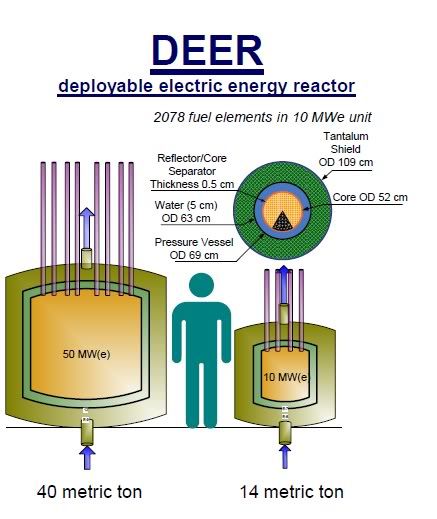
The one on the left runs at 50 megawatts and is a little less than the size of the cab on a semi-trailer truck.
To match that capacity with wind under optimal conditions, you would need seven Enercon E-126 Wind Turbines
the E-126 is formally available as a windturbine with maximal 7.58 MW output. The weight of the foundation of the turbine tower is about 2,500 t, the tower itself 2,800 t, the machine housing 128 t, the generator 220 t, the rotor (including the blade) 364 t. The total weight is about 6,000 t.
That's about 42,000 tons of raw materials to build enough wind capacity to match, under optimal conditions, the output of a 40 ton nuclear reactor . To match the reactors output exactly, including non-optimal days, you would need enough steel to build an aircraft carrier and enough concrete to sink it.
I hope you haven't fled the thread because the input of someone who understands economic realities would be helpful.
but without government intervention the market would generally move towards wind and solar.