• Quick note - the problem with Youtube videos not embedding on the forum appears to have been fixed, thanks to ZiprHead. If you do still see problems let me know.

Black holes

Just because I like to throw in wrenches...

I do hope you realize that you can annihilate a proton with an anti-proton, and also get light.

And you can annihilate a neutron with an anti-neutron, and get light.

So are you suggesting that all particles are standing light waves?
Yes, that's where you end up. Shocking isn't it? But you can diffract neutrons too. And buckyballs.

We've had this before, but I'll say it again. See Is the electron a photon with a toroidal topology? by Williamson and van der Mark, Annales de la Fondation Louis de Broglie, Volume 22, no.2, 133 (1997). Here's a picture from it. Inflate the torus until it's more like a sphere, and note that 4π denotes a sphere. Also see The nature of the electron by Qiu-Hong Hu, which is similar. Then there's Harmonic quintessence and the derivation of the charge and mass of the electron and the proton and quark masses by Andrew Worsley, Physics Essays Jun 2011, Vol. 24, No. 2 pp. 240-253. The latter applies spherical harmonics, usually applied to electron orbitals, to the particles themselves, wherein the electron Compton wavelength is given as λ = 4π / n c^1½ metres, where n is a dimensionality conversion factor with a value of 1. The light is going round at c one way and at half c the other, a bit like a moebius strip, and c dictates the structure. He gives the proton/electron mass ratio r = c^½ / 3π. Both expressions are subject to small binding-energy adjustments, but here's the raw numbers:

4π = 12.566370
c = 299792458
c^½ = 17314.5158177
4π / c^1½ = 12.566370 / (299792458 * 17314.5158177)
λ = 2.420910 x 10ˉ¹² m
Actual = 2.426310 x 10ˉ¹² m

c^½ = 17314.5158177
3π = 9.424778
c^½ / 3π = 17314.5158177 / 9.424778
r = 1837.12717877
Actual = 1836.15267245
 
Last edited:
We've had this before, but I'll say it again. See Is the electron a photon with a toroidal topology? by Williamson and van der Mark, Annales de la Fondation Louis de Broglie, Volume 22, no.2, 133 (1997). Here's a picture from it. Inflate the torus until it's more like a sphere, and note that 4π denotes a sphere. Also see The nature of the electron by Qiu-Hong Hu, which is similar. Then there's Harmonic quintessence and the derivation of the charge and mass of the electron and the proton and quark masses by Andrew Worsley, Physics Essays Jun 2011, Vol. 24, No. 2 pp. 240-253.

Speculative nonsense, pseudo-published in specialized crackpot journals. (Physics Essays is well known, but Annals de la Fondation Louis de Broglie is basically the same thing.)

Farsight, are you utterly unable to tell the difference between beyond-the-mainstream, utterly-unchecked speculation, and actual particle physics? Is there something preventing you from using qualifiers, like "A few isolated authors have speculated ...", rather than pretending that this is all known, or true, or established?

Anyway, your crackpot claims about toroidal-particle-substructure are off-topic in this thread about black holes. I recommend you start a new thread if you want to discuss that.
 
There is no such thing as an electric field! It's the electromagnetic field! For God's sake Vorpal, go and read Minkowski’s Space and Time. Go and look at this bit two pages from the back:
...
Did you catch that? It's the field.
And I say yet again: Take a look at the Lorentz force and it will be obvious:
[latex]\[ \frac{dp^\mu}{d\tau} = qF^\mu{}_\nu u^\nu \][/latex]
In the frame of the particle, it is at rest and only the time component u0 of the four-velocity is nonzero. The electromagnetic tensor is antisymmetric, so it has six independent components, and in particular F00 = 0. As a result, the condition of remaining stationary (i.e., Lorentz force vanishing) means the time-space components F0a = -Fa0 vanish. What is that? The electric field. What are the three components that are missing from this conditions? The magnetic field.

This is EM 101: F = q(E + v×B). If the particle is does not start out moving, then v = 0 and you get no information whatsoever about the magnetic field. This is neatly packaged using an antisymmetric rank-2 tensor, but it doesn't change the fact that you will have both electric and magnetic components to the electromagnetic field. Spacetime doesn't make basic EM go away.

Gravity isn't a force in the usual sense. Forget your constant force, it's a constant acceleration, and escape velocity is the flip side of the speed of an infalling body dropped from "a great distance".
I've talked about the simpler STR case because I know you can't understand geodesic motion and willfully ignore the Rindler coordinate chart. So to elaborate on my previous post:
1) In flat spacetime, a uniformly accelerated observer has a hyperbolic worldline, with speed bounded by the speed of light.
2) A uniform gravitational field must have no tidal forces, and so have flat spacetime. Hence, the uniform gravitational field is flat spacetime in the frame of a uniformly accelerated observer.
3) Hence, as any inertial particle passes the observer, the measured speed will be less than the speed of light, no matter the initial conditions.

When you drop your body into a black hole, it supposedly ends up going at the speed of light.
In what frame? In Schwarzschild coordinates, it does not. The freefalling particle gets asymptotically close to lightspeed in the sense that a sequence of stationary observers will measure it going to lightspeed as those observers get closer to the horizon.

Incidentally, that's just what happens for the uniform gravitational field: there is an acceleration horizon. Because accelerated observers have hyperbolic worldlines and hyperbolas have asymptotes.

It's not a base assertion. If we're all in space where light doesn't curve, Vorpal putting the pedal to the metal doesn't make it curve one iota. Learn to tell the difference between what you see and what's there.
Learn to actually check your assertions mathematically. You're completely wrong throughout, despite the fact that the calculations are pretty trivial.

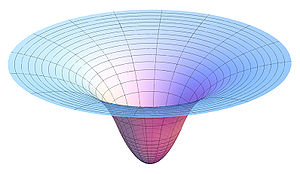
How many more times do I have to tell you about flat hills? Find some plot of gravitational potential like the upturned hat, and just look at it. ...
Are you ever going to actually calculate a geodesic to prove your assertions? Because that's how gravitational freefall works: geodesic motion.
 
1) In flat spacetime, a uniformly accelerated observer has a hyperbolic worldline, with speed bounded by the speed of light.
2) A uniform gravitational field must have no tidal forces, and so have flat spacetime. Hence, the uniform gravitational field is flat spacetime in the frame of a uniformly accelerated observer.

Yep. This reasoning works both ways. Suppose that you found yourself in a sealed box, in which you (and your portable gravimeter) always find yourselves accelerating in the -x direction. Since it's a very large box, you can explore it and look for gradients---you find none. The acceleration vector is of the same magnitude, and pointing in the same direction, no matter where you are.

So, you want to interpret that by guessing what's outside the box? Here are two guesses, both of which are consistent with the in-box spacetime:

a) Flat, empty spacetime, but there's a rocket attached to your box. Perfectly good explanation of the observations.

b) You're sitting still on the surface of a flat slab, infinite in x-y as far as you can tell, of constant areal density. That this matches the observations.

c) You're sitting still a distance r far above the same nearly-infinite slab, which must be large enough (R > r) to avoid inducing gradients. This matches the in-car observations too.

The a-c mapping is where the two intuitions match. A large slab, of radius R, has M = R^2. Therefore for some value of r the slab exceeds M/R = 1 and is a black hole with a horizon. Therefore, the spacetime geometry inside an accelerating car (case a) is exactly the same as the spacetime geometry inside a car hovering over a black hole, with a horizon (case c).
 
Farsight, I'm trying to figure out the practicalities of your idea for gravity, and it just isn't working out.

Since we're replacing the traditional concept of gravity as an attractive force with a new concept of a time light retardant force, I'll call it Farsight Force to distinguish it from standard gravitational force.

I'm assuming that the attraction towards the source of this Farsight Force is directly proportional to the gradient of the Farsight Force (if this isn't the case, please provide details), and this is the source of the problem.

If you take a force diminishing by distance according to the inverse square law, the gradient of that force is diminishing proportional the inverse cube of distance (and damn you for making me do math in order to figure this out :) ).

So the Farsight Force would have to diminish by less than the inverse square law in order for us to perceive gravity as diminishing according to the inverse square law. How is it possible for a force radiating evenly in all directions in three dimensional space to diminish at a rate less than the inverse square law would predict?
 
Last edited:
I'm really not sure you got Vorpal's point. You take a charged particle and place it at rest and it doesn't move. You'd seem to be saying that that demonstrates the absence of any magnetic field, since you're saying that it shows there's no electromagnetic field.
Yes, that's right. If you set down a charged particle in a region of space and it doesn't move, there's no electromagnetic field present. If you set down an uncharged particle in a region of space and it doesn't move, there's no gravitational field present. If you set down a charged particle and an uncharged particle and only the charged particle moves, an electromagnetic field is present. If you set down a charged particle and an uncharged particle and they both move linearly, a gravitational field is present. If you set down a charged particle and it moves rotationally, you might say that a magnetic field is present, but you should always remember that the magnetic field is merely how you see an electromagnetic field when you have motion relative to it. So it's like throwing a charged particle through an electromagnetic field.
 
By Jove Democritus! :jaw-dropp :eye-poppi :eek:

That's it! The TRUE SECRET TO THE UNIVERSE!!!!! :) :D

Atoms are made up of neutrons, protons, and electrons. Each of which, in turn, per Farsight, is a standing wave of light.

A crystal, of an element such as iron, is then also just a bunch of standing waves of light. Molecules are also just mixtures of standing waves of light.
You got it. Hence this physicsworld article:

"The first real-time movie of large molecules creating an interference pattern after passing through two slits has been made by an international team of physicists".
 
You can make it as simple as you like, but it will remain wrong. There simply isn't a direct analog of "gravitational field" in GR, but the closest is the connection, not the curvature. Of course that's meaningless to you, since you have no clue what those words even mean, let alone what the difference is.
Huff puff, sol really doesn't like it when I explain the gravitational field with reference to Einstein. He behaves like a witchdoctor faced with a pharmacist, all outraged, saying "you don't understand it". Tough. I do.

That's false, as Vorpal just tried to explain to you. If the electromagnetic field strength tensor in the rest frame of the particle has zero time-space components, but non-zero space-space components (that's a long-winded way of saying "there's a magnetic field, but zero electric field") then the particle won't move when you set it down.
So you're wrong. Admit it, learn from it, and move on. Can you do that?
I'm not wrong. See Electron magnetic dipole moment. The magnetic field exerts a torque on the electron. It "indeed behaves like a tiny bar magnet". Or a compass needle if you prefer. It moves. And you're wrong again.
 
Speculative nonsense, pseudo-published in specialized crackpot journals. (Physics Essays is well known, but Annals de la Fondation Louis de Broglie is basically the same thing.)

Farsight, are you utterly unable to tell the difference between beyond-the-mainstream, utterly-unchecked speculation, and actual particle physics? Is there something preventing you from using qualifiers, like "A few isolated authors have speculated ...", rather than pretending that this is all known, or true, or established?

Anyway, your crackpot claims about toroidal-particle-substructure are off-topic in this thread about black holes. I recommend you start a new thread if you want to discuss that.
I answered a direct question related to gravity and why things fall down. These people have to settle for back-street journals because of attitudes like yours. You dismiss the patent evidence and you have no counter-argument. Your contribution to this thread is negligible, all you offer is outraged abuse. These aren't crackpot claims, we really can make an electron from light in pair production, it really does have a magnetic dipole moment, we really can diffract it, and atomic orbitals really do feature standing waves. What do you think the electron is made of? Cheese? No, they aren't crackpot claims, but they have been censored by people like you.
 
And I say yet again: Take a look at the Lorentz force and it will be obvious:
[latex]\[ \frac{dp^\mu}{d\tau} = qF^\mu{}_\nu u^\nu \][/latex]
In the frame of the particle, it is at rest and only the time component u0 of the four-velocity is nonzero. The electromagnetic tensor is antisymmetric, so it has six independent components, and in particular F00 = 0. As a result, the condition of remaining stationary (i.e., Lorentz force vanishing) means the time-space components F0a = -Fa0 vanish. What is that? The electric field. What are the three components that are missing from this conditions? The magnetic field.

This is EM 101: F = q(E + v×B). If the particle is does not start out moving, then v = 0 and you get no information whatsoever about the magnetic field.
Electrons behave like little compass needles. You do get information about the magnetic field.

This is neatly packaged using an antisymmetric rank-2 tensor, but it doesn't change the fact that you will have both electric and magnetic components to the electromagnetic field. Spacetime doesn't make basic EM go away.
No motion, no field. The potential is uniform. That doesn't go away. Like I said, the potential is more fundamental than the field.

I've talked about the simpler STR case because I know you can't understand geodesic motion and willfully ignore the Rindler coordinate chart.
I understand geodesic motion, and I don't "wilfully ignore" the Rindler coordinate chart. I just find it irrelevant, a portrayal of what you see when you accelerate. I still don't seem to be able to get this across to you: a light beam doesn't bend just because you stepped on the gas. You just see it as bent. In similar vein rain doesn't slant just because you start running.

So to elaborate on my previous post:
1) In flat spacetime, a uniformly accelerated observer has a hyperbolic worldline, with speed bounded by the speed of light.
Yes, but a gravitational field is curved spacetime, so flat spacetime just isn't relevant.

2) A uniform gravitational field must have no tidal forces, and so have flat spacetime. Hence, the uniform gravitational field is flat spacetime in the frame of a uniformly accelerated observer.
And there is no such thing as a uniform gravitational field! A gravitational field is curved spacetime, so what you're proposing is a contradiction in terms. No wonder you end up with impossible nonsense scenarios like the sky falling in around a black hole and neverneverland descriptions of the infalling observer. Come on Vorpal, work it out. If you accelerate at 9.8m/s/s and keep on accelerating at a uniform 9.8 m/s/s you end up exceeding the speed of light, and you've contradicted special relativity.

3) Hence, as any inertial particle passes the observer, the measured speed will be less than the speed of light, no matter the initial conditions.
An accelerating observer always measures that speed as less than the speed of light. And he always measures the speed of light to be the same. Now go and read The Other Meaning of Special Relativity and understand why. When you're made of waves along with everything else, you always measure wave speed to be the same. And nothing made from waves can exceed that speed.

In what frame? In Schwarzschild coordinates, it does not. The freefalling particle gets asymptotically close to lightspeed in the sense that a sequence of stationary observers will measure it going to lightspeed as those observers get closer to the horizon.
In my frame. If you keep on accelerating at a uniform 9.8m/s/s whilst traversing the starry sky, I end up seeing you going from one star to another faster than light can go.

Incidentally, that's just what happens for the uniform gravitational field: there is an acceleration horizon. Because accelerated observers have hyperbolic worldlines and hyperbolas have asymptotes.
Aaaagh! There is no uniform gravitational field. You end up accelerating a falling body less than you accelerate a body that you placed at some elevation. If it's 9.8 m/s/s, that's what it is for all bodies.

Learn to actually check your assertions mathematically. You're completely wrong throughout, despite the fact that the calculations are pretty trivial.
I'm not wrong. You've used mathematics to confuse a constant force and a constant change of speed. When you're already moving at 299,792,457 m/s, a second later you're moving at 299,792,466.8 m/s. It isn't going to happen.

Are you ever going to actually calculate a geodesic to prove your assertions? Because that's how gravitational freefall works: geodesic motion.
No. Because that isn't how it works. I told you how it works. Get used to it. It isn't in your textbooks yet, but it will be.
 
Farsight, I'm trying to figure out the practicalities of your idea for gravity, and it just isn't working out.

Since we're replacing the traditional concept of gravity as an attractive force with a new concept of a time light retardant force, I'll call it Farsight Force to distinguish it from standard gravitational force.
Don't think of it as a force, the Newtonian F=ma and E=F x d doesn't apply because conservation of energy applies instead. Just think of it as inhomogeneous space that causes light to bend as per gravitational lensing. Take your cue for that from Einstein's Leyden address:

"This space-time variability of the reciprocal relations of the standards of space and time, or, perhaps, the recognition of the fact that “empty space” in its physical relation is neither homogeneous nor isotropic, compelling us to describe its state by ten functions (the gravitation potentials gμν), has, I think, finally disposed of the view that space is physically empty".

I'm assuming that the attraction towards the source of this Farsight Force is directly proportional to the gradient of the Farsight Force (if this isn't the case, please provide details), and this is the source of the problem.
No, the "force" of attraction is directly proportional to the gradient in the potential.

If you take a force diminishing by distance according to the inverse square law, the gradient of that force is diminishing proportional the inverse cube of distance (and damn you for making me do math in order to figure this out :) ).
No no, it's the gradient in the potential. You measure the speed of light at different floors in your very very tall building, and then draw a graph to plot the potential. It's a curve that starts out with a steep gradient which gradually gets shallower with altitude. Where the gradient in the potential is steeper, the force is greater.

So the Farsight Force would have to diminish by less than the inverse square law in order for us to perceive gravity as diminishing according to the inverse square law. How is it possible for a force radiating evenly in all directions in three dimensional space to diminish at a rate less than the inverse square law would predict?
You need to start again with this I'm afraid Brian.
 
Yes, that's right. If you set down a charged particle in a region of space and it doesn't move, there's no electromagnetic field present. If you set down an uncharged particle in a region of space and it doesn't move, there's no gravitational field present. If you set down a charged particle and an uncharged particle and only the charged particle moves, an electromagnetic field is present. If you set down a charged particle and an uncharged particle and they both move linearly, a gravitational field is present. If you set down a charged particle and it moves rotationally, you might say that a magnetic field is present, but you should always remember that the magnetic field is merely how you see an electromagnetic field when you have motion relative to it. So it's like throwing a charged particle through an electromagnetic field.

Oh my.
 
Farsight versus Einstein, part 1

Once again, Farsight has stated an important difference between FGR (Farsight general relativity) and the general theory of relativity put forth by Einstein:

When spacetime is flat, no gravitational field is present.

When spacetime is flat, no gravitational field is present.

You can make it as simple as you like, but it will remain wrong. There simply isn't a direct analog of "gravitational field" in GR, but the closest is the connection, not the curvature. Of course that's meaningless to you, since you have no clue what those words even mean, let alone what the difference is.
Huff puff, sol really doesn't like it when I explain the gravitational field with reference to Einstein. He behaves like a witchdoctor faced with a pharmacist, all outraged, saying "you don't understand it". Tough. I do.


Farsight can huff and puff all he likes, but he's arguing with Einstein here. From the English translation of "The Foundation of the General Theory of Relativity":

Albert Einstein said:
C. THEORY OF THE GRAVITATIONAL FIELD​

§ 13. Equations of Motion of a Material Point in the Gravitational Field. Expression for the Field-components of Gravitation

A freely movable body not subjected to external forces moves, according to the special theory of relativity, in a straight line and uniformly. This is also the case, according to the general theory of relativity, for a part of four-dimensional space in which the system of co-ordinates K0, may be, and is, so chosen that they have the special constant values given in (4).


Einstein's formula (4) is the 4x4 matrix of coefficients for the Minkowski metric in the familiar coordinate system for flat spacetime. Einstein continues by talking about the gravitational field that appears when you use a different coordinate system to describe exactly the same locally flat spacetime:

Albert Einstein said:
If we consider precisely this movement from any chosen system of co-ordinates K1, the body, observed from K1, moves, according to the considerations in § 2, in a gravitational field....

If the Γτμν vanish, then the point moves uniformly in a straight line. These quantities therefore condition the deviation of the motion from uniformity. They are the components of the gravitational field.


According to Einstein, therefore, the 64 coordinate-dependent Christoffel symbols "are the components of the gravitational field". (Because the Christoffel symbols are symmetric in their lower indices, not all of those components are independent.)

Let's do an example. As this example shows, Einstein's "components of the gravitational field" can be nonzero even in flat spacetime, contrary to Farsight's repeated baseless assertions.

Let's use the metric form posted by sol invictus. In that coordinate system, the four nonzero components of the covariant metric tensor are

[latex]
\[
\begin{align*}
g_{00} &= - (x^1 - r_0) \\
g_{11} &= \frac{1}{x^1 - r_0} \\
g_{22} &= 1 \\
g_{33} &= 1
\end{align*}
\]
[/latex]​

(I'm using MTW notational conventions, and I'm writing the r coordinate as x1 to prepare for the index and Einstein summation notations used below.)

To calculate the 64 components of the gravitational field, we'll need the components of the contravariant form as well:

[latex]
\[
\begin{align*}
g^{00} &= - \frac{1}{(x^1 - r_0)} \\
g^{11} &= (x^1 - r_0) \\
g^{22} &= 1 \\
g^{33} &= 1
\end{align*}
\]
[/latex]​

Einstein's equation (45) states his formula for the components of the gravitational field. Expanding Einstein's notation into modern notation, Einstein's equation becomes

[latex]
\[
\begin{align*}
\Gamma^\lambda_{\mu\nu}
&= \frac{1}{2} g^{\lambda\alpha} \left(
\partial_{\nu} g_{\alpha\mu}
+ \partial_{\mu} g_{\alpha\nu}
- \partial_{\alpha} g_{\mu\nu} \right)
\end{align*}
\]
[/latex]​

If I've done that calculation correctly, only 4 of the 64 Christoffel symbols are nonzero:

[latex]
\[
\begin{align*}
\Gamma^0_{01} &= \Gamma^0_{10} = \frac{1}{2 (x^1 - r_0)} \\
\Gamma^1_{00} &= \frac{1}{2} (x^1 - r_0) \\
\Gamma^1_{11} &= - \frac{1}{2 (x^1 - r_0)}
\end{align*}
\]
[/latex]​

With those Christoffel symbols in hand, it's straightforwardly tedious to calculate the 256 components of the Riemann curvature tensor via Einstein's equation (43). In modern notation, that equation becomes

[latex]
\[
\begin{align*}
R^{\alpha}_{\beta\gamma\delta} &=
\partial_{\gamma} \Gamma^{\alpha}_{\beta\delta}
- \partial_{\delta} \Gamma^{\alpha}_{\beta\gamma}
+ \Gamma^{\alpha}_{\kappa\gamma}
\Gamma^{\kappa}_{\beta\delta}
- \Gamma^{\alpha}_{\kappa\delta}
\Gamma^{\kappa}_{\beta\gamma}
\end{align*}
\]
[/latex]​

That calculation is greatly simplified by the following observations. As can be seen from the Christoffel symbols calculated above, the partial derivatives of the first two terms are zero unless the subscript on the derivative operator is 1. Similarly, every component of the Riemann tensor that has a 2 or a 3 as an index will be zero; that observation reduces the number of components from 256 to 16, even before we take advantage of symmetries.

I calculated the components of the Riemann tensor by hand, and found all of its 256 components are zero.

That means sol invictus has indeed given us an example of flat spacetime (because the Riemann curvature tensor is zero) that has a nonzero gravitational field (because four of the Christoffel symbols, which Einstein regards as the components of the gravitational field, are nonzero).

In his response to sol invictus, quoted above, Farsight said he understands all this stuff. That's great. I invite Farsight to check my calculations.

The bottom line is that Einstein disagreed with Farsight's repeated bare assertion that flat spacetime implies a zero gravitational field.

 
Last edited:
Don't think of it as a force, the Newtonian F=ma and E=F x d doesn't apply because conservation of energy applies instead. Just think of it as inhomogeneous space that causes light to bend as per gravitational lensing. Take your cue for that from Einstein's Leyden address:

Force, potential, curvature of space, whatever. It's irrelevant to the point. If it's effect is evenly distributed and omnidirectional in three dimensional space, and it diminishes at less than the inverse square law, then this means that the total effect of this force is increasing over distance (even if the localized effect is decreasing with distance because the effect is spread over a larger area).

And the total effect of the force increasing with distance is what doesn't make any sense.

No, the "force" of attraction is directly proportional to the gradient in the potential.

Wait, you disagree with me then you basically repeat what I just said? By Farsight Force I'm referring to this potential you mention.

No no, it's the gradient in the potential. You measure the speed of light at different floors in your very very tall building, and then draw a graph to plot the potential. It's a curve that starts out with a steep gradient which gradually gets shallower with altitude. Where the gradient in the potential is steeper, the force is greater.

But that's what I'm talking about. I figured it out by making up an example of objects experiencing different gravitational forces experienced at points different distances from a large mass, and then estimated the local gradient of this "potential" over a distance of a meter by taking the gravitational force half a meter closer to the mass from the point and subtracting the gravitational force thats half a meter further away.

I found that where gravitational force diminishes with the inverse square law, the gravitational gradient diminishes according to the the inverse cubed law. (This is the math I referred to in my previous post.) From this I must conclude that any force (or potential, or whatever) which diminishes according to the inverse square law must have a gradient which diminishes according to the inverse cubed law.

So if the experienced (or directly measured) force of gravity is directly proportional to the gradient of this potential, and this potential diminishes with distance according to the inverse square law, then we should be measuring gravity as diminishing according to the inverse cubed law... but we don't!

For us to experience or measure gravity as diminishing with the inverse square law, then the potential (whose gradient produces what we experience as gravity) must be diminishing at less than the inverse square law.

And that doesn't make any sense.

You need to start again with this I'm afraid Brian.

Where is my understanding of your physics flawed? The way I'm reading this you're disagreeing with me, but your corrections are the exact same thing I'm talking about, only worded slightly differently.
 
Last edited:
Force, potential, curvature of space, whatever. It's irrelevant to the point. If it's effect is evenly distributed and omnidirectional in three dimensional space, and it diminishes at less than the inverse square law, then this means that the total effect of this force is increasing over distance (even if the localized effect is decreasing with distance because the effect is spread over a larger area).
No. The effect diminishes with distance in line with the inverse square law, and the total effect tends to a limit.

And the total effect of the force increasing with distance is what doesn't make any sense.
That's what I've been trying to say to Vorpal about his uniform gravitational field.

Wait, you disagree with me then you basically repeat what I just said? By Farsight Force I'm referring to this potential you mention.
Don't. The force of gravity at some location is a measure of the gradient in the potential at that location. Look at the upturned hat again. The gradient reduces with distance.

But that's what I'm talking about. I figured it out by making up an example of objects experiencing different gravitational forces experienced at points different distances from a large mass, and then estimated the local gradient of this "potential" over a distance of a meter by subtracting the gravitational force half a meter further away from the gravitational force half a meter closer.
That's wrong. The force of gravity at some location tells you the local gradient at that location. The difference between the force of gravity at one location and another tells you how the gradient changes. That's the tidal force.

I found that where gravitational force diminishes with the inverse square law, the gravitational gradient diminishes according to the the inverse cubed law.
No. The force of gravity diminishes with the inverse law, and the gradient in gravitational potential diminishes with the inverse square law.

(This is the math I referred to in my previous post.) From this I must conclude that any force (or potential, or whatever) which diminishes according to the inverse square law must have a gradient which diminishes according to the inverse cubed law.
The force of gravity is only there because there's a gradient in the gravitational potential. Where there's no gradient, light goes straight and things don't fall down.

So if the experienced (or directly measured) force of gravity is directly proportional to the gradient of this potential, and this potential diminishes with distance according to the inverse square law, then we should be measuring gravity as diminishing according to the inverse cubed law... but we don't!
The force of gravity is there because of the gradient of the potential. Both diminish according to the inverse square law.

For us to experience or measure gravity as diminishing with the inverse square law, then the potential (whose gradient produces what we experience as gravity) must be diminishing at less than the inverse square law.
Look at the upturned hat to see how the potential varies. Invert it if you wish.

Where is my understanding of your physics flawed? The way I'm reading this you're disagreeing with me, but your corrections are the exact same thing I'm talking about, only worded slightly differently.
You're getting the gradient in the potential and the potential mixed up, and thinking that things are more complicated than they are. Look, here's the upturned hat. It's a plot of gravitational potential. Where the gradient is steep, the force of gravity at that location is high. It diminishes with distance from the centre. The potential increases with distance from the centre, but doesn't keep on increasing ad infinitum, it tends to a limit like a curve tending up to a horizontal line.

300px-GravityPotential.jpg

CCASA image by AllenMc see wikipedia
 
Huff puff, sol really doesn't like it when I explain the gravitational field with reference to Einstein.

Except that you're lying about Einstein. Einstein directly and explicitly contradicts you, as Clinger's quote shows.

He behaves like a witchdoctor faced with a pharmacist, all outraged, saying "you don't understand it". Tough. I do.

Why is it that your posts are always full of such bizarre fantasies? No one else needs to resort to such delusions - why you, Farsight?

I'm not wrong. See Electron magnetic dipole moment. The magnetic field exerts a torque on the electron. It "indeed behaves like a tiny bar magnet". Or a compass needle if you prefer. It moves. And you're wrong again.

No, Farsight - you're wrong. Your statement was a general unqualified assertion about charged particles, and it was false. As for electrons (or anything else with a mdm) - in a uniform magnetic field they do not move. Their quantum spin might or might not precess (depending on the initial quantum state and the orientation of the field), but they don't change position. Even in a non-uniform field they may or may not move, again depending on the state and the orientation of the field.
 
I'm not lying about Einstein, I'm quoting him. And I'm the one shattering the bizarre fantasies here, like the waterfall and neverneverland and the uniform gravitational field. The change in spin orientation is a movement, just as it is in the hyperfine transition where a photon is emitted. Go look up ferromagnetism and the Einstein-de Haas effect:

"The effect corresponds to the mechanical rotation that is induced in a ferromagnetic material (of cylindrical shape and originally at rest), suspended with the aid of a thin string inside a coil, on driving an impulse of electric current through the coil.[1] To this mechanical rotation of the ferromagnetic material (say, iron) is associated a mechanical angular momentum, which, by the law of conservation of angular momentum, must be compensated by an equally large and oppositely directed angular momentum inside the ferromagnetic material. Given the fact that an external magnetic field, here generated by driving electric current through the coil, leads to magnetisation of electron spins in the material (or to reversal of electron spins in an already magnetised ferromagnet — provided that the direction of the applied electric current is appropriately chosen), the Einstein–de Haas effect demonstrates that spin angular momentum is indeed of the same nature as the angular momentum of rotating bodies as conceived in classical mechanics. This is remarkable, since electron spin, being quantized, cannot be described within the framework of classical mechanics".

It isn't quantum magic. It's just movement. And as it happens electron spin can be described within the framework of classical mechanics, as a biaxial rotation where one rate is half the other. However when people do this they are met with opprobium and abuse and censorship by those who peddle surpasseth-all-human-understanding mysticism.
 
...Let's use the metric form posted by sol invictus. In that coordinate system, the four nonzero components of the covariant metric tensor are

[latex]
\[
\begin{align*}
g_{00} &= - (x^1 - r_0) \\
g_{11} &= \frac{1}{x^1 - r_0} \\
g_{22} &= 1 \\
g_{33} &= 1
\end{align*}
\]
[/latex]​
You lost me, and everybody else. What does sol's metric represent again? All I've managed to squeeze out of him is "flat spacetime", and more recently "constant proper acceleration". You can't make a gravitational field by zooming through space, Clinger. Things don't fall down as you pass by. Look, go back to what Einstein said and think it through then contribute sensibly to the discussion instead of hiding behind mathematics. Remember this:

"This space-time variability of the reciprocal relations of the standards of space and time, or, perhaps, the recognition of the fact that “empty space” in its physical relation is neither homogeneous nor isotropic, compelling us to describe its state by ten functions (the gravitation potentials gμν), has, I think, finally disposed of the view that space is physically empty".

Do you get it yet? Space isn't nothing. And you don't change space by moving through it.
 

Back
Top Bottom