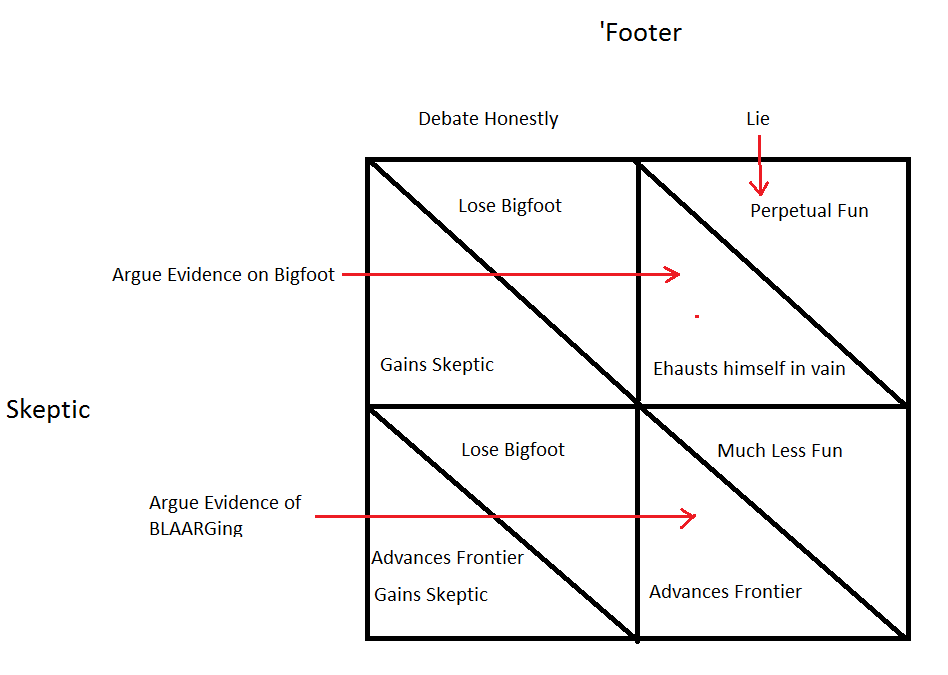
We have some decisions to make about terminology and it should eventually become a sticky, but let me illustrate how we did game theory in mathematics.
For a game, all you need is players, rules, sets of strategies and tactics, and outcomes or "payoffs". We have thus far taken on the layman's idea of "gaming", where someone gaming another party is tricking them. That isn't how the mathematicians view it. All players are in the game.
This is how the mathematicians would model a simple two-player game between a skeptic and a 'footer:
In this illustration we have given the 'footer two options: Debate honestly or lie. The Skeptic has been given one choice of arguing using science principles, but only regarding the existence of bigfoot. His second option is to use science, but with the additional knowledge of Live Action Alternate Reality Gaming.
The outcomes are in the four boxes, with the upper right of each box being the outcome to the 'footer and the lower left the outcome to the skeptic. The intersection of the column chosen by the 'footer and the row chosen by the skeptic tells us the relevant pay-off box. If the 'footer argues honestly then he loses bigfoot regardless of how the skeptic approaches things. Science prevails. The skeptic produces another skeptic out of a 'footer if all he does is argue the evidence for bigfoot. But there is an additional pay-off to the skeptic in arguing from the knowledge of Alternate Reality Gaming: he advances the frontier of science knowledge, demonstrating how it applies to the bigfoot arena. It solves an important mystery: how people can be so blind to overwhelming evidence.
All you have to do is look at it from the 'footer's perspective: the only way to keep bigfoot alive is to lie. They have no choice. BLAARGing means keeping bigfoot alive.
If the 'footer takes that lying approach, and the skeptic argues the evidence, then the BLAARGer has fun perpetually not just because he gets to keep bigfoot, but he toys with the stupid skeptic who is exhausting himself in vain. The literature regarding people who use all of these deceptive tactics tells us what motivates them is the sheer joy of manipulating other people, especially those you resent. A 6th grade educated BLAARGer can have a PhD scientist on his knees begging them to be reasonable or running off fact-checking every stupid canard the 'footer uses when the 'footer knows it is a lie to begin with. It is called Duper's Delight.
If the 'footer lies (BLAARGs) and the skeptic argues from science, but with the knowledge of Live Action Role Playing, then he will still never convert the 'Footer. But he does advance the frontier of science - how Live Action Role Playing applies to bigfoot. The 'footer loses something important to him and makes the game less fun. Anytime you are deceiving people and they become wise to you, it ruins Duper's Delight.
I did this to illustrate the difference between how the mathematicians approach this vs. what we are doing. I think if we proceed as most seem to want, we should call the over-all game the Bigfoot Game. Then you have the 'footers and faux skeptics BLAARGing and skeptics who are playing the bigfoot game too, but acting from science principles. Skeptics don't BLAARG as a general rule until some conflict of interest arises like opening up a consulting business to woo-peddlers or when they have a pet theory they want to push in favor of another, and then they start acting just like a 'footer on that particular subject matter.