
Bjarne on: Dark Energy, only an illusion.

Status
Not open for further replies.
"There are a few other ways that a photon can lose energy during its trip to us from a distant star. If the photon encounters an atom along its path, that atom could absorb it and then re-emit the photon at a lower energy. A photon could also encounter a particle and be scattered and in the process lose some of its energy to the particle. However, since the universe is mostly vast, open space, these events usually don't stop a star's light from reaching us." -- http://curious.astro.cornell.edu/question.php?number=680

Yes. Ergo: Exit your idea of photons loosing speed to vacuum energy, or whatever.

Hans
 
If I have understood it correctly, photons will change their direction when losing energy by hitting other particles. Could it be that photons hitting virtual particles in empty space occasionally lose tiny amounts of energy? And then their direction will change slightly.

Would that explain the different redshift for different frequencies? Yes, since the light from say a star radiates out in all directions and while photons heading towards Earth will be knocked off their course, other photons will be knocked in the direction towards Earth, so that overall it averages out and about an equal amount of photons will still hit Earth.

And the increase between spectral lines with increased redshift is explained by photons with lower frequencies having lower momentum than photons with higher frequencies and therefore lose energy faster.
 
The increasing distances between the spectral lines in the diagram are still puzzling. Sweeping them under the carpet doesn't solve it.

It is perhaps puzzling, but I suggest you leave it to qualified people to sort it out. Dreaming up ad hoc hypotheses will never help any.

Hans
 
If I have understood it correctly, photons will change their direction when losing energy by hitting other particles.

No, they will be absorbed, and a new photon will be emitted, possibly in a different direction.

Could it be that photons hitting virtual particles in empty space occasionally lose tiny amounts of energy? And then their direction will change slightly.

Virtual particles? What is virtual particles?? Some photons hit real particles, even in empty space, and are basically lost.
Would that explain the different redshift for different frequencies? Yes, since the light from say a star radiates out in all directions and while photons heading towards Earth will be knocked off their course, other photons will be knocked in the direction towards Earth, so that overall it averages out and about an equal amount of photons will still hit Earth.

No. If they reach us from another direction, they would appear to come from a different place.

And the increase between spectral lines with increased redshift is explained by photons with lower frequencies having lower momentum than photons with higher frequencies and therefore lose energy faster.

Tell me, Anders: Which of the words in "photons do not loose energy, they are either absorbed or not" do you not understand?

The photon is a quantum particle. You can't split it or reduce it.

Hans
 
No, they will be absorbed, and a new photon will be emitted, possibly in a different direction.


Virtual particles? What is virtual particles?? Some photons hit real particles, even in empty space, and are basically lost.


No. If they reach us from another direction, they would appear to come from a different place.


Tell me, Anders: Which of the words in "photons do not loose energy, they are either absorbed or not" do you not understand?

The photon is a quantum particle. You can't split it or reduce it.

Hans

But what about the quote I posted above: "A photon could also encounter a particle and be scattered and in the process lose some of its energy to the particle." -- http://curious.astro.cornell.edu/question.php?number=680

The photons would not reach us from another direction. I'm too lazy to draw a picture of it :D but imagine a photon sent from a star towards Earth but at an angle so that it slightly misses the Earth, and then the photon is knocked slightly so that its new direction hits Earth exactly. Do you get the picture?

Virtual particles are basically a result of quantum uncertainty and are not really particles, but they do have real physical effects.
 
The photons would not reach us from another direction. I'm too lazy to draw a picture of it :D but imagine a photon sent from a star towards Earth but at an angle so that it slightly misses the Earth, and then the photon is knocked slightly so that its new direction hits Earth exactly. Do you get the picture?
Why do I get the picture of a soccer ball streaking past you, hitting the wall behind you, and bouncing on the back of your head?
 
Why do I get the picture of a soccer ball streaking past you, hitting the wall behind you, and bouncing on the back of your head?

Sounds like I may have to make a drawing of it after all. :D Well, maybe not. Let me try again: As an example a photon is traveling in a straight line at an angle of 0.00001 degrees to the left of the target, and after half the way to its target it gets knocked 0.00001 degrees to the right. The result is that the photon will hit the target dead on even though it started with an angle that would have made it miss the target slightly.
 
Sounds like I may have to make a drawing of it after all. :D Well, maybe not. Let me try again: As an example a photon is traveling in a straight line at an angle of 0.00001 degrees to the left of the target, and after half the way to its target it gets knocked 0.00001 degrees to the right. The result is that the photon will hit the target dead on even though it started with an angle that would have made it miss the target slightly.

No. Already answered.

No, they will be absorbed, and a new photon will be emitted, possibly in a different direction.
Hans
 
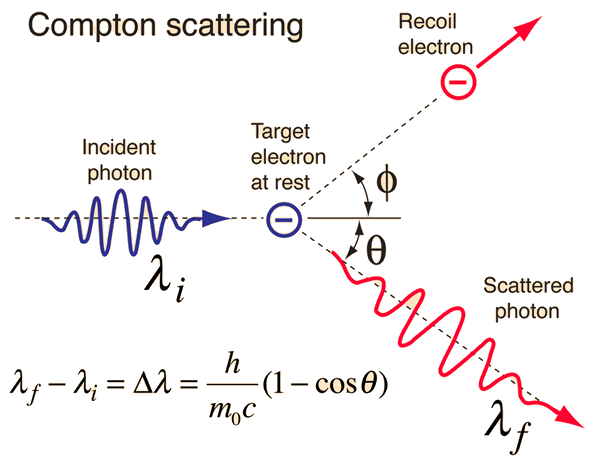
Sounds like you're talking about Compton scattering:

compton.gif

http://hyperphysics.phy-astr.gsu.edu/hbase/quantum/comptint.html

But honestly, the expansion of the universe is good science. My particular interest is relativity and fundamental physics, and from that I deduce that the universe just has to expand. It's like space has an innate stress-energy and since stress is directional pressure, space has a "pressure" to it. With no space beyond the universe, space expands rather like a stress-ball when you open your fist.
 
Sounds like you're talking about Compton scattering:

[qimg]http://hyperphysics.phy-astr.gsu.edu/hbase/quantum/imgqua/compton.gif[/qimg]
http://hyperphysics.phy-astr.gsu.edu/hbase/quantum/comptint.html

But honestly, the expansion of the universe is good science. My particular interest is relativity and fundamental physics, and from that I deduce that the universe just has to expand. It's like space has an innate stress-energy and since stress is directional pressure, space has a "pressure" to it. With no space beyond the universe, space expands rather like a stress-ball when you open your fist.

Yes! That looks exactly what I had in mind and that's probably what the quote I posted was about where it was mentioned that photons can lose some of their energy.
 
But honestly, the expansion of the universe is good science.

I think the Big Bang theory could be fairly correct. What I'm suspicious about is the accelerating expansion of the universe. I believe the universe expanded very quickly after the Big Bang and then the expansion slowed down and that today there is only very little expansion. And there will not be any big crunch. The universe will stay inflated by the dark energy which is the same thing as the vacuum energy.
 
Sounds like I may have to make a drawing of it after all. :D Well, maybe not. Let me try again: As an example a photon is traveling in a straight line at an angle of 0.00001 degrees to the left of the target, and after half the way to its target it gets knocked 0.00001 degrees to the right. The result is that the photon will hit the target dead on even though it started with an angle that would have made it miss the target slightly.

I really think you should make that drawing.

You will likely* find that the photon in question hits the target from a different direction, like 0.00001 degrees different.

The sun in question will then appear to be 0.00001 degree out of position.

*Depending on your drawing skills.
 
On a second thought, the photon scattering would only work for point-like objects like stars. For objects with a certain size the scattering would heavily distort the image.

Therefore my guess is that the vacuum energy simply causes friction for photons so that they lose energy (without changing their direction) and thereby redshift when traveling vast distances.

ETA: And even for stars the scattering would blur the image.
 
Last edited:
What I propose is similar to the so-called tired light models: http://en.wikipedia.org/wiki/Tired_light

The difference is that what I propose is an expanding universe PLUS vacuum energy friction for photons. So basically, the friction only serves to remove the need for an EXTRA type of dark energy causing acceleration of the expansion. In all other ways the proposal is the same as the standard Big Bang model.
 
Yes! That looks exactly what I had in mind and that's probably what the quote I posted was about where it was mentioned that photons can lose some of their energy.
They certainly can. But there's very few particles in space. If there was much scattering going on, space wouldn't look black. Check out Rayleigh scattering for this.

I think the Big Bang theory could be fairly correct. What I'm suspicious about is the accelerating expansion of the universe.
Don't be. The evidence for this from the High-z Supernova Search Team came as a real shock. Just write down a series of numbers like this: 1 4 9 16 25 36 49 to represent an expanding universe. Note that the increase between successive terms gets bigger and bigger. Then look at the increase as a percentage of the preceding term. It's getting smaller and smaller.

I believe the universe expanded very quickly after the Big Bang and then the expansion slowed down and that today there is only very little expansion. And there will not be any big crunch. The universe will stay inflated by the dark energy which is the same thing as the vacuum energy.
See above re the number sequence. I don't think there'll be any big crunch either - gravity doesn't pull space back in on itself, it affects the motion of things through space, that's all. And there is only very little expansion. It's not as if galaxies we could see last year now look half the size they did.

What I propose is similar to the so-called tired light models.
I don't think you should, Anders. I'm pretty sure space really is like that stress-ball.
 
But what about the quote I posted above: "A photon could also encounter a particle and be scattered and in the process lose some of its energy to the particle." -- http://curious.astro.cornell.edu/question.php?number=680

The photons would not reach us from another direction. I'm too lazy to draw a picture of it :D but imagine a photon sent from a star towards Earth but at an angle so that it slightly misses the Earth, and then the photon is knocked slightly so that its new direction hits Earth exactly. Do you get the picture?

Virtual particles are basically a result of quantum uncertainty and are not really particles, but they do have real physical effects.

No, that link just says the same as I do. No, if photons reach us from a different direction, they will seem to come from a different source.

Hans
 
Status
Not open for further replies.

ISF - Join now!

Every member here is approved by hand. No bots, no spam, just people who care about evidence and honest debate.

Membership is free!

Create your free account

Back
Top Bottom