Bigfoot - The Patterson-Gimlin Film

Status
Not open for further replies.
You don't get it, Huntster. Patterson hoaxed the PGF and subsequent hoaxing has occured even beyond the actual filming of "the bloke in a suit" at Bluff Creek, CA in 1967.

It has not been demonstrated that Patterson hoaxed anything.

What subsequent hoaxing at Bluff Creek are you referring to?

Lu, I wasn't speaking of subsequent hoaxing at the location of Bluff Creek, but I still could.

When Patterson (with Gimlin) finally left Bluff Creek at about 4:00 a.m., October 21, 1967, he took the camera and film with him. But he had already filmed Heironimus in the costume weeks prior to this at Bluff Creek. The film that he took out on October 21 was only of the fake trackway that he created on the 20th. This is what is being called "The 2nd Roll". Anyway, my point was that subsequent manipulation and modification of the PGF has happened after Patterson was at Bluff Creek.

The Dahinden Cibachrome with the artist-added hand, is one example of how Bigfoot hoaxery is trying to get the world to think that Bigfoot is really an existing wild animal. That modification was made after Patterson was at Bluff Creek.
 
You may be alone in your erroneous assumptions. Krantz knew the circumstances. He just didn't mention the names in the interview. He specifically mentions meeting Marx and Dahinden (pg. 43, Bigfoot/Sasquatch Evidence), which you might have known if you'd read Krantz.

In his book, Krantz relies heavily on information or casts provided by either Marx or Freeman. Most in bigfootdom consider those two information sources highly dubious.

"It was Cripplefoot that convinced him. In the late fall of 1969, Rene Dahinden, John Green, and other Bigfoot hunters descended on Bossburg, Washington, an old mining town on the Columbia River about 15 miles south of the Canadian border. Locals had reported a Sasquatch leaving unusual prints just outside the city limits. Krantz drove out to Bossburg a skeptic. "I gave Sasquatch only a 10 percent chance of being real," he told me. After retracing the tracks at the site, the professor brought a cast pair back to his lab. The 17-inch left foot appeared normal, but the right foot curved like a C and displayed enormous bunions and splayed toes.

I just hope the inclusion of "After retracing the tracks at the site, the professor brought a cast pair back to his lab", is merely an error in reporting and not a deliberate attempt to mislead. I say that because Krantz himself states on page 43 of Big Footprints, "All except the one covered footprint were gone when I examined the site."

He also says on page 43, "And here I obtained copies of the footprint casts that finally convinced me that the creatures were real."

The paragraph you cite implies that Krantz cast tracks and brought them back, when in fact he brought back copies of the other Bossburg tracks. He couldn't possibly have retraced the tracks at the site, because there was only one track left.

Applying what he knew about primate feet, the dynamics of weight distribution, leverage, and load arms, Krantz calculated the necessary position of an 800-pound ape's ankle, heel, and toe base, and compared that to the measurements of the track. "They were right on," he said. "Nobody could have faked that."

Claiming you can determine ankle structure based on a copy of a cast of a footprint seems quite arrogant. But that's not really surprising, considering Krantz thought himself the equivalent of Leonardo da Vinci.

This is what Krantz said in an interview with KXLY-TV reporter John Yager in 1992, "If someone faked [these footprints] with all the subtle hints of anatomy design, he had to be a real genius, an expert at anatomy, very inventive, an original thinker. He had to outclass me in those areas, and I don't think anyone outclasses me in those areas, at least not since Leonardo da Vinci. So I say such a person is impossible, therefore the tracks are real."

Krantz seemed pretty convinced that he couldn't be fooled by anyone. He writes, "I figured the whole thing out after studying the footprints; any hoaxer had to plan it all out from nothing. This requires an expert anatomist with a very inventive mind, more so than me, and I seriously doubt that any such person exists." (Big Footprints, page 63)

Soooo... the reasoning being... I can't be fooled, so it must be true? Magicians musta hated it when he came to their shows.

Here's a VERY interesting article in the Fall 1994 issue of Skeptical Inquirer regarding Krantz and the Bossburg prints.

http://www.findarticles.com/p/articles/mi_m2843/is_n5_v18/ai_16334418

I'm guessing you will probably dismiss the article entirely because it was written by Dennett, but you really should read it anyway.

RayG
 
...snip...The Dahinden Cibachrome with the artist-added hand, is one example of how Bigfoot hoaxery is trying to get the world to think that Bigfoot is really an existing wild animal. That modification was made after Patterson was at Bluff Creek.

Hoaxery may not be the most correct term. I think many footers think they are doing the right thing and using what they consider to be the correct methodology. So, they think they can see flashing teeth, hands, poop, whatever, and then use excessive zooming coupled with (mis)interpretation to add the "details" they "see".

But they are just being... Well, use the term you want, as long as it is nowhere close to "accurate", "impartial", etc.
 
Because if it was doctored by Patterson, it would prove that the film was faked.

There doesn't seem to be any good way to determine if Patterson was the primary "doctor" of the PGF. It obviously was his baby, but he may have recruited help in various capacities. When one examines the PGF as a hoax, it is rather obvious that Gimlin was a working cohort. But it is not clear who drew the hand on the Dahinden Cibachrome. Virtually all biographies and recollections of Roger Patterson describe him as a very artistic and capable craftsman in a range of endeavors. He is also described as a shifty trickster and manipulator of people.
 
Because if it was doctored by Patterson, it would prove that the film was faked.


No it wouldn't. It would just mean it was doctored. There is no question that we are looking at a real film ( I hope that doesn't confuse you ). The finger doesn't show up in the film ..The question is about the motive for doctoring still/s printed from the film..

If it was doctored by a skeptic, it would would not.


You might need to clarify this last sentence.. It doesn't make sense..
 
Uh...

Wait... A "detail" that needs to be highlighted:

Based on handprints, Krantz concluded that bigfeet has hands without opposing thumbs.

So, its either an unknown giant hominid or a Gigantopithecus... But its hands do not have opposing thumbs!!!!

I will write again: its hands do not have opposing thumbs!!!!

Oh, I see, we do not know for sure how Gigantopithecus hands actually were...
 
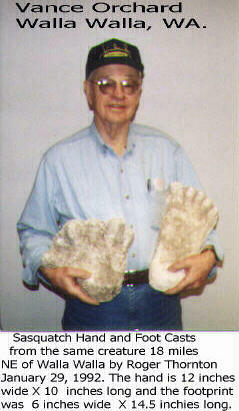
Here are plaster castings of Bigfoot's hand and foot. You decide if it has an opposite thumb, or not.

0_VanceOrchard.jpg


"As I got there and saw him," Jack the Logger said, " I stopped my truck and shut off the motor. He was standing there in a heavy, tufted grassy area, just standing and looking at me. We both eyeballed each other real good.

"Pretty soon … I was close enough I could see his facial expressions … he didn't look like an ape in the face, more like man features but hairy in the face. I would say he had a nose but not much. The skin was black and his hair color was like this (and he pulls a smoky-blue ski hat out of his truck cab). He was about this color and had gray hairs showing like an old dog will get around his nose.

"Anyway, while he was standing there, the expression on his face changed three or four times. That led me to believe that man may not be the only animal that has reasoning. This old boy was thinking and every time he'd go to a different train of thought, his expression would change." Bill asked if Jack could see its eyes. "I wasn't really interested in that," Jack said. "I was looking at the width of his shoulders and his height, wondering what the hell was going to happen!" How wide was the Bigfoot?

"He was a good yard or more through the shoulders and I've had people tell how a Bigfoot is about eight foot tall … well, this dude was taller than eight feet and closer to nine feet tall."

A most precious "campfire" story, with plaster casts to buttress its factuality!
 
If it was doctored by a skeptic, it would would not.....
You might need to clarify this last sentence.. It doesn't make sense..

If the film was doctored by anybody besides Patterson, than it cannot be established that Patterson hoaxed the film.

The person who doctored the film is the attempted hoaxer.
 
If the film was doctored by anybody besides Patterson, than it cannot be established that Patterson hoaxed the film.

The person who doctored the film is the attempted hoaxer.

Patterson did hoax the film. Others have improved the hoax afterwards. It's all part of a grand scheme to make people think that the PGF is authentic and that Bigfoot really is an undocumented wild animal. I think this diffuse (yet still coherent) cultish initiative is conspiratorial.
 
Is it me or would we expect a dude that is over nine feet tall to have a foot a bit longer than 14 inches?

Ever hear of Big Littlefoot? No? Then shut up, because Lu and Huntster only want to talk about facts with serious people. Get serious or get the hell out of here! ;)
 
Can you cite where Krantz stated that?

Here's some information on handprints.


While I find no specific cite by Kranz, the article you linked to says:

It is unlikely that any normal human handprint could show as much palm surface as that demonstrated in the Alpha print and not leave a distinct impression of the ball of the thumb. This observation lends support the proposal that sasquatch thenar musculature differs from that of humans, as suggested by inspection of the Marx and Freeman casts (Figs. 8, 11,12) and discussed by Krantz and Fahrenbach. The combination of proportionately longer metacarpals and deficient opponens pollicis (which serves to bring the thumb into contact with the tip of the fifth finger) suggests limited opposability of the sasquatch thumb, at least as compared with the human hand.

Do you disagree ?

Edit:
I read a little further in your link..
In spite of these apparent cast/print anatomical similarities, however, a palmar orientation of the sasquatch thumb, as proposed by Krantz in partial support of his contention that the sasquatch thumb is non-opposable.........,

So, the authors of the link you provided, seem to agree with the statement made by Correa Neto, without providing a source.

Do you have reason to believe they are in error ?
 
Last edited:
...suggests limited opposability of the sasquatch thumb, at least as compared with the human hand....
Do you disagree?....

No.

In spite of these apparent cast/print anatomical similarities, however, a palmar orientation of the sasquatch thumb, as proposed by Krantz in partial support of his contention that the sasquatch thumb is non-opposable.........,


So, the authors of the link you provided, seem to agree with the statement made by Correa Neto, without providing a source.

Do you have reason to believe they are in error ?

It appears that there is agreement that the opposable thumb is limited. There may be some disagreement as to the extent of the opposable thumb. I have not been made aware of Krantz stating the the thumb was not opposed.

I remain unaware of that allegation.
 
Can you cite where Krantz stated that?

Here's some information on handprints.

Here you go:

Krantz, G.S. 1992. Big Footprints: A Scientific Inquiry into the Reality of Sasquatch. Boulder, Colo.: Johnson Books.

Pages 66-67:
"The combination of a nonopposed thumb with the absence of a thenar pad is anatomically consistent. If this is a hoax, the perpetrator had to be very familiar with a variety of primate hands, most of which do have opposed thumbs and thenar pads, while some are lacking both. And this is above and beyond all the other physical problems of producing such fakes."

:book:READ KRANTZ!!!!!! :monkeyr:
:dl:

Taken from http://www.findarticles.com/p/articles/mi_m2843/is_n5_v18/ai_16334428.
 
Ever hear of Big Littlefoot? No? Then shut up, because Lu and Huntster only want to talk about facts with serious people. Get serious or get the hell out of here! ;)

He is also known as wobblefoot - since he can't keep his balance very well. I searched and didn't see that anyone had linked to this article yet:

http://www.spiritone.com/~brucem/bigf1.htm

I was looking for a bigfoot 'size' record - to see if it was completely beyond human foot sizes. LAL and Huntster - which prints do you think could not be caused by the phenomenon described in the link, or by someone with really big feet having a laugh?

Until recently, the guy with the largest feet had a US size 29 foot - I couldn't find any bigfoot references that were more than 31 inches long. Or is there another aspect of them that I missed in seven hundred pages that distinguish some of the tracks. If I am re-hashing something that has been discussed already - please ignore.
 
Anthropologist Richard Nelson's words:

...The distinction between humans and animals is further blurred by recognition of a human creature that occupies the wildlands and remains almost totally alien from society. This is nik’inla’eena, “the sneaker”, called “woodsman” in English. Woodsmen are as real as any other inhabitant of the Koyukon environment, but they are extremely shy and quick to vanish when people come near. They are said to be humans who became wild either after committing murder or engaging in cannibalism. Occasionally they harass people or steal from them, but they are not a great danger. People tell countless stories about encounters with woodsmen (see chap. 10) and regard them as regular inhabitants of the environment. They are especially interesting as a bridge across the narrow gap between humans and animals, or between the worlds of humanity and nature....

...Coming into Koyukon society from a very different background, I was suddenly confronted by the power of this reality. Although I had lived for several years among other native Alaskan peoples, I had never found access to this element of their lives. Among the Koyukon, my teachers clearly perceived in the fullest measure a different world than I did, or than people from my culture could perceive. Each of them was also rational and intelligent by any measure, biculturally fluent, and acutely observant. The great difference in our points of view was something I had been prepared for intellectually; but I was entirely unprepared for it emotionally, unready of the impact of living it.

My clear and certain comprehension of the natural world was ended. Fundamental assumptions I had learned about the nature of nature were thrown into doubt. I must emphasize that I underwent no great conversion and emerged no less an agnostic than before. But now I had to face an elemental question, as an anthropologist of course, but even more so as someone who had always been deeply involved with nature: Is there not a single reality in the natural world, an absolute and universal reality? Apparently, the answer to this question is no.

The issue that perplexed me is far from new in anthropology, though it was certainly new for me to deal with it as a direct personal experience. Anthropologists and linguists have written at great length about the different realities that humans perceive as members of different cultures and speakers of different languages.....

....The basic premise underlying anthropological writings on this subject, as I understand it, is this: Reality is not the world as it is perceived directly by the senses; reality is the world as it is perceived by the mind through the medium of the senses. Thus reality in nature is not just what we see, but what we have learned to see. In other words, my Koyukon teachers had learned through their own traditions about dimensions in nature that I, as a Euro-American, had either not learned to perceive or had been explicitly taught do not exist....

...What is the raven? Bird-watchers and biologists know. Koyukon elders and their children who listen know. But those like me, who have heard and accepted them both, are left to watch and wonder.......

.......Certainty is for those who have learned and believed only one truth......
 
Here you go:

Krantz, G.S. 1992. Big Footprints: A Scientific Inquiry into the Reality of Sasquatch. Boulder, Colo.: Johnson Books.

Pages 66-67:

..."The combination of a nonopposed thumb with the absence of a thenar pad is anatomically consistent. If this is a hoax, the perpetrator had to be very familiar with a variety of primate hands, most of which do have opposed thumbs and thenar pads, while some are lacking both. And this is above and beyond all the other physical problems of producing such fakes."

Thanks for that citation.

Do you agree with his words?

READ KRANTZ

Well, I might get around to it someday.

I've been reading elsewhere.
 
Status
Not open for further replies.

ISF - Join now!

Every member here is approved by hand. No bots, no spam, just people who care about evidence and honest debate.

Membership is free!

Create your free account

Back
Top Bottom