LAL
Illuminator

- Joined
- May 19, 2005
- Messages
- 3,255
How's that again ?
Bogus science at work ..
Skeptical denial at work, you mean?
" What we see here is a midtarsal break .. "
...... " Then why don't we see the midtarsal break in most of the prints ?.. "
" Because the creature usually chooses to put the foot down flat ? "
Which is normal for a compliant gait. Try the Grougho Marx walk and see how your feet tend to land.
........ " Oh, O.K. .. "
" Next we will take a look at the double ball ... "

I'm going to have to find Meldrum's explanation of the "double ball". It differs from Krantz'. Has to do with the thickness of the plantar pad, as I recall. Since William Parcher seems to have a copy of Murphy, maybe he could help us out here. I think that's where I read it.
And Lu, what do you suppose is the deal with the toes almost perpindicular to the plane of the foot in that one pic ?
There is some reason an animal with toes that are longer and more prehensile than human toes (but shorter than reconstructed Australopithecine toes)couldn't move them to the side? It's called a "considerable range of abduction".
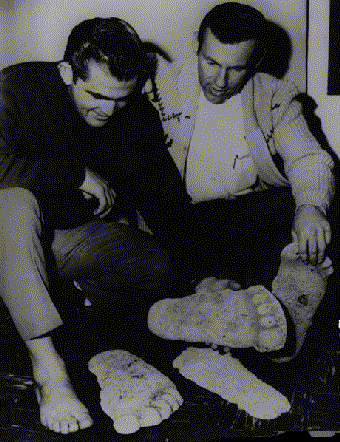
Have you seen photos of the Wrinkle Foot casts? The toes are quite splayed with the smallest toes at an angle of about 45°.
The right and left casts are not mirror images of each other. Krantz attributed it this to geriatric crippling. However........
"...if the midfoot is flexible, as proposed by Meldrum,(1999), then the variance can be more readily accounted for by the expression of a greater degree of supination in the right foot than the left. If the right leg was externally rotated, the resulting supination would raise the medial border of the foot slightly, including the proximal end of the hallucial metatarsal and internally rotate the calcaneus relative to the midfoot. These are precisely the distinctions evident in these casts." (Murphy, pg. 139)
What hoaxer would know all that? They had dermal ridges as well.
In addition, hoaxers would have to get all this right over three decades and thousands of miles. How likely is that?