
Bigfoot - serious, not follies

Bossburg track trouble.

I am having trouble reconciling the descriptions and illustrations of "cripple foot's" tracks. Not to mention the whole strange story of events around Bossburg and the tracks.

Anyway, the photo of the cripple foot track doesn't appear to match the desriptions and the skeletal illustrations.

Below are descriptions from various bigfoot supporters, the skeleton drawing of cripple foot, and the photo of cripple foot's track.

Does anyonw agree with me that the photo does not match the desriptions and the skeleton illustration?

I am not surprised that the illustration matches the descriptions, though. :D
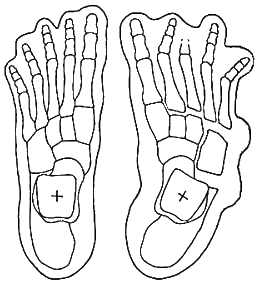
The right foot was deformed; the third toe was either badly twisted over or was missing, there being only a slight impression in the snow at its base; the little toe stuck out at a sharp angle; and the whole foot curved outwards and showed two distinct lumps on the outer edge.

The forepart of the foot is twisted inwards, the third toe has been squeezed out of normal alignment

It has only four toes-the middle one is either missing or somehow raised above the other four, which have spread to fill the gap. More significant is the distortion of the entire foot, which is bent radically inward from the heel.

10_boss_redo.gif


10_Bossburgsnow.jpg
 
Does anyonw agree with me that the photo does not match the desriptions and the skeleton illustration?

Me! Me! :D

What is supposed to be causing the bulges on the right side of the ' crippled ' drawing ?


They have drawn the outline to match the foot print, but the bone structure doesn't account for the bulges..
 
It may be true that there have been no big budget searches or well-funded expeditions for Bigfoot. The believers seem to be begging for this as well as some sort of legitimate recognition.

It is worth mentioning that Bigfoot is not found during big budget high-tech searches for lost humans in areas that are supposed to support populations of Bigfoot. When hikers, children or anyone goes missing in these regions (PNW included) there are very sophisticated searches for them. These include many people on the ground as well as aerial searches using human vision and technology such as infrared imagery.

When search parties and helicopters look for little Tommy Smith... why don't they find Bigfoot? An organized search in the PNW for a 4 foot tall bipedal primate (Tommy) should also uncover any 8 foot tall bipedal primates (Bigfoot), yes?
 
Elk was ruled out.
\

By whom? The people who had already ruled bigfoot in? :D


Your opinion is all you have.

That's all anyone has regarding bigfoot, isn't it?


Meldrum is an Associate Professor of Anthropology at Idaho State. His speciality is primate locomotion. Grover Krantz was a Professor of Physical Anthropology at Washington State University and Napier was in the Primate Biology Division of the Smithsonian.

Non-reponsive, your honor. I ask that you direct the witness to answer the question. :D

And then managed to get up leaving four knee prints, three in a row, but no hoof prints. And it's the only elk in the world with dermal ridges running down its knees and a shin so sharp it looks just like a hominid tendon.

No hoof prints? I'll just assume you are joking. The hoof prints are well documented.
 
Suddenly, I'm reminded of UFO sightings. They seem to have quite a lot in common with Bigfoot footprints: There's a long list of alternative explanations, and even if you debunk the entire known list, it doesn't really do all that much for the believer's case. Don't think I have much reason to believe unexplained possible footprints as proof of Bigfoot anymore than unexplained lights in the sky as proof of alien spacecraft.
 
William Parcher said:
It may be true that there have been no big budget searches or well-funded expeditions for Bigfoot. The believers seem to be begging for this as well as some sort of legitimate recognition.

It is worth mentioning that Bigfoot is not found during big budget high-tech searches for lost humans in areas that are supposed to support populations of Bigfoot. When hikers, children or anyone goes missing in these regions (PNW included) there are very sophisticated searches for them. These include many people on the ground as well as aerial searches using human vision and technology such as infrared imagery.

When search parties and helicopters look for little Tommy Smith... why don't they find Bigfoot? An organized search in the PNW for a 4 foot tall bipedal primate (Tommy) should also uncover any 8 foot tall bipedal primates (Bigfoot), yes?
Welcome to the disection .. errrr ummm, discussion..:D


Re; " It may be true that there have been no big budget searches or well-funded expeditions for Bigfoot. "


Au contrare.. Byrne has supposedly had access to millions in funding.

You have made some excellent points though..

Expect the usual tangental responses and obfuscation.
 
Diogenes said:
Welcome to the disection .. errrr ummm, discussion..:D

You have made some excellent points though..

Expect the usual tangental responses and obfuscation.

Thank you for the welcome. I presume you mean that I should expect a predictable response from LAL. I've now read this whole thread and I suppose that is forthcoming.

I don't know if there is a proper term for those who believe Bigfoot exists. Do they call themselves something? LAL seems to be an indefatigable defender of this giant wild ape. It seems that this forum has not even come close to dissuading this poster of their belief. That means something.

It's not about whether Bigfoot does or does not exist. That question is ironically tangential to the issue and frustration of skeptics. The issue is of the psychology and resources of the Bigfoot believer. Because of this, arguing about tendon impressions in mud will get everyone nowhere.

Bigfoot is the great American myth. It has been for a very long time. There are piles of printed supportive material on Bigfoot. The Internet has allowed for an explosion of anecdote, pseudoresearch and whatnot in support of Bigfoot existence. A person like LAL will never run out of things to point their finger at... even if they themselves have no tangible evidence or connection to Bigfoot.

This thread superficially looks like a long argument of Bigfoot evidence vs. skepticism of such evidence. It really isn't. This is a kind of intellectual war between myth perpetuation and an appeal to naturalistic rationality. It cannot be won by either side. I suppose a Bigfoot body would halt the debate. But (again) ironically, the lack of a body will only maintain the debate no matter how long this goes on.

This is not about an undiscovered giant hairy ape, this is about the minds of gracile hairless apes. Long shall live myths, romanticism and things that go bump in the night.
 
This is not about an undiscovered giant hairy ape, this is about the minds of gracile hairless apes. Long shall live myths, romanticism and things that go bump in the night.
Well said..

P.S.

I suppose a Bigfoot body would halt the debate.
But not the squirming, when the actual creature doesn't match the evidence that proved it's existance.
 
Correa Neto said:
So, at all sightings tracks are found? What is the percentage? And tracks, as it happens quite often, can be misinterpretated. What´s the percentage of possible misinterpretations? How many of these tracks were examinaed by people who really can understand them, and not an average joe/jane?

Krantz examined 750 casts and examined tracks in situ. Meldrum has examined tracks in situ[/B] on five occasions. Chilcutt examined Meldrum's collection (over 100), Ed de Palma, another fingerprint expert, examined casts in Krantz' possession. And then there are the many law enforcement officers who investigate right after a sighting........
How many times do I have to point out that they exist,

Once is enough on what you just said. :D

across the huge are they inhabited and that forest animals do get fossilized. And that bigfoot and related species, that have a geographic span of comparable size, never left a remain, fossil or not.

They may have left remains and even fossils that have never been found. You know fossils can be exposed and then weathered away before anyone discovers them.

The forests of the NW cover an area larger than Britain. I don't know of any fossil beds in that area, Pleistocene or otherwise.

And the source of his statement was?

Personal experience, I suppose. He searched for and found Asia's largest elephant. He wrote a book on it.

"Peter Byrne as recently as 1993 was challenged to find a subspecies of an elephant in Napal called the King Elephant by natives. They had an elephant with unusually pronounced lobes on its forehead that pointed back to the mammoth and mastodon days. He not only found it, but a mate to it."

http://www.royalforum.com/article.php?id=46

So, you must agree that its worthless to say it may be a relative to bigfoot. Gigantopithecus is completely useless as evidence for the existence of big foot. Actually it can be used as a smoking gun of its inexistence. Not to mention that first one must prove that bigfoot exists.

To convince science, one must bring in a body (which is no easy task) and then make comparisons to scanty fossil remains. I favor an Australopith, myself.

I don't think it's worthless to speculate about it. Giganto's mode of locomotion hasn't been established. A toe bone would help. Why hasn't anyone found a toebone?
Ah. Guesswork. Very solid.

There's been no census.
So, a forest animal has its habitat decreased but not its numbers?

Most of the deforestation has been in the East. Reports started coming in (to the white world) when settlers moved West. I think it's possible they started spreading into the East and Southeast relatively recently. There's not only a lot of wildland left, there's formerly logged over land that now has mature timber on it. In a sense, the habitat has increased since the unbridled logging of a century ago.
Regardless of how the environment recovered after conservation laws were created (and respected), the new-grown forests (note that this may encompass forests that may be over 40-years old), are very different in terms of biodiversity. And many are not yet able to sustain the same type and number od animals they did before. Not to mention that you must take in to account the lifespan (that if you accept cripplefoot exists must be above 40 years) and reproductive cycle of any species when considering how fast its number will (re)grow. Usually species composed of specimens that live long take more time to increase its number. And regarding pesticides, by your statement, I must assume you are not aware on their effect in the environment.

I was active in the Sierra Club soon after DDT misuse was at its height. The Forest Service was spraying the National Forests and using chemical fertilizers while spraying herbicides to kill the Alder. I wish you'd stop assuming I'm unaware.

The Bald Eagle has recovered enough to be taken off the endangered list. It was never seriously threatened in areas that didn't have a lot of agriculture, but Brown Pelicans had a 100% reproductive failure (due to thin shelled eggs) one year. Species that were most affected were the fish-eating birds at the top of the food chain.

It does not matter if no one uses prohibited pesticides anymore. Their effect is cumulative, and not only may last for decades but also tends to concentrate its effects at the top of the food chain, where large animals are located.

At one time human milk had higher than acceptable levels of DDT. The government kept raising the acceptable levels.

So how did humans, also at the top of the food chain, survive? We were eating products that were directly sprayed. When I was a kid in suburban Chicago, we and the mosquitos were directly sprayed.
And you are contradicting yourself. They MUST -of course, if they exist(ed)- have spread "almost all over" USA and Canada tens of thousands years ago and before European colonization. As most (if not all) large forest animal species, their numbers must have been quite larger when European colonist arrived at North America. And no one managed to shot one since the starting of colonization?

I've said before Green has five reports of shootings.

No contradiction. There are a couple of scenarios, both of which I've presented.
There´s weak evidence. That bigfoot researchers so far manage to provide just substandard quality evidence is their problem. But neither I or anyone else is forced to accept such poor data. That you refuse to see that is not my problem -unless you are debating it with me and the other posters here. And, in this case, being rude will not be of any help.

I'm sorry if I appeared rude, but I don't think anything I've said compares to some of the statements that have been directed at me by some of the posters.

I don't think my superiors would accept posting on message boards as a legitimate excuse for being late, so from now on I'll only answer you when I have more time and am not feeling frustrated and testy about some of the mockery and put-downs.
These Russian scientists, have they managed to publish at least one paper at a peer-reviewed science magazine of some importance? Or are they of the same type that said Nina Kulagina was the real deal?

I hope not. Google Bayanov, for one. Seems a Russian scientist has seen one. I 'll try to get her name.
So, the websites are wrong when it comes to the spelling and the way they tell the myth. The legend do speaks of a fanciful assemblage of unrelated animal parts. Are you going to deny that? The description I provided was taken by me directly from people who live in the Amazon forest and matches perfectly with that on the Amazonian myths site whose link I posted. Is it that hard to accept that the legend was distorted (consiently or not) by those who claim the mapinguari may be a crypto?
Those websites are far from being reliable sources of information.
There's disagreement, okay? Even on the spelling, which may have been Anglicized. I'd really like to rein in the subject a bit. Crypotozology deals with unidentified animals, and really only deals with mythological animals when the myths may be based on real creatures. Some of the cryptids have been identified and classified.
Sure. But then we´ll drop also on bigfoot, since there are conflicting ideas about it as well. My point is the unreliability of legends interpretation as source of information. Do you accept that?

Some of the legends from the Coast tribes, BC and California seem to be a fit. Others are too much of a stretch. But I find it interesting the fits are from where the largest population seems to reside.

Didin´t you asked to drop the issue? The myth was distorted by these people to fit their own needs. They picked up the parts that suited (vague humanoid shape, claws, etc.) and interpretated according to their own cultural backgrounds. I have seen this happen a handfull of times not only with the mapinguari, but also with other legends. And regarding the footprints, what evidence do you have that they were not misinterpretated? What´s the surce? Occultopedia?

I've posted a number of links on footprints, both here and on the Bigfoot Follies thread. Please read them.

This is the first time I've ever used Occultpedia (or even seen the site) and that was only in support of the spelling and hominid interpretation.
And are you sure they went to the Amzon forest and interviewed people who claimed to have seen the animal? Or, as adopted as standard practice by many "researchers", they just used scond- or third-hand accounts?

Nope. This is new to me.
Can you be sure that the sasquatch as a giant unknown to the science hominid is not just an interpretation based in the cultural background of bigfeet researchers? And that the original myth meant something else, that fitted well within Native North American´s cultural background?

http://www.bigfootencounters.com/articles/lummi1.htm

Myths don't kill dogs.
And regarding encounters... Well, people also claim to have had encounters with aliens. And there are footprints of aliens, landing gear marks, burnt vegetation, etc. Where to draw the line? Why UFOs are not "viable", but bigfeet are, if the evidence avaliable for both is of the same quality?

It's not. My favorite "burnt mark" was in a road. The perpetrator forgot to remove the matches.

As I tought. No biologist saw a bigfoot. No evidence, just lame excuses.

No comment.

Q. Are all forests in North America and Asia where these animals are supposed to live (or to have lived) similar to those of PNW?
A. No.
Here´s one of the flaws in your argument. I say there should be fossil remains of bigfeet and related species as well as recent remains.

I say there are few fossils anywhere (with the exception of marine). I find your whole "should" argument flawed. When I was a kid only three human "ancestors" (none were, actually) were known and one of them was Piltdown Man! In Dubois' time they didn't know which continent to look on. When Darwin came up with his theory no hominid fossils had been found at all. But they "should" have been, right?
Just after you answer me why UFOs are not "viable", but bigfeet are, if the evidence avaliable for both is of the same quality.
I'm not going to be able to get you to see this, but no, it's not.
I think you should only write this sort of thing after being certain about it. There are a lot of fossils of several species of bear.
http://jorde-lab.genetics.utah.edu/elibrary/Wooding_1997.pdf
http://www.sdnhm.org/fieldguide/mammals/ursu-ame.html

I'll check the sites later.
I asked specifically for fossils of Black Bear (Krantz estimated 100 Black Bear for every Sasquatch) in the Pacific Northwest, where even bodies of Black Bear that died of natural causes are seldom, if ever found. I've never said there are no bear fossils.

>remark accidently snipped<

No need. I wasn't rude in the first place. I also find it frustrating to lose a lengthy post while bringing up a website. That happened three times yesterday. Can we divide these into thirds, or something?

The only thing that might help you are solid evidences. What so far has not been provided by any big feet researcher.


Right, no bodies or testable tissue, yet, but plenty to point to a living animal. Science will give the grants to go get the body after a body's been brought in.

And have you ever heard of convergent evolution? See, a hipothesys stating that bigfeet evolved from squirrels or opossums via convergent evolution is at the very same level than any other about bigfeet´s evolution, since it is based on absolutely nothing of solid. First prove the animal exists. Then prove its a hominid.
And if they evolved somewhere else, where are the fossil of their ancestors?
Feel free to take all the time you need to take your feet of your mouth.


My feet are not in my mouth. Similar adaptations occur in similar niches, but hominids do not evolve from squirrels. Sasquatches have hominid characteristics right down to the fingernails.

Sorry, but since not all forests in North America and Asia where these animals are supposed to live (or to have lived) are identical to those of PNW, all you´ll managed to obtain were biased opinions.


No one said they are. Eastern climax forests are hardwood.

You´d better check your sources. Again. Dacite is the main type of lava, and it is also the type that nowdays is building the dome. Mt Saint Helen, as well as all the volcanos at the Cascades are what composite volcanoes. They were built by intercalations of tuffs (AKA ashes) and lava.
Check again your sorces when it comes to weathering of basalt. Basalt is composed by pyroxenes and calcic plagioclases (depending on the basalt it may have olivines). These minerals are very poor in water. In contact with water (atmospheric, raind, rivers, etc) they hidratate and become clay. Ph level has little to do with it. Climate is the most important factor. The more rainy and hot the climate, the faster will be the weathering.


It's the acid that etches the basalt and releases micronutrients, which is why the soils are so good, where you can find any. I rather thought the black sand was an end product of basalt erosion. Clay was pretty uncommon, as I recall. The rocks were identified by a geologist friend of my first architect.

I never said no siltation; I said little. Normally there wouldn't be enough to bury an animal before scavengers got it. Deer mice eat the bones to obtain calcium. Quick burial is really necessary, but then you have soil that is loaded with microbes that eat organic matter. So, little chance of preservation and even less of being found.
Ash=tuff. You can´t say there´s no silt in those rivers before making a detailed analysys of the sediment that is being carried.

I didn't say there's no silt in those rivers. I said there's not much. Most of it in the Columbia comes from farmland and ranches upriver in Eastern Washington.
And if there are glaciers that feed rivers, and the glaciers and the rivers pass through ash layers, then there´s silt. Even if they pass through solid rock. Ice from glaciers is an incredible erosive agent. It crushes and mills rocks. The flood water are crystal clear too?

Streams in Washington are crystal clear. A volcanic eruption that happens maybe once in 10,000 years isn't exactly a usual occurance. I'm not saying there's no siltation, but what I've seen would hardly be enough to cover a gnat. It tends to get filtered out by the vegetation en route to lower elevations. Sasquatches don't live above timber line.
The land I owned is between St. Helens and the Columbia (with Greenleaf Peak in between. It received a light dusting from the second eruption, but there was no inundation from the main eruption in that area.

A claim that you can not defend. Some peoplehere, including a ranger, have pointed aout that animal remains are found in the forests. And don´t write "In PNW..." because it´s been already answered.


Krantz interviewed dozens of people who frequent and study forests and got an answer of "0" on bear bodies (where cause of death was natural). I've found remains myself (I don't want to go through the horse story again; it's too painful), such as the skeleton of a deer hit by a car, but they were few and far between. There are few roads and fewer hunters in some of these areas. It's sheer luck to come across a body of any kind.

Talking about twisting words...
As the song says, "Before you accuse me, take a look at yourself"


Do you sing that to yourself in the mornings when you look in the mirror?

So what? Unreliable evidence.

To you, it all is, whether it's reliable or not.

What if I said you dismiss perfectly logical explanations because they don't fit in with your preconceived notions that there´s a 3m-high ape living in North America´s forests?


Let's see some evidence for some of these "perfectly logical" explanations.

I didn't start out with any "preconceived notions". I'd never heard of the things before I encountered Green's early books and then read an account of the Cox sighting on the front page of the Columbian. Wouldn't you be at least interested in a sighting with physical evidence a few miles from where you were planning to live and only about 40 miles from the current residence?

Talking about twisting words... You know, for someone who claims to know wildlife, you are pretty unaware of some aspects of animal behavior...


Such as? I don't claim to be an expert, but I know there are no Jaguars in the areas I'm talking about.

Rare event. OK. How many times this rare event happened in your lifetime? Let´s suppose it happens just once every 50 years (no, I´m not stating this is your age), we are talking about a period of 10Ky, that would be a total of 200 droughts. At least, since there may be other droughts "periodic" or not, smaller or larger...


Guaranteed, the PNW, didn't dry up. They just didn't experience the usual monsoons. I don't know how long it lasted. (Good excuse to call my brother in Seattle.......)

So, at droughts animals are not attracted to water sources such as caves?


I've never said they might not use caves at all, but, I don't think there would be any need to seek water in caves when there's so much of it around. Some animals just lick snow.

And these are not potential remains preservation sites? And aren´t there caves along several places withing bigfeet´s supposed habitat range?


Did you think Ape Caves were named for Chimpanzees?

Oh, I see "at PNW..."


Which has the largest population. And lousy preservation. There's a shot of a lava tube in Sasquatch Oddessy. Looks like there's some light coming in and even dripping water (I regret I never got to see them in real life). There's not a hint of a stallagtite. I'd guess there's no mud on the floor.

Look, the points of ths discussion on dry seasons, as well as those on geology, are to show you that:
(a) Your knoweledge of PNW is actually providing only biased opinions, that quite often are not usefull for comparsion with other areas;


I see. Living there didn't count, but it's okay for you to draw conclusions based on a textbook view that doesn't seem to have much to do with the area.

(b) There are several mechanisms that would allow the preservation of remains (fossil and present) of bigfeet carcasses at several places along its habitat.


Point me to Pleistocene fossils in these areas.

You are making claims that you can´t really defend.


Okay, I'm frustrated. Time for a break.

So, more claims that can not be defended.
http://www.accessexcellence.org/WN/SUA08/galop896.html
http://www.geoworld.org/na/usa/hi/prehistory/
And please, try not mixing the preservation processes.
And what about considering that what you know about PNW and what you gathered at the internet about caves may not be of great use as a standard for comparsion with other places?


I'll bring those sites up later. I'm not going to risk losing two feet of post.

You are demonstrating to have very little knoweledge on what you are talking about.


There's that condescension again. You don't consider that statement rude, do you? I could say the same (I have to someone else - it was true, of course) to you and it would be rude, right?

Hawaiian volcanoes are the type known as shield volcanoes. They are mainly composed by thick basaltic lava layers that create very gently-sloping (but very high - Hawaii´s elevation from the sea floor -where the volcanoes rise from- to its top is higher than that of the Everest, when measured from the sea level) mountains.


I know.

What is quite different from the Cascades´ composite cones built by interlayered tuffs and lava flows. Now, these basaltic lavas are very fluid, due to their composition and eruption temperature. Thus, they flow for long distances and cool slowly, what makes lava tube formation easier, hence the number of this type of cave that exists in Hawaii and other oceanic islands created by similar volcanoes. So, your point was?


Northwest volcanoes tend to explode. Crater Lake was once Mt. Mazama. The terrain is different, the vegetation is different, the rock is different and lava tubes aren't a great place to find preserved animals. The place to look, IMO, would be under St. Helens ash (if there's anything left but bits) and Roy Crowe is the only one I know of who's even attempted this.

There could be animals trapped in landslides, but I just don't know of any excavation for fossils going on in prime Bigfoot country.

And as in the other cases, the purpose of this was to demontrate that :
(a) Your knoweledge of PNW is actually providing only biased opinions, that quite often are not usefull for comparsion with other areas;


I don't know how good the evidence is for other areas, except for Georgia, which yielded one compelling cast.

(b) There are several mechanisms that would allow the preservation of remains (fossil and present) of bigfeet carcasses at several places along its habitat.


We've been over this before.

Twisting words again, eh? Are lava tubes at the Cascades the only places where remains -fossil and recent- of bigfeet could be found?


I don't think there are fossils in Cascades lava tubes. Correct me if I'm wrong.

And as in the other cases, the purpose of this was to demontrate that :
(a) Your knoweledge of PNW is actually providing only biased opinions, that quite often are not usefull for comparsion with other areas;


I'm really not concerned about other areas until I check them out more thoroughly.

(b) There are several mechanisms that would allow the preservation of remains (fossil and present) of bigfeet carcasses at several places along its habitat.


Such as where the Mammoths roamed?

Such as all northern states from USA, a great part of Canada and a chunk of Russia.


Where the Kaptars live.

And if there are reports of sightings at Tenesse, yes, that´s would be another place to find remains, past or present.


There are fewer reports from there than there are for Skamania County, which was first in Washington until Skagit beat it by one.
Got fossils in Tennessee? Right age? Right era?

Deers are not as tall as bigfeet, are they? Compare a 3-m tall bigfoot with a deer that can easily hide in the underbrush. Deer also blend in the shadows.
Oh, and deer have left remains, fossil and recent.


And they're common as rabbits. Saw one roadkilled Sunday. That's the first deer I've seen in WNC, living or dead, since I moved here eight years ago. They're diurnal. And what would prevent a Sasquatch from hiding in underbrush? I have a wild Rhododendron in the back yard that would easily conceal three or four 8' hominids.

And you are using the same argument to explain why there are no bigfeet fossils. So, creationists can´t use it as an evidence against evolution but you can use it as an excuse for the absence of bigfeet fossils?


Not an excuse. It's a fact there are gaps in the fossil record. That doesn't mean there is a god or isn't a Sasquatch, only that there are gaps in the fossil record.

That´s exactly what you are providing. An endless repetition of arguments that have no merit.


Repetitious, perhaps, because the same points keep coming up, but without merit? I don't think so. And they aren't all my arguments to begin with. There are a few people doing actual research on this. Meldrum's book should be ground-breaking.

If you think they have no merit it's only because you are so committed to your POV, you can't accept you could be wrong, IMO.
:p
 
Diogenes said:
Well said..

P.S.

But not the squirming, when the actual creature doesn't match the evidence that proved it's existance.

Squirming? I presume you mean the potential embarrassment of the Bigfoot believers when the found animal doesn't match the given descriptions? Humpf. That would be drowned out by the immediate reality of an unknown bipedal primate living in American forests.

If this were to occur, I think that the popular media would allow and promote a willy-nilly slap fest upon the skeptics. Smart skeptics would suddenly realize that a certain unknowable percentage of believers probably did have real eyewitness encounters.

But why do you propose what would happen if fiction were real? Has LAL's dogged persistence in this thread pushed your mean button?

The frustration of a skeptic who is battling a Bigfoot believer who has countless references to the 'reality' of Bigfoot can lead one to make reflexive gropings for a silver bullet. There must be something quick that can kill off all of these stupid hillbilly sheep woo woos, right? Not.

I don't think that informed skepticism looks good when wearing red hot cynicism.

But hey, LAL.... where is Bigfoot anyway?
 
Diogenes said:
Sounds like typical government behavior.. You have lots of cute stories, just no Bigfoot.

I've never claimed to have one.

I read Green about thirty years before I met Bryne. The last I saw on the planes (yesterday) was seventy five. I don't remember the exact figure Green gave or when I read that, so I said "dozens". Bryne said 73.

You'd think all those loggers and berry pickers and hunters "scanning" the forests would bring back some pieces, wouldn't you?

"Living in England as I do, it is easy to underestimate the size of the Pacific North West forests. We were pretty much at the southern end of the forests, which can be followed all the way up through Oregon, Washington, British Columbia and Alaska. Forests bigger than the landmass of Great Britain, with only a few medium sized cities in the way.

I wasn’t surprised then to hear that the Federal Aviation Administration say they have lost seventy-five planes in these forests – these aren’t planes that have simply crashed – they were planes that had crashed and never been found!"

http://www.bigfootproject.org/articles/bf_symp_2003_report.html
 
LTC8K6 said:
But....but.....but....all those witnesses, and all of that testimony..... How can the hair be from a bison? Who can't tell a bison from Chewbacca? :D

Even if it does turn out to be Bison hair, that doesn't prove nine people couldn't tell a Bison from a Sasquatch.

Thanks for the link, anyway. I'm glad further testing is going to be done. These things need to be checked out.
 
William Parcher said:
It may be true that there have been no big budget searches or well-funded expeditions for Bigfoot. The believers seem to be begging for this as well as some sort of legitimate recognition.

It is worth mentioning that Bigfoot is not found during big budget high-tech searches for lost humans in areas that are supposed to support populations of Bigfoot. When hikers, children or anyone goes missing in these regions (PNW included) there are very sophisticated searches for them. These include many people on the ground as well as aerial searches using human vision and technology such as infrared imagery.

When search parties and helicopters look for little Tommy Smith... why don't they find Bigfoot? An organized search in the PNW for a 4 foot tall bipedal primate (Tommy) should also uncover any 8 foot tall bipedal primates (Bigfoot), yes?

I've mentioned a couple of these already, where the results were fatal for the searchees. One was even in Skamania County, in the Gifford Pinchot where the 2/3 body imprint was found. A mushroom hunter was lost somewhere on talus after becoming separated from his companions. Evidently mushroom hunter sign isn't easy to follow either, even in the open.

I used to follow a game trail to get to my ex-husband's lake, and I don't recall seeing any kind of tracks on it, not deer, not even my own. The ground cover is springy. About all one sees from an aircraft are treetops and clearcuts (I haven't been in a helicopter, though I was once buzzed by one). At night, when they're active, one would see what?

Krantz had plans to search by a one-man aircraft. He thought early spring would be a good time to try to find winterkill, as I recall. He didn't live to carry out these plans, and I believe he mentioned his wife wouldn't let him fly the thing.

There've been sightings by DNR workers, and a track was found after St. Helens blew, but a lot of this stuff doesn't get reported, or even seen.

"John Green - saw a picture of Jerry Crew holding a cast. Green went down to Willow Creek, with his wife. He saw prints and was very impressed. Bob Titmus mailed Green, who came back to Willow Creek and saw more tracks (covered with leaves). Saw more in '59 and in '63 saw tracks near Hyampom, CA. In 1967, Bud Ryerson called Green, saying, "What you're looking for is here!" over 600 tracks in a row. Green flew down, with a tracking dog and handler. The dog smelled the first track, "and it was an electric shock, the dog's hair, on his back stood straight up!" The dog refused to follow the tracks or scent. The tracks were in deep dry dust. Then it rained over night leaving a thin layer of dried-mud on the top. A Forest Service worker drove up to them and said, "I've never seen any bigfoot tracks in these woods."

"What about these?", Green asked."

http://www.bigfootproject.org/articles/bf_symp_2003_report.html
 
Re: Bossburg track trouble.

LTC8K6 said:
I am having trouble reconciling the descriptions and illustrations of "cripple foot's" tracks. Not to mention the whole strange story of events around Bossburg and the tracks.

Anyway, the photo of the cripple foot track doesn't appear to match the desriptions and the skeletal illustrations.

Below are descriptions from various bigfoot supporters, the skeleton drawing of cripple foot, and the photo of cripple foot's track.

Does anyonw agree with me that the photo does not match the desriptions and the skeleton illustration?

I am not surprised that the illustration matches the descriptions, though. :D
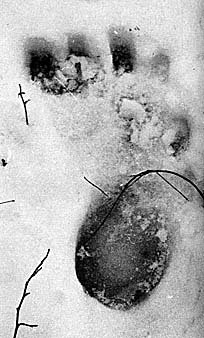

The photo is from the trackway (1089 tracks counted) Marx and Dahinden found. The casts are from near the dump, days earlier. The drawing is a good representation of the casts I have, except that it seems to be a top view.

Lots of this stuff is strange. That one reason I'm so interested in it. The "researchers" are a mixed bag and they mostly despised each other.


10_boss_redo.gif


10_Bossburgsnow.jpg
[/B][/QUOTE]
 
LAL said:
I've never claimed to have one.

I read Green about thirty years before I met Bryne. The last I saw on the planes (yesterday) was seventy five. I don't remember the exact figure Green gave or when I read that, so I said "dozens". Bryne said 73.

You'd think all those loggers and berry pickers and hunters "scanning" the forests would bring back some pieces, wouldn't you?

Who says they never did?

"Living in England as I do, it is easy to underestimate the size of the Pacific North West forests. We were pretty much at the southern end of the forests, which can be followed all the way up through Oregon, Washington, British Columbia and Alaska. Forests bigger than the landmass of Great Britain, with only a few medium sized cities in the way.

No bigfeet Here.. Move along

I wasn’t surprised then to hear that the Federal Aviation Administration say they have lost seventy-five planes in these forests – these aren’t planes that have simply crashed – they were planes that had crashed and never been found!"

Again, where did the FAA say this ? ( not that it would support your position, as I have pointed out several times )

http://www.bigfootproject.org/articles/bf_symp_2003_report.html
Cheese and Crackers! Did you read anything I wrote?


Aircraft that have disappeared without a trace, are NOT comparable to creatures we suspect exist, but have never found a specimen of!
( pardon my shouting )


We know ( can prove ) aircraft exist. We know they sometimes disappear without a trace.


It doesn't matter how impenetrable and rugged the PNW is, or who or what has disappeared there.

Until something exists, it doesn't matter where they hide; in the PNW or the wild Rhododendron in your back yard.


I was trying to point out how people like Green and Byrne like to toss out ' gee whiz ' sounding non sequiturs in an attempt give credence to their claims.

Lets move on..
 

ISF - Join now!

Every member here is approved by hand. No bots, no spam, just people who care about evidence and honest debate.

Membership is free!

Create your free account

Back
Top Bottom