Are 4 to 4.5 hour office fire simulations valid?

Tony Szamboti

Illuminator
Joined
Jun 2, 2007
Messages
4,976
I am curious to hear the voices of those who frequent this forum as to whether 4 to 4.5 hour fire simulation times are valid for WTC 7 studies such as those contained in the NIST and Weidlinger Associates analyses. The ARUP study used just one hour in its fire simulation.

We have all heard that the fires will burn up the fuel in any one area in about 1 to 2 hours maximum and also that the fires reach temperatures above 600 degrees C for about 40 to 60 minutes and then start to cool. This was shown in the Cardington test data.

See http://www.mace.manchester.ac.uk/pr...aBase/TestData/FullScaleFireTestBRE215741.pdf

It is also interesting that the Cardington test data for protected steel does not reach temperatures which would produce failure. WTC 7's steel was protected.
 
Last edited:
I am curious to hear the voices of those who frequent this forum as to whether 4 to 4.5 hour fire simulation times are valid for WTC 7 studies such as those contained in the NIST and Weidlinger Associates analyses. The ARUP study used just one hour in its fire simulation.

We have all heard that the fires will burn up the fuel in any one area in about 1 to 2 hours maximum and also that the fires reach a peak temperature for about 30 to 40 minutes and then start to cool. This was shown in the Cardington test data.

That depends on if a chimney effect was present, chimney effects redistribute soot as fuel,
Causing a fire to be hotter and last longer, in structures, such as buildings and debris or garbage piles.
If you an the other members of the Idiotic AE/911 truth had actually studied fire chemistry
From actual fires you wouldn't be asking dumb questions or making insane limited case statements about proof in the first place.

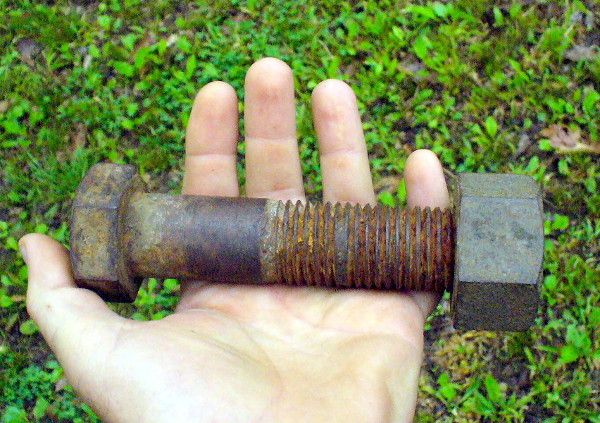
Just for you Tony, a picture of an A325 bolt 7/8th inch in diameter.
bolt1_zpsjc64mef0.jpg
 
Tony, could you please cite where you get the "4 to 4.5 hour fire simulation times" from? What section of the NIST report did you find these numbers in? Are they an assumption fed into a simulation software, or a result coming from a simulation software run? If the latter, perhaps you are not posing a useful question.

I think I remember that NIST checked the results of their fire sim against real world observations - what windows showed what evidence of fire at what times - and considered it a good enough match. Do I remember correctly? Then why do you think the time frame poses a problem?
 
We have all heard that the fires will burn up the fuel in any one area in about 1 to 2 hours maximum...

And yet my wood stove ticks over all night and is often sufficiently hot in the morning to self-ignite when I open the vents and toss on a few small logs. Same thing happened after a big bonfire - I went to the same spot next day to load the next batch of prunings and the damn stuff caught fire with no prompting from me.

Perhaps what you meant was "flames will subside in x hours"? That doesn't mean heat isn't still being produced, does it? Fire crews will damp down a building fire for many hours once the flames are under control, to prevent re-ignition.

Or perhaps you're just grasping at any straw whatsoever.
 
Tony, could you please cite where you get the "4 to 4.5 hour fire simulation times" from? What section of the NIST report did you find these numbers in? Are they an assumption fed into a simulation software, or a result coming from a simulation software run? If the latter, perhaps you are not posing a useful question.

I think I remember that NIST checked the results of their fire sim against real world observations - what windows showed what evidence of fire at what times - and considered it a good enough match. Do I remember correctly? Then why do you think the time frame poses a problem?

Chapter 10 in the NIST WTC 7 report and pages 20, B-83, B84, and B-85 of the Weidlinger report.
 
Last edited:
Chapter 10 in the NIST WTC 7 report and page 20, B-83, B84, and B-85 of the Weidlinger report.

No. Chapter 10 does not contain the number "4.5" [hours].
You can't have found your claim of "4 to 4.5 hour fire simulation times" in Chapter 10 of NCSTAR 1-9.
 
And yet my wood stove ticks over all night and is often sufficiently hot in the morning to self-ignite when I open the vents and toss on a few small logs. Same thing happened after a big bonfire - I went to the same spot next day to load the next batch of prunings and the damn stuff caught fire with no prompting from me.

Perhaps what you meant was "flames will subside in x hours"? That doesn't mean heat isn't still being produced, does it? Fire crews will damp down a building fire for many hours once the flames are under control, to prevent re-ignition.

Or perhaps you're just grasping at any straw whatsoever.

Wood stoves use a controlled air to fuel ratio, to limit amount of fuel consumed over a given time span, wind currents control open burning, as well as convection, and redepostation of fuels.

Also an insulation coverage, like gypsum dust can cause a smoldering fire, wind can blow the dust of initiating flame up though deoxidation of hot coals.

Fires are very complex chemical events especially in structures.
 
My phone won't open the Cardington page TSz linked but if memory serves it was a three storey test structure built within its test facility. Not nearly, not even close, to the floor area involved in any of the Manhattan fires on 9/11/01.

Of course we await citation confirmation for a 4.5 hour simulation run.
 
My first house had a small wood pile at the back of the property. It had sat untouched for years, the wood furnace had burned through the firebox and was unusable.
One spring as the snow began to recede I decided to get rid of the pile of partially rotted fire wood. I dumped a pint of gas on it and lit it. Despite being punky, wet, and now frozen, despite being surrounded by snow, it continued to burn all through the night and for half the next day. Reduced the entire pile to ash. There was not a thing left when I shoveled snow on the still smoking ground.
This, and above anecdotes, do not relate directly to office fires but illustrate that hard rules about burn time just do not apply.

Typical truther binary thinking though Tony. Sarns had the same either/or drive behind his "fire simulation".
 
Last edited:
No. Chapter 10 does not contain the number "4.5" [hours].
You can't have found your claim of "4 to 4.5 hour fire simulation times" in Chapter 10 of NCSTAR 1-9.

The figures in the NIST report show heating in one area for nearly 4 hours. However, the NIST report has also been shown to be non-explanatory due to girder trapping and the inability to break through the next floor down.

The figures in the Weidlinger report show heating in one spot for 4.5 hours, so let's talk about the Weidlinger report. You didn't comment on it. Why not?
 
Last edited:
The figures in the NIST report show heating in one area for nearly 4 hours. However, the NIST report has also been shown to be non-explanatory due to girder trapping and the inability to break through the next floor down.

The figures in the Weidlinger report show heating in one spot for 4.5 hours, so let's talk about the Weidlinger report. You didn't comment on it. Why not?

(According to your unproven limited case hypothetical), why can't you be honest and include that part, your's is a hypothetical case of maximum resistance to collapse nothing more.

Heating does not mean burning in the area convection heating do to air flow as well as refined fuel transport from one area to the other by air movements comes into play.
 
Last edited:
I am curious to hear the voices of those who frequent this forum as to whether 4 to 4.5 hour fire simulation times are valid for WTC 7 studies such as those contained in the NIST and Weidlinger Associates analyses. The ARUP study used just one hour in its fire simulation.

We have all heard that the fires will burn up the fuel in any one area in about 1 to 2 hours maximum and also that the fires reach temperatures above 600 degrees C for about 40 to 60 minutes and then start to cool. This was shown in the Cardington test data.


There is a problem. First of all, explain to us, how WTC 7 burned for almost 7 hours and then, explain why WTC 7 buckled. In other words, explain the buckling process of WTC 7 before that building collapsed?

You might as well throw away your CD theory and accept the fact that fire, in conjunction with impact damage, was responsible for the collapse of WTC 7 because that is the only evidence there is.
 
Last edited:
There is a problem. First of all, explain to us, how WTC 7 burned for almost 7 hours and then, explain why WTC 7 buckled. In other words, explain the buckling process of WTC 7 before that building collapsed?

You might as well throw away your CD theory and accept the fact that fire, in conjunction with impact damage, was responsible for the collapse of WTC 7 because that is the only evidence there is.

Don't do that, the more money AE/911 twoofers, scam off the ignorant unwashed masses that believe them, the less they will breed.

Do you want the ignorant unwashed masses breeding?:D

Tony is doing the human race a favor and holding down the reproduction of twoofer dumb, and I do mean Dumb.
 
The figures in the NIST report show heating in one area for nearly 4 hours. However, the NIST report has also been shown to be non-explanatory due to girder trapping and the inability to break through the next floor down.

The figures in the Weidlinger report show heating in one spot for 4.5 hours, so let's talk about the Weidlinger report. You didn't comment on it. Why not?

The max temperature recorded in the Cardington study you linked was 1108 C, with many elements (including beams, bolts, end plates, etc. reaching temperatures of 800-1000 C). Given that the test structure (a narrow, 8 floor building) was a great deal smaller than wtc 7, and the fires in the test structure burnt for a far shorter time over, it's really hard to compare the two. The linked study temperatures look in line with the WAI temperatures and the temperatures observed in the scale model test of the WTC 1 fires, in any case.
 
Last edited:
The figures in the NIST report show heating in one area for nearly 4 hours.
Which figures?
Which area?
And so what?

Tony, you are an engineer, you say? You are awfully imprecise and unfocused!

However, the NIST report has also been shown to be non-explanatory due to girder trapping and the inability to break through the next floor down.
Yeah, bla bla bla poison the well bla bla bla.

What is this crap thread about? Make a point like an engineer would! Don't jump around and make us guess what your beef is!

The figures in the Weidlinger report show heating in one spot for 4.5 hours,
Which figures?
Which area?
And so what?

so let's talk about the Weidlinger report. You didn't comment on it. Why not?
You din't cite it. Apparently, you were not interested in anyone whatsoever looking at it, or else you would have provided a proper citation, ideally complete with a working URL.

Are you this terribly sloppy in your professional dealings, too?
 
Last edited:
The max temperature recorded in the Cardington study you linked was 1108 C, with many elements (including beams, bolts, end plates, etc. reaching temperatures of 800-1000 C). Given that the test structure (a narrow, 8 floor building) was a great deal smaller than wtc 7, and the fires in the test structure burnt for a far shorter time over, it's really hard to compare the two. The linked study temperatures look in line with the WAI temperatures and the temperatures observed in the scale model test of the WTC 1 fires, in any case.

I think the Weidlinger report is problematic with continuous heating of one area for 4.5 hours. They reference the fire analysis conducted by Beyler (2010) for Hughes Associates, who was also involved in the NIST report, but they don't provide it or explain how it supports the claim for 4.5 hour heating of one area.
 
I think the Weidlinger report is problematic with continuous heating of one area for 4.5 hours. They reference the fire analysis conducted by Beyler (2010) for Hughes Associates, who was also involved in the NIST report, but they don't provide it or explain how it supports the claim for 4.5 hour heating of one area.
How will this help your CD fantasy? As Gage goes more nuts on 9/11, how will you recover from pushing the lie of CD. Gee, Gage believes in a stand down, how paranoid and crazy can Gage go before you expose him as a loon?

Failed to present evidence for CD, so you make up BS about the NIST report. Fire caused the collapse, your silent explosives remain fantasy.

I can't wait until you complete SIOP for 9/11 is explained. Here you are stuck on Flight 11, and Flight 175; what great fantasies do you have for Flight 77 and Flight 93; after this tangent of BS attacking NIST fails?
 
Last edited:
All this dodging and twisting Tony.
You haven't done anything, engineering-wise, have you?
All these assertions and grasping at straws, dodgings, changing the subject.
Show us a freebody.
 
I think the Weidlinger report is problematic with continuous heating of one area for 4.5 hours. They reference the fire analysis conducted by Beyler (2010) for Hughes Associates, who was also involved in the NIST report, but they don't provide it or explain how it supports the claim for 4.5 hour heating of one area.

It is called air flow, if you were an engineer, you would understand where and how that matters in a building fire.

Air goes in one point out the other and draws out the heat from combustion.

Look at the structure figure it out like an engineer would, or ask q real life engineer to explain it to you.

Simple as that.
 

ISF - Join now!

Every member here is approved by hand. No bots, no spam, just people who care about evidence and honest debate.

Membership is free!

Create your free account

Back
Top Bottom