• Security incident: ISF was recently accessed by intruders. Please change your password, and change it anywhere else you used it. Read more

Apparently Betelgeuse is about to go Supernova

Basically pressure being a matter of force/surface, the force is the weight of those layers, which means GMm/r2.


Right, and this implies a direct relation between density and pressure. Change one you change the other. The statement of yours that started this particular tangent seemed to imply there would be a disconnect between pressure and density. I don't understand what that meant.
 
I meant simply that when you picture the weight of a hundred million km worth of hydrogen just about inside the orbit of Jupiter, you need to picture that in the context of a gravity about 12 times higher than that experienced by Jupiter. I.e., just the density alone there isn't the whole picture.

Edit: basically, if you will, imagine this: you can find some altitude around Jupiter where strictly speaking the density is the same as on Mars. But the pressure sure as heck won't be the same. So just looking at the density doesn't give you much of a clue about pressure.

Edit 2: and I never said they were COMPLETELY disconnected. I'm not sure where that idea even comes from, seein' as I even wrote about how density goes into the ideal gas equation. And yes, it goes indirectly into gravity too. But it's only one factor of many. And strictly speaking all I said is that the 'outer parts' of Betlegeuse can be under more pressure than you'd call a good vacuum, even if density wise it's pretty rarefied. And I stand by that. Something can be quite trivially more dense and under less pressure and viceversa. E.g., the water in your cup is much denser, but under much less pressure than the air in your tires. Well, at least as long as your cup isn't 20m deep, anyway.

 
Last edited:
It would be nice if we had graphs showing density, pressure, and temperature, plotted against distance from the centre for different types of star including main sequence typical stars like our Sun, plus red giants and supergiants.

I've done an internet search but so far, I've only found a pdf of a scientific paper that contains complex formulae but no graphs.

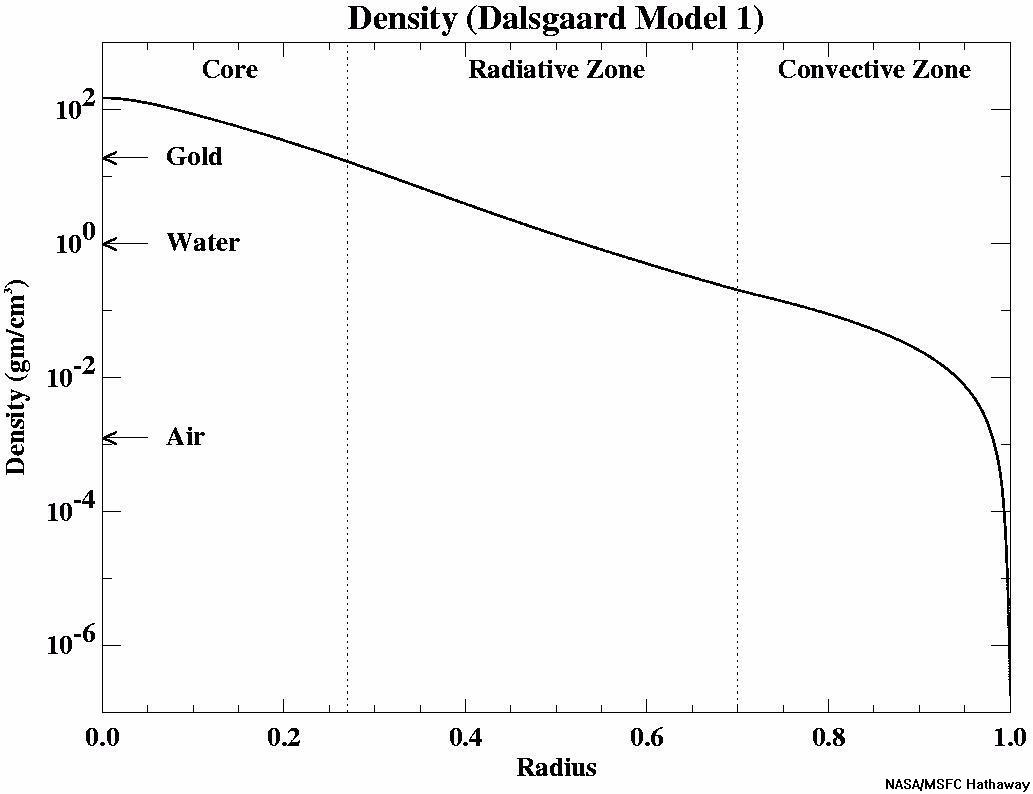
Here's a graph of density for our sun from a NASA.gov website.


Dalsgaard1_density_vs_r.jpg


Interesting that with a log scale it's a fairly straight line most of the way out to the "surface" (photosphere), but I doubt that would be the same for Betelgeuse.
 
Last edited:
Years ago I took an intro to astronomy class and posed a question the professor couldn't answer: is it possible for a star to be green? If not, why not? If so, why aren't we seeing any?
 
No black body spectrum appears green to our eyes.


ETA: I thought that would be hard to google, but that exact question actually has a wikipedia page dedicated to it.
 
Last edited:
Years ago I took an intro to astronomy class and posed a question the professor couldn't answer: is it possible for a star to be green? If not, why not? If so, why aren't we seeing any?
It's to do with so called 'black body radiation' curves - when the peak of the emission spectrum is in the green (which I think may be the case for our own sun) then the red and blue parts are also present so the object appears white to our eyes.

As temperature increases our eyes see red, yellow, white, blue. And it's not just some weird result of how the colour perception of our eyes work - scientific instruments agree (though obviously the colour names were invented in the first place to suit how our eyes work).
 
No black body spectrum appears green to our eyes.


ETA: I thought that would be hard to google, but that exact question actually has a wikipedia page dedicated to it.

Unfortunately that page assumes the reader knows what a "black body" is. The black body page defines it as "an ideal construct" which doesn't sound like a physical object at all, much less one that's radiating vast amounts of variously colored light. "Black body" sounds as opposite to a star as something could possibly be.
 
Exactly what a black body is and how it relates to emission, I'll let you google that or look it up on wikipedia.

How it relates to stars, well, basically stars are made of plasma, which basically means (very nearly) fully ionized gas. More to the point, it means a soup of electrically charged particles. Which are good at absorbing photons. It's probably as close to an ideal black body as you can possibly find in the universe.
 
Black bodies are called black bodies because that is their color when they are cold. They are objects that are emitting photons solely do to their temperature and not some other mechanism such a reflection.
 
Interesting that with a log scale it's a fairly straight line most of the way out to the "surface" (photosphere), but I doubt that would be the same for Betelgeuse.

TBH, actually I would expect it to be very similar, just with a higher slope.

Edit: just to clarify: higher slope if the X axis is still a percentage of the star radius. LESS slope if you just use km on the X axis.
 
Last edited:
Black bodies are called black bodies because that is their color when they are cold. They are objects that are emitting photons solely do to their temperature and not some other mechanism such a reflection.

Thank you, that makes sense. Unlike the post above it, which seems to suggest stars absorb light rather than emit it.
 
It doesn't actually matter if the star is actually black or any other color, it's sort of a confusing term that way. The actual point is that you are considering only the light emitted, not reflected. A planet could be green or any other color because when we look at a planet we see the light that it reflects, not the light that it emits, whereas when we look at a star we see emitted light, not reflected light. And that emitted light is called black body radiation.
 
One way to think about black body radiation is to think about lava, or melted steel in a foundry. Lava when it's hot will glow red or orange. The hotter it is, the brighter the light. That light you see from hot lava or melted steel is black body radiation. Even at night you can see it because it is emitted light and the spectrum it emits depends on its temperature. Once it cools down, the lava may turn black, but it doesn't really matter because then you are only seeing reflected light.

ETA: since stars are mostly made of hydrogen and helium, they would be mostly transparent if they were cold, like air. Air too would start to glow red when it gets hot enough.
 
Last edited:
Thank you, that makes sense. Unlike the post above it, which seems to suggest stars absorb light rather than emit it.

Yes, that charged particle soup is actually very good at absorbing light of all wavelengths. And then emit it again, according to the black body radiation. A photon from the core is absorbed and re-emitted gazillions of times until it finally gets emitted off the surface and finally breaks free. After a long long LONG time from when that energy was produced in the core.
 
ETA: since stars are mostly made of hydrogen and helium, they would be mostly transparent if they were cold, like air. Air too would start to glow red when it gets hot enough.

Indeed. And air too can get completely opaque to light and turn into a pretty black body if heated enough. The fireball of a nuke is almost completely opaque to light, for example. It's also hot, hence bright.
 
Just as a clarification, which may be what's not obvious here: the better something is at absorbing light, the better it also is at emitting it when hot. If you had a perfectly black thing (e.g., a narrow partial hole in a block of metal) and a very reflective thing next to each other, and heated them to a nice orange glow, the black one would actually be brighter.

So basically stars are good at emitting light BECAUSE they are very good at absorbing light.

Conversely, a thermos flask is mirrored because that too helps a bit with making it insulating. The vacuum helps prevent transmitting heat that way, but the mirroring also means less heat is radiated.

Basically think of it this way: you can run the same process in reverse. Whatever parameters are good for absorbing a photon, are also good for emitting one, and viceversa.
 
Last edited:
I skimmed the thread so far, and didn't find that this here has been discussed:

The original question is whether dimming is the prelude to, or last stage before, exploding as supernova.

I read the other day that it is the other way, usually: Stars that went supernova have been observed to brighten up somewhat before exploding.

So whatever the reason for Betelgeuse's dimming, it's not indicative of imminent explosion.
 

ISF - Join now!

Every member here is approved by hand. No bots, no spam, just people who care about evidence and honest debate.

Membership is free!

Create your free account

Back
Top Bottom