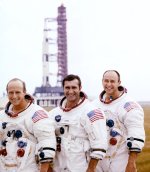
Apollo 11 Moon Landing Revisited: Hoax ~vs~ Debunk

Once the film is changed, you know? Once it comes to the end. The Apollo11 astronauts had to remove and replace the film casing with their hands still wearing thick gloves.
A Hasselblad film back is remarkably easy to change. You just snap it on the camera, and to remove it, you just push a lever to unlock it. You can see the lever on the top, here, labeled 'LOCK'.

hassel4 (1).jpg
 
A Hasselblad film back is remarkably easy to change. You just snap it on the camera, and to remove it, you just push a lever to unlock it. You can see the lever on the top, here, labeled 'LOCK'.

View attachment 78097
Given that other photo of Buzz Aldrin recently posted, are sure that's what the label says? :P
 
Okay, so are you saying the film Ektachrome developed specifically for Apollo11...
Ektachrome was introduced in 1946. Try again.

...was definitely polyester backed, with no gelatine?
This is exactly what I was talking about. You have no idea what you're talking about, but that's it going to prevent you from pretending you're the only one who does.
 
You seem to be conflating the film emulsion with the film base backing.
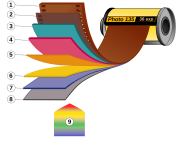
Photographic_Film_135.svg.png
1. Film base
2. Subbing layer
3. Red layer
4. Green layer
5. Yellow filter
6. Blue layer
7. UV filter
8. Protective layer

Of course in color film the emulsion is actually applied to the base in several layers. That Smarter Every Day series I linked to back in the late Paleolithic era of this thread showed the fascinating Kodak process for producing 35 mm color film.
 
You don't know what makes up photographic film. You're confusing emulsion with base.
Her instinct seems to be to use as many technical words concerning some subject as she can in an attempt to sound well versed. If your audience is composed of people who know next to nothing about how a car works, then you can probably impress them with talk about adjusting the points and re-jetting the carburetor on a 2024 Honda Accord. But an audience that knows something about cars is going to have the opposite reaction. Her audience here, of course, is composed of people who know far more about the Apollo Program (and related subjects like photography, physics and engineering) than most people, especially herself, and it makes me curious as to whether she's genuinely trying to force this charade forward as she would with an audience of equally ignorant rubes, or if being told she's wrong and theatrically insisting she's not the whole point of the performance?

 
Prior to changing magazines, the astronauts took several sacrificial exposures to wind the important exposures deep within the magazine. The primary radiation exposure to film still near the gate was from visible light.
Ah, then I guess the dark slides (or whatever the correct terminology is for the metal plate is) were too fiddly to operate with gloves on? (You may well have explained this before, apologies if so.)
 
Ah, then I guess the dark slides (or whatever the correct terminology is for the metal plate is) were too fiddly to operate with gloves on? (You may well have explained this before, apologies if so.)

The Reseau plate meant that the dark slide had to be removed with the magazine off the camera, hence the need to expose a few shots to allow for accidental exposure.

Wouldn't mind betting the process is on TV in the J missions.
 
Ah, then I guess the dark slides (or whatever the correct terminology is for the metal plate is) were too fiddly to operate with gloves on? (You may well have explained this before, apologies if so.)
I did explain it earlier, but you can hardly be faulted for not remembering it amidst 600 pages of Vixensplaining.

The glass reseau plates that applied the little crosshairs precluded attaching the magazines with the darkslide in place. They occupied the space in front of the magazine that would ordinarily be taken up by the darkslide prior to its being removed. The magazines were sent with the dark slides in place, but the darkslide was removed and discarded prior to attaching the magazine. The darkslide was fitted with a large wire loop for easy grasping in gloves. Normally the darkslide would be removed after attaching the magazine and reinstalled prior to removing the magazine.

Obviously the frame in the gate would be immediately ruined. But after attaching the magazine, the astronaut took a few exposures to bring fresh film from deep in the magazine into the gate. Congruently at the end of the roll, the astronaut wound several throwaway exposures through the gate so that the prior important frames would be preserved in the magazine. The the astronaut simply removed the magazine and stowed it in the film bag. Obviously here too, the frame in the gate would be ruined. Some of the dupe masters preserve these sun struck frames.

But yes, the surface of the Moon is littered with dozens of discarded darkslides.
 
Okay, I'll stop with the Apollo pictures, but I follow Andy Saunders on X. His book, Apollo Remastered, is a celebration of the lunar missions featuring high-resolution, digitally remastered NASA photos, and 16mm film transfers:


Just sharing because Christmas is around the corner. He also has a companion book covering Mercury and Gemini.

(Saunders is British, so obviously the Royal Family must be involved with the hoax/coverup).
 
Don't you realise that changing a magazine invariably ruins the film? It lets all the radiation in!

If you ever see something that's claimed to be a photograph, it's a hoax. Cameras actually contain very small demons with paintbrushes. I've read about them in a book.
Like watches. Don't buy a cheap watch though, the demons evaporate fairly quickly.
 
Her instinct seems to be to use as many technical words concerning some subject as she can in an attempt to sound well versed. If your audience is composed of people who know next to nothing about how a car works, then you can probably impress them with talk about adjusting the points and re-jetting the carburetor on a 2024 Honda Accord. But an audience that knows something about cars is going to have the opposite reaction. Her audience here, of course, is composed of people who know far more about the Apollo Program (and related subjects like photography, physics and engineering) than most people, especially herself, and it makes me curious as to whether she's genuinely trying to force this charade forward as she would with an audience of equally ignorant rubes, or if being told she's wrong and theatrically insisting she's not the whole point of the performance?

And people who know far more about the Apollo Program than they did before she decided to publicly humiliate herself.
 
Obviously the frame in the gate would be immediately ruined. But after attaching the magazine, the astronaut took a few exposures to bring fresh film from deep in the magazine into the gate.
So this is basically the equivalent of winding on the film after you have loaded it in the camera (just for the benefit of people who have actually used a regular 35mm camera).
 

ISF - Join now!

Every member here is approved by hand. No bots, no spam, just people who care about evidence and honest debate.

Membership is free!

Create your free account

Back
Top Bottom