Anthopogenic Global Warming Myth or Real ?

Considering these events occur (and have always occurred) every 2-7 years and last 1-2 years this seems a pretty obvious bet. Don't know about hotter than 98 however. It would have to be a pretty big one to get there.

See above on that; I'm not foolhardy enough to predict the severity of an El Nino. Given how much warmer we are now than in '96-97, it won't take much to bust the global temperature record, by whatever measurement.

I don't actually assign any great significance to El Nino/La Nina/Es Nada events in climate terms. My interest is in how the "global warming stopped in '98" brigade tries to extricate itself. It's a show that never ends :).

That "it stopped in '98" meme first emerged in early 2005, and as I recall the tag-line it was "no warming for seven years". Before 2005 the usual suspects were emphasizing how unusual '98 was, and the rest of us were agreeing. After 2005 they dropped that with some alacrity. At last they'd found a friendly decade to live in.

Decades only last so long, of course :).
 
No, what I expect is that the global temperature will exceed '98, even with a weaker effect. The reason being that it will be starting from a higher baseline. You'll recall that in early 2007 the Hadley Centre predicted that if the El Nino conditions persisted, that year would take the record from '98. That didn't depend on the strength of the El Nino, just that it hung around.

The '98 El Nino was remarkably strong, and I don't expect anything like a repeat. What we'll likely see is a moderate El Nino exceeding a strong one, and the deathknell of "global warming stopped in '98". Or at least the headless phase of that particular chicken :).

In the meantime, Solar Cycle 24 will or won't have done this or that, either of which will prove whatever in retrospect.

The '98 event caused a 1.5c warming vs a 0.25c average for El Nino. You're relying on the intrinsic temp increase to compensate for a 1.25c difference.

As always, your predictions are......brave.

:)
 
Last edited:
The '98 event caused a 1.5c warming vs a 0.25c average for El Nino. You're relying on the intrinsic temp increase to compensate for a 1.25c difference.

As always, your predictions are......brave.

:)
In one place, Capel predicts a " A sustained El Nino will occur in the next two-to-seven years", in another, he used the phrase "an extended El Nino" .

So I would assume he's calling for somewhat stronger than average El Nino, yielding a less probable version at an improbable time.

But is this presumed to be some sort of "proof of AGW" or what?

What I read into it (and I leave him to clarify) is that he expects a coming El Nino to overwhelm the current 10 year static or cooling world temperature, that being by definition the PDO cool phase.

Otherwise, what we have empirically is:

1. No global temperature rise and/or cooling to 2015-2030
2. Any "AGW" considerably weaker in net effect than #1.
 
In one place, Capel predicts a " A sustained El Nino will occur in the next two-to-seven years", in another, he used the phrase "an extended El Nino" .

I saw that too and am curious what CD means. ENSO events generally last about 18 months plus or minus 6.

So I would assume he's calling for somewhat stronger than average El Nino, yielding a less probable version at an improbable time.

But not impossible and he admits he likes to go against the odds.

But is this presumed to be some sort of "proof of AGW" or what?

What I read into it (and I leave him to clarify) is that he expects a coming El Nino to overwhelm the current 10 year static or cooling world temperature, that being by definition the PDO cool phase.

That’s how I see it too and why I called his prediction ‘brave’.

Otherwise, what we have empirically is:

1. No global temperature rise and/or cooling to 2015-2030
2. Any "AGW" considerably weaker in net effect than #1.

I assume you’re basing number one on the PDO reversal?

I lean towards agreeing with you with the warning that we’ve seen the PDO slip into a negative phase briefly in both the late teens and late 90’s and in both cases the situation did not last. If we truly have a reversal it will be interesting times, no doubt. (And CD will loose his bet about the Arctic ice extent.)
 
I saw that too and am curious what CD means. ENSO events generally last about 18 months plus or minus 6.

But not impossible and he admits he likes to go against the odds.

That’s how I see it too and why I called his prediction ‘brave’.

I assume you’re basing number one on the PDO reversal?

I lean towards agreeing with you with the warning that we’ve seen the PDO slip into a negative phase briefly in both the late teens and late 90’s and in both cases the situation did not last. If we truly have a reversal it will be interesting times, no doubt. (And CD will loose his bet about the Arctic ice extent.)
Yes.

Capeldodger considers climate to have baselines, like "a new baseline since 1998" . I don't buy that and think it is more a random walk on long term trends. But, Capel's "new baseline" actually does fit part of the PDO temperature effect - superimposed heavy blacK line.


Pacific Decadal Oscillations Closely Tied to ENSO
By Joe D'Aleo
 
Last edited:
I saw that too and am curious what CD means. ENSO events generally last about 18 months plus or minus 6.
From his reply to me it seems clear that he means an El Nino that persists for the usual 12 months or more, rather than peters out much sooner in the unusual way the one in 2007 did.

I do indeed remember the Hadley prediction, CD. I have found and quoted it several times to the deniers here, who insist on misremembering it is as a false Hadley prediction when - as you say - it was contingent on the El Nino conditions persisting as they typically would, but in the event did not.
 
Yes.

Capeldodger considers climate to have baselines, like "a new baseline since 1998" . I don't buy that and think it is more a random walk on long term trends. But, Capel's "new baseline" actually does fit part of the PDO temperature effect - superimposed heavy blacK line.


[qimg]http://www.internationalskeptics.com/forums/imagehosting/thum_142244723654333cdb.png[/qimg]

Pacific Decadal Oscillations Closely Tied to ENSO
By Joe D'Aleo

I've pulled you up on that graph once already; that conveniently-chosen sinusoid doesn't match up with the ENSO. Also, you've yet to explain how an oscillation could cause the sustained rise in temperatures that is under discussion here.
 
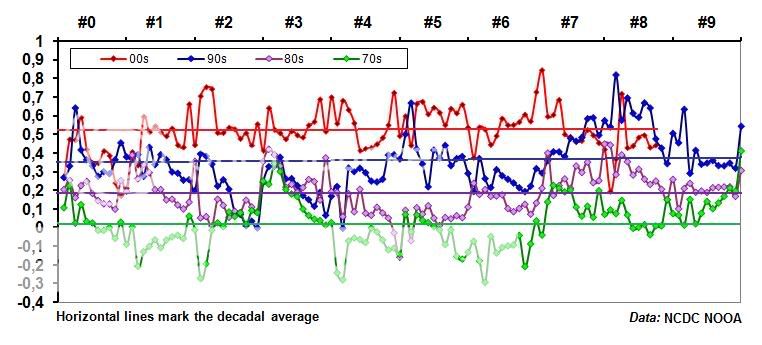
Personally, I think it's quite clear what CD means by a new baseline...

decadaltemp.jpg


The next El Niño doesn't need to be big... it just needs to show up.
 
In one place, Capel predicts a " A sustained El Nino will occur in the next two-to-seven years", in another, he used the phrase "an extended El Nino" .

So I would assume he's calling for somewhat stronger than average El Nino, yielding a less probable version at an improbable time.

What I mean is an El Nino isn't truncated as the 2006-7 El Nino was.

But is this presumed to be some sort of "proof of AGW" or what?

It's a prediction, and nobody with English as a first language would presume that a prediction is proof of anything.

Of course, when a prediction comes to pass it's evidence that the guy making the prediction might well know what he's talking about. Or it might be dumb luck, whatever.

What I read into it (and I leave him to clarify) is that he expects a coming El Nino to overwhelm the current 10 year static or cooling world temperature, that being by definition the PDO cool phase.

So when did this cool phase of the PDO kick in? Ten years ago?

Otherwise, what we have empirically is:

1. No global temperature rise and/or cooling to 2015-2030

Without benefit of time-travel we can have no empirical knowledge of the future. You're predicting a cooling phase. What's your reasoning?

2. Any "AGW" considerably weaker in net effect than #1.

Gibberish, frankly.
 
The '98 event caused a 1.5c warming vs a 0.25c average for El Nino. You're relying on the intrinsic temp increase to compensate for a 1.25c difference.

As always, your predictions are......brave.

:)

Not in this case (and I prefer "bold" anyway :)). In January 2007 the Hadley Centre predicted that if the El Nino conditions persisted, 2007 would exceed '98. You should check your source for the 1.5C anomaly -was it simply year-on-year (97-98) as against the average anomaly, or more sophisticated?

There was a big kick in '98, no doubt about it, but AGW was going on at the time. And still is, despite the protestations of basement-dwellers.
 
I do indeed remember the Hadley prediction, CD. I have found and quoted it several times to the deniers here, who insist on misremembering it is as a false Hadley prediction when - as you say - it was contingent on the El Nino conditions persisting as they typically would, but in the event did not.

It bears repeating, if only as a prophylactic :).

We seem to be zeroing-in (courtesy of the indefatigable mhaze) on the 20-year cooling phase I've picked up out in the weird-sphere. That's not going to turn out well, any more than the 60-80 year cycle that was supposed to explain arctic-ice retreat before summer 2005.

(mhaze and the 60-80 year cycle used to be, like, an item, y'know?, but he never mentions it now.)
 
Not in this case (and I prefer "bold" anyway :)). In January 2007 the Hadley Centre predicted that if the El Nino conditions persisted, 2007 would exceed '98. You should check your source for the 1.5C anomaly -was it simply year-on-year (97-98) as against the average anomaly, or more sophisticated?

There was a big kick in '98, no doubt about it, but AGW was going on at the time. And still is, despite the protestations of basement-dwellers.

My source was Wikipedia. A little childish I know but I never claimed to be more than an interested amateur.

If you’re telling me they’re wrong it would hardly be the most surprising thing I’ve heard this week.
 
Five more years will tell I guess.

Five more years will tell us more about Solar Cycle 24 and the "twenty-year cooling phase". I'll be holding out for the full seven, as stipulated. El Nino is a wayward child.

In five years we'll have empirical evidence for half of SC24, a quarter of the predicted "cooling phase", and a better understanding of the PDO. I doubt any of it will have turned out well for the usual suspects by 2013. With luck we'll be able to discuss the situation in hindsight :).
 
Five more years will tell us more about Solar Cycle 24 and the "twenty-year cooling phase". I'll be holding out for the full seven, as stipulated. El Nino is a wayward child.

In five years we'll have empirical evidence for half of SC24, a quarter of the predicted "cooling phase", and a better understanding of the PDO. I doubt any of it will have turned out well for the usual suspects by 2013. With luck we'll be able to discuss the situation in hindsight :).

Question for you Mr Dodger. I'm not trying to be a jerk, I'm just curious.

If we get mild cooling for say 5 out of the next 7 years If the next ENSO event is fairly ordinary and we don't come near the 98 max. If the Artic remains stubbornly icy. Will it actually mean anything? Will you consider the possibility that there may be a flaw in the AGW hypothesis?

By 2015 we'll know a great deal more about the climate but I'm not convinced we'll have any real answers.
 
Question for you Mr Dodger. I'm not trying to be a jerk, I'm just curious.

If we get mild cooling for say 5 out of the next 7 years If the next ENSO event is fairly ordinary and we don't come near the 98 max. If the Artic remains stubbornly icy. Will it actually mean anything? Will you consider the possibility that there may be a flaw in the AGW hypothesis?

It would blow AGW away, and I'd have to come to terms with a lot of new physics.

By 2015 we'll know a great deal more about the climate but I'm not convinced we'll have any real answers.

Tell me that you're still not convinced come 1015, when you're older and wiser with another seven years of empirical evidence to go by, and we'll talk about it.
 
It would blow AGW away, and I'd have to come to terms with a lot of new physics.

I find it interesting that you think this. Seems to me that it would only take one significant negative feedback mechanism that we're not currently aware of. Hardly an impossibility surely?

Tell me that you're still not convinced come 1015, when you're older and wiser with another seven years of empirical evidence to go by, and we'll talk about it.

I'm partly convinced now. I'm also partly sceptical. Another 7 years will probably change the ratio a little I admit.
 
I find it interesting that you think this. Seems to me that it would only take one significant negative feedback mechanism that we're not currently aware of. Hardly an impossibility surely?

Not impossible, but by that token, neither is an unknown positive feedback. An overnight recovery in the world's economy isn't impossible, but based on all available evidence, it's probably not going to happen and we'd be daft to plan around it. The current trend in surface temperatures is not unexpected given what the ocean currents are up to right now, so what reason (beyond wishful thinking) do we have to think the earth will cool down through the next El Nino?

If some new important process that we've not considered before rears its ugly head, the best we can do is attempt to understand it and incorporate it into the science and modify our predictions accordingly. It's worth pointing out though that negative feedbacks only reduce something's effect, not cancel it out. If there was some unknown process that will kick in and reduce the earth's temperature back down to normal (whatever that is), it's taking its sweet time about doing it if the last century is anything to go by.
 
I find it interesting that you think this. Seems to me that it would only take one significant negative feedback mechanism that we're not currently aware of. Hardly an impossibility surely?

You would still need to be able to explain paleo-climate data with that new negative feedback in play. If there is a strong unknown negative feedback it must be one that does not prevent warming when the world comes out of an ice age. This would put some very significant constraints over what this feedback could be.
 

Back
Top Bottom