I've read your response to my "challenge", BeAChooser, and at no point did you actually do what I asked.
That's not true, Frank. You wrote: "please use plasma cosmology to explain the following observations". You said "You MUST compare directly to observations." And I did. And I also pointed out how wrong Big Bang is in explaining observations in many areas. Which you just ignored. Don't think lurkers didn't notice.

So, out of politeness, I will repeat it. Please PROVIDE PREDICTED VALUES for the following:
So now you want to change the playing field and demand what Plasma Cosmology "predicted" for those things? Ok. Of course, I will also look at how well Big Bang astrophysicists did in predicting those things. I don't think you're going to like the result.
-the age of the universe (at least older than the solar system!)
Well, given that I already stated that Plasma Cosmology does not predict an age for the universe (just that it's old enough for the structures we see to form), I'm not sure what you are asking.
But it is interesting to again note that in order to make the age Big Bang cosmology says the universe has been around longer than the age Big Bang astrophysicists say certain types of stars have been around, they've had to introduce this notion of Dark Energy (an invisible, undetectable *energy* with bizarre characteristics that they say accounts for 76% of the universe). 76%. No minor fudge. And you just ignore that, Frank.
It is interesting to note that in my posts on this thread, I've quoted a mainstream astronomer who recently said that his team found a large structure (string of galaxies) in the distant universe that would have taken so long to form that Big Bang proponents are going to have to go back to the drawing board and reexamine their theories of the formation of the universe. And you just ignore that, too.
And you also ignored my pointing out that the 2004 American Astronomical Society meeting found that the universe looks very similar at high redshifts to its appearance today. Galaxies from 10 billion years ago appear to have a similar distribution of stellar ages and a similar spectrum of chemical elements produced by stars to that of our present-day galaxy. If the Big Bang really happened, these galaxies should appear much younger, with fewer heavy metals and mostly young stars. So we find yet another clue that the age predicted by Big Bang for the universe is wrong.
-the abundance of light elements (e.g., hydrogen, helium, and lithium)
Big Bang proponents claim the Big Bang theory predicted the abundance of hydrogen, helium and lithium. But did they?
Big bang predictions of the ratio of helium to hydrogen have been repeatedly adjusted to agree with the latest available estimates of the observed ratio. Is that what you mean by "prediction"?
Eric Lerner in
http://bigbangneverhappened.org/ states "Big Bang Nucleosynthesis (BBN) predicts the abundance of four light isotopes(4He, 3He, D and 7Li) given only the density of baryons in the universe. These predictions are central to the theory, since they flow from the hypothesis that the universe went through a period of high temperature and density--the Big Bang.
In practice, the baryon density has been treated as a free variable, adjusted to match the observed abundances. Since four abundances must be matched with only a single free variable, the light element abundances are a clear-cut test of the theory.
In 1992, there was no value for the baryon density that could give an acceptable agreement with observed abundances, and this situation has only worsened in the ensuing decade."
Lerner goes on to give considerable detail as to why the above is true, summing up his discussion thus: "Even ignoring 3He, the current observations of just three of the four predicted BBN light elements preclude BBN at a level of at least 7 s. In other words, the odds against BBN being a correct theory are about 100 billion to one. It is important to emphasize that BBN is an integral part of the Big Bang theory. Its predictions flow from the basic assumption of the Big Bang, a hot dense origin for the universe. If BBN is rejected, the Big Bang theory must also be rejected. Recently, Big Bang theorists have interpreted precision measurement of the anisotropy of the CBR as providing a direct measurement of the baryon density of the universe[15].(The CBR will be examined in more detail in section IV). These calculations imply h=6.14+-0.25 x10⁻¹⁰, a D abundance of 2.74+-0.2x10⁻⁵, a 7Li abundance of 3.76+1.03-0.38x10⁻¹⁰ and a 4He abundance of 24.84+-.04 %. While much has been made by Big Bang advocates of the agreement with D observations, overall this makes matters still worse for the validity of BBN, for the 7Li value alone is now excluded at a 7 s level, and the 4He is excluded at a 2 s level even for the highest estimate and at between a 4 s and 12 s level for the other estimates.
Very conservatively, this increases the odds against BBN, and therefore against the Big Bang itself, being a valid theory to above 2 x10-14 to one."
You wanted numbers. You got numbers.
Now here's what Lerner say about Plasma Cosmology:
*************
"In contrast to the extremely bad performance of BBN, the predictions of the plasma alternative have held up remarkably well. Plasma filamentation theory allows the prediction of the mass of condensed objects formed as a function of density. This leads to predictions of the formation of large numbers of intermediate mass stars during the formations of galaxies[8-10]. These stars produce and emit to the environment large amounts of 4He, but very little C, N and O. In addition cosmic rays from these stars can produce by collisions with ambient H and He the observed amounts of D and 7Li.
The plasma calculations, which contained no free variables, lead to a broader range of predicted abundances than does BBN, because the plasma theory hypothesizes a process occurring in individual galaxies, so some variation is to be expected. The range of values predicted for 4He is from 21.5 to 24.8 %. However, the theory is still tested by the observations, since the minimum predicted value remains a firm lower limit (additional 4He is of course produced in more mature galaxies).
This minimum value is completely consistent with the minimum observed values of 4He abundance, such as UM461 with an abundance of 21.9+-0.8 .
Further confirmation of these 16-year old predictions is in the widely noted observations that no galaxies, indeed no stars, have been observed that are entirely free of heavier elements, which is in accord with the predictions of the plasma-based stellar production of light elements.
Deuterium production by the p+p->d+p reaction has been predicted by plasma theory to yield abundances of the order of 2.2x10⁻⁵[8]. While more precise calculations will have to be done to improve this figure and to define the range of values that are likely,
it is notable that this prediction was made in 1989, at a time when no observations of high redshift D was available and the consensus values for primordial D from Big Bang theory were 3-4 times higher. Yet this predicted value lies within the range of observed high-z D values, although somewhat below the average D values.
In its present form, the plasma-stellar theory of light elements does not give a prediction for the absolute abundance of 7Li. The observed low and variable abundances of cosmic -ray spallation products of C, N, and O, which are 9Be and 11B in old stars, indicates that 7Li was probably formed by He-He fusion in the interstellar medium, but more modeling will be needed to develop concrete predictions.
The most dramatic confirmation of the predictions of the plasma-stellar model is in the discovery of large number of white dwarfs in the halo of the Milky Way. Since the theory predicts the formation of an initial population of intermediate-mass stars, it is a straightforward deduction that these stars must leave behind white dwarfs that should exist at present. Specifically the theory predicts that somewhat less than half the total mass of the galaxy should exist in the form of collapsed cores-either white dwarfs or neutron stars[27], and for the intermediate stars, which are too small to become supernovae, the normal end-point would be white dwarfs.
Recent observations of high proper motion stars have shown that halo white dwarfs constitute a mass of about 1011 solar masses, comparable to about half the total estimated mass of the Galaxy[28-29]. While these observations have been sharply criticized, they have been confirmed by new observations[30].
Not only are the existence of these numerous white dwarfs confirmation of much earlier predictions by the plasma theory, they create new and insurmountable problems for BBN. Even if the progenitor stars were only 2-3M, a mass of He equal to about 10-15% of the mass of the remnant white dwarfs would be released into the ISM. This would account for at minimum 50% of the observed He abundance, reducing the possible contribution from the Big Bang to less than 12% of the total mass. Such a low production of 4He is impossible with BBN for a baryon/photon ratio even as low as 1x10⁻¹⁰. Thus the plasma model has successful predicted a new phenomenon, while the BBN model has been decisively contradicted by observation."
*************
Oh oh ... you asked for numbers and you got numbers.
-the existence of the CMB (e.g., temperature)
-the power spectrum of the CMB (e.g., the l=200 peak, isotropy)
-the spectral index of CMB fluctuations
I notice you just ignored the lastest WMAP observation suggesting that the CMB might not be coming from behind galaxy clusters.

But let's look at the predictions Big Bang made for the CMB temperature anyway. Those predictions varied over a range of 5 to 50 K. Some Big Bang cosmologists adjusted their "predictions" to agree with observed temperatures. The prediction of 5 K, which was touted as agreement with the observed temperature, was made by scientists who had accepted a Big Bang cosmology that included concepts that were incorrect. And some scientists had noted that the temperature of radiation from space might reasonably be expected to be some small number of degrees above absolute zero anyway. In fact, some estimated temperatures in the range of 2 to 3 K; closer to that of the measured temperature than was estimated by Big Bang cosmologists, well before Big Bang cosmologists even existed.
http://www.plasmacosmology.net/bb.html "Big Bang supporters are fond of claiming CMB radiation as conclusive evidence for their theory, but these claims begin to look somewhat revisionist in the light of the following facts. The background temperature of space was predicted by Guillaume, Eddington, Regener, Nernst, Herzberg, Finlay-Freundlich and Max Born, based on a universe without expansion, and prior to the discovery of the CMB. Their predictions were far more accurate than models based on the Big Bang."
You might want to read this:
http://72.14.253.104/search?q=cache...ckground+temperature&hl=en&ct=clnk&cd=3&gl=us "History of the 2.7 K Temperature Prior to Penzias and Wilson ... snip ... Our conclusion is that the discovery of the CBR by Penzias and Wilson is a decisive factor in favour of a Universe in dynamical equilibrium, and against models of an expanding Universe, such as the Big Bang and the steady-state."
Oh oh ...
-the flatness of spatial curvature
Around 2000, several experiments found the universe to be almost geometrically flat. Like I said, plasma cosmology doesn't have a problem with the flatness of spatial curvature. Never did. And Big Bang theorists only get a flat universe by inventing a very special and unique event, inflation, that can only be described as magic that now they are trying to explain by invoking yet another invisible, untestable, bizarre mathematical construct ... string theory. Oh yeah ... Big Bang cosmologists have this problem solved.
-the matter power spectrum (e.g., scale of non-linear growth, presence of BAO peak)
-the lyman-alpha forest
Yeah ... you keep asking questions about that. I'll keep noting Big Bang scientists believe in dark energy because they don't know what those terms really mean and that such terms depend on a host of assumptions (like all redshifts are proportional to distance and haloing is real) that don't appear to be correct when observed data is looked at by plasma cosmologists.
-the luminosity-distance relations of type 1a supernova
I think I see what you are getting at, here. The distance relations here might be real since they don't depend on redshift. Can Plasma cosmology handle the possibility that regions of the universe are expanding away from some point? Sure.
It's even explained in
http://en.wikipedia.org/wiki/Plasma_cosmology "In 1971, Klein would extend Alfvén's proposals and develop the "Alfvén-Klein model" of cosmology. Their cosmology relied on giant astrophysical explosions resulting from a hypothetical mixing of cosmic matter and antimatter that created the universe or meta-galaxy as they preferred to speculate (see the Shapley-Curtis debate for more on the history of distinguishing between the universe and the Milky Way galaxy). This hypothetical substance that spawned the universe was termed "ambiplasma" and took the forms of proton-antiprotons (heavy ambiplasma) and electrons-positrons (light ambiplasma). In Alfvén's cosmology, the universe contained heavy symmetric ambiplasma with protective light ambiplasma, separated by double layers. According to Alfvén, such an ambiplasma would be relatively long-lived as the component particles and antiparticles would be too hot and too low-density to annihilate with each other rapidly. Annihilation radiation would emanate from the double layers of plasma and antiplasma domains. The exploding double layer was also suggested by Alfvén as a possible mechanism for the generation of cosmic rays[citation needed], x-ray bursts and gamma-ray bursts.[11] Ambiplasma was proposed in part to explain the observed baryon asymmetry in the universe as being due to an initial condition of exact symmetry between matter and antimatter.[12] According to Alfvén and Klein, ambiplasma would naturally form pockets of matter and pockets of antimatter that would expand outwards as annihilation between matter and antimatter occurred at the boundaries. Therefore, they concluded that we must happen to live in one of the pockets that was mostly baryons rather than antibaryons. The processes governing the evolution and characteristics of the universe at its largest scale would be governed mostly by this feature. Alfvén postulated that the universe has always existed[13] due to causality arguments and rejection of ex nihilo models as a stealth form of creationism.[14] The cellular regions of exclusively matter or antimatter would appear to expand in regions local to annihilation, which Alfvén considered as a possible explanation for the observed apparent expansion of the universe as merely a local phase of a much larger history."
Here's the index of Alfven's book:
http://www.plasma-universe.com/index.php/Cosmic_Plasma_(Boo) "Cosmic Plasma by Hannes Alfvén. Publ. 1981."
And a further description:
http://www.experiencefestival.com/a/Plasma_cosmology_-_Alfvns_model/id/5380663 "As theoretical considerations and experimental evidence from particle physics showed that matter and antimatter always come into existence in equal quantities, Alfvén and Klein in the early 1960s developed a theory of cosmological evolution based on the development of an "ambiplasma" consisting of equal quantities of matter and antimatter. Alfvén theorized that if an ambiplasma was affected by both gravitational and magnetic fields, as could be expected in large-scale regions of space, matter and antimatter would naturally separate from each other. When small matter clouds collided with small antimatter clouds, the annihilation reactions on their border would cause them to repel each other, but matter clouds colliding with matter clouds would merge, leading to increasingly large regions of the universe consisting of almost exclusively matter or antimatter. Eventually the regions would become so vast that the gamma rays produced by annihilation reactions at their borders would be almost unobservable. This explanation of the dominance of matter in the local universe contrasts sharply with that proposed by big bang cosmology, which requires a asymmetric production of matter and antimatter at high energy. (If matter and antimatter had been produced in equal quantities in the extremely dense big bang, annihilation would have reduced the universal density to only a few trillionths of that observed.) Such asymmetric matter-antimatter production has never been observed in nature. Alfvén and Klein then went on to use their ambiplasma theory to explain the Hubble relation between redshift and distance. They hypothesized that a very large region of the universe, consisting of parts alternately containing matter and antimatter, gravitationally collapsed until the matter and antimatter regions were forced together, liberating huge amounts of energy and leading to an explosion. At no point in this model, however, does the density of our part of the universe become very high. This explanation was appealing, because if we were at the center of the explosion we would observe the Doppler shifts from receding particles as redshifts, and the most distant particles would be the fastest moving, and hence have the largest redshift. This explanation of the Hubble relationship did not withstand analysis, however. Carlqvist determined that there was no way that such a mechanism could lead to the very high redshifts, comparable to or greater than unity, that were observed. Moreover, it was difficult to see how the high degree of isotropy of the visible universe could be reproduced in this model. While Alfven’s separation process was sound, it seems almost impossible for the process to reverse and lead to a re-mixing of matter and antimatter."
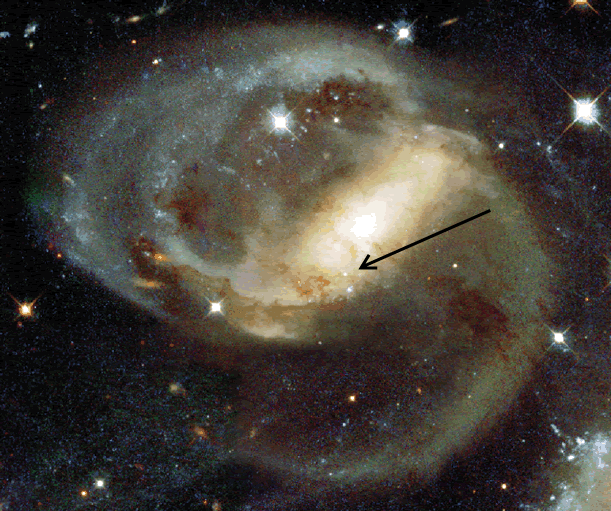
Let me point out that images like this
which I've discussed previously might challenge the assertion made above that Alfven/Klein's model doesn't work (because it's claimed there is no way the mechanism proposed could produce the very high redshifts observed). BUT most such redshifts are associated with quasars ... which that image proves can't be at the great distance the Big Bang proponents claim. And the other objects with high redshifts tend to get AGNs, which also may have a mechanism producing redshifted light. So maybe Alfven/Klein's model isn't falsified by observations after all?
And here are some other interesting items related to this topic:
http://www.springerlink.com/content/n216463814t475x5/ " A matter-antimatter separation mechanism"
http://www.springerlink.com/content/m3340j418xqn8071/ "Size of ambiplasma domains in the Universe"
http://www.springerlink.com/content/m630681632782587/ " Equations for a plasma consisting of matter and antimatter"
http://adsabs.harvard.edu/abs/1987STIN...8814053A "
Cosmology in the plasma universe, Authors: Alfven,*Hannes ... snip ... Publication Date: 05/1987 ... snip ... Criteria a cosmological theory must satisfy in order to be acceptable in the plasma Universe are considered. Matter-antimatter symmetry, and Klein's cosmological model are discussed. Prophetic and actualistic approaches to adopting Big Bang cosmology to the plasma Universe are assessed. Traditional Big Bang theory leads to difficulties due to the prophetic nature of its predictions. Actualistic approaches, extrapolating backwards from present conditions lead to increasing uncertainty the further they go. It is stressed, however that the Hubble expansion was caused by annihilation in a large region (1 billion light years) called Bigger Big Bang."
http://cossc.gsfc.nasa.gov/docs/cgro/epo/news/antimatter.html "ANTIMATTER CLOUDS AND FOUNTAIN DISCOVERED IN THE MILKY WAY, Scientists using data from an instrument on NASA Compton Gamma Ray Observatory (CGRO) have discovered two unexpected clouds of antimatter in the Milky Way Galaxy which scientists call antimatter annihilation radiation."
http://www.nasa.gov/centers/goddard/news/topstory/2003/0903rhessi.html "ANTIMATTER FACTORY ON SUN YIELDS CLUES TO SOLAR EXPLOSIONS"
http://www.spacedaily.com/reports/Where_Has_All_The_Antimatter_Gone_999.html "Where Has All The Antimatter Gone, Apr 12, 2007 ... snip ... Matter and antimatter were created in equal amounts in the Big Bang but
somehow the antimatter disappeared resulting in the Universe, and everything in it, including ourselves, being made of the remaining matter."
Somehow? It's hard not to laugh at all the handwaving the Big Bang proponents are doing. Oh what the heck ... ROTFLOL!
Say, Frank ... do you have an explanation for where the antimatter went? One that those who aren't in the priesthood could understand?
If I were to go out and measure the spatial curvature of the universe, what does plasma cosmology predict to be the answer?
Just what it is ... without the need for inflation or any other wacky, unexplainable nonsense. Now it's your turn, Frank ... tell our readers how many different models of inflation the Big Bang priesthood has dreamed up over the years ... because one magical gnome was not enough to fit the data ...
If I go looking for CMB anisotropies, at what multipole should I find the largest peak?
If I look for spectral index of CMB fluctuations, what does plasma cosmology say I will find?
So Frank ... the latest observational data from astronomers (that I cited earlier) suggests the CMB is not coming from behind galactic clusters like you and the Big Bang assume. You have an explanation? Because if you don't have one, I'd have to say your numbers mean next to nothing.
If I go looking at the distribution of matter in the universe, what are the RMS fluctuations in 8 Mpc spheres?
This question is truly hilarious when TV's Frank's experts are basing their numbers on a claim that 20% of the matter in the universe is invisible, non-interacting (except for gravity) and undetermined (because they can't seem to find it despite 30 years and thousands of mega-dollars trying). Just so everyone knows, their model assumes the existence of 5 TIMES more matter than ordinary matter (you know, the stuff that obeys physics as we know it here on earth). Which came first, Frank? The observations or that dark matter (and let's not forget the 76% dark energy) fudge factor you threw into your model?
You should get the idea. The above 4 questions have answers, from observations, that are simple numbers. There are very basic, fundamental aspects of our universe. So, from plasma cosmology, what should these numbers be? Feel free to give estimates and uncertainties with your answer, but try to be precise. That's all I want. 4 numbers. That's all your post has to be. That's all. If you can't limit your post to 4 numbers and associated discussion, then I will not read it.
Got him on the run, don't I folks.
ROTFLOL! I recommend readers try to make heads or tails of this:
http://www.valdostamuseum.org/hamsmith/cosconsensus.html It's probably where Frank gets all *his* numbers. And if its any guide, he has lots more where those 4 came from. And it took a lot of money and time to develope them. But in the meantime, as I've demonstrated, he can't even tell us why a high redshifted quasar would be in front of a low redshifted galaxy. And that's just one example I've noted. To put it simply, Frank can't see the forest through his numbers.

Now I wonder if TV'sFrank will

from the rest of things that are wrong with Big Bang. It's growing into quite a list:
http://72.14.253.104/search?q=cache...t+element+abundance&hl=en&ct=clnk&cd=13&gl=us "The Top 30 Problems with the Big Bang, April 2002"
ROTFLOL!