I see you have some technical questions above to answer, and I am sure you are getting round to them.
I did, and I hope you read and understood my answers. You will also see that I've been offering some technical questions of my own. And so far they are all going unanswered. Is that fair? Or is that just the way the Big Bang community works?
In laymans terms what is Plasma Cosmology?
Just so there is no confusion, Plasma Cosmology is not the steady state model.
It seems to me, above all else, that Plasma Cosmology begins with the view that electromagnetic phenomena (which is stronger than gravity) and plasma (which is subject to electromagnetic forces and far more common than uncharged matter) dominate the formation and behavior of the bodies we see in the cosmos.
That doesn't mean that gravity has no effect or no role, but the majority of the phenomena that are seen can be explained by a combination of gravity and electromagnetic-plasma linked phenomena where the latter usually dominates.
The physics of electricity, magnetism and plasmas are well understood. When scientists in those disciplines apply that knowledge to a universe filled with plasma and electrical currents (which produce magnetic fields), they find that the natural result is the filamentary structures we see everywhere we look.
There are many different plasma phenomena that seem to play a role in space. A very important phenomena is that when high intensity electric current passes through a plasma (they are excellent conductors), the currents naturally align themselves with the magnetic fields, causing the current carrying plasma to take on a corkscrew (spiral) shape. These are called Birkeland Currents and they usually occur in pairs.
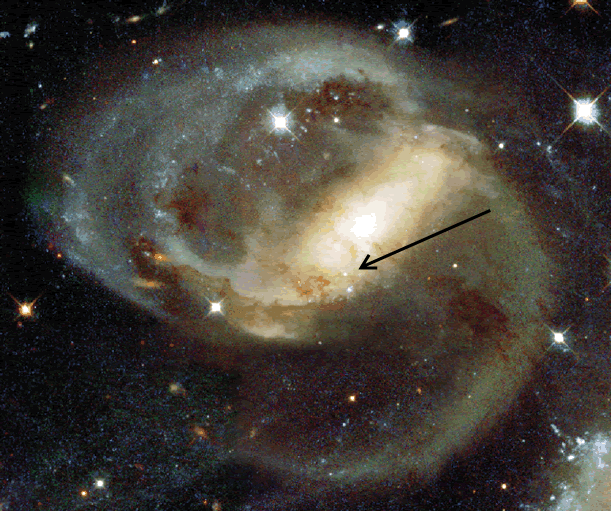
It was discovered that pairs of Birkeland Currents interact, accreting and compressing even non-ionized matter between them. They sort of wind up like two ropes spun together. And these joined pairs can then can interact with other Birkeland Currents. Anthony Peratt has demonstrated that pairs of Birkeland Currents (we are calling them currents but we are still talking about the plasma that is carrying the currents) can evolve the spiral like shapes seen in galaxies, as well as all the other galactic types that are seen.
A phenomena called a z-pinch can occur in these windings that can further concentrate matter and produce major electromagnetic effects. Plasma Cosmologists say these knots are where objects form ... stars, quasars, and galaxies ... in large Birkeland Currents. It has been demonstrated that z-pinches can produce jets composed of synchrotron radiation (something produced by new stars, quasars, and even seen in active galaxies), as well as everything else you can imagine in the way of particles and electromagnetic energy.
Nuclear physicists have been trying to use this pinch effect to create sustained fusion because the density/temperature/time conditions in these z-pinches can fuse material but they haven't as yet found them stable enough to sustain fusion for commercial use. But they might explain the generation of certain particles and elements found coming from the surface of stars.
Another important plasma phenomena is the Double Layer. Double Layers (DL) allow plasma to isolate electrically one section of itself from another. The isolating wall is made of two closely spaced layers, one consisting of positive charges and the other of negative charges. Most of voltage difference will be contained in it, thus, this is where the strongest electric fields are found. DLs form around lots of objects and can explain many phenomena that are seen in space, stars, galaxies.
The model that plasma cosmologists have for stars and galaxies once they form is also worth noting. It is called a homopolar motor and was first developed by Michael Faraday in 1831. Alfven developed an electric star model that is a homopolar motor. It can explain many aspects of solar behavior and the plasma currents that are seen streaming into and out of the sun. Alfven also applied the homopolar model to galaxies. Lerner modified that to explain the electromagnetic phenomena seen in the center of many galaxies and in quasars. Now remember, we are talking physics that is well understood and has been around for a long time. And there has been no need to invent magical particles, forces, interactions and events that no one has ever detected. Big Bang has inferred those thing to explain phenomena that plasma cosmology seems able to explain with well established physics.
How did the universe start or has it always existed ? How is it changing and what will it change into ?
What did is change from?
You might want to read the paper by Alfven that I linked above titled "On Hierarchical Cosmology". It presents his view of it back in the 1980s. There are changes to the theory since then, but I think it is still fundamentally intact. He also has a book titled Cosmic Plasma that goes into even more detail.
Probably the biggest change is the growing belief that the source of the energy output of stars is a plasma/electrical/magnetic phenomena rather than nuclear fusion driven. Don't laugh. They present a pretty convincing case. (See Donald Scott's book).
Also what will cause the change in opinion to Plasma cosmology?
Failure of the Big Bang community to address the contradictions with observations will eventually catch up to it. They won't be able to hide behind magical gnomes for ever.

What special prediction does it have that the other theories don’t?
I think I discussed this in the previous several posts. Suffice to say that Plasma Cosmologist has actually predicted many more observations than Big Bang Cosmology erroneously claims to have predicted. Most of Big Bang's predictions do not qualify as predictions as they have required major modifications to their model (often involving magical gnomes) to make the model fit the data that is observed.
And keep in mind that the resources that have gone into trying to support the Big Bang model are staggering in comparison to what resources have gone into investigating and supporting Plasma Cosmology. If those resources had been spent on investigating the latter, who knows where our understanding of the universe would stand today. Consider the implications to other fields if some of what plasma cosmologists say is true. The notion that the energy production of stars is an electric process would have a staggering effect on the whole field of energy production. Even the underlying notion we have of what matter is, might be different today because a lot of our investigation of particle physics has been driven by the need to support the Big Bang.
You are welcome.