You are using an out of date browser. It may not display this or other websites correctly.
You should upgrade or use an alternative browser.
Animal emotions including depression and suicide.
- Thread starter Cainkane1
- Start date
Number Six
JREF Kid

- Joined
- Sep 5, 2001
- Messages
- 5,016
Okay, maybe that's a form of the first one I listed, that dogs exhibit more of what we call emotion than other animals, on our first glance that is, which is why we find them endearing, but that it's not really more emotion than other animals but just some we more perceive as more emotion. So maybe a rabbit has a lot of emotion inside it but we don't see it because mostly it just sits there.
Possibly.
But the conclusion you drew was that some of what we perceived as emotion in dogs was not emotion. Now, that could be true, but it doesn't necessarily follow from the fact that we perceive more emotional behaviors in dogs. It could be that all of those perceived emotional displays really are emotional displays. It could be that dogs have an even richer emotional life than humans, and we are unable, for whatever reason, to pick up on the subtle cues. This might explain why some people get unexpectedly bit.
meow
Critical Thinker

- Joined
- Feb 7, 2009
- Messages
- 470
Okay, maybe that's a form of the first one I listed, that dogs exhibit more of what we call emotion than other animals, on our first glance that is, which is why we find them endearing, but that it's not really more emotion than other animals but just some we more perceive as more emotion. So maybe a rabbit has a lot of emotion inside it but we don't see it because mostly it just sits there.
almost every one of your posts is off the mark. we've been selecting dogs for specific traits for more than 30,000 years. we've been making them less wolf-like and less reptile-like the whole way through.
my dog doesn't lick me --ever; he's always happy to see me when i've been away even when his belly is stuffed full and he can't eat another bite.
--not only that but he insists on sleeping in the same room with me and if he doesn't get his way he'll cry all night. never heard of a lizard or rabbit insisting on sleeping with their owner.
Number Six
JREF Kid
- Joined
- Sep 5, 2001
- Messages
- 5,016
Possibly.
But the conclusion you drew was that some of what we perceived as emotion in dogs was not emotion. Now, that could be true, but it doesn't necessarily follow from the fact that we perceive more emotional behaviors in dogs. It could be that all of those perceived emotional displays really are emotional displays. It could be that dogs have an even richer emotional life than humans, and we are unable, for whatever reason, to pick up on the subtle cues. This might explain why some people get unexpectedly bit.
Yes but again that gets to, what is emotion. Maybe dogs have no emotional life at all and what we're seeing is something other than emotion and meanwhile turtles have the richest emotional life of any creature but it's emotion we can't see. It comes down to how emotion is defined, which I suspect has already been addressed by scientists.
Nursedan
Critical Thinker

- Joined
- Mar 16, 2010
- Messages
- 490
Didn't read the article but did read the OP -
I saw my Grandpa's dog essentially kill itself. We were fishing on his lake and the dog (very old and getting sick) jumped into the water from the other side of the lake, about 300 feet from us. He could have walked around the lake and jumped in (or he could have not jumped in at all) but he decided to jump in the water far from where we could save him. He struggled for about 100 feet then we realized what was happening and he went under and floated to the surface. I have to say it seemed as if he knew exactly what he was doing.
Edit: Ok read the article. About what I thought it would be.
Last edited:
caniswalensis
Master Poster

- Joined
- Jun 12, 2010
- Messages
- 2,561
When wolves leave their puppies alone, it's usually because they're off hunting. When the adults come back, the puppies greet them enthusiastically to get their attention. Then they try to lick the adults' faces, to get them to regurgitate some food. Dogs retain puppy instincts throughout life.
Despite that, I love to be joyously greeted by a dog.
If you really love it, you'd regurgitate.

Number Six
JREF Kid
- Joined
- Sep 5, 2001
- Messages
- 5,016
almost every one of your posts is off the mark. we've been selecting dogs for specific traits for more than 30,000 years. we've been making them less wolf-like and less reptile-like the whole way through.
my dog doesn't lick me --ever; he's always happy to see me when i've been away even when his belly is stuffed full and he can't eat another bite.
--not only that but he insists on sleeping in the same room with me and if he doesn't get his way he'll cry all night. never heard of a lizard or rabbit insisting on sleeping with their owner.
Dogs are pack animals and want to be with their alpha dog. And just because they're full doesn't mean they'd say "You know, I'm full so I won't try to get food." When they not full and they lick your face I doubt they're thinking "I hope master regurgitates some food." They just do it. As I said in another post, if it were a conscious effort to get you to regurgitate food they'd stop eventually since people never regurgitate food for their dogs to eat.
Dogs lick places other than people's face though. I don't know that it's a sign of emotion or affection. It might a grooming think or something else.
Number Six
JREF Kid
- Joined
- Sep 5, 2001
- Messages
- 5,016
I saw my Grandpa's dog essentially kill itself. We were fishing on his lake and the dog (very old and getting sick) jumped into the water from the other side of the lake, about 300 feet from us. He could have walked around the lake and jumped in (or he could have not jumped in at all) but he decided to jump in the water far from where we could save him. He struggled for about 100 feet then we realized what was happening and he went under and floated to the surface. I have to say it seemed as if he knew exactly what he was doing.
Dawgwin Award Winner.
I Ratant
Penultimate Amazing

- Joined
- Apr 8, 2008
- Messages
- 19,258
.Didn't read the article but did read the OP -
I saw my Grandpa's dog essentially kill itself. We were fishing on his lake and the dog (very old and getting sick) jumped into the water from the other side of the lake, about 300 feet from us. He could have walked around the lake and jumped in (or he could have not jumped in at all) but he decided to jump in the water far from where we could save him. He struggled for about 100 feet then we realized what was happening and he went under and floated to the surface. I have to say it seemed as if he knew exactly what he was doing.
Edit: Ok read the article. About what I thought it would be.
What he was doing was probably something he'd done before.
Nursedan
Critical Thinker
- Joined
- Mar 16, 2010
- Messages
- 490
.
What he was doing was probably something he'd done before.
Actually, this particular dog hadn't swam for years, being old and sick. I thought that as it was happening; that he was trying to reach us - but no, there didn't seem to be a reason for him jumping into the cold water (other than to end his life).

I'll add that before this experience I thought that humans were the only species aware of the fact that we will one day die. This experience made me question that.
Last edited:
Pup
Philosopher

- Joined
- Dec 21, 2004
- Messages
- 6,679
The pup licking the face of the mother dog is an example of our perception being different from what is going on. When they do it in the wild we say the pups are trying to get the mother dog (or wolf, whatever) to regurgitate food. When they do it to us it's suddenly because the dog loves us. But the drive for the dog is the same either way. (snip)
I guess maybe it all comes down to how emotions are defined. If human brains create human emotions what are dog brains capable of creating relative to human brains? I don't know exactly.
I think that one can state the case either way: Either "emotions" lead to actions by which we can deduce what other humans/creatures feel. Or actions feel like they're driven by something we wrongly call "emotions" but they're really just stimulus-response behaviors.
Both explanations work equally well for humans or animals.
Once can say that pups don't really "love" their parents and licking is just a way to get food, but one can say the same thing about human children, that smiling or hugging parents isn't because they "love" them, it's a successfully bred-in way to get attention and care, spurred by certain brain activity that provokes the behavior.
The problem is that one can only experience what that brain activity "feels like" oneself. When a person remembers what it "feels like" to want to hug her mother in childhood, it "feels like" the thing that we label with the word "love."
So it really does come down to a definition of what an emotion is, and therefore how one can observe it objectively in other animals/humans, without relying on behavioral indicators, even in humans.
To greatly oversimplify... As an example, if an increase in adrenaline is the defining characteristic of the emotion "excitement" in humans, then by definition, any animal experiences the emotion of "excitement" when their body increases adrenalin, whether they're a mouse or a human.
If that's not a suitable definition, then it needs refined until whatever we're getting at is achieved. And I have a feeling that "what we're getting at" would go down the political path of animal rights very quickly, with headlines: "Scientists say cattle at slaughter houses feel same emotions as humans" or "Scientists say cattle cannot feel any emotions."
Cheetah
Master Poster

I don't doubt that animals have some level of what humans call emotions but there are two difficulties I have with flat out stating what we see in animals is point blank emotion.
A lot of people seem to agree that at least mammals do seem to have emotions, but what about birds? If they do then surely mammals have too.
Whenever I’ve lived in a place with a garden I periodically toss out a few handfuls of birdseed and I enjoy watching the interactions between the different birds that come to feed. The general trend seems to be that there is a lot of squabbling between members of the same species (especially males), but different species seem to mostly ignore each other, or at least stay out of each other’s way (with larger more aggressive species having the right of way).
On one occasion I had a bunch of Masked Weavers, Laughing Doves and a single young male Rock Pigeon feeding, all three species basically ignoring each other.
A while later another, female, Rock Pigeon arrived and started feeding. The male immediately showed interest and starting to follow her around, but alas she was not at all interested and just wanted to fill up on some seeds.
The male started strutting around her, puffing out his chest, crooning, bobbing his head and very much trying to impress her. She would just turn her back on him and continue pecking up seeds. This went on for a few minutes, the strutting, bobbing and crooning growing progressively more exaggerated. When he got too in her face she would fly up into a tree, he would follow, continuing his antics, she would fly down again and grab a couple of seeds before he’d be there again.
This happened repeatedly, until he was literally bouncing up and down, bowing down until his chin touched the ground, rearing up as high as possible, puffing out his chest and crooning very loudly, strutting around like a wind-up toy, lifting his feet too high.
Eventually she had had enough and just took off and flew away, he froze, stood there in a seeming daze for a few seconds, his chest deflating.
He then suddenly swung around and grabbed a Weaver, yanking out a beak full of bright yellow feathers, turned and attacked a dove, ripping out half of it’s tail. This went on for a few minutes, whenever another bird would get close to him he’d go for them, until there were bunches of feathers scattered on the lawn. It took the other birds a while to realize that they now had an attack pigeon in their midst, before they took to the trees.
After just a few minutes he calmed down and started feeding again, the other birds returned and things were back to normal.
This certainly looked like an emotional response to me, what do you think, I’d be very interested?
This seems very similar to something that happens in pubs and clubs around the world, the young, cocky, horny guy trying to impress the girl, getting progressively more 'inventive' in his attempts, before finally being rejected, her leaving and him then taking his frustration out on someone else by picking a fight and beating them up.

Last edited:
Stomatopoda
Muse

- Joined
- Oct 24, 2011
- Messages
- 920
I don't understand why some treat emotion as a binary "yes/no" value, or separate from instinct. It seems (imo) more logical to view emotion as a very complex form of instinct. Also, I don't see how the idea of animals (including humans) having emotion as well as being biological "machines" are incompatible. A computer can be a trillion times more complex than a flashlight, but at no point does it ever stop being a machine.
Cheetah
Master Poster
^^^
I agree, but don't know if emotion is even more complex than any other instinct, I think they are sort of the same thing to a large degree.
Last edited:
Okay, maybe that's a form of the first one I listed, that dogs exhibit more of what we call emotion than other animals, on our first glance that is, which is why we find them endearing, but that it's not really more emotion than other animals but just some we more perceive as more emotion. So maybe a rabbit has a lot of emotion inside it but we don't see it because mostly it just sits there.
There are a few possibilities here, two of which are: dogs have the same amount of emotion as, say, crows, but they also have "fake" emotions that we misinterpret as real.
Or dogs have the same amount of emotion as, say, crows, but those emotions are more easily noticed by humans because they express their emotions in similar ways to us.
It seems to me that whatever their internal experience, dogs use emotions in much the same way and for the same reason that humans do. If we evolved to have emotional responses as the underlying mental factor of the behavioral response that is interpreted as emotion, I suspect that dogs do it the same way.
It's possible that they've found a more efficient way to have those behaviors, but I don't see why we should assume that when we know that our way evolved.
Similarly I expect that they have a mental experience of vision that is in some ways similar to ours (and different from our experience of sound).
caniswalensis
Master Poster
- Joined
- Jun 12, 2010
- Messages
- 2,561
I know animals have emotions, because I have seen my little kitten weep bitter tears after I beat it.
Halfcentaur
Philosopher

- Joined
- Jun 10, 2010
- Messages
- 6,620
My dog was happy when I'd leave for a long time and come back. But when I left for 5 months living in Asia and Europe, the moment I got back she went absolutely insane, she wasn't just acting happy to see me, she was whining and shaking overcome with some kind of sensation to the point of freaking out, and she would not leave my side for days after.
My dog was happy when I'd leave for a long time and come back. But when I left for 5 months living in Asia and Europe, the moment I got back she went absolutely insane, she wasn't just acting happy to see me, she was whining and shaking overcome with some kind of sensation to the point of freaking out, and she would not leave my side for days after.
_____________________
Halfcentaur,
A similar reunion brought the warrior Odysseus to tears. HERE
///
I Ratant
Penultimate Amazing
- Joined
- Apr 8, 2008
- Messages
- 19,258
.There are a few possibilities here, two of which are: dogs have the same amount of emotion as, say, crows, but they also have "fake" emotions that we misinterpret as real.
Or dogs have the same amount of emotion as, say, crows, but those emotions are more easily noticed by humans because they express their emotions in similar ways to us.
It seems to me that whatever their internal experience, dogs use emotions in much the same way and for the same reason that humans do. If we evolved to have emotional responses as the underlying mental factor of the behavioral response that is interpreted as emotion, I suspect that dogs do it the same way.
It's possible that they've found a more efficient way to have those behaviors, but I don't see why we should assume that when we know that our way evolved.
Similarly I expect that they have a mental experience of vision that is in some ways similar to ours (and different from our experience of sound).
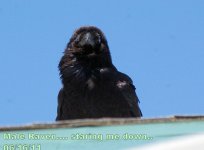
Not a crow... we have ravens around here, and the two never appear together.
A young raven fell out of its nest, and for a couple days the parents gave everyone holy hell even getting close to it.
This one in particular took umbrage at my interest in Junior, and would follow me around yelling at me.
And it had a stony stare!