
• Security incident: ISF was recently accessed by intruders. Please change your password, and change it anywhere else you used it. Read more

Ancient conspiracy to hide the Truth about Jesus Christ?

joseph8th

Scholar
Joined
Mar 10, 2012
Messages
64
OK, I've been lurking for a while, and randi.org seems like the perfect place to pose this topic for consideration. The first part's not exactly woo, since it's an argument that's been made numerous times by scholars since the 1950s, and had the endorsement of Joseph Campbell and Huston Smith. It is however pretty far out for any other forum (I have a lifelong ban from Hannity.com for even bringing it up.) The 2nd part I will make up as I go along, when I get that far.

For your entertainment, I give you...

The Mushroom Theory of Everything

21Fourth.jpg


Year: 1967. R. Gordon Wasson published his "Soma: Divine Mushroom of Immortality", the result of decades of globe-trotting research. (A few years earlier he had introduced 'magic mushrooms' to American hippies while studying the religious uses of hallucinogenic mushrooms in Mexico.) Scholars begin to sign on to the entheogenic theory of the origin of Vedic Hinduism from shamanic prehistoric roots.

Year: 1970. Dr. John Marco Allegro, the only independent translator on the International Team studying the Dead Sea Scrolls, and the team leader for the translation of the famed "Copper Scroll", published his magnum opus, "The Sacred Mushroom and the Cross". He made the cover of Time magazine. The death threats started, and his career ended. Twenty-odd years later, Baigent and Leigh ("Holy Blood, Holy Grail" fame) would dedicate "The Dead Sea Scrolls Deception" to him, while Freemasons Knight and Lomas dedicate "The Hiram Key" to him.

Meanwhile, scholars suddenly flee the entheogenic theory. It was fine applied to Hinduism, but don't touch Christianity or Judaism! Indeed, there is an excellent analysis of their tetchy debate on the subject of their similar findings, each conducted separately over the course of their long careers: http://www.egodeath.com/WassonEdenTree.htm

Fast forward to the earliest years of the 21st century. By now, the skinny graduate students who accompanied Wasson to Mexico decades before were getting gray, themselves. Ruck and Staples, tenured professors, work to teach a new generation about what they learned. Other scholars, working in areas as far afield as Greek mythology to Native American traditions to Alchemy and Medieval Christianity have had time to talk to each other, and a slew of new books (both scholarly and popular) begin to appear by authors like Clark Heinrich, Mark Hoffman, Jonathan Ott, and others. Multiple journals appear, such as "Entheos" and "MAPS", which publish new research. Here's just a few, so you know I'm not joking:

Works of Carl Ruck & Blaise Staples
"Strange Fruit: Alchemy and Religion, the Hidden Truth" by Clark Heinrich
"Hidden Worlds: Survival of Pagan Shamanic Themes in European Fairytales" by Ruck, et al.
Entheos

And in each of these, competing thesis vie for dominance -- is Manna an ergot or an Amanita button? Heated debates divide the field until new research turns up to settle it: tentatively a conflation of symbols for a class of kosher hallucinogens, represented by the Amanita Muscaria. It's strikingly similar to legitimate scholarly research and peer review.

To keep this from being overlong, I'll get to the 2nd part, now (I can supply more info on the 1st part later). Here's where the evidence intrudes on conspiracy theory...

It is the thesis of several of these scholars some or all of Soma, Haoma (of the Magi), Ma'at (Egyptian 'food of the gods'), Manna ('angel food'), the Philosopher's Stone, the Holy Grail, and hermaphroditic Christ (Mithras) are all symbols of the same ancient sacrament: the Amanita Muscaria mushroom.

41487925.jpg


In an article co-authored with Mark Hoffman , Ruck argues that Freemasons inherited knowledge of the alchemical secret of the stone: that these are all the same hidden substance. "He that hath an ear, let him hear what the Spirit saith unto the churches; To him that overcometh will I give to eat of the hidden manna, and will give him a white stone, and in the stone a new name written, which no man knoweth saving he that receiveth it." Rev. 2:17

My own research (full disclosure, I have met Ruck and know Hoffman) suggests that Newton was instrumental in stopping the Rosicrucians from trying to reveal the secret of the stone, and establishing Freemasonry to reveal it at a certain time in the future. (Aside from alchemy, he also studied eschatology and predicted the date of the apocalypse.) Here's a great resource for Newton's alchemical texts.

Heheh... :D Have fun!
 
I don't know much about magic mushies, but what about this little theory:

Citing the Targum in his annotated Torah translation, "The Living Torah", Rabbi Aryeh Kaplan notes cannabis as one among several other possible interpretations of keneh bosem as an ingredient in the holy anointing oil.[23] The main advocate of the idea that kaneh bosm was cannabis was Sula Benet in her Early Diffusion and Folk Uses of Hemp (1967),[24] Benet identifies it as the hemp plant, or cannabis. Benet argues that in support of the theory that reads cannabis as an ingredient to the holy anointing oil is that most of the other ingredients, if not all, are also theorized to come from Central Asian lands in which, Benet claims, cannabis was frequently used for spiritual (Scythian) and medicinal use (sana of the Buddhist vinya shared by many ancient schools of Buddhism).[citation needed]
http://en.wikipedia.org/wiki/Holy_anointing_oil

But seriously, I don't think those ancients conspired to keep mushrooms secret. If they wanted to have visions, all they had to do was wander around in the desert for a while without a hat.

I'm leaning towards the idea that St Paul was an agent of the Romans actively working to sabotage the Messianic Movement which was threatening the Roman Puppet Authorities in 1st century Palestine.

Here's a video of Robert Eisenman talking about some fake "Ossuary of James" and in the process explaining a lot of his kooky old theories about the Dead Sea Scrolls etc:


Part one of five.

Doesn't really look so kooky when you compare it to the "Jesus was a mushroom" Theory.
 
Well, funny that you should mention conspiracies, because that's increasingly the impression I'm getting about the original Xianity: it was a big conspiracy theory.

Mark is probably the best example, because he was writing the first BS... err... "gospel" in the modern meaning of the word about Jesus, so he's understandably cautious. He doesn't yet have any data to gauge how much BS can you say happened somewhere and have people lap it up anyway. Plus at this point nobody knows when or if Jesus existed, and who's still alive from those places -- or if anyone at all -- to say otherwise. Or if people would say "wait, if it didn't happen long ago, why doesn't anyone else talk about those miracles?" Turns out that he was wrong, people swallowed any BS anyway if it promised them what they wanted to believe, but he doesn't know that yet.

Mark's solution? Make it a conspiracy to hide the truth, and started by none other than Jesus himself.

At the end of pretty much every single parable or miracle, Mark dutifully adds a line that Jesus told the people not to tell others, or told the apostles to tell people not to tell others, etc. (Which sticks out like a sore thumb when you compare it to later gospels and stuff like the parable of the ten coins, where Jesus on the contrary, threatens you if you DON'T multiply what you got from him.)

So Mark's solution boils down to tens or even hundreds of people who witnessed that stuff, know Jesus is the messiah, but just don't tell anyone about it. And if you think about it, they also somehow don't convert to following that messiah, even though they know he's the messiah. (But eh, I guess that's just the kind of thing you'd expect from a bunch of Jews, right?;))

Or at least don't tell anyone they are, presumably not even their descendants, since we don't see many Xian Jews in the 2nd century. I.e., it's still a retarded solution, since basically it involves a everyone in that conspiracy being ok even with their kids burning in hell, rather than break the silence.

It's as literal a conspiracy theory as it gets. It literally involves a large, and impossible to check and coordinate, group of people, all keeping a secret, to the detriment of everyone (here, even to the detriment of themselves and their families), although basic self-interest makes it nonsense to toe that line.
 
Well, funny that you should mention conspiracies, because that's increasingly the impression I'm getting about the original Xianity: it was a big conspiracy theory.

...

It certainly has at least one thing in common with most of the modern CTs...

Teh EEVIL JOOS!!11!1!!
 

Nice... Guess I should've lurked moar back to 2007. I see a mushie had posed the whole Terrance McKenna thesis, and tossed in most of the same links along the way that I did. McKenna's was the straight "shamanic roots of religion" theory ("Food of the Gods"). The OPer of that thread didn't do the best job of defending the OP.

I'm not attached to this theory. Like a defense attorney... I don't need to believe my 'client' is innocent of woo to supply y'all with fodder. Plus, pictures!

Wasson is more realistic than McKenna (considerably older, as well) and merely argues that the use of Soma was introduced to Asia by the same people who introduced it to people of Kamchakta (where religious use of Amanita was 1st documented in the 19th century... still used today). At that point, the Amanita as Soma was substituted with other more readily available substances, but the original description was kept out of tradition.

Allegro's argument is based on comparative linguistic analysis of the texts of fertility cults (especially that of the Sumerians) and OT/DSS texts. He argues that Amanita use was part of the religious heritage Judaism inherited from Egypt, and that the authors of (some of) the DSSs initiated many of the traditions that would soon be consolidated into the myth of Christ -- the last supper among them, in which the command to eat the body and blood was initiatory, with Amanita the sacrament.

Ruck's research has recently focused on Amanita use in Mithraism, an important initiatory cult of Christian-era Roman royalty (with Persian roots) where that use was considerably less disguised. In many ways the prototype for Freemasonry, even the Mithraeum were secret, and so many were used, even in Europe, well into the Christian era. They're tourist attractions, now. This cult had found a welcome home in Alexandria, where it appears to have strongly influenced the development of Hermeticism in that period. Alchemy, of course, was famously referred to as the "Mithraic art", but it's earliest "non-fictional" Western practitioner was 1st century Mary the Jewess, reflecting the fact that it's religious component was pluralistic from infancy. Alexandria was just about the only place at the time where that syncretism could happen.

Meanwhile, according to Allegro in "The Dead Sea Scrolls and The Christian Myth" following the defeat of the Jewish revolt (Maccabean, circa 150 BCE), the zealots scattered and the earliest Christian groups began to develop. The cat was out of the proverbial bag, as commoners began to practice the same initiatory rite that had formerly been reserved for Prophets, Priests, Kings, Caesars and Pharaohs. Death and rebirth. Apotheosis. Entheos. It was in the interest of Rome to control the narrative, as mushroom munching spread like wildfire south and west (in places where compatible Sol Invictus or Zoroastrianism was already dominant).

Part II:
Along came Constantine. Mushroom munching Mithraite, until, according to legend, he lay on his deathbed. That's when Roman royalty publicly gave up on keeping Mithraism secret, and chose instead to co-opt Christianity. It was a simple matter of publicly replacing Sol Invictus (until then the dominant public religion of Rome) with Christ, by cherry picking from extant Christian texts, to compose a canon compatible with Mithras/Sol, whose power was vested in, of course, the leader of Rome. Voila'! The Bible! Mithraism would continue in secret for centuries, with its references in texts being almost universally alchemical.

And that's where, in this story I'm telling, now with contextual support from Clark Heinrich's "Strange Fruit", alchemy takes center stage... I'll also upload some images that support the Mushroom ToE.
 
I don't know much about magic mushies, but what about this little theory:


http://en.wikipedia.org/wiki/Holy_anointing_oil

But seriously, I don't think those ancients conspired to keep mushrooms secret. If they wanted to have visions, all they had to do was wander around in the desert for a while without a hat.

I'm leaning towards the idea that St Paul was an agent of the Romans actively working to sabotage the Messianic Movement which was threatening the Roman Puppet Authorities in 1st century Palestine.
Here's a video of Robert Eisenman talking about some fake "Ossuary of James" and in the process explaining a lot of his kooky old theories about the Dead Sea Scrolls etc:

http://www.youtube.com/watch?v=DdKNltsJNB8
Part one of five.

Doesn't really look so kooky when you compare it to the "Jesus was a mushroom" Theory.


I fully agree with you more.... Paul was a Roman SPY trying to subvert the Jewish militaristic messianic movement from the INSIDE by diluting it and eventually leading it to a whole innocuous direction (e.g. pacifism).

But have a look at this debate and listen to the question posed about Paul's ANGLE at minute 1:19:00

The question about the angle of Paul was quite nice but of course the response left a lot to be desired.....the lady asks if Paul's angle was to proselytize gentiles to bring them under the fold of the Jewish god despite the exclusivity of YHWH by creating this new angle to allow gentiles to be included under the Jewish god regardless of his racist past....interesting…. Humphreys gave a good answer.

The debate is quite good..... annoying though that Ken Humphreys did not respond quite strongly enough to some of the rubbish from the other guy.

For example.... "the fact that we are talking about it in universities proves it is true", which seemed to be the thrust of his argument which I could have destroyed with a few words like the fact that people talk about literature and Alice in Wonderland and other fictions in universities and they also talk about other numerous MYTHOLOGIES and other religions like Islam....does that prove they too are true?.

Another example is "Paul said he was persecuted".... Humphreys makes a week attempt at asking how can we believe Paul....I would have responded that Mormons and Moslims and many others suffered and were willing to be and many were martyred for their faiths...does that prove they were true too?


Well, there are a few problems with that theory.

First of all, it's not clear why they would actually have a conspiracy to keep shrooms secret. Using hallucinogens was perfectly legal, and other mystery cults (e.g., the cult of Eleusis) did it too as part of their initiation. And at least one Roman Emperor off the top of my head was initiated too, plus a whole bunch of senators, so it's not like they'd make their own passtime illegal.

While a good case can be made that Paul's Xianity COULD have been a mystery cult -- keeping it for the initiates is the least crazy explanation for why he writes 20-page letters about Jesus, yet fails to mention even a single physical trait, saying, etc, of Jesus or even location associated with Jesus, even when it would have solved whatever he's arguing right there -- I don't think the later church actually conspired to keep anything secret. The more parsimonious explanation is that if you have too few initiates (we really only know of Theudas) and someone else starts a less mysterious sect, with full details of Jesus, it will overtake you. Basically rather than try to keep secret, some guy we now call Mark or the founder of whatever church he was in, went "screw the whole secrets cult and finding excuses when people ask about that guy, let's just MAKE UP a story."

Second, well, I have a hard time taking any theory seriously when it's at the Dan Brown level of ignorance and actually think that that decision was made at Nicaea or by Constantine at all. Sorry.

The truth is actually MUCH sadder, although also less glamorous.

First of all, actually Constantine never drew a canon. The final composition of the Bible wasn't decided until looong after his death. As far as Constantine was concerned, as long as you agreed with a basic creed about Jesus, he didn't give a screw about what gospel you follow or what details you believe in around that creed.

Second, and this is the good news for the religious, the actual texts that went into it were written LONG before Constantine. And the 4 gospels were already chosen by the sect that would become dominant around 180 CE or so, when Irenaeus mentions them. That's like a century and a half before Nicaea or Constantine. Other sects followed other gospels, and even in catholicism there was still debate which epistles are genuine and which should be left out, but the 4 gospels were already canon for the catholics since at least 180 CE.

Third, however, this is kinda funny and what makes the story even sadder. The choice actually seems to be even more arbitrary than people think. At least involving Constantine and a bunch of bishops and all, has SOME legitimacy. There would have been some consultation and voting there. The real version doesn't even have that claim to legitimacy.

If you draw a timeline, pretty much nobody has even heard of the 4 gospels until Irenaeus mentions them. Then suddenly they're all the rage. But previously even when church fathers like Justin Martyr argue with unbelievers and give quotes, they obviously never heard of these 4 gospels, because they'd solve some things right there. But nobody quotes them, somehow. (Apologists produce claims that they have quotes, but they boil down to finding some simple and common sentence in some epistle that also exists in a gospel, and going, "look, he quotes Matthew!" No, he doesn't.)

Note that I'm not saying that they were necessarily WRITTEN in the 2nd century (although they COULD theoretically be). I'm willing to allow that they're WRITTEN by the end of the 1st century. But they don't seem to have much of a following until the late 2nd century. They're at most some obscure texts that haven't yet gained much traction or even popularity.

Then suddenly Irenaeus travels around and manages to get a couple of churches (still very small groups at this point) to form a cartel -- that which we'd later call catholicism -- and wouldn't you know it, suddenly had 4 gospels which are proving THEIR dogma to be true. And a long (and stupid) argumentation for why only these 4 can possibly count, and everyone else's gospels are automatically false.

Now the problem here is that it happens in the middle of a MAJOR Roman persecution of Xians. Irenaeus himself got his post as bishop after his predecessor ticked off the Romans and got himself executed. You wouldn't have large groups of Christians travelling to a big conference to vote on it. That would be a recipe to get themselves all rounded up and executed. It's just Irenaeus and a couple of other bishops that take a fully arbitrary decision.

So, yeah, I see no reason to blame Constantine there. Not just it's unsupportable historically, but even if I were in a mood to lie against Jesus, WTH, the truth is more damning than any lie I could come up with.

Third, the connection to Mithras is very tennuous anyway, because we don't really know what the Mithranists were doing at the time. And we certainly don't have any mention of shrooms in their rituals.

In fact, for what we do know, they didn't need any shrooms to get their believers drowsy and prone to suggestion and confabulation. They actually used cellars without windows, and with a candle or two thrown in for good measure. Pack enough people there for a sermon, and that room's O2 content will drop quite a lot by the end of it. Add the gloomy atmosphere, and the whole mystery theme (including the implication that if you don't toe the line, you'll not get initiated in the next level of the mysteries any time soon), and you have all you need to keep people coming back for more. In that setup, really, shrooms are superfluous.
 
Well, there are a few problems with that theory.

First of all, it's not clear why they would actually have a conspiracy to keep shrooms secret. Using hallucinogens was perfectly legal, and other mystery cults (e.g., the cult of Eleusis) did it too as part of their initiation. And at least one Roman Emperor off the top of my head was initiated too, plus a whole bunch of senators, so it's not like they'd make their own passtime illegal.

While a good case can be made that Paul's Xianity COULD have been a mystery cult -- keeping it for the initiates is the least crazy explanation for why he writes 20-page letters about Jesus, yet fails to mention even a single physical trait, saying, etc, of Jesus or even location associated with Jesus, even when it would have solved whatever he's arguing right there -- I don't think the later church actually conspired to keep anything secret. The more parsimonious explanation is that if you have too few initiates (we really only know of Theudas) and someone else starts a less mysterious sect, with full details of Jesus, it will overtake you. Basically rather than try to keep secret, some guy we now call Mark or the founder of whatever church he was in, went "screw the whole secrets cult and finding excuses when people ask about that guy, let's just MAKE UP a story."

Second, well, I have a hard time taking any theory seriously when it's at the Dan Brown level of ignorance and actually think that that decision was made at Nicaea or by Constantine at all. Sorry.

The truth is actually MUCH sadder, although also less glamorous.

First of all, actually Constantine never drew a canon. The final composition of the Bible wasn't decided until looong after his death. As far as Constantine was concerned, as long as you agreed with a basic creed about Jesus, he didn't give a screw about what gospel you follow or what details you believe in around that creed.

Second, and this is the good news for the religious, the actual texts that went into it were written LONG before Constantine. And the 4 gospels were already chosen by the sect that would become dominant around 180 CE or so, when Irenaeus mentions them. That's like a century and a half before Nicaea or Constantine. Other sects followed other gospels, and even in catholicism there was still debate which epistles are genuine and which should be left out, but the 4 gospels were already canon for the catholics since at least 180 CE.

Third, however, this is kinda funny and what makes the story even sadder. The choice actually seems to be even more arbitrary than people think. At least involving Constantine and a bunch of bishops and all, has SOME legitimacy. There would have been some consultation and voting there. The real version doesn't even have that claim to legitimacy.

If you draw a timeline, pretty much nobody has even heard of the 4 gospels until Irenaeus mentions them. Then suddenly they're all the rage. But previously even when church fathers like Justin Martyr argue with unbelievers and give quotes, they obviously never heard of these 4 gospels, because they'd solve some things right there. But nobody quotes them, somehow. (Apologists produce claims that they have quotes, but they boil down to finding some simple and common sentence in some epistle that also exists in a gospel, and going, "look, he quotes Matthew!" No, he doesn't.)

Note that I'm not saying that they were necessarily WRITTEN in the 2nd century (although they COULD theoretically be). I'm willing to allow that they're WRITTEN by the end of the 1st century. But they don't seem to have much of a following until the late 2nd century. They're at most some obscure texts that haven't yet gained much traction or even popularity.

Then suddenly Irenaeus travels around and manages to get a couple of churches (still very small groups at this point) to form a cartel -- that which we'd later call catholicism -- and wouldn't you know it, suddenly had 4 gospels which are proving THEIR dogma to be true. And a long (and stupid) argumentation for why only these 4 can possibly count, and everyone else's gospels are automatically false.

Now the problem here is that it happens in the middle of a MAJOR Roman persecution of Xians. Irenaeus himself got his post as bishop after his predecessor ticked off the Romans and got himself executed. You wouldn't have large groups of Christians travelling to a big conference to vote on it. That would be a recipe to get themselves all rounded up and executed. It's just Irenaeus and a couple of other bishops that take a fully arbitrary decision.

So, yeah, I see no reason to blame Constantine there. Not just it's unsupportable historically, but even if I were in a mood to lie against Jesus, WTH, the truth is more damning than any lie I could come up with.

Third, the connection to Mithras is very tennuous anyway, because we don't really know what the Mithranists were doing at the time. And we certainly don't have any mention of shrooms in their rituals.

In fact, for what we do know, they didn't need any shrooms to get their believers drowsy and prone to suggestion and confabulation. They actually used cellars without windows, and with a candle or two thrown in for good measure. Pack enough people there for a sermon, and that room's O2 content will drop quite a lot by the end of it. Add the gloomy atmosphere, and the whole mystery theme (including the implication that if you don't toe the line, you'll not get initiated in the next level of the mysteries any time soon), and you have all you need to keep people coming back for more. In that setup, really, shrooms are superfluous.

There was an air of mystery about the mass in the early church.

The Mass (or Liturgy) of the Catechumens is an ancient title for the first half of the Roman Catholic or Eastern Orthodox worship service known as the Mass or Divine Liturgy. This part of the Mass is now referred to by the Catholic Church as the Liturgy of the Word. It was originally called the Mass of the Catechumens, because the Catechumens, or candidates for Baptism, were required to leave the ceremony before the beginning of the Liturgy of the Eucharist, or Mass, proper.
 
This whole "Jesus was a mushroom" thing is old hat. It was aired in 1970 by John M. Allegro in his book The Sacred Mushroom and the Cross. Many years after it was published, I managed to pick up a used hardback copy for $1.00 at a garage sale; and, let me tell you, it was worth every penny.
 
Amanitas are so damn uncomfortable however compared to the psiolocybin containing mushrooms which generally offer euphoric transcendent experience. Amanita is more deliriant than hallucinogen, with cramping and extreme nausea often experienced.
 
This whole "Jesus was a mushroom" thing is old hat. It was aired in 1970 by John M. Allegro in his book The Sacred Mushroom and the Cross. Many years after it was published, I managed to pick up a used hardback copy for $1.00 at a garage sale; and, let me tell you, it was worth every penny.
You were robbed. I think that Allegro was confusing Jesus with Santa Claus - a pardonable error. Santa wears shroom-coloured red and white clothing. He comes from north Siberia or Lapland where mushroom consumption is traditional (grapes and barley don't grow there, so no wine or beer was to be had) which we know because he travels on a sledge pulled by flying reindeer. Sometimes mushrooms were fed to reindeer, and shamans would then drink their urine, after which they "flew".

And Santa enters houses through the chimney, which was customary in ancient Siberian dwellings which were entered through the smoke hole by means of a ladder.
 
You were robbed. I think that Allegro was confusing Jesus with Santa Claus - a pardonable error. Santa wears shroom-coloured red and white clothing. He comes from north Siberia or Lapland where mushroom consumption is traditional (grapes and barley don't grow there, so no wine or beer was to be had) which we know because he travels on a sledge pulled by flying reindeer. Sometimes mushrooms were fed to reindeer, and shamans would then drink their urine, after which they "flew".

And Santa enters houses through the chimney, which was customary in ancient Siberian dwellings which were entered through the smoke hole by means of a ladder.

He is also known to be pretty Jolly. He can see into people's minds (knows who's naughty or nice) and spends most of his time off with the pixies...
 
Rock art expert Prof. David Lewis-Williams has a pretty convincing hypothesis on the origin of religion.

http://www.amazon.com/Conceiving-God-Cognitive-Evolution-Religion/dp/050005164X

Entheogens have a role to play in some cultures but not all.
The important point is that entheogens are not the only way to change ones conscious experience. Try holding your breath for 3 minutes, fasting for 40 days, chanting continuously for 3 hours, running around a mountain for 24 hours non-stop or sitting in the pitch dark in an underground cave for 3 days.
These activities all effect brain activity and Lewis-Williams thesis is that neuroscience is finding that these changes in brain activity have a distinct pattern. The difference between religions is the different cultural interpretation of these patterns.

The "conspiracy" in Christianity has to do with the mainstream Christian church denying that it's origin and quite probably its future is dependent on changes in its adherents conscious awareness beyond normal daily awareness. Its founders and initial leaders interpreted this different brain activity as direct spiritual experiences with its gods/angels etc, but now its leaders are purely academic and argue for a religion without direct experience. The obvious reason for the growth in the charismatic movement has been the desire for this direct experience.

The whole point of religion is its spirituality which as significant events in ones life are simply experiences of brain activity outside the normal daily consciousness.
I think atheists are missing the point in that understanding and studying this thesis and driving it home is the one sure way to put religion in its place. Arguing for evidence based on religious texts, archaeology and any other matter outside of the human brain is a waste of time.

Religion without changes in brain activity is going nowhere. The concern is the cultural interpretation of these changes in brain states that is being provided by lunatics with agenda's instead of scientifically understood reasons for these changes in brain states.

I even think we could use these abilities to change in brain states for mental health therapy. After all that is what shamans are supposed to have done and claim to do in some cultures still. This work just needs to be systematized using the scientific method. I believe our greatest breakthroughs in mental health therapy will come from exploring the same techniques which evolved into religion but based on scientific methods this time.
 
I think that most of the Atheists here realise this. It is the Theists and the Mystics that seem to have a hard time grasping the idea that having a vision of God doesn't mean they saw anything outside of their own head.

Perhaps but we should take this observation much more seriously.
Instead we argue with theists/mystics about the validity of their cultural interpretation of these visions instead of supplying an alternative interpretation based on the scientific method.
 
Perhaps but we should take this observation much more seriously.
Instead we argue with theists/mystics about the validity of their cultural interpretation of these visions instead of supplying an alternative interpretation based on the scientific method.

I'm not sure how to go about that. I've seen a few posts by Hans Musterman where he makes a good case for St Paul being Schitzophrenic. But most ancient holy teachings are so adulterated by traditions and cross cultural influences that pinpointing a single individual or experience in order to analyse it would be pretty much impossible.

Maybe we can look at something like the prophecies of Ezekial and say that they are the kinds of hallucinations that people have when suffering from dehydration and sunstroke or something, but believers will just say "But that is what a true vision from God looks like!". How do we prove otherwise?
 
Last edited:
I'm not sure how to go about that. I've seen a few posts by Hans Musterman where he makes a good case for St Paul being Schitzophrenic. But most ancient holy teachings are so adulterated by traditions and cross cultural influences that pinpointing a single individual or experience in order to analyse it would be pretty much impossible.

Maybe we can look at something like the prophecies of Ezekial and say that they are the kinds of hallucinations that people have when suffering from dehydration and sunstroke or something, but believers will just say "But that is what a true vision from God looks like!". How do we prove otherwise?

I think we should take a long view of not trying to convince people now of there mistaken beliefs, but methodically working on understanding and using changes in brain activity to supply to future generations that which religion now claims to supply. The work required is to show that many ideas, not just religious ideas, are the result of brain activity influenced by physical and chemical parameters and that these ideas are shaped by our cultural backgrounds. By understanding and then offering modifications to these physical, chemical and cultural inputs we can replace subjective historical interpretations of religious texts with objective evidence of their origin.
 
This whole "Jesus was a mushroom" thing is old hat. It was aired in 1970 by John M. Allegro in his book The Sacred Mushroom and the Cross. Many years after it was published, I managed to pick up a used hardback copy for $1.00 at a garage sale; and, let me tell you, it was worth every penny.

Darn. Lost my original reply. (I blame emacs for training me to use ^-W to Cut... closed the damn tab. Heh.) Attempt #2:

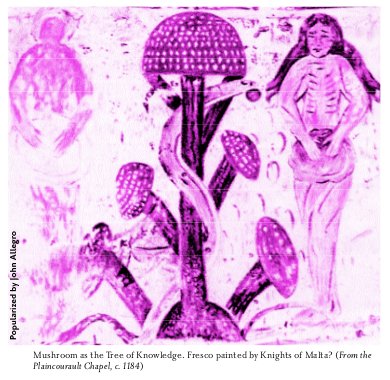
RE Allegro... yah, I mention him above a couple times for Part I. $1.00 is a good deal, BTW... his book was blacklisted after 1st pub. and never reprinted. But the research never stopped... published mostly under academic imprints and in journals. That's starting to change, thanks to the intervening years of research by a number of scholars (yes, tenured professors teaching at respected universities). In fact, Carl Ruck just published "Mushrooms, myths, and Mithras" with City Lights Books, and like I said I know Mark Hoffman... there's a slew of other books in the works for coming years. This would be the go-to text on the mushroom connection to Mithraism and to answer the question of what the Mithraites were up to in the time of the Councils of Nice. This isn't over, yet. :) Image analysis alone is a research-intensive process, but continues to turn up rebuses... Here's a couple of my favs (but there's too many to include... see this broken page):
562024f6f2b8d6ee7a.jpg
562024f6f2b8d975df.jpg


RE Conspiratorial tone of my Part II (incl. Constantine, Nice)... Sure!! Like I said, I'm not married to this theory. I've happily admitted I'm pushing your C.T. buttons for our mutual entertainment. :p A complete and accurate accounting of how canon was selected doesn't really move the story along. Read this way: "The Mithras connection" foreshadows the emergence of Freemasonry (cf, "Freemasonry and the Survival of the Eucharistic Brotherhoods") from it's Hermetic roots (cf, "The Rosicrucian Enlightenment" by Dame Francis Yates) in the 17th-18th c's.

In fact, if I were to digress into the Nicean Councils, I'd probably focus on the Arian controversy (after Arius of Alexandria, defending Athanasius) which would've became ortho Roman Xtianity if Constantine had his druthers. It wouldn't be hard to argue that Arianism, which continued as an influential "heresy" and wasn't stamped out until the 7th c., provided cover for the introduction of Hermeticism to the Pyrenees (cf, mea culpa "The Elixir & The Stone" by good ole Baigent & Leigh, which argues that alchemists manufactured and consumed recreational drugs). Or that this theory (whatever its merits) contributed to the resurfacing of Arianism in the 16th c. among Enlightenment types, including Isaac Newton.

The conspiratorial tone of this narrative is helped along by conveniently real conspiracies: Rosicrucians really did have a profound influence on the Enlightenment, and they really were a secret society of Hermeticists including some of both Western and Eastern science's greatest thinkers. They did form the Invisible College, which really did form the foundation of both the Royal Society of Science and the Grand Lodge of England, with overlapping membership. The RS really did hide RS Prez Newton's alchemical and eschatological texts for 200 years. John Maynard Keynes really did hide them for another 30-odd years. Newton did urge R.C. Robert Boyle not to reveal the secret of the Stone until the world was ready. He really did predict the date of the Apocalypse (the revealing) for this century, conveniently about a century after his lost notes were 'discovered'. (Note that Wikipedia's section on Newton's religion gives undeserved weight to Christian apologist Snobelen's interpretation.)

562024f6f2bd32cb7e.jpg
562024f6f2b8daba36.jpg
562024f6f2bf85d3f8.jpg
562024f6f2bd31cf8e.jpg


So for purposes of this narrative, Hermeticism is the key ingredient, and it's long association with both Abrahamic religions, and Eastern religions, alike...

Heheh... more to come, and I'll get back to posters RE ur eviscerations.
 

ISF - Join now!

Every member here is approved by hand. No bots, no spam, just people who care about evidence and honest debate.

Membership is free!

Create your free account

Back
Top Bottom