-
Security incident: ISF was recently accessed by intruders. Please change your password, and change it anywhere else you used it. Read more
You are using an out of date browser. It may not display this or other websites correctly.
You should upgrade or use an alternative browser.
You should upgrade or use an alternative browser.
Merged Alien Big Cats in the UK?
- Thread starter mummymonkey
- Start date
Marduk
Banned

- Joined
- Apr 26, 2009
- Messages
- 10,183
The problem is: Nobody makes an effort to count the number of stray cats in small communities.
or people

Marduk
Banned
- Joined
- Apr 26, 2009
- Messages
- 10,183
Just correcting myself here. The sources I'm looking at say that only sheep were cleared from the forest, and they left the deer. (I'm not seeing anything about wild boar, I may be getting mixed up with Kent there.) The whole forest area was free of sheep for about 18 months.
So when the sheep were culled for FMD, the deer increased in numbers and spread. So what were these pumas eating, Mr. Frank Tunbridge, 60? 300 head of deer really doesn't seem much to support a bunch of big cats to me, and the census findings tell us that the population was actually getting larger.
This is just getting silly.
Rolfe.
http://en.wikipedia.org/wiki/Forest_of_Dean#NatureThe deer are predominantly fallow deer and these have been present in the forest since the 13th century currently numbering around 400. A number of the fallow in the central area of the forest are melanistic. More recently roe deer and muntjac deer have arrived spreading in from the East but they are in much smaller numbers.
The Forest is also home to wild boar; the exact number is currently unknown but possibly a hundred. The boar were illegally re-introduced to the Forest in 2005. A population in the Ross on Wye area on the northern edge of the forest escaped from a wild boar farm around 1999 and are believed to be of pure Eastern European origin, a second introduction was when a domestic herd was dumped near Staunton in 2004 but these were not pure bred wild boar —attempts to locate the source of the illegal dumps have been unsuccessful. The boar can now be found in many parts of the Forest.
so :-
fallow deer
roe deer
muntjac deer
wild boar
domestic boar
eastern european boar
badgers
rabbits
hares
foxes
mice
rats
voles
moles
bats
stoats
weasels
squirrels
birds
hedgehogs
pets
if theyre there they eat better than I do
Last edited:
To the original post I say, my first thought was that it was a Black Labrador Retriever. It does seem to move as "perkily" as a Lab, but perhaps it is a cat.
It's hard to tell from the angle of photography, but the size could be deceptive, and hence a bog standard "moggie" (I like learning new words).
[anecdote alert]
As pertaining to North American cats, I observed a Puma (Cougar) last year in eastern Canada.
I have a cottage in Haliburton, Ontario. It's been my second home for over 40 years. Last year, my daughter and I were driving along a gravel road not far from the cottage, and I observed in the ditch what I thought might be a white-tailed deer. I slowed to let her have a good look, and as we got to about 10 metres away, the animal stood up, looked, and bolted into the bush past the ditch.
It was a cougar. (Puma Concolor) . There was no doubt. As soon as I saw the tail I knew it was something I wasn't expecting to see there.
My daughter blurted out, "Is that a mountain lion?"
I said, "no, we call them cougars".
I was amazed, even though the Eastern Cougar used to be indigenous to the area. Then colour was very similar to a deer, and I read that Puma can take on the colour of their prey. There are many deer there. It's 1000's of sq. km. of swamp.
[/anecdote]
I reported the sighting to the MNR, but they claimed that most of the sightings in Ontario were escaped exotic pets.
It seems that recently, with increased sightings, that they may be changing their tune, and possibly, the Eastern Cougar has made inroads to being re-established in Ontario.
FYI, the articles I have read indicate that the Eastern Cougar is genetically identical to the South-Western Puma (ie. Puma Concolor).
It's hard to tell from the angle of photography, but the size could be deceptive, and hence a bog standard "moggie"
(I like learning new words).[anecdote alert]
As pertaining to North American cats, I observed a Puma (Cougar) last year in eastern Canada.
I have a cottage in Haliburton, Ontario. It's been my second home for over 40 years. Last year, my daughter and I were driving along a gravel road not far from the cottage, and I observed in the ditch what I thought might be a white-tailed deer. I slowed to let her have a good look, and as we got to about 10 metres away, the animal stood up, looked, and bolted into the bush past the ditch.
It was a cougar. (Puma Concolor) . There was no doubt. As soon as I saw the tail I knew it was something I wasn't expecting to see there.
My daughter blurted out, "Is that a mountain lion?"
I said, "no, we call them cougars".
I was amazed, even though the Eastern Cougar used to be indigenous to the area. Then colour was very similar to a deer, and I read that Puma can take on the colour of their prey. There are many deer there. It's 1000's of sq. km. of swamp.
[/anecdote]
I reported the sighting to the MNR, but they claimed that most of the sightings in Ontario were escaped exotic pets.
It seems that recently, with increased sightings, that they may be changing their tune, and possibly, the Eastern Cougar has made inroads to being re-established in Ontario.
FYI, the articles I have read indicate that the Eastern Cougar is genetically identical to the South-Western Puma (ie. Puma Concolor).
Last edited:
I Ratant
Penultimate Amazing

- Joined
- Apr 8, 2008
- Messages
- 19,258
.The problem is: Nobody makes an effort to count the number of stray cats in small communities.
Since the entrance of the cougar, and most lately the bobcat, the instances of feral cats has dropped a LOT locally.
Especially at the office complex where the bobcat took up residence.
The three or four ferals I could expect to see on an evening's walk thru that area has dropped to zero.
The lion got credit for lowering the population here in the community, although there's coyotes active here also.
Since the entrance of the cougar, and most lately the bobcat, the instances of feral cats has dropped a LOT locally.
Are you saying that Cougars actually prey on feral housecats?!!

The lion got credit for lowering the population here in the community, although there's coyotes active here also
Was the coyote population affected too?
There was mention made of the Blue Mountains (New South Wales) Black Cat earlier in the thread.
The NSW government took the reports seriously enough to produce a 23 page report which either supports or doubts the claims.
There really doesn't seem to be any reason for the government to cover up the existence of big wild cats.
The NSW government took the reports seriously enough to produce a 23 page report which either supports or doubts the claims.
And why would DEFRA and the Forestry Commission be covering anything up? Why not simply tell the newspapers?
There really doesn't seem to be any reason for the government to cover up the existence of big wild cats.

OOPA'S do, indeed, exist. There is nothing mysterious about them. I do not see why people fail to comprehend this occurence?
OOPAs?
Last edited:
Apparently it's "Out of Place Animals". I don't see anyone is denying that they are found, and in fact Rolfe gave some examples. What is being questioned is whether a big cat could live in a populated area without leaving undeniable evidence. Next you'll be claiming bigfoot is real.
Rolfe
Adult human female

http://en.wikipedia.org/wiki/Forest_of_Dean#Nature
so :-
fallow deer
roe deer
muntjac deer
wild boar
domestic boar
eastern european boar
badgers
rabbits
hares
foxes
mice
rats
voles
moles
bats
stoats
weasels
squirrels
birds
hedgehogs
pets
if theyre there they eat better than I do
Er, like I said, show me the bodies! No matter the number of species, depredations by large predators leave evidence.
Note one species which just isn't on that list. Felis concolor just doesn't seem to be recorded there, for some unaccountable reason.
You can see how closely the wildlife (and even the tamelife) in that area is studied. It's crawling with people counting stuff. It's also crawling with members of the public, and they're not all just picnickers. Some of them are very serious wildlife enthusiasts, with big expensive cameras.
Just suppose a puma was miraculously transported to that habitat, from whatever source. I'd give it a month, tops, before it was obvious to every sane adult in the location what was going on, and the main controversy was between the farmers who wanted to shoot it on sight and the animal-lovers insisting it should be trapped and sent to a zoo.
Rolfe.
Rolfe
Adult human female
Apparently it's "Out of Place Animals". I don't see anyone is denying that they are found, and in fact Rolfe gave some examples. What is being questioned is whether a big cat could live in a populated area without leaving undeniable evidence. Next you'll be claiming bigfoot is real.
Well, yeah. Felicity, for a start. But this isn't a huge continent we're sitting on. This is a relatively small island, in continental terms. A well populated island, with farming going on everywhere - and that's farming, not ranching, with a law that obliges farmers to inspect their stock at least every 24 hours. Sheep are gathered and counted and dosed and marked, and people get pretty pissed-off when above-normal losses are noted. Even in the Highlands the deer are managed for shooting purposes, and indeed the shooting is necessary precisely because there are no predators picking them off. You tell a gamekeeper that his hill is supporting a family of pumas that he hasn't noticed and he'll laugh in your face.
Also, there are very strict import restrictions in place. You can't just swan into the country with a leopard in a cage. Even if you managed to smuggle something in in a private yacht, you couldn't afford to let anyone see what you had because it's illegal to keep wild animals without a licence. By and large, we know what's here, and nothing is just walking in off the street, as it were.
And if anything does get out, it's noticed and dealt with pretty soon. No mystery there.
Rolfe.
Rolfe
Adult human female
There really doesn't seem to be any reason for the government to cover up the existence of big wild cats.
Well, exactly. The problem, if there is one, is that nobody has ever taken the fruitcakes in the BBCS as seriously as they think they should be taken. They're cranks. So the replies they're getting are really government apparatchik-speak for "go away and stop bothering us you silly little man." However, the obsessive big cat enthusiast interprets this as "we're not going into the sort of detail you want because we have something to hide."
What surprises me is the lack of anyone stating the obvious. That any alien species will leave traces of its presence in the ecosystem. Something as big as a puma is inevitably going to leave pretty big traces, especially of what it's been eating. Every real instance of a big cat on the loose has been accompanied by dead sheep in abundance.
One needs to think about what the environment and the ecosystem would look like if something like that was there. At that point it becomes painfully clear that nothing is there. The few, ambiguous "sightings" and a handful of mauled (but not consumed) animals and a blurry pawprint or two just don't cut it.
Just explaining this to the local paper and radio station would put a big crimp in the public's propensity to believe these stories. But on the other hand, maybe nobody wants to do that? Are the stories themselves a bit of a tourist attraction? Nessie is worth fostering, after all.
Rolfe.
Marduk
Banned
- Joined
- Apr 26, 2009
- Messages
- 10,183
Apparently it's "Out of Place Animals". I don't see anyone is denying that they are found, and in fact Rolfe gave some examples.
tcoh, there goes my thunder
Marduk
Banned
- Joined
- Apr 26, 2009
- Messages
- 10,183
Nessie is worth fostering, after all.
Rolfe.
bloody plesiosaurs turn up everywhere, theyre practically vermin in some american lakes
allegedly
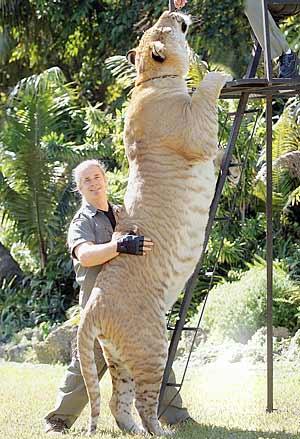
Actually, _if_ such a big cat existed, my wildly uninformed bet would be more on "hybrid" than "mutant". Some hybrids of closely related species -- e.g., the Liger -- end up with some hormonal imbalance that makes them not stop growing.
I have no idea what could a moggie breed with for something like that to happen, though.
Like this Liger at around 1:59. The rest is just about a mini Bigfoot