Abenomics: medicine or poison for Japan?

Medicine or poison?

  • Medicine

    Votes: 12 27.3%
  • Poison

    Votes: 3 6.8%
  • Don't know

    Votes: 18 40.9%
  • Planet X

    Votes: 11 25.0%

  • Total voters
    44
Yes, the BoJ is doing the opposite and the result has been a rise in bond yields...

No, bond yields are rising in spite of the BoJ monetizing bonds, because the JGB investor is panicing. Your claim was ridiculous on its face, that is, the suggestion that the BoJ wants rates to rise, given its actual policy, which is to debase the yen and buy bonds, which, all else being equal, would have the opposite effect. Clearly, the BoJ doesnt want rates to rise (bonds to sell off).
 
Getting crowded:

Reuters said:
Japan's public pension fund - a pool of over $1 trillion - is considering a change to its portfolio strategy that could allow its investment in domestic stocks to grow with a rallying market
Link.
 
Deflation not defeated yet:

Japan deflation ebbs, output up; Bank of Japan target still elusive

TOKYO – Japan's factory output picked up in April and deflation abated slightly as a weaker yen and firmer overseas demand boosted growth, boding well for Prime Minister Shinzo Abe's efforts to shake the world's third-largest economy out of nearly two decades of stagnation.

But core consumer prices continued to fall and manufacturers forecast further weakness ahead, government data showed on Friday, underscoring the challenges the Bank of Japan, under new Governor Haruhiko Kuroda, faces in meeting its 2-percent inflation target.

"The deflationary trend shows no signs of changing," said Yuichi Kodama, chief economist at Meiji Yasuda Life Insurance in Tokyo. He forecast the economy will continue to recover through the latter part of the fiscal year to March 2014.

"However, expectations for deflation, deeply embedded among the public, are very persistent," Kodama said. "It appears quite difficult for monetary easing implemented by Governor Kuroda to achieve a positive cycle of inflation and economic recovery."

 
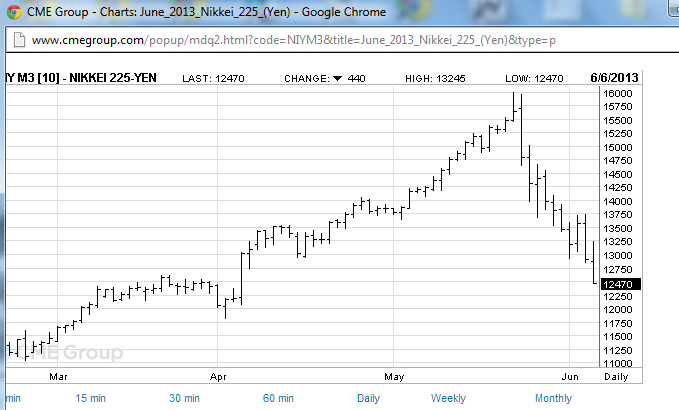
Nikkei - "Sell in May" was the plan after all..

it's what the professional money did anyway. this chart is about due some red** for a while now. (**tech trader analysis)


nikkei2.png


Futures continued dumping on Friday and closed near the lows (in sympathy with US equities) closing at -18.9% from the recent highs, approx 120 pts from an official bear market.


nikkei1.png


I'm not commenting or concluding anything about the fundamentals of Japanese economy from this, the 2 are almost entirely disconnected IMO.
 
Nikkei Futures with a 12 handle back on currently. ..think the algos might have finished frontrunning Abenomics for the moment
 
Wages, which had been falling, are starting to rise again:

Japanese Wages Gain in Boost for Abe Campaign to Reflate Economy

Japan’s wages rose by the most in a year in April, a gain that supports Prime Minister Shinzo Abe’s campaign to reflate the world’s third-biggest economy after 15 years of falling prices.

Monthly wages including overtime and bonuses rose 0.3 percent from a year earlier to 273,427 yen ($2,746), the Labor Ministry said today in Tokyo. Abe aims to sustain investor and public confidence amid market volatility, with the Topix index of stocks sustaining declines today.

Obviously 0.3 percent is not much, but previously they had been falling. The previous report had been -0.9% yoy. Hopefully they will further accelerate. Summer bonuses are expected to be 7.4% higher than last year:
Japan’s economy expanded the most in a year last quarter as consumers responded to the campaign mounted by Abe and Bank of Japan chief Haruhiko Kuroda. Major Japanese companies may boost summer bonuses by 7.4 percent, the most since 1990, according to a survey published last week by Keidanren, the country’s biggest business lobby.
Jobs are being added too:
Employment rose by 40,000 jobs in April, and the labor force participation rate was at 59.6 percent from 58.9 percent in March, according to the government statistics bureau. The jobless rate was 4.1 percent, unchanged from March and compared with a 4.3 percent rate in February.
 
Oh, I get it. Thanks. They seem to be back on a 13 handle now.

Like I said before, the bulls algos got a little carried away and we had a correction. It's still up a lot from 6 months ago.

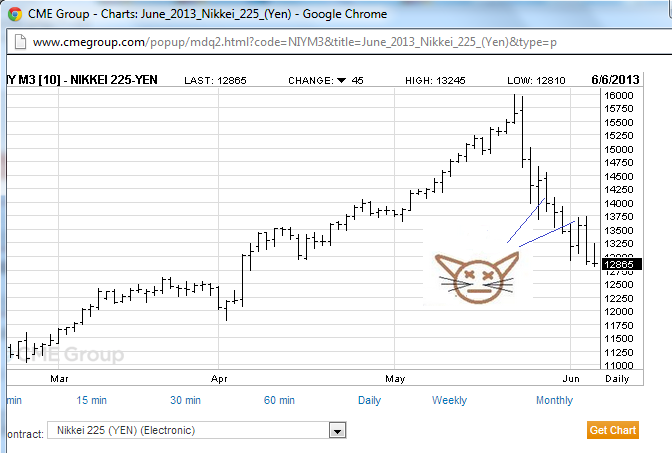
this I could live with.. :D the machines have been selling the yen and buying CB backed (hence frontrunning) Risk assets - whatever's going up fastest that day
 
this I could live with.. :D the machines have been selling the yen and buying CB backed (hence frontrunning) Risk assets - whatever's going up fastest that day

Are you you saying it's not a bunch of men in a trading pit yelling buy and sell orders at each other? Whatever will they come up with next?
Next they'll eliminate ticker tape!
:D
 
Last edited:
text book dead cat bouncing..

so these are what DCBs look like on a daily timeframe. if you're not familiar with this chart style, the 2 pins either side of the vertical range bar indicate opening price (left pin) and closing price, (right pin)

1785251b03b1ddbdec.png


so we can say now that those two bounces were definitely DCBs because price then broke down further past the previous lows. and as I type this I see it's official, the Nikkei has now technically traded into a bear market, although it hasnt closed below that level yet
 
Kevsta, if you have time can you do a chart of the Nikkei vs. the yen (vs. dollar)?

I have a theory that whenever the yen strengthens vs. the dollar the Nikkei goes down and whenever the yen weakens the Nikkei goes up (or at least about 90% of the time).
 
Kevsta, if you have time can you do a chart of the Nikkei vs. the yen (vs. dollar)?

I have a theory that whenever the yen strengthens vs. the dollar the Nikkei goes down and whenever the yen weakens the Nikkei goes up (or at least about 90% of the time).

you're correct there is definitely (carry) correlation. you can pull these up for yourself (for almost anything) if you wanted using www.netdania.com

go to charts, start typing Nikkei in bottom left box and get the Nikkei chart up, then right click on it, select overlay and insert USDJPY and you get

nikkeiyen.png


Netdania only do the "cash" charts, not futures so this is showing last night's close, while the CME ones I posted above are futures and trade continually.

[edit] that first big down red bar from the top is known as a "shift bar" - in one 4 hour session the marketmakers have "shifted" the range and everybody who's bought at 14500+ back since the 9th of May is now underwater in the blink of an eye.

Then we head downwards to see where the now-trapped trader's pain thresholds are, because remember the MMs dont actually bank any money until you bail with your losses, otherwise it's just a floating paper gain (for them, loss for you) in the "open float". But this is the classic distribution pattern (offloading their longs to the herd) and then slamming the door shut. this is text book manipulation, and in normal markets it is this exact pattern playing out on an (inter) daily basis that I trade.
 
Last edited:
well, at approaching 400pts 500pts below the 12815 20% mark, I think it's safe to say the bear has definitely been spotted luncheoning in the woods.

1785251b0bb0eb8887.png


a quick roundup of Abenomics thus far, courtesy of, who else.. :D

Equities are practically unchanged now [-400pts 500pts actually now]; Equity implied volatility is up 60%; JGB yields have more than doubled; and the nation's currency is 6% weaker...
 
Last edited:
Yen remains stubbornly strong:

Asian Stocks Drop as Yen Surge Weighs on Japanese Shares

Asian equities fell, with the regional benchmark index poised for the largest weekly drop in a year, as the yen’s biggest surge in three years weighed on Japanese shares and investors awaited a U.S. jobs report.

Japan’s Topix index slid 2.2 percent with all but one of the 33 industry groups on the gauge falling. Newcrest Mining Ltd. slumped 8.1 percent as Australia’s biggest gold producer said it will write down the value of its mines by as much as A$6 billion ($5.7 billion). Honda Motor Co., a Japanese carmaker that gets 47 percent of its revenue in North America, dropped 3.9 percent. Texhong Textile Group Ltd. (2678) surged 11 percent toward a record in Hong Kong after the fabric maker said earnings may jump.
. . .
The yen yesterday rose by the most against the dollar since May 20, 2010. Japanese Finance Minister Taro Aso said the government won’t intervene in the currency market for now.

Nikkei is at 12,732 as I type and the yen is at 96.52, down from the recent high of 103.74.

What I see is that investors are worried that the QE won't spark enough inflation and the yen will remain stronger than companies like Toyota would like it to be. What I don't see are signs of Peter Schiff's predicted hyperinflation or 200 yen/dollar.

For the record, the Nikkei is still up 33% from 6 months ago.
 
Now I see why the yen has been so strong. Currency speculators who had been betting against it had been unwinding their positions:

Yen Climbs Most in Almost Four Years as Bearish Bets Are Unwound

The yen rallied the most in almost four years against the dollar as mounting speculation about the Federal Reserve’s stimulus plans sparked volatile trading and spurred investors to unwind bearish bets on Japan’s currency.

The 17-nation euro reached a three-month high against the dollar as European Central Bank President Mario Draghi said the region’s economy should recover this year. The U.S. currency had its biggest weekly loss since September versus the euro even as a report yesterday showed U.S. jobs growth was higher than forecast last month. The Bank of Japan, which bolstered bearish yen bets with 7 trillion yen ($70 billion) per month of bond-buying, will announce its next policy decision on June 11.

“Given the incredible number of people that were short the yen, it needed to retrace at some point and either book profits or curtail over-exuberance,” Ravi Bharadwaj, a senior market analyst in Washington at Western Union Business Solutions, a unit of Western Union Co., said yesterday in a telephone interview. “The actual efficacy of the BOJ drastically increasing its quantitative-easing policies is still very much unverified.”

The yen appreciated 2.9 percent to 97.56 per dollar this week in New York, the biggest gain since the five days ended July 10, 2009. It touched 94.99 yesterday, the strongest since April 4. The yen rose 1.3 percent to 128.96 per euro and reached the highest level since April 16. The shared currency gained 1.7 percent to $1.3218.
 

ISF - Join now!

Every member here is approved by hand. No bots, no spam, just people who care about evidence and honest debate.

Membership is free!

Create your free account

Back
Top Bottom