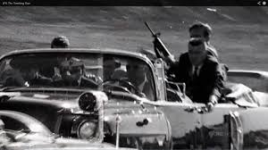
The claims were by a ballistics guy, Donahue. He accepts the magic bullet for shot 2, but says the first one hit the pavement, the second one went in through the neck and back out and through Connally, but the third shot was by a SS agent with an AR-15.
His major theory is that the bullet from Oswald's rifle couldn't have done the damage and that the full metal jacket from the AR-15 could have and would have essentially disintegrated in the skull, if I read it correctly and that explains all those fragments in Kennedy's skull.... IF THERE WAS NO THIRD SHOT BY OSWALD.
Cripes. I think I first dealt with this back in '94.
The problem with that theory is, in the 60's, bullet fragmentation wasn't really seen as a wounding mechanism. It was actually pretty well ignored. It's been some time since I dug through the medical literature, but in the 60's the big explanation for the 5.56NATO bullet's wounding ability was solely due to its velocity. You saw (and still see) that talked up a lot, and contributions such as the bullet's yaw or fragmentation are flat out ignored. It was all about velocity and energy dump, with lots of emphasis on the temporary cavity. It stayed that way up through the 80's until Col. Martin Fackler did a bunch of testing and documented how fragmentation enhances wounds. I would therefore not expect fragmentation to enter into anyone's cunning plan in 1963, or even accidental shooting cover-up. It simply wasn't considered, and I would not expect anyone to be familiar with the 5.56NATO, or even any other bullet's, fragmentation tendencies. Heck, IIRC research into this bullet didn't really even start until after the Vietnam was well underway in the late 60's. Sweden was doing research into how inhumane the bullet was, but again, they focused on velocity, and not fragmentation.
I hate typing out the long explanation, so in short, any bullet with the center of gravity towards the rear of the bullet wants to rotate 180 degrees and travel base-first. The spin imparted by the rifling counteracts this, and keeps the bullet nose-first in flight. However, tissue is too dense for this to work anymore, and so the bullet will want to yaw, given enough of a path to do so. Even the lowly .22LR will do this, and so will the 6.5mm FMJ Carcano. How
long it takes to do so varies. The 6.5mm fired by the Carcano does so after about 2 feet.
[1] The 5.56NATO takes around 7-10 inches.
The 5.56NATO, if traveling fast enough (usually over 2500fps), when it yaws, breaks apart. The faster it goes, he more it fragments. Around 2500fps, it may just break into two. Most all other bullets remain intact through this yaw cycle. However, when striking a hard surface, any bullet may deform and fragment, and people don't realize how little it can take to make this happen.
Window glass is seen as a fairly fragile material. Heck, my brother put a
tennis ball through my bedroom window growing up. However, glass is also hard, and in the video
Deadly Weapons by Anite Productions you can see even steel core 7.62x39 FMJ bullets fired by the AK-47 series rifle break apart into fragments when striking it.
Bone is also a hard material, and it will cause bullets to deform and maybe break apart. I am therefore not surprised that the 6.5mm FMJ Carcano bullet did so upon striking JFK's skull.
[1]As an aside, I'm not at all surprised by the path the second bullet took as it traveled through Connolly. When the bullet passed through Kennedy's neck, it was destabilized and began to yaw slightly. When it hit Connolly the bullet's yaw cycle continued, but when this bullet yaws, tests have shown it changes direction
up to 90 degrees. Nor is it the only bullet that does this. You can't always connect an entrance would with the exit wound and claim that's the path the bullet took.