• Security incident: ISF was recently accessed by intruders. Please change your password, and change it anywhere else you used it. Read more

Paul The Herodian and the DSS

Brainache, I have realized my error.
There is an academic reading of the section of Acts which I cited that cross references Paul to Josephus by way of the same event; assumed to be copied by the author of Acts from Josephus.

I made the error of assuming this reference from Eisenman's context (I'm reading his position from here: http://www.depts.drew.edu/jhc/eisenman.html).

I will look again at the proposition tomorrow under the right reference (as well as respond to the rest).

No worries Jayson. It might have something to do with my clumsy writing.

Thanks for the link. I hadn't seen that particular essay before. I could have saved myself a lot of time and effort if I just linked to it in the OP, snipped a quote and asked "Whaddayathink?".

It did put something straight for me about Paul's Tribe of Benjamin stuff:
Eisenman said:
Paul's claim to being of the tribe of Benjamin may relate to a general genre of such claims in the Diaspora, but it also illustrates the superficial ease with which such claims could be passed off on credulous and relatively unschooled audiences. It is more likely that Paul derives the claim to Benjaminite birth not from any actual genealogical link, but from the simple fact of his Hebrew namesake "Saul" being from the tribe of Benjamin.

His audience weren't OT Scholars, the only thing they knew about "Benjaminites" was that "Saul" was a famous one from Jewish history (King David's dad).
 
Here I go again, replying to myself. Oh well, it keeps me off the streets...

The article that Jayson linked to above ends with this paragraph:
Though these matters are hardly capable of proof, and we have, in fact, proved nothing, still no other explanations better explain the combination of points we raise. One thing cannot be denied, Paul's Herodian connections make the manner of his sudden appearances and disappearances, his various miraculous escapes, his early power in Jerusalem, his Roman citizenship, his easy relations with kings and governors, and the venue and terms of his primary missionary activities comprehensible in a manner no other reconstruction even approaches. When it comes to linking the thrust of these testimonies and allusions to the political Sitz im Leben of later Qumran sectarian texts and that Lying Spouter so prominent in them, much good sense can be achieved, but such a discussion is perforce beyond the scope of this study.

The bold is how I see it. Someone show me a better explanation and I'll go with that, but the currently accepted Apologetics are not it.

At the moment I'm cautiously optimistic for this little "kooky" pet theory of mine. It might be that one-in-ten-thousand outsider theories that turns out to be right. Still not really any way to prove it right now, but I guess that's the case with most Ancient History. It all comes down to "Plausibility" and I haven't seen anything that makes this idea implausible. Yet.

Countdown to Jayson destroying my illusions starts now.

...
 
Hey Brainache,
Can you help me out here; I've been looking over Book 18 and for the life of me I can't find Saulus, or any variant of that, in the text anywhere. I'm assuming that I'm missing something staring me right in the face.
http://www.sacred-texts.com/jud/josephus/ant-18.htm

Sorry, my mistake. I should have said Ant. 20. This bit:
...a sedition arose between the high priests, with regard to one another; for they got together bodies of the boldest sort of the people, and frequently came, from reproaches, to throwing of stones at each other. But Ananias was too hard for the rest, by his riches, which enabled him to gain those that were most ready to receive. Costobarus also, and Saulus, did themselves get together a multitude of wicked wretches, and this because they were of the royal family; and so they obtained favor among them, because of their kindred to Agrippa; but still they used violence with the people, and were very ready to plunder those that were weaker than themselves.
http://www.sacred-texts.com/jud/josephus/ant-20.htm

Eisenman argues that Josephus put this "Saulus" incident in the wrong decade or something, but it resembles the picture we have of Paul's early activities as a persecutor from the bible.


ETA: Phew! That was a close one. Illusions still intact for now.
 
Last edited:
Hmm, I think there's an easy way (oddly) to see if this link is plausible.

"Costobarus also, and Saulus, did themselves get together a multitude of wicked wretches, and this because they were of the royal family"

Leads us to Antiquities 15 7:9-10 where we are introduced to the individual (wrapping in spoiler to not bloat the thread on first-pass load):
9. Costobarus was an Idumean by birth, and one of principal dignity among them, and one whose ancestors had been priests to the Koze, whom the Idumeans had [formerly] esteemed as a god; but after Hyrcanus had made a change in their political government, and made them receive the Jewish customs and law, Herod made Costobarus governor of Idumea and Gaza, and gave him his sister Salome to wife; and this was upon the slaughter of [his uncle] Joseph, who had that government before, as we have related already. When Costobarus had gotten to be so highly advanced, it pleased him and was more than he hoped for, and he was more and more puffed up by his good success, and in a little while he exceeded all bounds, and did not think fit to obey what Herod, as their ruler, commanded him, or that the Idumeans should make use of the Jewish customs, or be subject to them. He therefore sent to Cleopatra, and informed her that the Idumeans had been always under his progenitors, and that for the same reason it was but just that she should desire that country for him of Antony, for that he was ready to transfer his friendship to her; and this he did, not because he was better pleased to be under Cleopatra's government, but because he thought that, upon the diminution of Herod's power, it would not be difficult for him to obtain himself the entire government over the Idumeans, and somewhat more also; for he raised his hopes still higher, as having no small pretenses, both by his birth and by these riches which he had gotten by his constant attention to filthy lucre; and accordingly it was not a small matter that he aimed at. So Cleopatra desired this country of Antony, but failed of her purpose. An account of this was brought to Herod, who was thereupon ready to kill Costobarus; yet, upon the entreaties of his sister and mother, he forgave him, and vouchsafed to pardon him entirely; though he still had a suspicion of him afterward for this his attempt.

10. But some time afterward, when Salome happened to quarrel with Costobarus, she sent him a bill of divorce (12) and dissolved her marriage with him, though this was not according to the Jewish laws; for with us it is lawful for a husband to do so; but a wife; if she departs from her husband, cannot of herself be married to another, unless her former husband put her away. However, Salome chose to follow not the law of her country, but the law of her authority, and so renounced her wedlock; and told her brother Herod, that she left her husband out of her good-will to him, because she perceived that he, with Antipater, and Lysimachus, and Dositheus, were raising a sedition against him; as an evidence whereof, she alleged the case of the sons of Babas, that they had been by him preserved alive already for the interval of twelve years; which proved to be true. But when Herod thus unexpectedly heard of it, he was greatly surprised at it, and was the more surprised, because the relation appeared incredible to him. As for the fact relating to these sons of Babas, Herod had formerly taken great pains to bring them to punishment, as being enemies to his government; but they were now forgotten by him, on account of the length of time [since he had ordered them to be slain]. Now the cause of his ill-will and hatred to them arose hence, that while Antigonus was king, Herod, with his army, besieged the city of Jerusalem, where the distress and miseries which the besieged endured were so pressing, that the greater number of them invited Herod into the city, and already placed their hopes on him. Now the sons of Babas were of great dignity, and had power among the multitude, and were faithful to Antigonus, and were always raising calumnies against Herod, and encouraged the people to preserve the government to that royal family which held it by inheritance. So these men acted thus politically, and, as they thought, for their own advantage; but when the city was taken, and Herod had gotten the government into his hands, and Costobarus was appointed to hinder men from passing out at the gates, and to guard the city, that those citizens that were guilty, and of the party opposite to the king, might not get out of it, Costobarus, being sensible that the sons of Babas were had in respect and honor by the whole multitude, and supposing that their preservation might be of great advantage to him in the changes of government afterward, he set them by themselves, and concealed them in his own farms; and when the thing was suspected, he assured Herod upon oath that he really knew nothing of that matter, and so overcame the suspicions that lay upon him; nay, after that, when the king had publicly proposed a reward for the discovery, and had put in practice all sorts of methods for searching out this matter, he would not confess it; but being persuaded that when he had at first denied it, if the men were found, he should not escape unpunished, he was forced to keep them secret, not only out of his good-will to them, but out of a necessary regard to his own preservation also. But when the king knew the thing, by his sister's information, he sent men to the places where he had the intimation they were concealed, and ordered both them, and those that were accused as guilty with them, to be slain, insomuch that there were now none at all left of the kindred of Hyrcanus, and the kingdom was entirely in Herod's own power, and there was nobody remaining of such dignity as could put a stop to what he did against the Jewish laws.

Which, this crosses into the Talmudic tradition as well:
Teacher of the Law at the time of Herod, and perhaps a member of the prominent family known as "The Sons of Baba" ("Bene Baba"), who, at the time of the siege of Jerusalem by Herod (37 B.C.), resisted its surrender, and whom Costobarus protected from the wrath of Herod for ten years, until they were discovered and put to death (Josephus, "Ant." xv. 7, § 10). But, according to a tradition preserved in the Babylonian Talmud (B. B. 3b et seq.), Baba ben Buṭa was the only teacher of the Law who was spared by Herod. According to this tradition it was Baba b. Buṭa, deprived of his eyesight by Herod, who advised the latter to rebuild the Temple in expiation of his great crimes. The following conversation between the king and the blind teacher, with its haggadic embellishments, forms the principal part of this tradition, and it probably rests upon a historical foundation:

"One day Herod came to visit the blind teacher and, sitting down before him, said, 'See how this wicked slave [Herod] acts.' Said he [Baba] to him, 'What can I do to him?' Said he, 'Curse him, sir.' Said he, 'It is written (Eccl. x. 20), "Curse not the king; no, not in thy thought."' 'But,' said Herod, 'he is no king.' Upon which Baba said, 'Let him be only a man of wealth, it is written (ib.), "And curse not the rich in thy bedchamber"; or let him be merely a chief, it is written (Ex. xxii. 27 [A.V. 28]), "Curse not a ruler of thy people."' 'But,' said Herod, 'this is interpreted to mean a ruler that acts according to the customs of thy people; but that man [Herod] does not act according to the customs of thy people.' Said he, 'I am afraid of him,' to which Herod replied, 'There is no man here to go and tell him; for I and thou sit here alone.' Said he, 'It is written (Eccl. l.c.), "For a bird of the air shall carry the voice, and that which hath wings shall tell the matter."'

"Herod now disclosed himself, and said, 'Had I known that the rabbis were so discreet, I should not have put them to death. What, now, can a man like me do to repair this wrong?' 'He,' said Baba, 'has extinguished the light of the world [put to death the teachers], as it is written (Prov. vi. 23), "For the commandment is a lamp; and the Law is light"; let him busy himself with the light of the world [the Temple], of which it is written (Isa. ii. 2), "All nations shall flow unto it"' [a play on nahar, which also means "light"]. Said Herod, 'I am afraid of the [Roman] government.' To which Baba replied, 'Send a messenger; he will be one year in going to Rome, will be detained there one year, and make his home voyage in one year, and in the mean while thou shalt have torn down and built'; and Herod did accordingly."

In halakic tradition Baba b. Buṭa is recorded as a disciple of Shammai; and it is said that he prevented an opinion of Shammai concerning a question of sacrifices from becoming a rule, because he was convinced of the correctness of Hillel's opposing opinion (Beẓah 20a et seq.). Baba was so scrupulous in his religious observances that he brought a free-will offering every day, for fear that he might have committed a sin requiring atonement. These sacrifices were called "sin-offerings of the pious" ("ḥasidim"). Baba was a member of the "bet din" and always saw that justice was done, particularly to women (Giṭ. 57a; Ned. 66b).
http://www.jewishencyclopedia.com/articles/2276-baba-ben-buta


There's all the citations circling around this entry in Romans 16:11, which Eisenman is linking to Josephus' entry in Book 20.

First, we have to ask: does Paul ever discuss anything to do with Baba, of any kind?
Answer: no.

That's one strike, but not a critical blow - perhaps we're missing such a letter Paul wrote?
So we cannot rest on this alone.

Let's next take a look at the Greek of Romans and see if it supports Eisenman's reading:
ἀσπάσασθε Ἡρῳδίωνα τὸν συγγενῆ μου. ἀσπάσασθε τοὺς ἐκ τῶν Ναρκίσσου τοὺς ὄντας ἐν κυρίῳ.

The word itself isn't very helpful because this word can be used to refer to either direct relatives, or being of the same race or country.

However, the word use is helpful because we can look at Romans 16:7 (NIV for quick version):
Greet Andronicus and Junia, my fellow Jews who have been in prison with me. They are outstanding among[d] the apostles, and they were in Christ before I was.


In Greek:
ἀσπάσασθε Ἀνδρόνικον καὶ Ἰουνιᾶν τοὺς συγγενεῖς μου καὶ συναιχμαλώτους μου, οἵτινές εἰσιν ἐπίσημοι ἐν τοῖς ἀποστόλοις, οἳ καὶ πρὸ ἐμοῦ γέγοναν ἐν Χριστῷ.

It's becoming a bit more difficult to go with this linking, as it would have us treat one entry different than the other, unless we read Romans to be stating that Paul is a relative of Herod, Andronicus and Junia; but this is unlikely.


Using this same method Eisenman is using, we could equally make a claim that Paul is related to Andronicus ben Meshullam (Josephus - Ant. 13. chapter 3, section 4), the Jewish scholar of the 2nd c BCE, and claim the dates are just a mistake.

Another issue that occurs to me in using this as the link is that this is a letter to Rome in preparation for Paul coming to Rome.
I'm not really sure why Paul would be asking fellow Christians in Rome to say howdy to King Herod, especially when Paul is heading to Jerusalem before setting out to Rome (chapter 15):
23 But now that there is no more place for me to work in these regions, and since I have been longing for many years to visit you (Rome), 24 I plan to do so when I go to Spain. I hope to see you while passing through and to have you assist me on my journey there, after I have enjoyed your company for a while. 25 Now, however, I am on my way to Jerusalem in the service of the Lord’s people there.


It seems a bit jarring to send a message to Christian fellowships in Rome (not Roman officials or Hebrew leaders) and ask them to send a message of greeting to a King in the Levant region where you are heading out to anyway.

I don't even know that we can be certain that the Herod mentioned is the same as the King Herod so famously known; most of the people Paul is listing are names that mean practically nothing to us and are vague ghosts of history at this point.


Yeah...I can't see this link. It's too far reaching.


I need something better than this, I think, to make a case for it.
If everything hinges on this cross-link, then I couldn't follow Eisenman the rest of the way.
 
Last edited:
Hmm, I think there's an easy way (oddly) to see if this link is plausible.

"Costobarus also, and Saulus, did themselves get together a multitude of wicked wretches, and this because they were of the royal family"

Leads us to Antiquities 15 7:9-10 where we are introduced to the individual (wrapping in spoiler to not bloat the thread on first-pass load):


Which, this crosses into the Talmudic tradition as well:


There's all the citations circling around this entry in Romans 16:11, which Eisenman is linking to Josephus' entry in Book 20.

First, we have to ask: does Paul ever discuss anything to do with Baba, of any kind?
Answer: no.

That's one strike, but not a critical blow - perhaps we're missing such a letter Paul wrote?
So we cannot rest on this alone.

That was the Grandfather of Saulus' buddy Costobarus. The Costobarus who was a relative of the original Herod, who tried to get Cleopatra to ask Antony to let him be king of the Edomites/Idumeans.

So, I'm not sure why Paul would mention his friend's Grandfather's teacher anywhere.

Let's next take a look at the Greek of Romans and see if it supports Eisenman's reading:


The word itself isn't very helpful because this word can be used to refer to either direct relatives, or being of the same race or country.

However, the word use is helpful because we can look at Romans 16:7 (NIV for quick version):


In Greek:


It's becoming a bit more difficult to go with this linking, as it would have us treat one entry different than the other, unless we read Romans to be stating that Paul is a relative of Herod, Andronicus and Junia; but this is unlikely.


Using this same method Eisenman is using, we could equally make a claim that Paul is related to Andronicus ben Meshullam (Josephus - Ant. 13. chapter 3, section 4), the Jewish scholar of the 2nd c BCE, and claim the dates are just a mistake.

Another issue that occurs to me in using this as the link is that this is a letter to Rome in preparation for Paul coming to Rome.
I'm not really sure why Paul would be asking fellow Christians in Rome to say howdy to King Herod, especially when Paul is heading to Jerusalem before setting out to Rome (chapter 15):


It seems a bit jarring to send a message to Christian fellowships in Rome (not Roman officials or Hebrew leaders) and ask them to send a message of greeting to a King in the Levant region where you are heading out to anyway.

I don't even know that we can be certain that the Herod mentioned is the same as the King Herod so famously known; most of the people Paul is listing are names that mean practically nothing to us and are vague ghosts of history at this point.


Yeah...I can't see this link. It's too far reaching.


I need something better than this, I think, to make a case for it.
If everything hinges on this cross-link, then I couldn't follow Eisenman the rest of the way.


Eisenman argues that "Junius" is "Julius", possibly Julius Archelaus. He argues that this Julius is the Nephew of Paul mentioned in Acts.

Herodion is (according to the theory) Herod, the child of Aristobulus and Salome then resident in Rome. Their household is mentioned immediately before "Herodion".

Eisenman compares Caesar-Caesarion with Herod-Herodion. A family name which was not very popular outside of this particular family.

How else can we account for Paul's Roman Citizenship?

But really if none of this is conclusive, it can be discarded without affecting the overall impression that Paul is at least aligned with the Herodians.
 
Last edited:
My point regarding the Baba was that I was looking around for any position against it in like fashion as Herod, as that would help if there was a shared position that we could see; but I can't rest on the absence of this entirely.

Regarding Junius, et. al.
I get a bit uneasy when we have to start respelling multiple names to get what we're after.
Could it be?
Yes, it could be.
On the other hand, I don't feel comfortable running conclusions on assuming multiple name spelling errors when, if I had proposed such a thing I would be nervous and insecure that that's all I really had to go on.

I'm alright with making conjectures, but when we start rewriting the spelling to get other words or names in a conjecture itself so that we can make ends meet for another conjecture, that's where I start to get uneasy.

As to the citizenship; that would have been granted by birthright if he was born in Tarsus at the time we are given, as Tarsus was granted to being a free city of Rome and the people were given citizenship by default.
Here's how that worked out:
Pompey subjected Tarsus to Rome, and it became capital of the Roman province of Cilicia, the metropolis where the governor resided. In 66 BC, the inhabitants received Roman citizenship.
http://en.wikipedia.org/wiki/Tarsus,_Mersin

We don't need to craft a complicated means of understanding his citizenship because it was a long standing grant to where he was born.
That he has citizenship just helps sympathize the claim that he is from Tarsus.


As to alignment:
I don't see any ideological conflicts between Paul and Herodians, and Paul claims to have studied under a teacher of shared social circles as Herodians, so I don't see much problem there.
I can't verify it, but I don't see any critical flaws in the proposition.
 
Last edited:
My point regarding the Baba was that I was looking around for any position against it in like fashion as Herod, as that would help if there was a shared position that we could see; but I can't rest on the absence of this entirely.

Regarding Junius, et. al.
I get a bit uneasy when we have to start respelling multiple names to get what we're after.
Could it be?
Yes, it could be.
On the other hand, I don't feel comfortable running conclusions on assuming multiple name spelling errors when, if I had proposed such a thing I would be nervous and insecure that that's all I really had to go on.


I'm alright with making conjectures, but when we start rewriting the spelling to get other words or names in a conjecture itself so that we can make ends meet for another conjecture, that's where I start to get uneasy.

Well it's only a small point in the theory, and doesn't really matter that much either way, just a tantalising maybe.

As to the citizenship; that would have been granted by birthright if he was born in Tarsus at the time we are given, as Tarsus was granted to being a free city of Rome and the people were given citizenship by default.
Here's how that worked out:

http://en.wikipedia.org/wiki/Tarsus,_Mersin

We don't need to craft a complicated means of understanding his citizenship because it was a long standing grant to where he was born.
That he has citizenship just helps sympathize the claim that he is from Tarsus.

OK thanks. I hadn't realised that. I thought it was a lot rarer than it apparently was.

As to alignment:
I don't see any ideological conflicts between Paul and Herodians, and Paul claims to have studied under a teacher of shared social circles as Herodians, so I don't see much problem there.
I can't verify it, but I don't see any critical flaws in the proposition.

So still not impossible. Yay.
 
Well it's only a small point in the theory, and doesn't really matter that much either way, just a tantalising maybe.
I'm being pedantic (forgive me), but "hypothesis"; not "theory".
Theory is a reflective proposition in light of hard facts, and aims to be tested for validation.
An hypothesis is more supposition based on an interpretation of facts, and aims to prompt further inquiry or testing so to form a theory.
An hypothesis is generally filled with conditional axioms of conjecture and admitted gaps, while a theory has filled in the gaps and accepts only axioms which are verified data points prior to the formation of the theory, thereby leading to a finite possibility which can be tested for probability.
Eisenman isn't offering us something we can very well test, and he isn't either giving us only one direction to go. He's more saying that he thinks there's some possibilities that exist in a bunch of different manners which may imply Paul was related in some fashion to the Herodian family.

OK thanks. I hadn't realised that. I thought it was a lot rarer than it apparently was.
Well; it is much as you think.
However Tarsus was made the capital of the Roman province of Cilicia; capitals tended to get this perk for morale boost and (more importantly) to spur the economic boom as citizenship had ownership and business entitlement impacts under the law.
You didn't really want a capital of a province to suffocate under non-citizenship status; it would really slow down trade and commerce.


So still not impossible. Yay.
Surely possible; I don't know how valuable, but possible.
 
Last edited:
I'm being pedantic (forgive me), but "hypothesis"; not "theory".
Theory is a reflective proposition in light of hard facts, and aims to be tested for validation.
An hypothesis is more supposition based on an interpretation of facts, and aims to prompt further inquiry or testing so to form a theory.
An hypothesis is generally filled with conditional axioms of conjecture and admitted gaps, while a theory has filled in the gaps and accepts only axioms which are verified data points prior to the formation of the theory, thereby leading to a finite possibility which can be tested for probability.
Eisenman isn't offering us something we can very well test, and he isn't either giving us only one direction to go. He's more saying that he thinks there's some possibilities that exist in a bunch of different manners which may imply Paul was related in some fashion to the Herodian family.

...

OK yeah, I'm a bit sloppy in my writing as well as clumsy. Sorry, but Theory is easier to spell. Did I mention I'm lazy as well?

I'll try harder.

I don't think Eisenman is some super-genius who has seen something here that no one else noticed in the last 2000 years. It's just that he is amongst the first to have access to all of the material and he wasn't constrained by religious rules. He wouldn't have started putting this idea (that's even easier to spell than "theory") together if he hadn't had access to the stuff from Nag Hammadi, the Cairo Geniza and the Dead Sea Scrolls. Stuff which Scholars hadn't seen until the second half of the 20th century.
 
Theory/Hypothesis :p (I know, I was being pedantic).

It's a neat idea; I don't know what impact it has though.
I can't side with the "related" aspect, but I could sympathize with the aligned with...but in the aligned with angle, I somewhat wonder what difference it ends up making for us?

I keep trying to wrap my head around what would be different either way it is positioned (which is helpful for plausibility) and I can't see much difference since Paul doesn't seem to rely on the Herodian siding all that much aside from one entry of a "howdy" to some Herodian in Rome who's hanging out with some church goers, and dropping a line to who his instructor was when he's on trial.

Paul spends a heck of a lot more time flip-flopping between Jew/Roman and 'don't need authority of men'/'I have authority of Jerusalem' far more than anything related to Herod.
 
Last edited:
Theory/Hypothesis :p (I know, I was being pedantic).

It's a neat idea; I don't know what impact it has though.
I can't side with the "related" aspect, but I could sympathize with the aligned with...but in the aligned with angle, I somewhat wonder what difference it ends up making for us?

I keep trying to wrap my head around what would be different either way it is positioned (which is helpful for plausibility) and I can't see much difference since Paul doesn't seem to rely on the Herodian siding all that much aside from one entry of a "howdy" to some Herodian in Rome who's hanging out with some church goers, and dropping a line to who his instructor was when he's on trial.

Paul spends a heck of a lot more time flip-flopping between Jew/Roman and 'don't need authority of men'/'I have authority of Jerusalem' far more than anything related to Herod.

I'm not sure, but I think for people interested in the History of the time and place, placing Paul as a member of Herod's family is interesting. Not least because it makes Paul, the founding saint of Christianity, a close family relative of one of the biggest Villains in the NT(or, if not relative, then enthusiastic supporter). A Villain whose family interests Paul was furthering by inventing a syncretic religion which just happens to oppose the Zealots (ie: the members of Jesus' family) on just about every point of doctrine.

Paul's new religion of equality between Jews and Greeks, no circumcision, no purity rules, etc was anathema to the community led by James.

I would like to think that for people to whom Jesus is an important figure, learning that Paul's "Christ Jesus" was born from a desire to suppress the real Jesus, might come as a shock.

It probably won't change anything, but I still think it's interesting.
 
I disagree that Paul attempted to change the Jesus philosophy in character, and I'll explain why tomorrow.
 
Last edited:
I disagree that Paul attempted to change the Jesus philosophy in character, and I'll explain why tomorrow.

OK. I get the sense that you mean he kept the moral teachings, but just dumped the OT Mosaic Laws. But I'll let you explain.
 
I mean he kept both as the Jesus message was, but translated the metaphorical language to something that Hellenestic cultures could comprehend; and that this is itself what James could not understand (to Paul's frustrations).
 
I mean he kept both as the Jesus message was, but translated the metaphorical language to something that Hellenestic cultures could comprehend; and that this is itself what James could not understand (to Paul's frustrations).

I'm not so sure about that. I get the impression that Paul was using the same language and metaphors as the Zealots, but that in just about every case the meanings of the lessons are turned around 180 degrees.

The Zealots say love your neighbour, but separate yourself from the impure.
Paul has Jesus hanging out with prostitutes.

The Zealots say you should not have a foreigner in power in Judea. Paul says "obey your masters" "pay your taxes" .etc

The Zealots say faith without works is useless. Paul says faith is everything.

He is contradicting them all down the line. And Paul's positions aren't just anti-Zealot, they are anti-Jewish.
 
I'm not so sure about that. I get the impression that Paul was using the same language and metaphors as the Zealots, but that in just about every case the meanings of the lessons are turned around 180 degrees.

The Zealots say love your neighbour, but separate yourself from the impure.
Paul has Jesus hanging out with prostitutes.

The Zealots say you should not have a foreigner in power in Judea. Paul says "obey your masters" "pay your taxes" .etc

The Zealots say faith without works is useless. Paul says faith is everything.

He is contradicting them all down the line.
So was the Jesus message, so there's no real conflict in that itself.

And Paul's positions aren't just anti-Zealot, they are anti-Jewish.
No, he's anti-conservative and thinks the "back-woods" hard-core traditionalists (as he was) are ignorant and holding back progress in ignorance.

He's not against Jews at all though; we see him regularly speaking to Jews who are part of his converted system regularly.


So this explanation takes a bit to explain, and I hope I don't bore you along the way, but I don't know of a way to show how Paul was dead-on with the Jesus philosophy and didn't attempt to deviate it, but that when the later theologians attempted to understand it through over-analyzing everything when they began to build an official dogma, that much of what Paul had written was taken out of context and converted again and this time into the variation we are more familiar with today.
Though the words themselves did not change from Paul to theologians, the meanings radically changed; theologians took things Paul used metaphorically much more literally.


OK, so firstly, I'll link the timeline of the Hebrews for reference point.

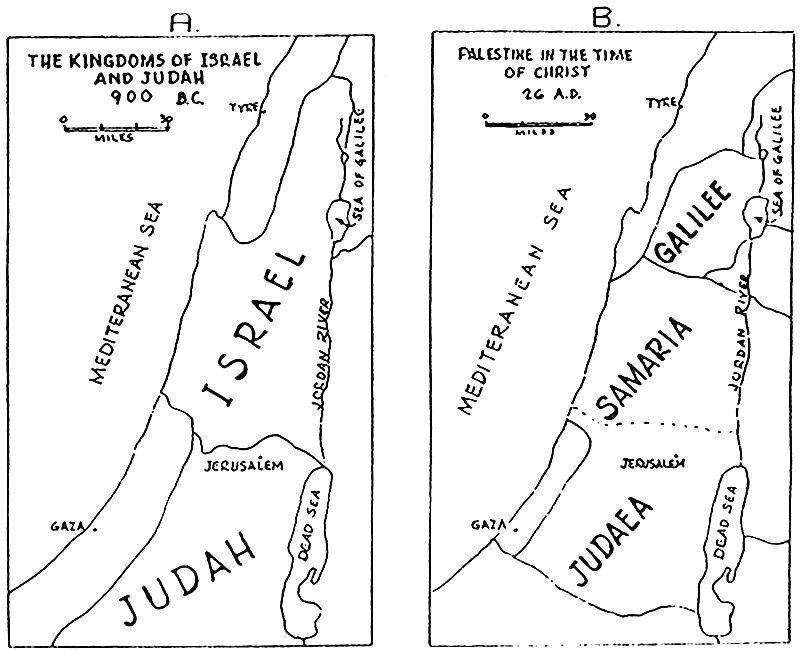
We have to go back to the split in 930 BCE when we have the Kingdom of Israel up north and the Kingdom of Judah in the south.

There's two access points to the Levant region, effectively:
North and South.
South was the way Egypt used to enter the region while North was the way the Greeks and Romans used most often (as well as just about everyone else).

As a result, Israel lost their kingdom faster than Judah, though Judah eventually lost theirs as well around 586 BCE during the Babylonian exile.
The Persians took over shortly after that, and allowed Judah to rebuild the temple and establish their province again in hopes of pacifying the issues.

Side note: Samaria offered to help build it, but the Judean Hebrews rejected their assistance (presumably because then Samaria would be able to claim access to the Temple, and the Hebrews of Judah had banned them as a people and denied recognizing them as fellow Jews) [keep in mind the parable of the good Samaritan that came later]

The Kingdom of Israel, however, was not restored.
It became Galilee, and Galilee was essentially allowed governance by Judah, but here we have our problem and why I brought all of this up.

Between Galilee and Judah was Samaria (before/after picture):
fig2.jpg


Now, again, keep in mind that the North was just constantly trampled on over and over (as you can see from the timeline) by comparison to the South, and even when they did get some sovereignty, they didn't have governing sovereignty and they also still relied on the Temple in Judah and didn't have their own Temple.
No officials related to Judah were stationed in Galilee for theocratic interaction or oversight; Galilee just had to travel south to do anything.

In their way was Samaria; so Galileans had to walk around and south out of their way to get to Jerusalem.

Because Galilee didn't have a Temple or priests from Judah, they didn't have an official Torah (Torah required having handlers and readers who were allowed to touch and read from the Torah).

Linking back to the trampling of the north by other nations, and then being neglected, you could see Hellenistic structures of grand scales if you stood on the banks of the Sea of Galilee within the Galilean boundary.
That's just an example, but such mix of culture was every where.
Unlike the South, more of the North was mixed in blood than the South, and culturally surrounded by more non-Hebrew culture than the South.

Yet, these peoples clearly still wanted to adhere to their Hebraic belief system; they were still a people of Hebrew identity and wants.

As a result we see a different type of religious practices starting up North than in the South.
In the North we start to see small synagogues where people would show up, and the eldest elder would stand at the front and recite from memory or some scrap of the Torah they had obtained. During the recital or reading, other elders would walk around to those sitting on the floor or stairs around the synagogue and help answer questions any of them had about something the eldest elder was orating, without stopping the process.

Quite naturally, following the Law to the exact and pedantic letter became next to impossible in the North, while it was a daily reminder in the South with regular official public readings and, of course, having the priesthood and theocratic political parties such as the Pharisees and Sadducees.

In the South, there was only one central authority: the Temple and the priesthood.
If you wanted permission to do something or get an exemption under the law, then you needed to speak to the judges; bottom line, no exception.
These figures would act like the supreme court and consult the documents and rule on a case.

Up North, this wasn't an option.
They couldn't just whip up some documents, debate over semantics and come to a ruling.
They had to rely on the age-old council of elders structure and general community justice, unless someone wanted to go all the way down to Jerusalem to file a request for their case to be heard in hopes of a ruling; with no guarantee the ruling would be in their favor.


Now we can enter the Jesus philosophy from this angle.
Jesus is claimed as a Galilean, and shows every indication of being such a representative figure.
(I'm just going to talk of Jesus as a person for simplicity, but it's more the ideas that's of note and not whether or not the individual was or was not real)

Jesus essentially has one central message that he's after to push for, and it only really makes sense under the context listed above.
The message isn't love and peace and all of the things that we take from it today, but instead it was that all Herbrews have the authority of Abraham in them, and in them is the authority of Adam.
His argument is blood-based.

He argues for the concept and essence of the Law and not the letter of the Law while lacking the essence.

Every argument he makes is about how any Hebrew is a son of the divine and has the authority to make moral decisions; that one doesn't need to follow a strict decree of actions like a machine to be seen as living a good life.

His link in this argument is centered around the bloodline.
Indeed, this is his reason for the Samaritan parable, and it wasn't an altruistic sense of global humanity; that wasn't within the scope of concern.
Samaritans were Hebrews; excommunicated Hebrews (if you asked a Samaritan, they would say Judah strayed and the Samaria kept the old faith steadfast after the fall of the Kingdom of Israel and later Judah).


The parable was a sociopolitical point that Hebrews shouldn't be fighting with Hebrews, and that instead should be working together to help each other before they are all (once again) wiped out like before; but with a fear attached to the idea this time of finality.


That's good enough for the moment regarding Jesus, so we'll next swing over to Paul.

Now Paul sees all of this and thinks of all the Jews not in the Levant region; something the Jesus philosophy doesn't really ever show signs of thinking about.

Paul takes this consideration and expands it, due to complex issues of mixed peoples (a Gentilian Jew is married to a Gentile, who do I talk to? Just the Jew? Why not the Gentile? Isn't this pedantic? Isn't pedantic what Jesus was stating was a problem?).

But Paul has a challenge; nothing of what Jesus was talking about makes sense to a Hellenistic mind; authority of the divine (moral decisions) by grant of access through blood right?
Immediately there is an issue here; Gentiles that aren't Jews don't have blood right to that authority, and if they are mixed, then we could argue inferiority to authority by blood right.

So Paul converts this to something that makes sense in the Hellensitic culture: "holy spirit".
Essentially, he upgrades the importance of the holy spirit to the point that it is a replacement for the authority by blood right; and we see a holy spirit (in the Greek anyway) that is not an entity, but a presence of solidarity.

His disinterest in the pedantic practices of the Law wasn't really new for Paul; Jesus outlines much the same while considering that doing so does not remove one thing from the Law, because from a Galilean perspective; it doesn't.
From a Judean perspective; it absolutely did. And in this we have all of those conversations in the text arguing back and forth over the various pedantic sections of the Law and Jesus' typical replies which force the opposition argument to make a moral decision on the matter on their own and not rely on him answering the question directly - which in itself makes his point.

So Paul isn't deviating or changing anything about the Jesus philosophy, but he changes the metaphors by reading the essence of the Jesus philosophy in like fashion that the Jesus philosophy read the essence of the Law, and how neither considered this to be an action which removed or eradicated the Law; as both were working from the essence rather than pedantic and strict adherence to the letter and action of the Law.


Like Jesus, Paul runs into problems with this as Paul then thinks this means that he doesn't need any authority by any person for his teachings anymore than Jesus needed authority from any person or agency to give such teachings.

James doesn't agree with Paul; James more sees that Jesus was as described above, but only for Hebrews and not Gentiles, and when the headaches of the tangled mess comes about regarding how to apply such a ruling over Gentiles when Jews are split and spread among the Gentiles, James more or less waves his hands in the air and walks away and prefers to just stick to the simple world of talking to Hebrews around his area who are of the same culture and thereby more sensible to James.

Paul, as such, sees any Hebrew who wants to hold to the pre-Jesus message concept as sort of backwoods and ignorant; heading down a path of division and eradication.

About the only real tangent that Paul strongly deviates from the Jesus philosophy on specifically is in changing the scope of salvation; no longer is the message concerned with only the aim of steering the Hebrews away from eradication once again, but instead, now the message is focused on personal destruction more directly, and community building in spirit as a solution.

 
Last edited:
So was the Jesus message, so there's no real conflict in that itself.


No, he's anti-conservative and thinks the "back-woods" hard-core traditionalists (as he was) are ignorant and holding back progress in ignorance.

He's not against Jews at all though; we see him regularly speaking to Jews who are part of his converted system regularly.

Paul is definitely against the OT Laws. Can we agree on that?

So this explanation takes a bit to explain, and I hope I don't bore you along the way, but I don't know of a way to show how Paul was dead-on with the Jesus philosophy and didn't attempt to deviate it, but that when the later theologians attempted to understand it through over-analyzing everything when they began to build an official dogma, that much of what Paul had written was taken out of context and converted again and this time into the variation we are more familiar with today.
Though the words themselves did not change from Paul to theologians, the meanings radically changed; theologians took things Paul used metaphorically much more literally.

OK, now I have to ask how you can tell the authentic sayings of Jesus from things put in the Gospels to support Paul's theology?

Paul comes before the Gospels. The Gospels have Jesus insulting the Jews, calling them a generation of vipers etc How is it that the Messiah can turn around and be so hateful towards the very people who are proclaiming him "King"?

The Gospels are full of Roman anti-semitic rhetoric, as are Paul's letters.

OK, so firstly, I'll link the timeline of the Hebrews for reference point.

{snip for space}
As a result we see a different type of religious practices starting up North than in the South.
In the North we start to see small synagogues where people would show up, and the eldest elder would stand at the front and recite from memory or some scrap of the Torah they had obtained. During the recital or reading, other elders would walk around to those sitting on the floor or stairs around the synagogue and help answer questions any of them had about something the eldest elder was orating, without stopping the process.

Quite naturally, following the Law to the exact and pedantic letter became next to impossible in the North, while it was a daily reminder in the South with regular official public readings and, of course, having the priesthood and theocratic political parties such as the Pharisees and Sadducees.

So now I have to ask about Judas The Galilean. Wasn't he from the North? Wasn't he the guy (along with his buddy "Sadok") who kicked off the whole Zealot movement over the issue of Taxation and that Census of Quirinius?

Seems to me that Galilee is where all of the Zealot business started in the first place.

In the South, there was only one central authority: the Temple and the priesthood.
If you wanted permission to do something or get an exemption under the law, then you needed to speak to the judges; bottom line, no exception.
These figures would act like the supreme court and consult the documents and rule on a case.

Up North, this wasn't an option.
They couldn't just whip up some documents, debate over semantics and come to a ruling.
They had to rely on the age-old council of elders structure and general community justice, unless someone wanted to go all the way down to Jerusalem to file a request for their case to be heard in hopes of a ruling; with no guarantee the ruling would be in their favor.


Now we can enter the Jesus philosophy from this angle.
Jesus is claimed as a Galilean, and shows every indication of being such a representative figure.
(I'm just going to talk of Jesus as a person for simplicity, but it's more the ideas that's of note and not whether or not the individual was or was not real)

Jesus essentially has one central message that he's after to push for, and it only really makes sense under the context listed above.
The message isn't love and peace and all of the things that we take from it today, but instead it was that all Herbrews have the authority of Abraham in them, and in them is the authority of Adam.
His argument is blood-based.

Except for the "not one jot or tittle" bit of the Sermon On The Mount. Or, really most of the Sermon On The Mount, which rather than lifting any obligation to obey the Laws of Moses, actually reinforces and adds to them, making them even more strict. Now just looking at a woman with lust is adultery, you don't even have to touch her.

I guess you could argue that Jesus was being sarcastic or something, but that would be silly.

He argues for the concept and essence of the Law and not the letter of the Law while lacking the essence.

Every argument he makes is about how any Hebrew is a son of the divine and has the authority to make moral decisions; that one doesn't need to follow a strict decree of actions like a machine to be seen as living a good life.

And that's where he sounds like Paul's sock-puppet.

His link in this argument is centered around the bloodline.
Indeed, this is his reason for the Samaritan parable, and it wasn't an altruistic sense of global humanity; that wasn't within the scope of concern.
Samaritans were Hebrews; excommunicated Hebrews (if you asked a Samaritan, they would say Judah strayed and the Samaria kept the old faith steadfast after the fall of the Kingdom of Israel and later Judah).


The parable was a sociopolitical point that Hebrews shouldn't be fighting with Hebrews, and that instead should be working together to help each other before they are all (once again) wiped out like before; but with a fear attached to the idea this time of finality.

To unite against their common enemy - The Judean Peoples' Front.... er I mean the Bloody Romans.

That's good enough for the moment regarding Jesus, so we'll next swing over to Paul.

Now Paul sees all of this and thinks of all the Jews not in the Levant region; something the Jesus philosophy doesn't really ever show signs of thinking about.

Paul takes this consideration and expands it, due to complex issues of mixed peoples (a Gentilian Jew is married to a Gentile, who do I talk to? Just the Jew? Why not the Gentile? Isn't this pedantic? Isn't pedantic what Jesus was stating was a problem?).

But Paul has a challenge; nothing of what Jesus was talking about makes sense to a Hellenistic mind; authority of the divine (moral decisions) by grant of access through blood right?
Immediately there is an issue here; Gentiles that aren't Jews don't have blood right to that authority, and if they are mixed, then we could argue inferiority to authority by blood right.

So Paul converts this to something that makes sense in the Hellensitic culture: "holy spirit".
Essentially, he upgrades the importance of the holy spirit to the point that it is a replacement for the authority by blood right; and we see a holy spirit (in the Greek anyway) that is not an entity, but a presence of solidarity.

You know the concept of the Holy Spirit is in the Dead Sea Scrolls don't you? And that the DSS are the literature of the Zealots?

I think we can safely say that Paul didn't invent the concept, he just used it for his own ends.

His disinterest in the pedantic practices of the Law wasn't really new for Paul; Jesus outlines much the same while considering that doing so does not remove one thing from the Law, because from a Galilean perspective; it doesn't.
From a Judean perspective; it absolutely did. And in this we have all of those conversations in the text arguing back and forth over the various pedantic sections of the Law and Jesus' typical replies which force the opposition argument to make a moral decision on the matter on their own and not rely on him answering the question directly - which in itself makes his point.

And I would argue again that what we are seeing here is Paul's position retro-fitted to Jesus.

So Paul isn't deviating or changing anything about the Jesus philosophy, but he changes the metaphors by reading the essence of the Jesus philosophy in like fashion that the Jesus philosophy read the essence of the Law, and how neither considered this to be an action which removed or eradicated the Law; as both were working from the essence rather than pedantic and strict adherence to the letter and action of the Law.


Like Jesus, Paul runs into problems with this as Paul then thinks this means that he doesn't need any authority by any person for his teachings anymore than Jesus needed authority from any person or agency to give such teachings.

James doesn't agree with Paul; James more sees that Jesus was as described above, but only for Hebrews and not Gentiles, and when the headaches of the tangled mess comes about regarding how to apply such a ruling over Gentiles when Jews are split and spread among the Gentiles, James more or less waves his hands in the air and walks away and prefers to just stick to the simple world of talking to Hebrews around his area who are of the same culture and thereby more sensible to James.

I tend to think it more likely that James' teachings match that of Jesus than Paul's do. Paul never even met Jesus. James was Jesus' own brother. Who do you think knew Jesus better?

This applies if Jesus was real or mythical. You have to expect a "Brother Of The Lord" to know a bit more about "The Lord" than the enemy-turned-convert Paul.

Paul, as such, sees any Hebrew who wants to hold to the pre-Jesus message concept as sort of backwoods and ignorant; heading down a path of division and eradication.

About the only real tangent that Paul strongly deviates from the Jesus philosophy on specifically is in changing the scope of salvation; no longer is the message concerned with only the aim of steering the Hebrews away from eradication once again, but instead, now the message is focused on personal destruction more directly, and community building in spirit as a solution.

And I say that Paul's "community building" was all about attempts to stabilise those Hellenistic cities where Paul did his missionary work and the Herodians were in power.


I think we might be in for a long one here. I'll see if I can find that DSS Holy Spirit reference, I read it just the other day.
 
Last edited:
Paul is definitely against the OT Laws. Can we agree on that?
He's not against "The Law"; he's against iterations of Law.
It's like not being against "The Constitution" but being against the iterations of it.
The concepts that the laws were aiming to instill; he's for those.
He's against the idea that the exact letter and iteration of a given clause are as important as the concepts they were attempting to convey.

It's an important difference as what it means is that "The Law" was malleable and movable; something it was not supposed to be.
The justification for this position (unmovable) was that man can't claim to know what the divine wants; Jesus, and therefore Paul, disagreed with this core difference of understanding.

OK, now I have to ask how you can tell the authentic sayings of Jesus from things put in the Gospels to support Paul's theology?

Paul comes before the Gospels. The Gospels have Jesus insulting the Jews, calling them a generation of vipers etc How is it that the Messiah can turn around and be so hateful towards the very people who are proclaiming him "King"?

The Gospels are full of Roman anti-semitic rhetoric, as are Paul's letters.
That's not entirely accurate.
The iterated textual copies that we have are later than Paul's letters, but it's rather clear that the concepts were there in various demographics prior to Paul's letters.

As to "how to tell the difference" - years and years of research in textual analysis, Greek, and anthropological research to learn the people, their culture, their history, and their world views.

It's hard to explain in general abstract, but if you have a specific section, I can show you how I can go about this and you can draw a decision from that as to whether or not what I'm doing makes sense to your mind or not.

As to insulting; yes, there's regular insulting taking place regarding what I call, "conservative" Hebrews; not all Hebrews.
The struggle was against the ultra-conservative theocratic tradition and those sociopolitical factions.

So now I have to ask about Judas The Galilean. Wasn't he from the North? Wasn't he the guy (along with his buddy "Sadok") who kicked off the whole Zealot movement over the issue of Taxation and that Census of Quirinius?

Seems to me that Galilee is where all of the Zealot business started in the first place.
I apologize, I was using the term as an adjective and was forgetting about the use of it as a noun for the political faction which died terribly.

Yes, there is the Zealot party, but that's a rather different tangent outright, but it highlights something I typically point out: most of the radical political activists (of any given variation) around this time appear to have come from the North in general.
Each had their ideas in which they were convinced would solve everything.

Times were incredibly strained and Galilee was hurting even more than Judah; taxes were a huge issue for Galilee, as they were already paying money to Judah under Temple tax.

Except for the "not one jot or tittle" bit of the Sermon On The Mount. Or, really most of the Sermon On The Mount, which rather than lifting any obligation to obey the Laws of Moses, actually reinforces and adds to them, making them even more strict. Now just looking at a woman with lust is adultery, you don't even have to touch her.

I guess you could argue that Jesus was being sarcastic or something, but that would be silly.
He wasn't being sarcastic; he was referring to the point and meaning.
The reason for stating that if you just look and lust; that's bad enough was to highlight that the Law was about a concept, and the Letter of it only went so far in describing the action - Jesus takes the point to side-step it entirely and points out the if your "heart" is wrong, regardless of action, then you are wrong.

That's pretty much the entire point of the "mount" section.

And that's where he sounds like Paul's sock-puppet.
Other way around - Paul was influenced by the philosophy.

Now, does this mean that the concepts didn't get re-touched up under Pauline influence and other cultures?
No; that absolutely happened, just look at the train wreck that is John.

To unite against their common enemy - The People's Front Of Judea.... er I mean the Bloody Romans.
Exactly, ;)

You know the concept of the Holy Spirit is in the Dead Sea Scrolls don't you? And that the DSS are the literature of the Zealots?

I think we can safely say that Paul didn't invent the concept, he just used it for his own ends.
Yes, that's why I stated that he "upgraded" it to a different application to stand-in for the "blood right" access to authority which Jesus was claiming.

Paul saw the spirit concept as a form of zeitgeist (to use our terms today).

And I would argue again that what we are seeing here is Paul's position retro-fitted to Jesus.
Of course Paul was retro-fitting his ideas to that of Jesus; that's kind of my point.
Paul see the conceptual tangent of Jesus - the essence of it - and extrapolates from there; ignoring the pedantic "by the letter" approach as he saw Jesus doing likewise.

I tend to think it more likely that James' teachings match that of Jesus than Paul's do. Paul never even met Jesus. James was Jesus' own brother. Who do you think knew Jesus better?

This applies if Jesus was real or mythical. You have to expect a "Brother Of The Lord" to know a bit more about "The Lord" than the enemy-turned-convert Paul.
I agree; James most likely matches the Jesus philosophy better than Paul, but we don't have James' philosophies, but I wasn't comparing the two in competition; Paul didn't see a problem because from Paul's view, Gentiles wren't under the Law to begin with, and so the entire issue wasn't applicable to begin with, and Paul (in his view) could continue on with the essence of everything and not worry about Hebrew customs so directly and literally.

Jesus wasn't saying to just stop outright; otherwise groups like the Ebionites wouldn't exist (who followed "Christian" ideals, but yet held to the Law in practice).
Instead, he was more attempting to point out that the Law wasn't itself the point; the Law served to deliver a point, and was capable of being subject to application and judged in use per each case by anyone - not just Judges.

The reason Paul doesn't care about it at all is that he wasn't concerned with Hebrew custom directly, only in essence in as far as the Jesus philosophy went, and in that is where James and Paul had conflict.
To James, this approach was terrible and wrong. James still felt that a Gentile should convert fully, while Paul saw no reason for that.

This was a problem because Jesus doesn't really talk about what to do with a Gentile.

And I say that Paul's "community building" was all about attempts to stabilise those Hellenistic cities where Paul did his missionary work and the Herodians were in power.
As far as I'm aware, Herod didn't have any control at all in Asia Minor, Galatia, or Corinth; all places Paul was rather focused on.

I think we might be in for a long one here. I'll see if I can find that DSS Holy Spirit reference, I read it just the other day.
http://www.biblicalstudies.org.uk/pdf/holy-spirit-qumran.pdf

http://www.biblicalstudies.org.uk/back_dss.php
This is a good general resource for just about anything to do with the DSS.
 
Also, consider this idea.
If Paul created, effectively, Christianity and attempted to do so in ways to help Herod, then why does Rome convict Christians when they put Herod in power, why does Paul get sent from Jerusalem to Rome for trial at all, why is Paul constantly in jail by Roman authority, and why would Paul ever talk to James at all when going to Jerusalem instead of Herod?
 

ISF - Join now!

Every member here is approved by hand. No bots, no spam, just people who care about evidence and honest debate.

Membership is free!

Create your free account

Back
Top Bottom