I'm not so sure about that. I get the impression that Paul was using the same language and metaphors as the Zealots, but that in just about every case the meanings of the lessons are turned around 180 degrees.
The Zealots say love your neighbour, but separate yourself from the impure.
Paul has Jesus hanging out with prostitutes.
The Zealots say you should not have a foreigner in power in Judea. Paul says "obey your masters" "pay your taxes" .etc
The Zealots say faith without works is useless. Paul says faith is everything.
He is contradicting them all down the line.
So was the Jesus message, so there's no real conflict in that itself.
And Paul's positions aren't just anti-Zealot, they are anti-Jewish.
No, he's anti-conservative and thinks the "back-woods" hard-core traditionalists (as he was) are ignorant and holding back progress in ignorance.
He's not against Jews at all though; we see him regularly speaking to Jews who are part of his converted system regularly.
So this explanation takes a bit to explain, and I hope I don't bore you along the way, but I don't know of a way to show how Paul was dead-on with the Jesus philosophy and didn't attempt to deviate it, but that when the later theologians attempted to understand it through over-analyzing everything when they began to build an official dogma, that much of what Paul had written was taken out of context and converted again and this time into the variation we are more familiar with today.
Though the words themselves did not change from Paul to theologians, the meanings radically changed; theologians took things Paul used metaphorically much more literally.
OK, so firstly, I'll link the
timeline of the Hebrews for reference point.
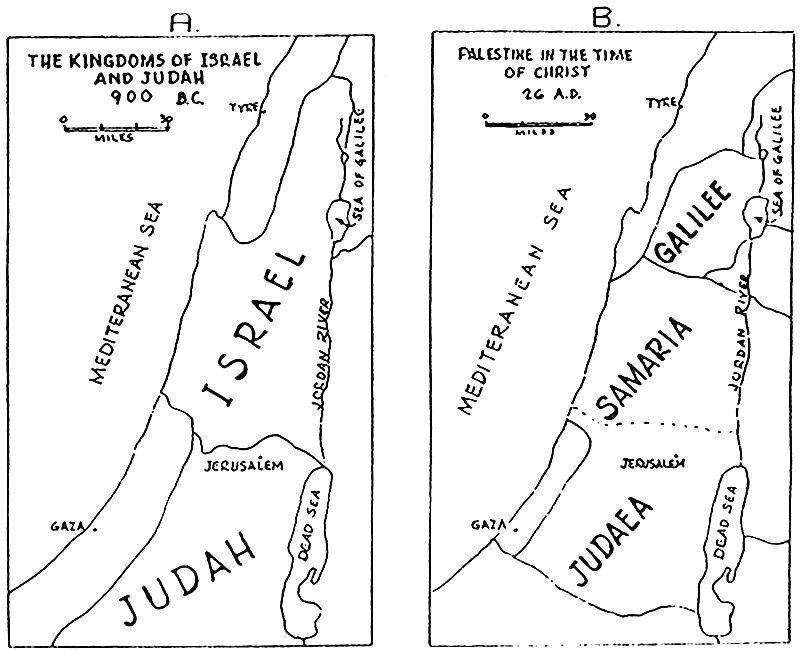
We have to go back to the split in 930 BCE when we have the Kingdom of Israel up north and the Kingdom of Judah in the south.
There's two access points to the Levant region, effectively:
North and South.
South was the way Egypt used to enter the region while North was the way the Greeks and Romans used most often (as well as just about everyone else).
As a result, Israel lost their kingdom faster than Judah, though Judah eventually lost theirs as well around 586 BCE during the Babylonian exile.
The Persians took over shortly after that, and allowed Judah to rebuild the temple and establish their province again in hopes of pacifying the issues.
Side note: Samaria offered to help build it, but the Judean Hebrews rejected their assistance (presumably because then Samaria would be able to claim access to the Temple, and the Hebrews of Judah had banned them as a people and denied recognizing them as fellow Jews) [keep in mind the parable of the good Samaritan that came later]
The Kingdom of Israel, however, was not restored.
It became Galilee, and Galilee was essentially allowed governance by Judah, but here we have our problem and why I brought all of this up.
Between Galilee and Judah was Samaria (before/after picture):
Now, again, keep in mind that the North was just constantly trampled on over and over (as you can see from the timeline) by comparison to the South, and even when they did get some sovereignty, they didn't have governing sovereignty and they also still relied on the Temple in Judah and didn't have their own Temple.
No officials related to Judah were stationed in Galilee for theocratic interaction or oversight; Galilee just had to travel south to do anything.
In their way was Samaria; so Galileans had to walk around and south out of their way to get to Jerusalem.
Because Galilee didn't have a Temple or priests from Judah, they didn't have an official Torah (Torah required having handlers and readers who were allowed to touch and read from the Torah).
Linking back to the trampling of the north by other nations, and then being neglected, you could see Hellenistic structures of grand scales if you stood on the banks of the Sea of Galilee within the Galilean boundary.
That's just an example, but such mix of culture was every where.
Unlike the South, more of the North was mixed in blood than the South, and culturally surrounded by more non-Hebrew culture than the South.
Yet, these peoples clearly still wanted to adhere to their Hebraic belief system; they were still a people of Hebrew identity and wants.
As a result we see a different type of religious practices starting up North than in the South.
In the North we start to see small synagogues where people would show up, and the eldest elder would stand at the front and recite from memory or some scrap of the Torah they had obtained. During the recital or reading, other elders would walk around to those sitting on the floor or stairs around the synagogue and help answer questions any of them had about something the eldest elder was orating, without stopping the process.
Quite naturally, following the Law to the exact and pedantic letter became next to impossible in the North, while it was a daily reminder in the South with regular official public readings and, of course, having the priesthood and theocratic political parties such as the Pharisees and Sadducees.
In the South, there was only one central authority: the Temple and the priesthood.
If you wanted permission to do something or get an exemption under the law, then you needed to speak to the judges; bottom line, no exception.
These figures would act like the supreme court and consult the documents and rule on a case.
Up North, this wasn't an option.
They couldn't just whip up some documents, debate over semantics and come to a ruling.
They had to rely on the age-old council of elders structure and general community justice, unless someone wanted to go all the way down to Jerusalem to file a
request for their case to be heard in hopes of a ruling; with no guarantee the ruling would be in their favor.
Now we can enter the Jesus philosophy from this angle.
Jesus is claimed as a Galilean, and shows every indication of being such a representative figure.
(I'm just going to talk of Jesus as a person for simplicity, but it's more the ideas that's of note and not whether or not the individual was or was not real)
Jesus essentially has one central message that he's after to push for, and it only really makes sense under the context listed above.
The message isn't love and peace and all of the things that we take from it today, but instead it was that all Herbrews have the authority of Abraham in them, and in them is the authority of Adam.
His argument is blood-based.
He argues for the concept and essence of the Law and not the letter of the Law while lacking the essence.
Every argument he makes is about how any Hebrew is a son of the divine and has the authority to make moral decisions; that one doesn't need to follow a strict decree of actions like a machine to be seen as living a good life.
His link in this argument is centered around the bloodline.
Indeed, this is his reason for the Samaritan parable, and it wasn't an altruistic sense of global humanity; that wasn't within the scope of concern.
Samaritans were Hebrews; excommunicated Hebrews (if you asked a Samaritan, they would say Judah strayed and the Samaria kept the old faith steadfast after the fall of the Kingdom of Israel and later Judah).
The parable was a sociopolitical point that Hebrews shouldn't be fighting with Hebrews, and that instead should be working together to help each other before they are all (once again) wiped out like before; but with a fear attached to the idea this time of finality.
That's good enough for the moment regarding Jesus, so we'll next swing over to Paul.
Now Paul sees all of this and thinks of all the Jews not in the Levant region; something the Jesus philosophy doesn't really ever show signs of thinking about.
Paul takes this consideration and expands it, due to complex issues of mixed peoples (a Gentilian Jew is married to a Gentile, who do I talk to? Just the Jew? Why not the Gentile? Isn't this pedantic? Isn't pedantic what Jesus was stating was a problem?).
But Paul has a challenge; nothing of what Jesus was talking about makes sense to a Hellenistic mind; authority of the divine (moral decisions) by grant of access through blood right?
Immediately there is an issue here; Gentiles that aren't Jews don't have blood right to that authority, and if they are mixed, then we could argue inferiority to authority by blood right.
So Paul converts this to something that makes sense in the Hellensitic culture: "holy spirit".
Essentially, he upgrades the importance of the holy spirit to the point that it is a replacement for the authority by blood right; and we see a holy spirit (in the Greek anyway) that is not an entity, but a presence of solidarity.
His disinterest in the pedantic practices of the Law wasn't really new for Paul; Jesus outlines much the same while considering that doing so does not remove one thing from the Law, because from a Galilean perspective; it doesn't.
From a Judean perspective; it absolutely did. And in this we have all of those conversations in the text arguing back and forth over the various pedantic sections of the Law and Jesus' typical replies which force the opposition argument to make a moral decision on the matter on their own and not rely on him answering the question directly - which in itself makes his point.
So Paul isn't deviating or changing anything about the Jesus philosophy, but he changes the metaphors by reading the essence of the Jesus philosophy in like fashion that the Jesus philosophy read the essence of the Law, and how neither considered this to be an action which removed or eradicated the Law; as both were working from the essence rather than pedantic and strict adherence to the letter and action of the Law.
Like Jesus, Paul runs into problems with this as Paul then thinks this means that he doesn't need any authority by any person for his teachings anymore than Jesus needed authority from any person or agency to give such teachings.
James doesn't agree with Paul; James more sees that Jesus was as described above, but only for Hebrews and not Gentiles, and when the headaches of the tangled mess comes about regarding how to apply such a ruling over Gentiles when Jews are split and spread among the Gentiles, James more or less waves his hands in the air and walks away and prefers to just stick to the simple world of talking to Hebrews around his area who are of the same culture and thereby more sensible to James.
Paul, as such, sees any Hebrew who wants to hold to the pre-Jesus message concept as sort of backwoods and ignorant; heading down a path of division and eradication.
About the only real tangent that Paul strongly deviates from the Jesus philosophy on specifically is in changing the scope of salvation; no longer is the message concerned with only the aim of steering the Hebrews away from eradication once again, but instead, now the message is focused on personal destruction more directly, and community building in spirit as a solution.



 (I know, I was being pedantic).