• Quick note - the problem with Youtube videos not embedding on the forum appears to have been fixed, thanks to ZiprHead. If you do still see problems let me know.

Moderated Global Warming Discussion

Status
Not open for further replies.
More detail on insolation

At the earths orbit the insolation received from the Sun varies from ~1365.5 W/m^ at the bottom of the sunspot cycle to 1366.5 at the peak of the sunspot cycle, a difference of 1W/m^2 (This is actually a change of 0.07 not the 0.2 I gave above. I was thinking it was +/- 1W/m^2 and rounding up)


The Earth's albedo is ~0.31 meaning only 69% of that energy enters the atmosphere so the real swing is only 0.7W/m^2 which is still 0.07%.


Greenhouse forcing is also measured in W/m^2, but it applies in all directions not just the direction of the Sun. Conversion factor is [area of a circle]/[surface area of a sphere] which works out to 4.
 
It's NOT substantiated by "reliable sources".....your quotes are referenced to a 1994 report...
Board on Global Change, National Research Council
ISBN: 978-0-309-05148-4, 180 pages, 6 x 9, paperback (1994)

a 1994 summary is the extent of your research?? :rolleyes:
BV
solar intensity variations are considered to have been influential in triggering the little ice age,[31]

Lets look at current knowledge instead....

Raymond Bradley of UMass, who has studied historical records of solar activity imprinted by radioisotopes in tree rings and ice cores, says that regional rainfall seems to be more affected than temperature. "If there is indeed a solar effect on climate, it is manifested by changes in general circulation rather than in a direct temperature signa"

This fits in with the conclusion of the IPCC and previous NRC reports that solar variability is NOT the cause of global warming over the last 50 years.

and from the same Wiki article you claim is substantive evidence

BV
and some of the warming observed from 1900 to 1950

fast forward circa 20 years...to NOAA

Much has been made of the probable connection between the Maunder Minimum, a 70-year deficit of sunspots in the late 17th-early 18th century, and the coldest part of the Little Ice Age, during which Europe and North America were subjected to bitterly cold winters. The mechanism for that regional cooling could have been a drop in the sun’s EUV output; this is, however, speculative.

Solar Variability and Terrestrial Climate Jan 2013

http://science.nasa.gov/science-news/science-at-nasa/2013/08jan_sunclimate/

the snips are from the document above...a rather more current and extensive research.

As you have been informed - solar output ( not sunspot count ) has a small role in climate.....it no way subverts the current reality of AGW.
 
Thank you all for your participation in the world's biggest uncontrolled experiment.

 
None of this addresses the real point which is when sunspot numbers are compared to actual measurements we see only a few tenths of a percent change in solar activity.

Considering the energy put out by the sun and that the sun is the only thing heating the earth, to dismiss it as inconsequential is absurd.

LOL. We had better hope 0.2% is not as significant as you claim because if it is the 1.5% from greenhouse gasses we’ve caused so far is going to have much bigger impact than even the worst case estimates.

OMG, this is pure genius. Comparing increases in solar radiance to greenhouse gases. Why should such a comparison be made? Red Herring much?


In the end you cannot claim with a straight face that solar variation does not change climate.
 
It shows you can't read very well. there is no citation for solar output and the Maunder minimum. Which is why I asked for what I did about the solar radiance proxies and the Maunder minimum.


So I see you don't know how to read sources and just pretend that something says something it doesn't.

Why don't you read teha ctual source material then bring us teh meaningful bits?

I am not required to satisfy your every demand.

Solar variance is well recognized as a cause of global warming.

Sunspots are well recognized to be associated with solar output.

I stand on these facts, if you disagree with them that is your prerogative.
 
First it’s not clear how much, if any, of this CH4 comes from a warming arctic, more importantly CH4 is relatively short lived in the atmosphere so any pre 1950 caused by solar activity would be long gone.

I guess you're forgetting that the increased solar activity in question is since 1950.
 
Missed out this bit:

Solar output in the last 50-60 years compared to the 400 year observable recorded average has been constant or even decreasing a little .
batvette, if you had bothered to read Solar activity & climate: is the sun causing global warming? rather then relying on a stance of ignorance then you would know this. See the "Total Solar Irradiance from 1713 to 1996" diagram from Wang 2005.

There is no "unprecedented peak" in solar output. Everyone (except apparently you, batvette :D) expects solar output to increase because that is what stars do. What is surprising (but not unprecedented) is that solar output has been constant for 35 years.

Constant? Not a relevant description unless you mean there has been constant increased output every cycle against the 400 year average.

You are clearly trying to present that the last six cycles have been NORMAL and even lessening from normal. That's not accurate at all.

Let's say a pipe has an average flow of 100 gallons an hour for 350 hours into a 100 gallon barrel changed every hour.
The next 50 hours we increase the flow to 120 gallons an hour with fluctuations between 115 and 125 gallons each hour.
Even if at the end of the 50 hours the flow was only 115 gallons, each hour still had more water flowing than at any time in the previous 350 hours-and every hour there was still more water flowing than our 100 gallon bucket could hold. It didn't matter that the overflow was 15 or 20 or 25 gallons, it kept adding up and at no point was there less than 100 gallons an hour, leaving a void we could expect to mitigate any overflow.
 
This may not be as scientifically presented as people like in this forum, but us farmers take it very seriously and behind the scenes it actually is all based on science.

I'll just post the link for you guys to discuss, and let you guys figure out the rest. As I stated in my first post on this thread, the solution is staring people straight in the face. The carbon in the air is actually a benefit if you simply change your POV and realize that carbon simply needs put back in the soil where it benefits instead.

While you guys argue about details of sunspots and various other minutia, which you could argue till the cows come home and still have no results, we (all the various organic and semi organic people in agriculture) are just doing it.

Soil Carbon Challenge - Vermont Kickoff - Highlights

Innovative No-Till: Using Multi-Species Cover Crops to Improve Soil Health
 
I am not required to satisfy your every demand.

Solar variance is well recognized as a cause of global warming.

Sunspots are well recognized to be associated with solar output.

I stand on these facts, if you disagree with them that is your prerogative.

You have not established them as fact you have established them as your assertion and opinion.

Therefore your argument suffers, it also shows you don't understand the issue very well and so far just can't find the data to show it agrees with you.

So you have demonstrated your argument is empty quite well.
 
Let's say a pipe has an average flow of 100 gallons an hour for 350 hours into a 100 gallon barrel changed every hour.
The next 50 hours we increase the flow to 120 gallons an hour with fluctuations between 115 and 125 gallons each hour.
Even if at the end of the 50 hours the flow was only 115 gallons, each hour still had more water flowing than at any time in the previous 350 hours-and every hour there was still more water flowing than our 100 gallon bucket could hold. It didn't matter that the overflow was 15 or 20 or 25 gallons, it kept adding up and at no point was there less than 100 gallons an hour, leaving a void we could expect to mitigate any overflow.

Ok, let's go with your analogy, first you don't have to change the barrel as it has a plug hole in the bottom, representing the heat being radiated from the earth, the more water in the barrel the faster it flows out, increase the inflow and the water level will rise until it reachs a new equilibrium where the outflow matches the inflow, similarly decrease the size of the plug hole in the bottom and the same thing happens.

So if we observe the level of water in the barrel rising there are two possible explanations, either the inflow is increasing or the outflow is being restricted.

But say we know that the inflow varies in an 11 hour cycle by 0.1% but the average over the cycle hasn't increased for the last 40 hours. We also know that something is clogging the plug hole restricting its size by about 1.5%.

So why is the water level rising?
 
I guess you're forgetting that the increased solar activity in question is since 1950.
No one can remember something that does not exist, batvette :eye-poppi.
Solar activity & climate: is the sun causing global warming?
In the last 35 years of global warming, the sun has shown a slight cooling trend. Sun and climate have been going in opposite directions. In the past century, the Sun can explain some of the increase in global temperatures, but a relatively small amount
...
As shown in the Intermediate level rebuttal of this argument, dozens of studies have concluded that the Sun simply cannot account for the recent global warming, but here we'll go through the calculations for ourselves.
(my emphasis added)

The reality is an increase in solar output until ~1975 and then a constant or decreasing solar output from ~1975.
 
Constant?
Yes.
Solar activity & climate: is the sun causing global warming?
Solar output in the last 50-60 years compared to the 400 year observable recorded average has been constant or even decreasing a little.
That means that the trend in solar output was zero or negative since the 1950's (proxy data) and negative since 1978 (satellite data).
See the "Total Solar Irradiance from 1713 to 1996" diagram from Wang 2005.

There is no "unprecedented peak" in solar output. Everyone (except apparently you, batvette :biggrin:) expects solar output to increase because that is what stars do. What is surprising (but not unprecedented) is that solar output has been constant for 35 years.

FYI, batvette, List of solar cycles.
 
Batevette you continually demonstrate you lack of understanding of how the atmosphere and climate work.

For starters the most glaring statement is that solar is the only energy source and it's not.

It' is far and away the major source but not the only source.

Most of incoming solar is re-radiated back out into space and only GHG traps the heat.

http://www.skepticalscience.com/heatflow.html

Solar variance is well recognized as a cause of global warming.

Your language is incredibly sloppy for a science forum.....solar variation by your own claim contributes to global cooling since you brought up the Maunder minimum.....to which a reduced solar irradiation is considered a "contributing" factor.

So no, solar variation is NOT a cause of global warming. An increase in solar radiation is but it's still at levels a magnitude below changes in GHG - something you conveniently over look.

At present there is no concern about another Little Ice Age. Recent satellite measurements of solar brightness, analyzed by Willson (4), show an increase from the previous cycle of sunspot activity to the current one, indicating that the Earth is receiving more energy from the Sun. Willson indicates that if the current rate of increase of solar irradiance continues until the mid 21th century, then the surface temperatures will increase by about 0.5C. This is small, but not a negligible fraction of the expected greenhouse warming.

http://www-das.uwyo.edu/~geerts/cwx/notes/chap02/sunspots.html

I find it amusing you are so ready to accept solar variation which is very much a work in progress and a minor factor and established to be at most a small fraction of the warming and yet reject the extremely well understood and established AGW/GHG science which underlies the bulk of the warming in place and to come.

You can't have it both ways.
I suspect you are just reluctant to accept responsibility ....

It's getting warmer
We're responsible for most of it by way of introduction of fossil GHG and changes in land use.
 
This may not be as scientifically presented as people like in this forum, but us farmers take it very seriously and behind the scenes it actually is all based on science.

I'll just post the link for you guys to discuss, and let you guys figure out the rest. As I stated in my first post on this thread, the solution is staring people straight in the face. The carbon in the air is actually a benefit if you simply change your POV and realize that carbon simply needs put back in the soil where it benefits instead.

While you guys argue about details of sunspots and various other minutia, which you could argue till the cows come home and still have no results, we (all the various organic and semi organic people in agriculture) are just doing it.

Soil Carbon Challenge - Vermont Kickoff - Highlights

Innovative No-Till: Using Multi-Species Cover Crops to Improve Soil Health

I have nothing against putting carbon back into the soil, where (in the form of organic matter) it is beneficial.

The problem is how to achieve that economically and at a sufficient rate.

Unfortunately it seems as if the natural carbon sinks are being overwhelmed, and I haven't seen enough to convince me that the carbon-sinking efficiency of any farming technique is adequate - or indeed whether it would be more area-efficient than some of the natural processes it would be competing against (farmland would have been forest, grassland or some other environment before being converted - this is especially true in the rainforest regions that are being deforested to make way for extensive farming)
 
Considering the energy put out by the sun and that the sun is the only thing heating the earth, to dismiss it as inconsequential is absurd.


This STILL doesn't address teh point that the sunspot proxy only suggests less than a 0.1% change in solar activity.

In addition to not addressing the point it also demonstrates a significant lack of understanding about basic physics on your part. The temperature of something changes based on the difference between energy out and energy it, not just energy in as this statement suggests you believe.


OMG, this is pure genius. Comparing increases in solar radiance to greenhouse gases. Why should such a comparison be made? Red Herring much?

Given that both impact the top of atmosphere energy balance Why SHOULDN'T such a comparison be made?

In the end you cannot claim with a straight face that solar variation does not change climate.

Can you claim with a straight face I haven't told you the opposite at least 3 times?

Specifically I've said the impact of solar changes are dwarfed by the current impact of greenhouse gasses. You have yet to actually try to address this.
 
I guess you're forgetting that the increased solar activity in question is since 1950.

We've already established there is no meaningfully increase in solar activity since the 1950's. Multiple people, including myself, have linked papers showing this.
 
Considering the energy put out by the sun and that the sun is the only thing heating the earth, to dismiss it as inconsequential is absurd.
The subject is climate change, not why we have a climate at all. If the change in solar output is a few tenths of a percent, to claim it has a significant (that is, consequential) impact on climate does require an explanation. I don't see an obvious one. Do you?

OMG, this is pure genius. Comparing increases in solar radiance to greenhouse gases. Why should such a comparison be made? Red Herring much?
Heat is heat. A forcing is a forcing. The claim that solar change of a few tenths of a percent exerts a greater forcing than AGW requires some explanation (CO2 has increased by 40%, that's a few tenths, and not of a percent). I don't have one. Do you?


In the end you cannot claim with a straight face that solar variation does not change climate.
And we don't. We discuss solar variation in the context of contemporary climate change.
Edited by Gaspode: 
Edited for moderated thread.
 
Last edited by a moderator:
OMG, this is pure genius. Comparing increases in solar radiance to greenhouse gases. Why should such a comparison be made? Red Herring much?

You actually have your expletive backwards as changes in solar radiance are a magnitude below GHG as a factor in warming.
The sun's output does not vary much at all.

The GHG content is up 40% - do you understand equilibrium at all??

Solar variation is the change in the amount of radiation emitted by the Sun (see Solar radiation) and in its spectral distribution over years to millennia. These variations have periodic components, the main one being the approximately 11-year solar cycle (or sunspot cycle). The changes also have aperiodic fluctuations.[1]
In recent decades, solar activity has been measured by satellites, while before it was estimated using 'proxy' variables. Scientists studying climate change are interested in understanding the effects of variations in the total and spectral solar irradiance on Earth and its climate.
Variations in total solar irradiance were too small to detect with technology available before the satellite era, although the small fraction in ultra-violet light has recently been found to vary significantly more than previously thought over the course of a solar cycle.[2] Total solar output is now measured to vary (over the last three 11-year sunspot cycles) by approximately 0.1%,[3][4][5] or about 1.3 Watts per square meter (W/m2) peak-to-trough from solar maximum to solar minimum during the 11-year sunspot cycle.
The amount of solar radiation received at the outer surface of Earth's atmosphere averages 1366 W/m2.[1][6][7] There are no direct measurements of the longer-term variation, and interpretations of proxy measures of variations differ. The intensity of solar radiation reaching Earth has been relatively constant through the last 2000 years, with variations estimated at around 0.1–0.2%.[8][9][10] Solar variation, together with volcanic activity are hypothesized to have contributed to climate change, for example during the Maunder Minimum. However, changes in solar brightness are too weak to explain recent climate change.[11]

1 tenth of 1% variance over 3 cycles.

http://en.wikipedia.org/wiki/Solar_variation

meanwhile

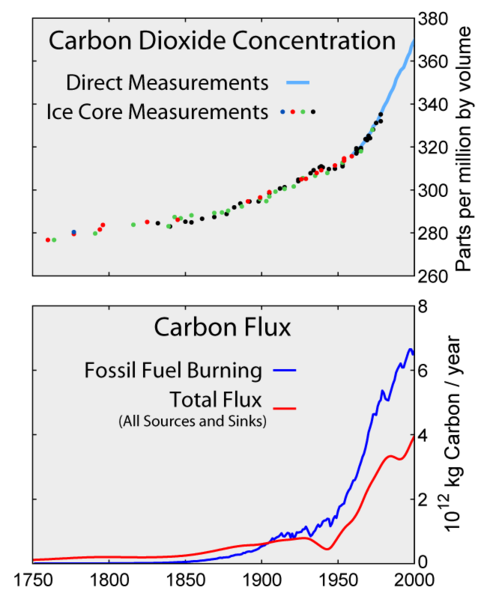
481px-Carbon_History_and_Flux_Rev.png

wiki image.

C02 increases are cumulative - it does not reset to zero each year. Every year we trap more heat and the earth warms.

This is the mechanism that is well established...

wiki image
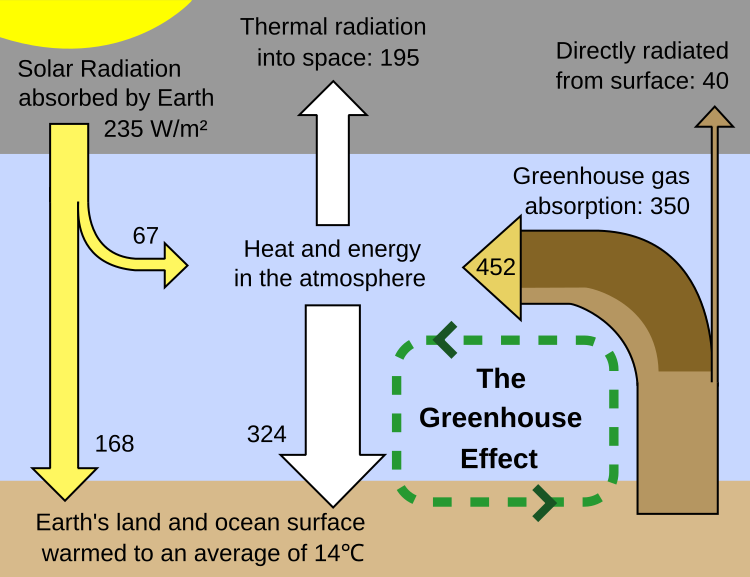
750px-Greenhouse_Effect.svg.png


Summary [edit]

This figure is a simplified, schematic representation of the flows of energy between space, the atmosphere, and the Earth's surface, and shows how these flows combine to trap heat near the surface and create the greenhouse effect. Energy exchanges are expressed in watts per square meter (W/m2) and derived from Kiehl & Trenberth (1997).
The sun is responsible for virtually all energy that reaches the Earth's surface. Direct overhead sunlight at the top of the atmosphere provides 1366 W/m2; however, geometric effects and reflective surfaces limit the light which is absorbed at the typical location to an annual average of ~235 W/m2. If this were the total heat received at the surface, then, neglecting changes in albedo, the Earth's surface would be expected to have an average temperature of -18 °C (Lashof 1989). Instead, the Earth's atmosphere recycles heat coming from the surface and delivers an additional 324 W/m2, which results in an average surface temperature of roughly +14 °C [1].
Of the surface heat captured by the atmosphere, more than 75% can be attributed to the action of greenhouse gases that absorb thermal radiation emitted by the Earth's surface. The atmosphere in turn transfers the energy it receives both into space (38%) and back to the Earth's surface (62%), where the amount transferred in each direction depends on the thermal and density structure of the atmosphere

This process by which energy is recycled in the atmosphere to warm the Earth's surface is known as the greenhouse effect and is an essential piece of Earth's climate. Under stable conditions, the total amount of energy entering the system from solar radiation will exactly balance the amount being radiated into space, thus allowing the Earth to maintain a constant average temperature over time.

However, recent measurements indicate that the Earth is presently absorbing 0.85 ± 0.15 W/m2 more than it emits into space (Hansen et al. 2005). An overwhelming majority of climate scientists believe that this asymmetry in the flow of energy has been significantly increased by human emissions of greenhouse gases [2].

What has happened so far does not reflect what is coming....the radiation exchange is imbalanced and the atmosphere will warm until that balance is restored....each year we add more imbalance and those additions will have an impact as much as 100,000 years out.

Carbon is forever
Carbon dioxide emissions and their associated warming could linger for millennia, according to some climate scientists. Mason Inman looks at why the fallout from burning fossil fuels could last far longer than expected.
http://www.nature.com/climate/2008/0812/full/climate.2008.122.html
 
While you guys argue about details of sunspots and various other minutia, which you could argue till the cows come home and still have no results, we (all the various organic and semi organic people in agriculture) are just doing it.
We mere gardeners are doing it as well; the only problem I have is with your blithe assumption that it can cancel fossil-fuel emissions, which it really can't. There's no end of agricultural land (much of it only recently so) in need of remediation, given that modern industrial agriculture is more or less outdoor hydroponics in which soil is simply a support material in which a natural ecosystem is an undersirable complication. The best we could do is return it to pre-industrial standards, which will not return any continuing emissions to the soil.

It could make a contribution on climate change, of course, but that's not where the real benefits lie, and those are sufficient in themselves. At the root (so to speak) is sustainability; continued emissions are anything but that.
 
The reality is an increase in solar output until ~1975 and then a constant or decreasing solar output from ~1975.

As compared to WHAT time period?

Has the solar output decreased against merely the 1975 peak? Or has it decreased against what could be determined to be NORMAL solar output over the last 400 years?
 
Status
Not open for further replies.

Back
Top Bottom