• Quick note - the problem with Youtube videos not embedding on the forum appears to have been fixed, thanks to ZiprHead. If you do still see problems let me know.

Moderated Global Warming Discussion

Status
Not open for further replies.
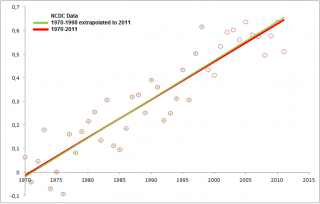
How much did the Earth warm during the first decade of the 21st century?

During the first decade of the 21st century and in just one decade? 0.26 to 0.35°C (0.47 to 0.63 Fahrenheit) depending on the dataset chosen! (a little less if you celebrated the millennia on 31st Dec 1999 because of a belief about the existence of a year 0)

If you were expecting a different outcome, you were rolling on the escalator.

That escalator is one favourite of epistemological hedonists.
 
Sometimes a smack aside the head IS warranted


When he shows that graph to audiences, says Mann, "I often hear an audible gasp." In this sense, the hockey stick does indeed matter—for it dramatizes just how much human irresponsibility, in a relatively short period of time, can devastate the only home we have.

snip

Indeed, two just-published studies support the hockey stick more powerfully than ever. One, just out in Nature Geoscience, featuring more than 80 authors, showed with extensive global data on past temperatures that the hockey stick's shaft seems to extend back reliably for at least 1,400 years. Recently in Science, meanwhile, Shaun Marcott of Oregon State University and his colleagues extended the original hockey stick shaft back 11,000 years. "There's now at least tentative evidence that the warming is unprecedented over the entire period of the Holocene, the entire period since the last ice age," says Mann.

good read....

http://www.motherjones.com/environment/2013/05/most-controversial-hockey-stick-chart-climate-change
 
Ok, so we know that most of the Earth's warming took place during the last 20 years of the 20th Century. How much did the Earth warm during the first decade of the 21st century?

The warming trend for 1970-2000 is nearly indistinguishable from the trend from 1970 – 2010.

There is too much noise to accurately calculate the trend for any single decade in isolation, so numbers you may have seen for the last 10 years were not statistically significant. Unfortunately a lot of this type of dishonest work has been circu7lated blindly by dishonest or uninformed media outlets.
 
Ok, so we know that most of the Earth's warming took place during the last 20 years of the 20th Century. How much did the Earth warm during the first decade of the 21st century?

You tell us: How much did it warm?

 
you are talking about Maunder minimums and at best there is some influence and the influence would be towards a cooling...it's not at the moment of any significance.

If we look at the cycles since reliable measurement began:

http://science1.nasa.gov/media/medi...y_noaaprediction_resources/maunderminimum.jpg
Edited by Locknar: 
Edited, breach of rule 5.


We can see that 5 of the last 6 cycles from around 1940 were the highest since record keeping began- and the one that peaked around 1990 is the third highest ever. While it is indeed lower than the highest ever, why would we expect a cooling trend between these cycles when it is still a period of increased solar output against the 400 year average?
Wouldn't an immediately noticeable cooling trend only happen if the solar activity were below average?
Shouldn't we instead just continue a heating trend, albeit slightly less than the highest peak? Which may actually not be decreased at all because of the residual effect of the methane released by polar melt caused by the record peak cycle?
 
Last edited by a moderator:
Interesting article stretching the climate record back millions of years in an Arctic local. Continuous record thanks to a random meteor.

http://phys.org/news/2013-05-ice-free-arctic-future.html
significant snip

"One of our major findings is that the Arctic was very warm in the middle Pliocene and Early Pleistocene [~ 3.6 to 2.2 million years ago] when others have suggested atmospheric CO2 was not much higher than levels we see today. This could tell us where we are going in the near future. In other words, the Earth system response to small changes in carbon dioxide is bigger than suggested by earlier climate models," the authors state.
Read more at: http://phys.org/news/2013-05-ice-free-arctic-future.html#jCp
 
If we look at the cycles since reliable measurement began:

http://science1.nasa.gov/media/medi...y_noaaprediction_resources/maunderminimum.jpg
Edited by Locknar: 
Edited, breach of rule 5.


We can see that 5 of the last 6 cycles from around 1940 were the highest since record keeping began- and the one that peaked around 1990 is the third highest ever. While it is indeed lower than the highest ever, why would we expect a cooling trend between these cycles when it is still a period of increased solar output against the 400 year average?
Wouldn't an immediately noticeable cooling trend only happen if the solar activity were below average?


Solar has an influence on the fluctuations, but not on the overall trend.

Shouldn't we instead just continue a heating trend, albeit slightly less than the highest peak? Which may actually not be decreased at all because of the residual effect of the methane released by polar melt caused by the record peak cycle?

That is an interesting hypothesis. Now you just need to show that the methane values have increased and persisted for the required amount of time AND demonstrate that the physics of CO2 are completely misunderstood, and that it's measured accumulation in the atmosphere would not cause warming. So you need to prove that CO2 behaves differently in the lab and in the field.

With no hint of irony I tell you, a Nobel awaits you if you succeed.
 
Here is an article using very conservative numbers that talks about what I discussed earlier and it concludes sequestration to pre-industrial levels in 40 years. Of course if arable land were also to sequestering carbon using modern organic methods, that 40 years would be reduced. And if emissions were reduced too, that would further shorten the time needed.

I believe there is huge potential to solve this issue by using agriculture for carbon sequestration in the soil. The biggest benefit being the large amount of land available and the proven technologies of agriculture that actually produce income and feed people, instead of costing astronomical sums as many other proposed solutions.
 
If we look at the cycles since reliable measurement began:

http://science1.nasa.gov/media/medi...y_noaaprediction_resources/maunderminimum.jpg
Edited by Locknar: 
Edited, breach of rule 5.


We can see that 5 of the last 6 cycles from around 1940 were the highest since record keeping began- and the one that peaked around 1990 is the third highest ever. While it is indeed lower than the highest ever, why would we expect a cooling trend between these cycles when it is still a period of increased solar output against the 400 year average?
macdoc spoke of a cooling influence, not a trend. The influence of late has been towards cooling, with a with a remarkablly long and deep last minimum.

Wouldn't an immediately noticeable cooling trend only happen if the solar activity were below average?
No trend is immediately noticeable. Events are immediately noticeable. Influences are also immediate. Trends are revealed by events and, hopefully, can be explained by influences.

Shouldn't we instead just continue a heating trend, albeit slightly less than the highest peak? Which may actually not be decreased at all because of the residual effect of the methane released by polar melt caused by the record peak cycle?
Not necessarily; it depends on how long the system takes to equilibrate. As for positive feedbacks, they have no momentum at all.

What one would expect, if one neglected the very minor solar variation in the last century but included AGW, is just what we're seeing - and what's more, it was predicted. The solar explanation, on the other hand, is a post facto exercise.
 
Ok, so we know that most of the Earth's warming took place during the last 20 years of the 20th Century. How much did the Earth warm during the first decade of the 21st century?
Would that we had the observational network to know for certain, but it certainly was a lot.

Surface temperatures didn't show much signal, but then they are notoriously volatile. Arctic sea-ice and permafrost react more ponderously, of course, which means that their signal is much clearer.

For the future we now have ARGO deployed and bedding-in so a more accurate answer will be available for the 2nd decade of the 21stCE. I think it's safe to say it will turn out to be a lot.
 
I don't think I have to to offer that if the climate is going to change it would be a prudent thing to try and mitigate the negative effects as best you can. This means storing and moving water to where it is needed and away from where it is not, a well as a possible change in the types of crops you grow.

It's just science, not hard to figure out. :boggled:
The type of crops you grow isn't science, it's business. The infrastructure and operation of water storage and movement isn't science, it's business. Figuring out the optimum mix ain't easy.
 
If we look at the cycles since reliable measurement began:

http://science1.nasa.gov/media/medi...y_noaaprediction_resources/maunderminimum.jpg
Edited by Locknar: 
Edited, breach of rule 5.


We can see that 5 of the last 6 cycles from around 1940 were the highest since record keeping began- and the one that peaked around 1990 is the third highest ever. While it is indeed lower than the highest ever, why would we expect a cooling trend between these cycles when it is still a period of increased solar output against the 400 year average?
Wouldn't an immediately noticeable cooling trend only happen if the solar activity were below average?
Shouldn't we instead just continue a heating trend, albeit slightly less than the highest peak?

No. A change in the sun would not cause the earth to warm indefinitely. It takes ~20-30 years for a forcing to be fully reflected in global temperature. This means a peak in 1950 would be fully feat by 1980.

BTW since direct satellite observation of the sun began in the 1970 there has been a very slight downward trend in it's energy output, which would imply stable temperatures or slight cooling.

Any warming or cooling from this would be small. Changes in the Sun's output are measured in tenths if a percent, much smaller than current greenhouse forcing.
 
http://www.nytimes.com/2013/05/11/s...red-milestone.html?pagewanted=1&smid=fb-share


Does this mean the world is going to turn into "Waterworld" starring Kevin Costner?

no, but it causes already sea levels to rise today and it will continue to do so for a very long time. and the faster the land based ice masses melt the faster sea level rise. millions of people will have to move as many people are living in coastal areas. some of the populated cities on the planet will have to be moved.
 
Here is an article using very conservative numbers that talks about what I discussed earlier and it concludes sequestration to pre-industrial levels in 40 years.

An article? Articles say all sort of things.

I'll take a look to it later and get back to you.

Of course if arable land were also to sequestering carbon using modern organic methods, that 40 years would be reduced. And if emissions were reduced too, that would further shorten the time needed.

Epistemological hedonism takes all sort of forms. If you believe it, the it is true. Don't discuss it because it is true: the opening "Of course ..." guarantees it.

The problem with your assertion is the same you had many posts before -the same you forgot to reply to-: you forgot to tell how to feed mankind and serving fauna, but "modern organic methods" looks so fine, because they are methods, they are organic, and, if any doubt remains, they are also modern. You are just parroting the typical salespeech using adjectives galore and lacking figures and hard data.

I believe there is huge potential to solve this issue by using agriculture for carbon sequestration in the soil. The biggest benefit being the large amount of land available and the proven technologies of agriculture that actually produce income and feed people, instead of costing astronomical sums as many other proposed solutions.

You believe this. Others believe in aliens who abducted them. Others believe in god. Others believe their life partner is true to them. Believing doesn't get us an inch closer to any kind of state of true.

From your paragraph it's clear you are trying to promote a business the same way chicory sellers say "chicory is healthy: it doesn't contain trans fats nor cholesterror". It is all true, but that's not the point of it at all.

The question remains: why are you here in the science forum in a AGW specific thread doing promotion of one of many concurrent palliatives*** as if it is the panacea?


***(the world wide banning of incandescent lamps would do more than your proposed panacea, and much quicker)
 
Here is an article using very conservative numbers that talks about what I discussed earlier and it concludes sequestration to pre-industrial levels in 40 years. Of course if arable land were also to sequestering carbon using modern organic methods, that 40 years would be reduced. And if emissions were reduced too, that would further shorten the time needed.

I believe there is huge potential to solve this issue by using agriculture for carbon sequestration in the soil. The biggest benefit being the large amount of land available and the proven technologies of agriculture that actually produce income and feed people, instead of costing astronomical sums as many other proposed solutions.

Actuallythe figure of 40 years to get CO2 levels back to 280 ppm assumes emissions are reduced to zero.

from the article
If we utilize available lands worldwide, estimating sequestration on the conservative side at 0.5 tons per acre, we are capturing an additional 5 gigatons of carbon per year from the atmosphere, or the equivalent of 2.5 parts per million. If we were to stop pushing carbon upwards, in roughly forty years we would be back to preindustrial levels of 280 ppm.
Enter the big “If”: We still have to reduce our greenhouse gas emissions, as close to zero as possible as soon as possible. But we also have to understand that only reducing emissions is not nearly enough, given already active positive feedback loops such as melting ice, non-linear phenomena in the wings, and the unpleasant time lag surprises lurking in the thermal mass of the oceans.[ix] Even though sequestering carbon in soils can help blunt the effects of emissions along the way, while providing all the above-mentioned benefits of restoring soil health, we must stop spewing carbon into the atmosphere.
 
Here's my question:

If CO2 levels have increased 25%, how come average yearly temperatures have not?

Perhaps the "CO2 changes cause average temperature increases & decreases" theory is flawed?
 
Here's my question:

If CO2 levels have increased 25%, how come average yearly temperatures have not?

Perhaps the "CO2 changes cause average temperature increases & decreases" theory is flawed?

beause CO2 is not the only thing having an influence on the average global temperature.
for example, alot of human caused aerosols are in the air that actually cool , or mask the warming. then we also have very complicated ocean circulations, we had a double la nina for example which is causing lower sea surface temps. which lowers the global average temperature. etc etc
 
Here's my question:

If CO2 levels have increased 25%, how come average yearly temperatures have not?
Because that's not how it works. Doubling the amount of CO2 in the atmosphere produces a forcing of about 1 degree Celsius, which in turn produces positive feedbacks resulting in a total increase of around 3 degrees Celsius.

Perhaps the "CO2 changes cause average temperature increases & decreases" theory is flawed?
It's not a theory, it's a proven fact.

Can I politely suggest you read up on the basic science. I recommend The Royal Society's summary, you can download it here:

http://royalsociety.org/policy/publications/2010/climate-change-summary-science/

It's only about a dozen pages and should provide the background understanding you appear to be lacking.
 
Status
Not open for further replies.

Back
Top Bottom