Your homework:
1. How much modern contamination would be necessary to alter the result of dating a first century cloth to the thirteenth century? Show your work.
2. What is the mechanism for the introduction of this contamination?
3. How did this contamination survive the decontamination pretreatment used by the three labs? In detail please.
4. What are the sources for your claim that: " a parallel dating was made using vegetable fragments that are present on the Shroud". Include the provenance of the material, chain of custody (at least to the same standard as the radiocarbon dating), nature of the testing (including by whom performed, where and how), detailed results. I assume this dating was properly peer reviewed and published in a reputable and relevant journal such as Radiocarbon? Ray Rogers garbage isn't sufficient.
5. With regard to your claim that "a separate group of fabric experts has proposed that a completely different restoration technique than the "french reweaving" existed in the Middle Ages" please supply details as to these alleged experts and their supposed technique. Include how this technique can't be detected even with high magnification microscopy under non-visible spectrum illumination.
Also supply examples of the technique for comparison. You may also speculate as to why there are no records of the repairs, unlike the more visible ones.
6. With regard to your claim that "there is a test supporting this claim -- because the specific structures of the imprints on the Shroud, forming the image, have been found to be reproducible using ultraviolet lasers" please supply details, including who carried out the tests, the methodology, results and where it was published. Also provide a reasonable chain of events that could have caused the shroud image to be produced in this way in the first century BC. No magic god radiation please.
7. With regard to your claim that "there are some literary and iconographic early mediaeval sources EARLIER than the terminus ante quem of the radiocarbon dating" provide these sources and justify why they are evidence for the shroud's existence prior to ~1355CE.
Then why put those ideas on the table?
Desperation. There is no genuine evidence that the shroud is anything other than another medieval fake relic but that doesn't suit the beliefs of some god botherers, hence the denial and lying.
It is a transfer print (of whatever nature) from a wrapped body.
Untrue.
The 3D artist who recently created a 3D image derived from the front and back images on the Shroud had to compensate for the distortion caused by that wrapping.
This claim has already been dealt with and shown to be rubbish. Nearly as bad as the images of coins on the eyes crap.
- Do I need to say anything more about my earlier claim that, "everyone involved accepts that the control samples were not effective"?
- I meant that everyone involved accepts that the control samples were not effective, in that they were not effectively blinded, and consequently did not preclude bias on the part of those involved.
- I still think that at least many of the people involved were relevantly biased, and that their biases did affect the procedures. I can try to support that claim -- or, I can get on with trying to support my claim that patching was apparently involved.
Oh stop the lying. You tried to smear those who carried out the radiocarbon testing and your pathetic attempt was demonstrated to be nonsense.
I've explained the blinding process in great detail.
The same scientists attempted, fairly exhaustively, to use a great number of variant techniques to reproduce the physical characteristics of the markings on the Shroud. Of them all, ultraviolet lasers was the only one that succeeded.
Rubbish. As has already been dealt with in this thread the shroud image is the result of painting and has been duplicated using medieval techniques. Several times.
The tests dated the age of the shroud to between 300 BC and 400AD.
Alas for the desperate god botherers the shroud is a medieval artifact.
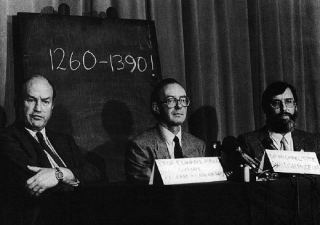
Now, to reiterate:
The shroud is a medieval fake. This has been well established by scientific testing (chemical, microscopic, spectroscopic and radiocarbon), expert examination (textile, weave and artistic style) and historical research (comparison to others, culture and documentation) and is supported by other evidence:
Historical: the lack of evidence for the shroud's existence prior to the mid fourteenth century; further it's emergence during the 'holy relic' craze (along with about forty other such burial shrouds); lack of mention of a miraculously imaged Shroud in any early Christian writings; the distinct changes in the shroud, fading of colour, since its first exposure
Physiological: the lack of resemblance of the shroud image to an actual human body; likewise the position of the body with hands folded across the genitals isn't possible for a body lying flay (the arms aren't long enough)
Textile: the weave patten of the shroud does not match anything known from first century Mid East but matches medieval Europe well; no example of the complex herringbone twill weave has even been shown to come from the first century Mid East
Testimony: the d'Arcis Memo indicates the shroud was created around 1354 and was a known fake
Artistic: the face of the image resembles medieval Byzantine style, with Gothic elements; the unnaturally elongated body shape and extremities are typical of the elongated style the Late Medieval/High Gothic period
Reproducibility: contrary to the claims of shroudies the image can and has been reproduced using medieval methods
Analytic: examination, microscopic (including electron microscopy) and chemical testing show the shroud image is made from common artistic pigments of the period of its origin
Cultural: the shroud does not match with what is known of first century Jewish burial practices or the only extant sample of such burial cloths; nor does the shroud match the biblical accounts; nor are there any demonstrated artifacts of the putative Jesus extant today; nor does the supposed historical background indicate that such a cloth would have been preserved, certainly without much publicity prior to ~1355
Serological: a minor point (as blood probably wouldn't survive this long anyway) but despite the best attempts of (and much lying and pseudoscience by) shroudies there is no evidence for blood residue
Frankly the consensus of all the factors is the strongest reason to accept the medieval origin of the shroud, not any one factor.



 So the textile experts who examined the shroud on multiple occasions, using microscopy, micro-photography and multi-spectral illumination all got it wrong?
 That really does cut the allegation of bias off at the knees.

