• Security incident: ISF was recently accessed by intruders. Please change your password, and change it anywhere else you used it. Read more

NIST blew WTC7 Stage 1 analysis

If the cigarette lighter in the car doesn't work it does not mean that the whole car is unserviceable
None of what I say about the "poor" quality of 12.5.3 has been pushed outside the boundaries of 12.5.3.

That others make such leaps is "not my problem" :)

Your focus in this recent series of posts on wrong choice of methods or wrong use of methods - not where they fit in the whole scheme which was my focus.
Understood.

And they couldn't win that one no matter how good they got the analysis/explanation.
Oh, I don't know...perhaps if they'd done what I have, they'd have ended up with an acceleration profile refuting claims of "x(s) of freefall" and also the rather, in my opinion, pivottal early motion information with which to clarify many "opinions".

All they had to do to achieve such was do the thing "as best they could". That didn't happen. They had the "reasonably accurate" moire method to play with... (aka imo no excuse)

There was no way that a CT was going to stop at the explanation given
:) What caused WTC (x) to be in motion ~x(s/mins) prior to release ?

But that bit of "blew it" does not confirm the more global claim that "NIST blew WTC7 Stage 1 analysis". That would be false global claim OR a system v sub-system error OR a set v subset confusion if I use some alternate terminology.
How "right" is it ? Not very, at all...

Then, given the clarity of what is actually being discussed the two recent attempts to totally change the topic are even more ludicrous in missing the point. Merely noise.
Er, who, what ?

As for: ..they blew that one. And expecting that Chandler would appreciate their conceded agreement was.......lets leave it at 'somewhat naive' ;)
Would have been much more productive to have not "duplicated" the poor quality data...
 
It was not technically accurate.
It was more accurate than NIST's "40% longer than freefall", which I'd say proves ElMondo's point, and mine.

Chandler pushed to have his voice heard by NIST in public in a way that NIST could not ignore him and had to address his claims. Had you done the same at the appropriate time, maybe section 12.5.3 would be very different now. That didn't happen, thus NIST only addressed Chandler's claims and now it's too late to do anything about it.

NIST didn't "blow it" in that "40% longer than freefall" was already enough for the purposes of the report, just as "100 years later, the Negro still is not free" was good enough for MLK's speech.
 
It was not technically accurate.

Ok, fine, provisionally accepted: It wasn't technically accurate. So Chandler was wrong. Does that mean that there was no freefall, and any truther argument to the contrary was wrong?

-----

The point was that Chandler's entire find was minutiae. It's only relevant to any support or critique of the NIST report in that it provided a higher level of detail that was so minute it was practically irrelevant and unnecessary. It's the equivalent of criticizing a study of a man-made reservoir's capacity because a second measurement was different by a pint. That's what I'm getting at.
 
None of what I say about the "poor" quality of 12.5.3 has been pushed outside the boundaries of 12.5.3.
Exactement - despite me taking the risk of using an analogy. Repeating the risk - they used a more broken cigarette lighter.
...That others make such leaps is "not my problem" :)
Agreed - and I doubt that I have ever missed when "they" make quantum leaps off the focus of discussion.

Understood.
Great - remember I have been identifying four different perspectives - my technical perspective, your perspective, my alternate one from a "PR" viewpoint and my procedural one about "reversed burden of proof".

...Oh, I don't know...perhaps if they'd done what I have, they'd have ended up with an acceleration profile refuting claims of "x(s) of freefall" and also the rather, in my opinion, pivottal early motion information with which to clarify many "opinions".
Could well be but - (avoiding the temptation to guess why) - they didn't. :rolleyes:
...All they had to do to achieve such was do the thing "as best they could". That didn't happen. They had the "reasonably accurate" moire method to play with... (aka imo no excuse)..
Yes -- but they were not you. :o
...:) What caused WTC (x) to be in motion ~x(s/mins) prior to release ?...
That could well be a big point. But I predict that, if you raise it through 2011/2012/2013 many people colloquially described as "debunkers" will miss the point due to a phenomenon named after certain meteorological conditions. ;)

(Oops its already 2013 :o)

...How "right" is it ? Not very, at all...
Sure but we haven't even defined "Perspective 5" - NIST's de facto and poorly selected objective which doesn't/didn't fit the challenge of its marketplace viz: To be bullet proof against dedicated goal post moving CT's
...Er, who, what ?
How'd they do with the conclusion though?

(Damage + Fire = Collapse)

Yea, that's why this thread is so stupid. None of this changes the conclusion.
Both those I suggest are "recent attempts to totally change the topic". The "conclusion" relevant to this thread being whether or not " NIST blew WTC7 Stage 1 analysis" and the topic does not include "Damage + Fire = Collapse". A situation I seem to recall that you may have encountered on previous occasions. :)
...Would have been much more productive to have not "duplicated" the poor quality data...
No doubt for you and I but, taking my point - I doubt it would have changed the Chandler et al responses. Their apparent intention was to set NIST up for (mis)representation to suit their viewpoint. It wouldn't matter at all where NIST placed the goalposts - those goalposts were going to be moved.
 
Last edited:
Both those I suggest are "recent attempts to totally change the topic".

Incorrect.

Originally Posted by NoahFence
How'd they do with the conclusion though?

(Damage + Fire = Collapse)
Originally Posted by twinstead
Yea, that's why this thread is so stupid. None of this changes the conclusion.

...a question that has been asked ad nauseum in this thread, in threads where it's ON topic, hell - pretty much everywhere. No answer coming anywhere, whether the person posing it is rude, polite, or in between.

Under NO circumstances can we get an answer to this question, as we also can't get an answer to the question "why is this even in the conspiracy subforum at all?"

So forgive me if I don't give a rats ass if you guys are butthurt at the "constant" off-topic question. Its been asked and ignored while ON topic elsewhere.
 
I am familiar with your assertions as to "NIST stage 1" is "crap". I have been
trying to learn Major_Tom's position on the OP.

...


Yes debate is quite likely pointless but I am interested in what M_T sees as the extent of error needed to qualify as the emotive "blown" (or "blew").

I'd phrase it a bit differently.

NIST stage 1 description sucks, but their description of WTC1 early movement and collapse initiation movement sucks more.


Ozeco, the last 5 pages of this thead, various posters have weighed in on how they perceive "good enough". Some examples...


The following posts are from the "Reload this Page NIST blew WTC7 Stage 1 analysis" thread, pages 5 to 9.


Page 5:

DMG post 163: "I believe their biggest mistake was falling for the "truther" meme and bothering to explain this "free-fall". It added nothing to the report and I've never heard any building professional asking for an explanation. They saw it this way also and didn't put in much effort. I doubt it had anything to do with ability to do it correctly."


Ozeco post 168: "They tried to assist and it fed the dishonesty of the truth movement - the crap about Chandler "forced" NIST to "admit" freefall. Still we have had a bit of fun explaining the free body physics and why parts of a falling sub-system can exceed G. And, in doing that, we revealed that quite a few "debunkers" also get a bit lost in the basics so "truthers" aren't the only ones who don't comprehend basic physics". - post 168


Ozeco post 169: "Take care - misuse of the expression "good enough" is becoming an art form in other arenas.
However it is the key issue here - arguably NIST misread the required level of "good enough" needed for the audience. So it wasn't good enough for that bit of the audience. And the "cost benefit" questions of how far should a public agency go to satisfy minority groups is a more complex issue than we need to discuss here. Bottom line is no matter how far you go a determined nit picker opponent will want you to go further. And lines have to be drawn at some stage.

That much is obvious. The difficult question is where and when to say "that's enough" and draw the line."


DGM post 172: "For the people that branded them lies, nothing they could have done would change that. No one else really considered it an issue. You provided a much better data set and even that has had no effect with those that claim "free-fall" is an issue.

NIST should have ignored it and stayed with what was the important details. NIST made a wrong decision when they decided to play "debunker" for an issue that had no merit in the first place (CD)."


Ozeco post 174: "The relevant issue is what I usually frame as "understanding the mechanism"..."


Ozeco post 234: "Sure - and that is a key part of the apparent difference. There are "two sides" in effect claiming "black versus white" when reality is shades of grey. The two central issues to my observation - seem to be:
1) What level of precision is needed for any specific purpose or audience. Some purposes need higher accuracy than others Demands for near perfection being unnecessary in some cases whilst "near enough" approximations may not be "good enough"; AND
2) Issues from errors or mistakes of method - and the two can overlap - they are not mutually exclusive. The only thing they seem to share is the reluctance of opponents holding polarised views to actually address the reality that needs/objectives differ.


Is sort of appropriate. How often 9/11 arguments get lost between two objectives of:
a) Understanding the Towers collapses; OR
b) Proving NIST was wrong.

To commandeer Oystein's words for an equally valid observation "...beware of unnecessary conflation."

Even if every observation made by NIST was wrong it cannot affect the reality of what happened on 9/11. No report written years later can change the actual physical events of history."


Page 7:

Ozeco: In my opinion - expressed many times on various forums - the issues of objective setting and appropriate setting of "good enough" standards are not adequately understood. However experience tells me that attempting to discuss those matters does not get much support.


DGM post 269: "But never an engineering study to support these posts.

Maybe AE 9/11 could help out with this. I heard they have 1600 engineers.

Truth be told. All of this is to cast doubt on what is accepted. Present something that can be absorbed by the worlds engineers that significantly changes the accepted view (piece A moved causing piece B) . To date, no one has.

Do you agree?"


Beachnut post 280: "NIST saved a lot of money by not studying nonsense to the nth+1 degree. The report would be pending."


page 8:


Basquearch page 284: In addition, these distinctions without a difference don't change NIST's conclusions.


NoahFence page 286: "What's the point? The conclusions remain precisely the same.

Tall building + Massive fire = Collapse."


DGM page 288: If I wasn't interested, I wouldn't ask. I also want to know what this actually means (besides "they got it wrong). What's right?


DGM page 308: "The issue here is this is outside of the scope of their report. Because some people wanted it to match what was seen they tried to model what would really be impossible( too many variables). They should have stuck to responding to their intended audience and ignored everyone else.

The main issue. NIST tried to dumb it down and make a video. In this they failed. The report however is correct and exactly what they were tasked to do (minus the irrelevant distractions)."


Justin39640 post 310: "The NIST reports are about studying how and why these structures collapsed so that new structures can be made to prevent or at least prolong collapse in order to give time to evacuate."


DGM post: "... The report however is correct and exactly what they were tasked to do (minus the irrelevant distractions).
Depends on your definition of "correct".

NIST concludes a "probable" collapse scenario, and it is possible (femr2 seems to have done so) to show they are not exact.

So there is a chance that NIST is wrong about details of the actual collapse, and may even have the initiating event wrong. It may be impossible to know this, or perhaps it is knowable.

But what is ultimately the purpose of such investigations? -> To find out if future buildings can be made safer. Lessons learned.

And so, even if NIST is "not correct" on smaller or larger details containing the actual collapse, they did identify problems with long-span trusses that apparently had not been adequately dealt with in existing building codes. It is "probable" that expansion of trusses can induce walk-off of girders and render columns unbraced. Even if that turned out to not have happened.

If it turns out that NIST's collapse sequence is really wrong (as in "wasn't started by girder walk-off on floor 13"), then of course one should wonder what really happened, and if NIST missed another hazard that should be addressed.


None of this "proving NIST wrong" of course amounts to "proving CD right" - there isn't even a prima facie case to be answered.


At the very least, the simulation shows that, in that building, collapse can spread east-west in the core before bringing the shell down. It's my hunch that this is a good-enough confirmation - but certainly my hunch is biased."


Originally Posted by Oystein:

"If it turns out that NIST's collapse sequence is really wrong (as in "wasn't started by girder walk-off on floor 13"), then of course one should wonder what really happened, and if NIST missed another hazard that should be addressed.

This is true. One would also wonder why no one that is reporting that they are wrong has proposed any other theory or narrative to explain this progression.

At this point in the game, just arguing their wrong just doesn't cut it. Could it be that it just doesn't matter?"


DGM post 316: "Again, how does this actually effect the scope of what NIST was tasked to explain(or do). Would it effect possible codes suggested to prevent this from happening in the future?

You do know why NIST actually investigated this? It wasn't to explain why this building collapsed. Remember, this building was a one off, Think big picture."


DGM post 318: "Yes you did but, it did not actually address the picture as NIST was (initially) tasked to explain."


NoahFence post 340: "It's patently obvious that aircraft damage and-or fire felled the twin towers, and twin towers + fire felled every other building. NIST picking is just a stupid hobby for people who think they're smart."


pgimeno post 341: "To answer whether NIST blew stage 1 analysis we have to answer these questions:

1. What's the goal of such analysis?
2.What accuracy was required to accomplish that goal?
3. What accuracy was actually used?
4. Do their conclusions accomplish that goal within the methods they used?

Without 1) and 2) it makes no sense to discuss 3). And of course 4) is not being discussed at all."


Ozeco post 343: "And how far to go in pursuit of details is a personal choice and "subjective" in that aspect. BUT once that choice is made the decision as to whether NIST got it right or wrong can be based on objective facts - observations - measurements - logic.

AND demonstrating that NIST got it wrong does not mean that "NIST blew it". The claim NIST blew it can only be supported when NIST went to a depth of detail needed to suport NIST's own findings and got it wrong at that level.

If somebody personally prefers to go deeper into detail than NIST and finds that NIST was wrong at that extra depth it does not qualify as "NIST blew it" except.....

...if it can be shown that NIST needed to go to that greater detail to support NIST's own conclusions AND got it wrong at that necessary depth of detail.

And what I have just posted has been the subject of many aborted discussions I have held with another of our colleagues over the past few years."


Ozeco page 348: "I know. There is a barrier of disconnect between those who understand that the key parameter is "good enough" - good enough for purpose that is. Which is your point "2. What accuracy was required to accomplish that goal?" and my statement of the same point using different words.

You will be aware of one member posting here and elsewhere who has made an art form of denigrating "good enough" and using it as a snide insult. Totally off track. (Not femr2 - he doesn't engage in those activities.) But "good enough" is the test. However what objective numbers qualify as "good enough" depends on the goal - your point #1. And people have different goals. Legitimately different goals. Not always applied legitimately and several of our debunkers being the worst offenders. (the point probably too subtle for many truthers. )

The implied "only perfection will satisfy" does not apply to everyone. But it is legitimate for those who hold that standard for their purposes - not for imposing on others.

"Only perfection will satisfy me" could be acceptable BUT the implied "only perfection should satisfy YOU" is wrong."


All these posts touch on the question of "good enough" as different people see it. SInce the NIST descripion WTC1 movement sucks more than their description of WTC7 stage 1 movement, it is interesting to check whether the same quotes can be applied to WTC1 movement. It that good enough, too? I'll do that a bit later on the "Major Tom" book thread where WTC1 is being discussed now.

 
Last edited:
Both those I suggest are "recent attempts to totally change the topic".
Incorrect.
8 posts earlier, 27 hours earlier and on the same page is not recent?

......a question that has been asked ad nauseum in this thread, in threads where it's ON topic, hell - pretty much everywhere...
Thanks for agreeing that it is "off topic". And for repeating it later in your post.
 
recent attempts...not recent attempts...somewhere in between.

On topic, off topic....

no matter. They refuse to answer that question simply because people they percieve are beneath them are asking them. I'm sure if Richard Gage asked, they'd answer tout de suite.
 
It was more accurate than NIST's "40% longer than freefall"
The accuracy of the "40% longer than freefall" meme was not improved at all, which is somewhat of a shame, as it's particularly inaccurate, a prime candidate for improvement, and pretty easy to improve upon.

Additional detail was included, but not more accuracy.

which I'd say proves ElMondo's point, and mine.
I wouldn't.

Chandler pushed to have his voice heard by NIST in public in a way that NIST could not ignore him and had to address his claims. Had you done the same at the appropriate time, maybe section 12.5.3 would be very different now. That didn't happen, thus NIST only addressed Chandler's claims and now it's too late to do anything about it.
In my view NIST replicated his claim (badly), they didn't address it, imo. Their moire method already "existed". Even simply tracing every frame would have made a significant difference. Instead most of the available video information was simply discarded.

NIST didn't "blow it" in that "40% longer than freefall" was already enough for the purposes of the report, just as "100 years later, the Negro still is not free" was good enough for MLK's speech.
In your opinion. Mine differs. I make the distinction. You don't. I suggest you do.
 
So Chandler was wrong.
Of course.

Does that mean that there was no freefall, and any truther argument to the contrary was wrong?
Freefall was reached, possibly even exceeded (for the NW corner), but claims of any sustained period of freefall are incorrect, as I've demonstrated many, many times.

The point was that Chandler's entire find was minutiae. It's only relevant to any support or critique of the NIST report in that it provided a higher level of detail that was so minute it was practically irrelevant and unnecessary.
There's a rather funny history in that paragraph, from "debunker" unintentional memoirs, which begins with "there is no freefall", to "of course there's 2.25s of freefall and it's expected", to "over g is impossible", to... :rolleyes:

Of course, the deep seated desire of many to reject criticism of NIST is a very hard nut to crack, and takes time and persistence.

The point is "NIST blew WTC7 Stage 1 analysis ?".
 
I doubt it would have changed the Chandler et al responses.
Perhaps, though I would like to believe that presentation of early motion would have had some effect.

I understand that many would try and reject improved displacement/velocity/acceleration data, if it didn't agree with the primitive Chandler fudge.

Hell, many DO. Here. Constantly :rolleyes:

They must be secret Chandler supporters, as there's very little effective difference between the NIST and Chandler datasets :)
 
The accuracy of the "40% longer than freefall" meme was not improved at all, which is somewhat of a shame, as it's particularly inaccurate, a prime candidate for improvement, and pretty easy to improve upon.

For example, from a related thread...

It's pretty straightforward now that decent quality video is available.

2 Clips...

  1. CBS-Net Dub7 47.avi (RAW NIST FOIA - 1Gb DV File) (A direct link, but haven't checked it)
  2. http://xenomorph.s3.amazonaws.com/WTC7_Anonymous.mpg

Start | NIST T 0 | Frame 5398 of (1)
End | Frame preceeding appearance of a particular window blow out on the RHS of the North face | Frame 5476 of (1)

Start | Frame denoting appearance of a particular window blow out on the RHS of the North face | Frame 86 of (2)
End | Estimated impact of roofline to GZ, based upon extrapolation of a 25 frame segment just prior to building becoming obscured and calculation of remaining storeys to go | Frame 272 of (2)

Gives 2.6 + 6.2 = 8.8s

WTC7 is still visible 5.44s after the synch point in video (2), whilst there are still at least 8 storeys to go... 5.4+2.6 = 8s.

End point might need some twiddling, and I'm no fan of the NIST T0. My Dan Rather based T0 for vertical descent of the NW corner is ~1s after NIST's. I imagine Chandler will have it after NIST's.

Using a T0 1s after NIST's, gives estimated full descent time (NW corner based) of ~7.8s

...and a full descent time ~31% longer than freefall.


Incidentally...
(If recalculated using the partial descent the "40%" is based upon, shifting T0 1s later would result in "13% longer than freefall")

(Sticking T0 back to the inflexion in early motion, with partial descent, around 20s before NIST's T0, would result in "650% of freefall")
 
Last edited:
All these posts touch on the question of "good enough" as different people see it.
It would appear that most folk now accept that did/did not "blow it" comes down to opinion, though there is no doubt at all that 12.5.3 "sucks".

Also, please spend the extra couple of minutes formatting your posts into something even vaguely readable. There's no excuse not to, especially for something that long. :(
 
It would appear that most folk now accept that did/did not "blow it" comes down to opinion, though there is no doubt at all that 12.5.3 "sucks".

Perhaps it sucks but the NIST description of WTC1 collapse initiation movement sucks more.

You are doing better than me. From 2010 to 2013 I had no luck getting anyone to see how the NIST describes the WTC1 collapse initiation movement.

May 11, 2010: OOS Collapse Model thread that branched into this thread

October 26, 2010: WTC 1 Feature List, WTC 2 Feature List merged

From 2010 to 2013 I had no luck getting anyone to see how the NIST describes the WTC1 collapse initiation movement.

I could even post every quote from the NIST reports on the subject directly in front of people and every image used to support the description like I do here:

....3.2: NIST WTC1 Misrepresentations


and then I could ask, "How does the NIST describe WTC1 early movement?" Doing so, I still cannot get anyone to see the quotes. 3 years. All recorded in the linked threads.


Also, please spend the extra couple of minutes formatting your posts into something even vaguely readable. There's no excuse not to, especially for something that long. :(

It is a mess and I can't format it anymore. The quotes by various people were compiled in that post to be moved to another thread. In the other thread I will check whether general forms of these same arguments can be applied to WTC1 collapse initiation motion.


You know, Femr2, I could blame the time of day I submitted the post, the dark lighting or the girl pestering me when I tried to gather the info, but I won't. The post sucks, but the NIST description of WTC1 initiation movement sucks more.


I'll extract the info in that post, and if you want it removed to AAH, that is fine by me.
 
Last edited:
Perhaps it sucks but the NIST description of WTC1 collapse initiation movement sucks more.
I didn't mention your prior comments about WTC1 as it is off topic.

You are doing better than me. From 2010 to 2013 I had no luck getting anyone to see how the NIST describes the WTC1 collapse initiation movement.
Resistance is futile :) But WTC1 is still off topic in this thread.

From 2010 to 2013 I had no luck getting anyone to see how the NIST describes the WTC1 collapse initiation movement.
Yeah, you just said.

I could even post every quote from the NIST reports on the subject directly in front of people and every image used to support the description
That subject being WTC1/2, still being off topic here.

and then I could ask, "How does the NIST describe WTC1 early movement?"
Which would still be off topic here.

It is a mess and I can't format it anymore.
You quoted from this thread. No excuse not to contain each quote in it's own quote tage, separating each individual quote from your input. If it ain't worth spendin' a few minutes on, it ain't wurf a-postin' :)

In the other thread I will check whether general forms of these same arguments can be applied to WTC1 collapse initiation motion.
There's no need to discuss it here then.

The post sucks, but the NIST description of WTC1 initiation movement sucks more.
I don't deny it, but really need to keep on topic.
 
Did “NIST blew WTC7 Stage 1 analysis”?

Did “NIST blew WTC7 Stage 1 analysis”?​

Blew: to have spoiled through clumsiness, incompetence; botch.​

NIST’s purpose was to find the timing of collapse initiation and progression.​

femr2’s purpose was to be able to graph what happens to the acceleration of the NW corner over time as accurately as possible.​

NIST’s and femr2’s analyses are composed of the video raw data, data tracking method, and mathematical model.​

A) Video data: ( 2 videos)​
For the analysis of the fall initiation and progression of the north wall, NIST used the Camera 3 location (~2200 feet from the north face of the building). This video is of substantially higher resolution by being ~ 10 times closer and subject to less atmospheric refraction* than the Dan Rather video. Less jitter from camera likely. The field of view of the building is wider, the number of pixels mapping the north face greater. If you enlarge this frame (ctrl +) to maximum, the pixels cannot be seen.​

For the analysis of the fall initiation and the acceleration of the NW corner, femr2 used the Camera 2, aka Dan Rather view (~21,000 feet from the north face of the building). This video is of substantially lower resolution by being ~ 10 times farther and subject to more atmospheric refraction* than the Camera 3 video. More jitter from camera likely. The field of view of the building is narrower, the number of pixels mapping the north face fewer. If you enlarge the following frame (ctrl +) to maximum, the pixels can be seen and the point selected for SynthEyes as the NW corner of the building. Can one tell where the exact NW corner of the building is?
*Atmospheric refraction- “Atmospheric refraction near the ground produces mirages and can make distant objects appear to shimmer or ripple, elevated or lowered, stretched or shortened with no mirage involved…. the amount of atmospheric refraction is a function of temperature and pressure as well as humidity…”​
Heat mirage at 102 deg.F. ​

B) Data tracking method:​
NIST- For determining the beginning of the north wall global collapse, NIST used a point atop the parapet above the eastern louvers edge, near the collapse of the East pent house,​
Adobe software to determine gray pixel gradients in 250 steps within each pixel. Few data points, appears to be manual, but not stated.​

For determining the overall progression, from the start of the north wall collapse until obscured by buildings in front, NIST used a second point at the top of the wall near the center of the north wall above a window 18 stories below. Fewer displacement data points at about 4 per second, could be manual, but not stated.​

femr2 – for pixel tracking the fall of the Dan Rather view of the NW corner femr2 used SynthEyes software. This software interpolated/iterated/averaged displacement to 1/1000s of a pixel location accuracy per femr2.​

C) Mathematical Model: ​
Originally Posted by femr2 I do not agree that *the NIST model(s)* provide greater accuracy.
W.D.Clinger - Yet it is an objective fact that, during the interval from 11 to 13 seconds on your time scale, using your own measurements of the NW corner, using the objective criterion of least squares, NIST's model as described in section 12.5.3 is more accurate than your Poly(10) model.
http://www.internationalskeptics.com/forums/showthread.php?postid=7154921#post7154921


-----------------------------------------------------------------------------------------------------------------​

femr2’s criticism of NIST’s data in two parts.​

I’ve replaced the bullets with numbers.​

PART 1
femr2 The NIST data suffers from the following (non-exhaustive) series of technical issues, each of which reduce the quality, validity and relevance of the data in various measures...

4)--- NIST likely used a manual (by hand-eye) tracking process using two single pixel columns, rather than a tried and tested feature tracking method such as those provided in systems such as SynthEyes. Manual tracking introduces a raft of accuracy issues. Feature tracking systems such as SynthEyes employ an automated region-based system which entails upscaling of the target region, application of LancZos3 filtering and pattern matching (with FOM) to provide a sub-pixel accurate relative location of initial feature pattern in subsequent frames in video.

How does one test the accuracy of femr2’s data?​
Dan Rather video+ SynthEyes data plot, displacement to velocity data thanks to W.D.Clinger.

​
How much confidence can we have in femr2’s data?​

For V1=5 ft/sec ; V2=50 ft/sec ; deltaT= .017 sec; Acceleration = 2647 ft/sec2!
Accuracy is relative, impossible is wrong. This acceleration is impossible and wrong.
​

NIST’s any 2 adjacent data points don’t exhibit this instability.
​
femr2velacc.jpg


Manual tracking of a few points must be less accurate than automated tracking: False

Dan Rather less resolution video + femr2 model +automated SynthEyes subpixel data tracking is more accurate than NIST’s Camera 3 higher resolution video + single pixel displacement tracking . False.​

8)--- NIST used the Cam#3 viewpoint which includes significant perspective effects (such as early motion being north-south rather than up-down and yet appearing to be vertical motion). It also means that each horizontal position across the facade requires calculation of a unique scaling metric, which NIST did not bother to do.
nistkinkcrop.jpg


NIST To = 0 Start of EPhouse collapse
NIST 6.9s. start of top of wall collapse
NIST 7.9s. femr2 claims fall of NW corner indicates start of north wall collapse, that NIST is 1 second late..

​
Shown above: NIST 10.0s. ; 3.1 sec after top of parapet collapse, 2.1 sec after, per femr2’s claim of start of real collapse. After ~ 7 stories of fall.​

Column 79 and EPenthouse collapses, pulls down and in on the wall near penthouse. Wall cannot kink in without structure pulling down. This is the start of the north wall collapse. The structure inside continues to collapse east to west. ~1 s later the structure collapse inside reaches femr2’s NW column pulling it down. femr2 mistakes this as the start of the north wall collapse.​

Conclusion: North wall falls, kink moves in line away from femr2’s Dan Rather view and cannot be seen. North wall fell vertically and kinked in simultaneously. NIST start of global collapse at +6.9s. is right.
True.​

13)---NIST performed only a linear approximation for acceleration, choosing not to further derive their chosen displacement function.

femr’s acceleration curves, Poly(10), Poly(50), S-G smoothed are all different. Which one is right? How can you tell? The one with the most parameters and oscillation? Why not Poly (100)?
819970289.jpg


Measurement error would explain why NIST chose ~4 frames per second instead of ~60 frames per second, and for timing the collapse, 3 physical parameters instead of femr2’s 11 or 51 imaginary ones.
​

NIST performed only a linear approximation for acceleration, choosing not to further derive their chosen displacement function. – True.
PART 2
​
1)---NIST did not deinterlace their source video. This has two main detrimental effects: 1) Each image they look at is actually a composite of two separate points in time, and 2) Instant halving of the number of frames available...half the available video data information. Tracing features using interlaced video is a really bad idea, especially for features changing vertical position. I have gone into detail on issues related to tracing of features using interlaced video data previously.
NIST didn’t state whether they used interlaced or deinterlaced video. femr2 doesn’t prove what NIST used.
NIST could have used the odd numbered or even numbered fields only, in the frames they selected. femr2 doesn’t prove what NIST used.

NIST did not deinterlace their video: Don’t know.

2)---NIST did not sample every frame, reducing the sampling rate considerably and reducing available data redundancy for the purposes of noise reduction and derivation of velocity and acceleration profile data.
They were interested in the general trend by sampling ~4 frames per second. This reduces noise and derivation of velocity and acceleration profile data. See 4).

There’s no evidence the data points NIST selected were less noisy than the ones femr2 selected at the same locations, perhaps more. See 4)

There’s no evidence that sampling ~ 60 frames per second decreases available data redundancy considerably for the purposes of noise reduction and derivation of velocity and acceleration profile data. Due to measurement error, there are diminishing returns in increasing the frame sampling rate. NIST may have determined 4 frames per second is optimal.

NIST did not sample every frame: True

Increasing the sampling rate to 60 frames per second is optimal: False

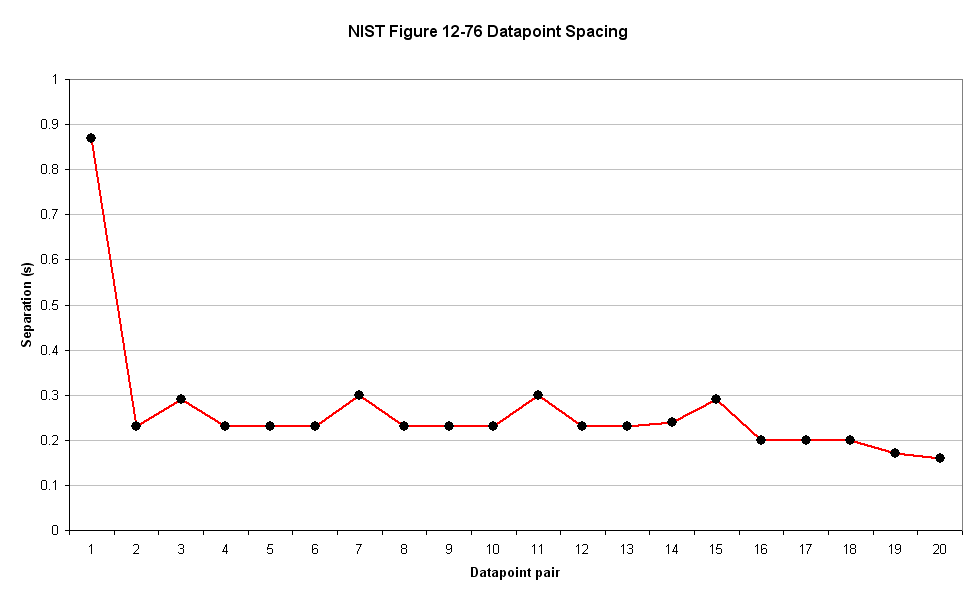
3)--- NIST used an inconsistent inter-sample time-step, skipping roughly every 56 out of 60 available unique images. They ignored over 90% of the available positional data.
NIST used an inconsistent inter-sample time-step and skipped many frames: True
Increasing the sampling rate to 60 frames per second is optimal: False

5)---NIST tracked the *roofline* using a pixel column, rather than an actual feature of the building. This means that the trace is not actually of a point of the building, as the building does not descend completely vertically. This means the tracked pixel column is actually a rather meaningless point on the roofline which wanders left and right as the building moves East and West.
NIST top of parapet pixel is an actual feature, an actual point of the building, no different than femr2’s top of parapet point at the NW corner. Claim False.

The building does not descent completely vertically. True

NIST’s tracked pixel column is a rather meaningless point. False

The N-S, E-W movement is small compared to the vertical movement for the first 18 stories fall. True

NIST’s moire technique, and Photoshop subpixel gray scale used in their pre collapse E-W motion, might have been used to track this E-W motion during wall fall. Don’t know, neither does femr2.

femr2 solved this E-W, N-S drift problem in his own data tracking. False.

6)--- NIST chose an initial trace location which precluded starting the trace before the East Penthouse had already descended (as the East Penthouse obscured their trace location). Consequently they no way of gathering early motion data, or quantifying long term noise levels.
NIST selected the initial trace location, near the failed column 79, under the Epenthouse as the start of the global north wall collapse. Global collapse began after the start of the Epenthouse collapse, not before. True.

NIST calculated horizontal displacement for the full 7.5 minutes duration of the Camera3 video before global collapse initiation, gathering early motion data. They would have noticed notable vertical motion. Section C.1.3 on. True.

NIST had no way of gathering early motion data, or quantifying long term noise levels. False. See above.

7)---NIST chose a trace endpoint which could not be traced from their selected T0 time, and so subsequently merged data from two separate traces together, without accounting for change in scaling metric.
NIST selected a second point near the center of the north wall, above the top of the windows 18 floors below, otherwise they would not have selected this second point.
This suggests that either the NIST positional trace was started using the rooftop structures, or the trace was performed manually. True.

NIST chose a trace endpoint which could not be traced from their selected T0 time. NIST chose a second point above their end point. Claim that NIST calculated fall time from East screen point location. False

NIST merged data from two separate traces together. False.

9)--- NIST did not perform perspective correction upon the resultant trace data.
NIST did not perform perspective correction upon the resultant trace data. Don’t know, neither does femr2.

10)--- NIST did not recognise that the initial movement at their chosen pixel column was primarily north-south movement resulting from twisting of the building before the release point of the north facade.
False. See 8) above.

11)---NIST did not perform static point extraction (H, V). Even when the camera appears static, there is still (at least) fine movement. Subtraction of static point movement from trace data significantly reduces camera shake noise, and so reduces track data noise.
I don’t understand how these graphs prove femr2’s point.

NIST didn’t perform static point extraction. Claim: Don’t know.

12)---NIST did not choose a track point which could actually be identified from the beginning to the end of the trace, and so they needed to splice together information from separate points. Without perspective correction the scaling metrics for these two points resulted in data skewing, especially of the early motion.
Yes they did. See 7) and 9) above. Claim False.

14)--- NISTs displacement function, if derived to obtain acceleration/time contains a ~1s period of over-g acceleration. Whilst that in itself is fine, it's at the wrong time, and in their conclusions they ignore it.
NIST p.602 ”The slope of the velocity curve is approximately constant between about 1.75 and 4.0 s. … The slope of the straight line was found to be 32.2 ft/s2… Note that this line closely matches the velocity curve between about 1.75s and 4.0 s.” NIST was aware velocity and acceleration closely matched, but were not exact. This was their purpose.

It’s at the wrong time. See 8). False.

In their conclusions they ignore ~1s period of over g acceleration. True.

15)--- NISTs displacement function, if derived to obtain acceleration/time does not suggest a 2.25s period of roughly gravitational acceleration.
Dan Rather less resolution video + SynthEyes inaccurate subpixel acceleration + NIST velocity and acceleration functions = Don’t know if NIST suggests 2.25 s period of roughly gravitational acceleration.

16)--- The displacement data appears to have been extracted initially from the T0 pixel column, but using the scaling factor determined for a point above Region B, further skewing the displacement data.
See 7) . False.


----------------------------------------------------------------------------------------------------------​
... Acceleration makes more sense, but the results are still way off. And this, ultimately, is going to be the cornerstone of my point in this thread: Obtaining a reasonable, plausible result in velocity & acceleration is one of the few objective checks that one can employ to get a sense of accuracy & error in the position vs. time graph.​

The extended +30g values at the beginning & end of your acceleration graph don't make any sense whatsoever.
…..

When one is taking few data points, then the issue of "smoothing the data" (i.e., frequency filtering) is irrelevant. As soon as one starts gathering data higher speeds, then there is a metric that is going to be of the form ∂y * ƒ (where ∂y = position error & ƒ = frequency) which sets a limit on the known accuracy of your results.

…..​
The engineering says that there is error in all measurements and therefore in all calculations. The art says that there are acceptable & unacceptable levels of error.

The acceleration graph that you produced has a clearly unacceptable level of error. It shows the building having an average of about +10G over the first 1.2 seconds or so. Which, from a zero initial velocity, means that the building would have jumped upwards about 180 feet.​
I trust that you agree that this is an unacceptable level of error...”

W.D.Clinger - http://www.internationalskeptics.com/forums/showthread.php?postid=6233630#post6233630
“Bottom line: For our purposes, calculating accelerations from positions by taking second differences, the error in the accelerations is linear in the position error but quadratic in the sampling rate.
That means femr2's subpixel resolution is helpful, but the higher sampling rates are substantially less helpful.”​

“The NIST fit is superior where it matters. Look at it from the standpoint of propagation of errors, and all will become immediately clear.”

“…the model is a ludicrous mathematical fantasy resulting from blindly misapplied polynomial over-fitting, and adds nothing to anyone's understanding of the data or the actual event, instead providing a false pretense of accuracy and "truth."

Oystein - http://www.internationalskeptics.com/forums/showthread.php?postid=7172021#post7172021 "No, they are incapable of differentiating between signal and noise. At best, and in theory only, they compress noise to the same degree that they compress signal. In practice, As WDC comprehensively proved, they add noise (compression artefact) while reducing the signal."

W.D.Clinger – http://www.internationalskeptics.com/forums/showthread.php?postid=7163702#post7163702
“the purpose of computing is insight, not number.”​
“All three parameters of NIST's nonlinear model have clear physical significance… The 11 parameters of femr2'sPoly(10) model do not correspond to any physical interpretation. They're just numbers, and provide no insight.”
femr2 - http://www.internationalskeptics.com/forums/showthread.php?postid=7163739#post7163739
“What is my purpose ?
It's certainly not to generate a parameterised and generalised model to describe how a building falls down. FAR from it.​

I've stated it numerous times now.
It's a data extraction and visualisation exercise.​
-------------------------------------------------------------------------------------------------------------------
Femr2 has had the advantage of seeing NIST’s cards first and try to best them after.​
If this were a contest between NIST’s experienced Ph.D.s and femr2 as to who can achieve the greater accuracy, I would bet on NIST.
Summary:
1. NIST extracted data from the Camera 3 video with higher resolution than femr2’s Dan Rather camera view.
2. NIST’s model for Stage 1 is superior to femr2’s.
3. A determination of the optimal frame sampled per second needs to consider displacement measurement error, which femr2 didn't do.
​
4. NIST’s model analyses physical factors, femr2’s calculates arbitrary parameters.
5. femr2 is wrong to claim that the kink developed without vertical falling motion.
6. femr2’s SynthEyes produces impossible, wildly inaccurate velocity and acceleration data of the north wall.​
___________________________________________________

By NIST’s standards - to find the timing of collapse initiation and progression - NIST did not “ blew WTC7 Stage 1 analysis”.

By femr2’s standard - to be able to graph what happens to the acceleration of the north wall over time as accurately as possible - NIST could have done better in some parts, did much better than femr2 in most others, so NIST, under an all-or-nothing standard, “blew WTC7 Stage 1 analysis”.

For a long time femr2 has promoted the myth that femr2’s analysis is the most accurate possible, it is not.
By femr2’s own standard - to be able to graph what happens to the acceleration of the NW corner over time as accurately as possible - femr2 “ blew WTC7 Stage 1 analysis”.​
 
Did “NIST blew WTC7 Stage 1 analysis”?
IMO, yes.

NIST’s purpose was to find the timing of collapse initiation and progression.
Their purpose is not entirely clear, given that everything beyond the draft "12.5.3 Collapse Time" was invoked as a response to Chandler.

femr2’s purpose was to be able to graph what happens to the acceleration of the NW corner over time as accurately as possible.
Nope. You've already made your first fatal mistake. There's very little about my critique of NIST's extended 12.5.3 that has ANYTHING to do with my own data or methods.

My purpose within this thread is to highlight the issues and errors with NIST's own study, as has been presented many times before.

NIST’s and femr2’s analyses are composed of the video raw data, data tracking method, and mathematical model.
Again, you are making a stupid comparison between datasets. Where's my "mathematical model" ? :rolleyes:

For the analysis of the fall initiation and the acceleration of the NW corner, femr2 used the Camera 2, aka Dan Rather view
As I've already discused with you, and to which you've already agreed that you were wrong...I use BOTH videos. Short memory you have.

(~21,000 feet from the north face of the building). This video is of substantially lower resolution by being ~ 10 times farther and subject to more atmospheric refraction* than the Camera 3 video.
Yet my Dan Rather data is still substantially higher quality that NIST's effort. lol. Not that that's relevant within this thread anyway :rolleyes:

NIST- For determining the beginning of the north wall global collapse, NIST used a point atop the parapet above the eastern louvers edge, near the collapse of the East pent house, Adobe software to determine gray pixel gradients in 250 steps within each pixel. Few data points, appears to be manual, but not stated.
See list of issues with NIST's method, and, as you've already agreed, they messed up in a serious way selecting their T0 :rolleyes:

How does one test the accuracy of femr2’s data?
Not relevant to the issues with NIST 12.5.3, and certainly not by the botched WDC hit=piece you've referred to later in your post.

Accuracy is relative, impossible is wrong. This acceleration is impossible and wrong.
ROFL. Using the wrong methods, WDC intended his results to be as they were. Just as tfk made me giggle when suggesting the data showed velocity variance of +/- 60 ft/s. The problem being his idiotic choice of method to derivative. lol.

NIST’s any 2 adjacent data points don’t exhibit this instability.
Of course not :rolleyes:

Manual tracking of a few points must be less accurate than automated tracking: False
Hilariously incorrect.

Dan Rather less resolution video + femr2 model +automated SynthEyes subpixel data tracking is more accurate than NIST’s Camera 3 higher resolution video + single pixel displacement tracking . False.
Hilariously incorrect.

NIST To = 0 Start of EPhouse collapse
Incorrect.

NIST 6.9s. start of top of wall collapse
That is the NIST T0 :rolleyes:

femr2 claims fall of NW corner indicates start of north wall collapse, that NIST is 1 second late..
I claim NIST T0 is ~1s early, absolutely, for the purspose in hand.

Wall cannot kink in without structure pulling down.
Oh dear.

This is the start of the north wall collapse. The structure inside continues to collapse east to west. ~1 s later the structure collapse inside reaches femr2’s NW column pulling it down. femr2 mistakes this as the start of the north wall collapse.
ROFL. I've traced multiple points. You are talking utter excrement.

North wall fell vertically and kinked in simultaneously.
The issue is that NIST treated apparent vertical motion AS vertical, when it wasn't vertical. That screwed their data.

NIST start of global collapse at +6.9s. is right.
No, it's not.

femr’s acceleration curves, Poly(10), Poly(50), S-G smoothed are all different.
They all show the same trend shape.

Which one is right?
All of them. Understanding what you are looking at is the first step, then appropriate interpretation becomes important. A point you clearly don't see.

Measurement error would explain why NIST chose ~4 frames per second instead of ~60 frames per second
No, it wouldn't. I'm quite sure NIST's measurement error is significantly higher than mine, for many reasons. A list of which I'm likely to provide you with.

and for timing the collapse, 3 physical parameters instead of femr2’s 11 or 51 imaginary ones.
ROFL. The poly fits are not "models" they are simply a form of smoothing, compression if you will.

And you're STILL comparing my data to NIST's...fatal flaw in your "argument". ROFL.

NIST could have used the odd numbered or even numbered fields only, in the frames they selected.
They did not.

femr2 doesn’t prove what NIST used.
Incorrect. I've shown inter-sample timings many times.

NIST did not deinterlace their video: Don’t know.
YOU don't know. I do, and they as much as state so.

They were interested in the general trend by sampling ~4 frames per second. This reduces noise and derivation of velocity and acceleration profile data. See 4).
No it doesn't. It just means it's simpler to derive as there's next to no data at all. Method doesn't have to account for higher frequency data.

There’s no evidence the data points NIST selected were less noisy than the ones femr2 selected at the same locations, perhaps more. See 4)
Whilst I disagree, it's irrelevant, as the problems with 12.5.3 have nothing to do with my data.

Is this sinking in yet ?

NIST may have determined 4 frames per second is optimal.
ROFL. Have a think about...
415549729.png


Increasing the sampling rate to 60 frames per second is optimal: False
Incorrect for a fair number of reasons. Want a list ?

NIST top of parapet pixel is an actual feature, an actual point of the building, no different than femr2’s top of parapet point at the NW corner. Claim False.
Incorrect. Seems you don't understand the issue. Surprise :rolleyes:

NIST’s tracked pixel column is a rather meaningless point. False
Not getting it, are you.

NIST’s moire technique, and Photoshop subpixel gray scale used in their pre collapse E-W motion, might have been used to track this E-W motion during wall fall. Don’t know, neither does femr2.
A point you have invented. How bizarre.

femr2 solved this E-W, N-S drift problem in his own data tracking. False.
Incorrect. NW corner has 2 dimensional motion. HOW many times have I shown you graphs which contain two axes of motion ? Jeez :rolleyes:

AGAIN, none of this is relevant, as my data is not part of the many issues with NIST 12.5.3 :rolleyes:

NIST calculated horizontal displacement for the full 7.5 minutes duration of the Camera3 video before global collapse initiation, gathering early motion data. They would have noticed notable vertical motion. Section C.1.3 on. True.
You really do try and make it sould like you know what you're doing. "Noticable" motion began minutes prior to release, and they ignored that out of incompetence. The point they chose was moving primarily N-S rather than vertically. etc. They didn't notice an awful lot :(

NIST had no way of gathering early motion data, or quantifying long term noise levels. False. See above.
ROFL. Making up your own "claims" again. How deceitful :) NIST had oodles of early motion data (and of a similar quality to mine it being generated by the moire method), they just didn't use it :rolleyes:

NIST chose a trace endpoint which could not be traced from their selected T0 time. NIST chose a second point above their end point. Claim that NIST calculated fall time from East screen point location. False
Utter nonsense. Clearly you don't "get it" again. Surprise.

NIST merged data from two separate traces together. False.
:rolleyes: Utter nonsense. Trace from T0 location spliced with vertical pixrel row over "region b". Proven many times. You don't seem to be able to understand the simplest of these issues, which have been clearly explained, with appropriate visual evidence, many times.

NIST did not perform perspective correction upon the resultant trace data. Don’t know, neither does femr2.
Nonsense. They make it abundently clear that they could have, but didn't :rolleyes: Read the bleedin' report again.

False. See 8) above.
Not false.

I don’t understand how these graphs prove femr2’s point.
Not a surprise.

NIST didn’t perform static point extraction. Claim: Don’t know.
They didn't.

Yes they did.
No, they did not.

It’s at the wrong time. See 8). False.
It's at the wrong time.

Femr2 has had the advantage of seeing NIST’s cards first and try to best them after.
If this were a contest
Which is where your entire post falls apart so spectacularly.

My data has no bearing upon the issues with 12.5.3. The issues are internal, and nothing to do with my superior data methods.

Your entire post is nonsense.

Whilst I admire your, frankly pathetic, time investment, I'm afraid the end result is a joke.

I'll respond to it in full detail when I have time.

I will apologise in advance, as I'm not going to be gentle with you.

You've made these wandering impotent attacks upon me, my work, and data for a couple of years now, and your incompetent posts are simply irritating, as it is possible the uninformed might take your words as being "true", which they are not.

I have a feeling it will be a long post. I'm sure you will enjoy it, though you really shouldn't.
 

ISF - Join now!

Every member here is approved by hand. No bots, no spam, just people who care about evidence and honest debate.

Membership is free!

Create your free account

Back
Top Bottom