• Security incident: ISF was recently accessed by intruders. Please change your password, and change it anywhere else you used it. Read more

NIST blew WTC7 Stage 1 analysis

To answer whether NIST blew stage 1 analysis we have to answer these questions:

  1. What's the goal of such analysis?
  2. What accuracy was required to accomplish that goal?
  3. What accuracy was actually used?
  4. Do their conclusions accomplish that goal within the methods they used?
Without 1) and 2) it makes no sense to discuss 3). And of course 4) is not being discussed at all.

Let me take as an example the "I have a dream" speech from Martin Luther King, and center in this part:

Five score years ago, a great American, in whose symbolic shadow we stand today, signed the Emancipation Proclamation. [...]

But 100 years later, the Negro still is not free. One hundred years later, the life of the Negro is still sadly crippled by the manacles of segregation and the chains of discrimination. One hundred years later, the Negro lives on a lonely island of poverty in the midst of a vast ocean of material prosperity. One hundred years later, the Negro is still languished in the corners of American society and finds himself an exile in his own land. And so we've come here today to dramatize a shameful condition.
​

Now someone which I'll call Mot_Rojam for no special reason :D comes and says, no, 100 years is very inaccurate. The speech was given on August 28, 1963 and the Emancipation Proclamation was signed on January 1, 1863. That's 36763 days or 100.65 years.

And someone called 2rmef traces the historical data and finds out that the hour at which Lincoln sat to sign and at which MLK gave his speech are separated by 100.653697984626433832 ± 0.00000317541 years, after taking into account leap seconds and equinox precession.

So, they claim, MLK blew his Negro timeline analysis.

Did he? Well, first of all, what was the purpose of that analysis? Is 100 years not accurate enough for his purposes? Did his speech fail to accomplish his goal?

So, yes, motive is important. We first should ask 2remf and Mot_Rojam, what was the goal of MLK's timeline analysis, in order to claim he blew it up?
 
And someone called 2rmef traces the historical data and finds out that the hour at which Lincoln sat to sign and at which MLK gave his speech are separated by 100.653697984626433832 ± 0.00000317541 years, after taking into account leap seconds and equinox precession.

So, they claim, MLK blew his Negro timeline analysis.
:(

Here is information which should assist you in determining the quality of NIST WTC7 Stage 1 Analysis...


NIST T0 Selection

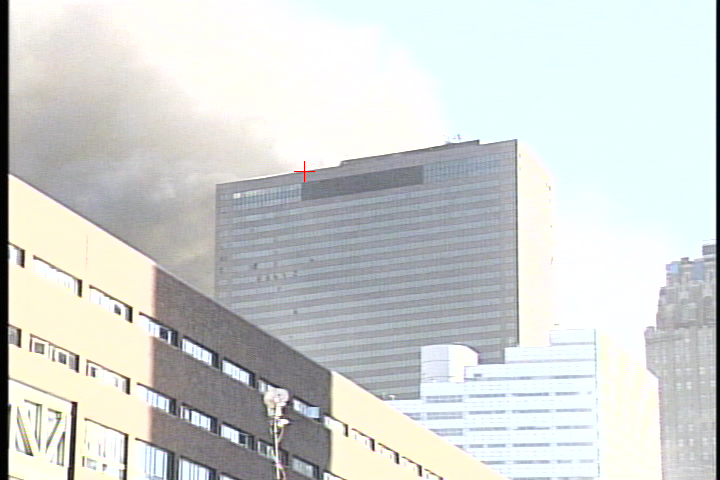
By usage of the brightness profile in NIST Figure 12-75 the exact pixel and (interlaced) frame that NIST selected was determined...


Source Video | CBS-Net Dub7 47.avi (RAW NIST FOIA - 1Gb DV File)
Pixel | 304, 171
Frame | 5398

That point is the exact start of the NIST Stage 1.

It is also ~6s after the start of the East Penthouse descent.

The following graph shows motion of the NW corner relative to the NIST T0 and their East Penthouse release time...


As you can see, relative to NW corner motion, the NIST T0 looks pretty meaningless.

When early motion is examined...

[qimg]http://femr2.ucoz.com/_ph/7/2/666377698.jpg[/qimg]

...the placement of T0 becomes even more subjective.

It's a good second out, even if you were to ignore every other issue...which just by itself would make significant difference to "stage 1 time interval"... in the order of >30%.

The NIST release time for the East Penthouse is also inaccurate, but that's not relevant for this thread. (It's much closer to exactly 6s prior to their T0).


NIST chose that spot with the assumption that detected motion after that point in time was vertical. In fact that motion is initially primarily North->South, as the formation of the "kink" was misinterpreted by NIST to be vertical in nature.

If they had compared the roofline profile of their chosen Cam#3 viewpoint...

...against that seen from the Dan Rather viewpoint...

...it would have been obvious that the "kink" was formed primarily North->South.

There are other ways to prove such, but comparison of the two images above (which are synchronised at the same point in time) is by far the simplest way to present the NIST interpretation error.

So, the start point of NIST "Stage 1" is, at best, flawed.


NIST Stage 1 Interval

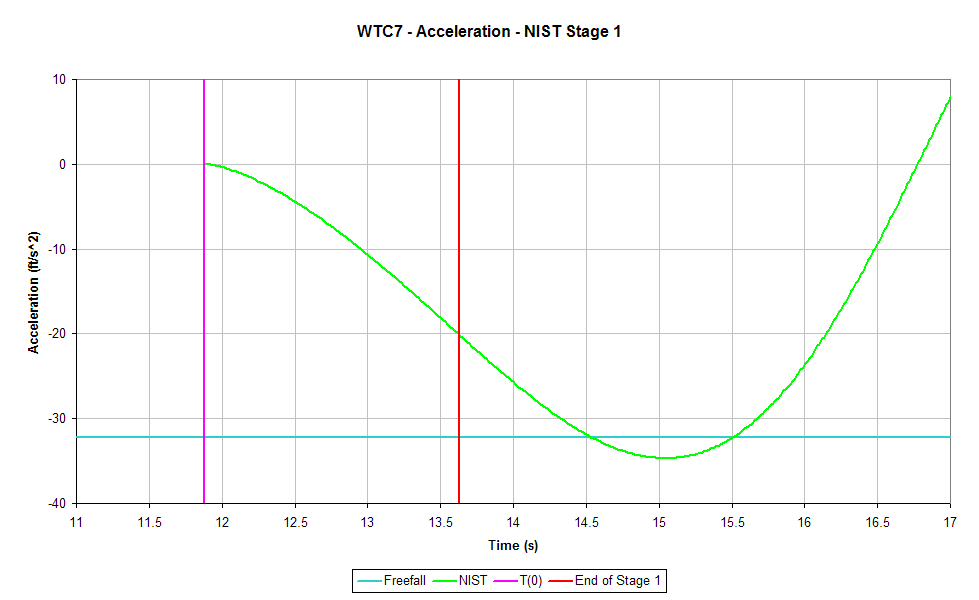
Here is a graph of the NIST acceleration profile as derived from the equation provided, along with the Stage 1 1.75s timing...


Well, it would seem that NIST didn't derive their (time derivative of curve fit) velocity equation for acceleration, as that would put their stage 1 (which is defined by NIST as being terminated when "freefall" was attained) a little later on.

So how did they come up with the time ?

I'd suggest a guesstimate, using eye-balled velocity graph slope as a rough indicator.

Is it therefore surprising that their Stage 1 period is inaccurate ?


A more correct "Stage 1" Timing

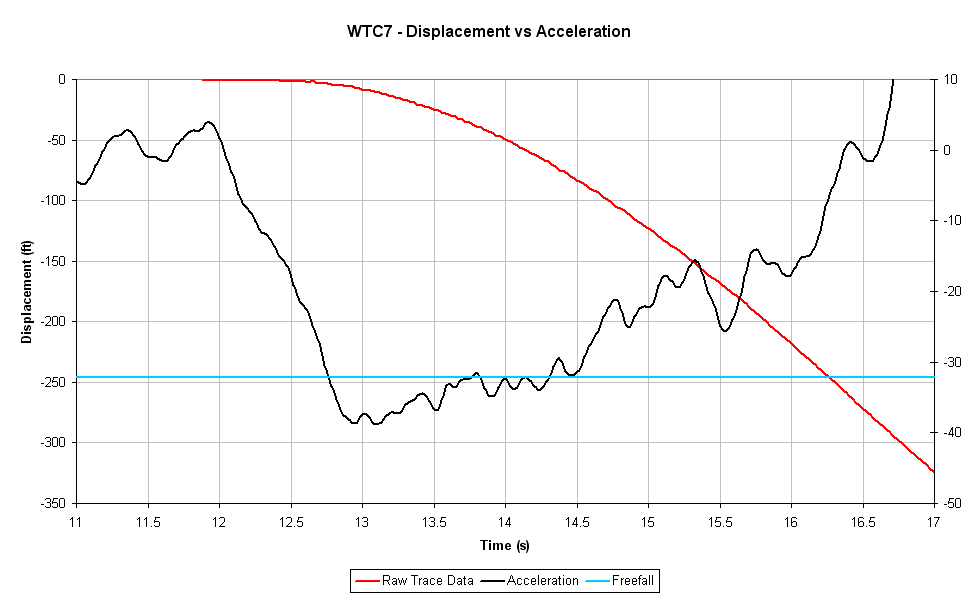
If Stage 1 "means" the time between release and the start of the period of approximately freefall descent, then firstly acceleration profile data must be determined...


...then simply measure the time between release and maximum acceleration...

~1s

(Just before the 12s mark to just before the 13s mark)

If you want to suggest the end-point should be a little earlier (as the maximum acceleration is over "freefall", fine. That would put "Stage 1" period down to ~0.75s.

As you also know, there are a number of additional factors which affect the NIST data...

The NIST data suffers from the following (non-exhaustive) series of technical issues, each of which reduce the quality, validity and relevance of the data in various measures...

  • NIST did not deinterlace their source video. This has two main detrimental effects: 1) Each image they look at is actually a composite of two separate points in time, and 2) Instant halving of the number of frames available...half the available video data information. Tracing features using interlaced video is a really bad idea, especially for features changing vertical position. I have gone into detail on issues related to tracing of features using interlaced video data previously.
  • NIST did not sample every frame, reducing the sampling rate considerably and reducing available data redundancy for the purposes of noise reduction and derivation of velocity and acceleration profile data.
  • NIST used an inconsistent inter-sample time-step, skipping roughly every 56 out of 60 available unique images. They ignored over 90% of the available positional data.
  • NIST likely used a manual (by hand-eye) tracking process using two single pixel columns, rather than a tried and tested feature tracking method such as those provided in systems such as SynthEyes. Manual tracking introduces a raft of accuracy issues. Feature tracking systems such as SynthEyes employ an automated region-based system which entails upscaling of the target region, application of LancZos3 filtering and pattern matching (with FOM) to provide a sub-pixel accurate relative location of initial feature pattern in subsequent frames in video.
  • NIST tracked the *roofline* using a pixel column, rather than an actual feature of the building. This means that the trace is not actually of a point of the building, as the building does not descend completely vertically. This means the tracked pixel column is actually a rather meaningless point on the roofline which wanders left and right as the building moves East and West.
  • NIST chose an initial trace location which precluded starting the trace before the East Penthouse had already descended (as the East Penthouse obscured their trace location). Consequently they no way of gathering early motion data, or quantifying long term noise levels.
  • NIST chose a trace endpoint which could not be traced from their selected T0 time, and so subsequently merged data from two separate traces together, without accounting for change in scaling metric.
  • NIST used the Cam#3 viewpoint which includes significant perspective effects (such as early motion being north-south rather than up-down and yet appearing to be vertical motion). It also means that each horizontal position across the facade requires calculation of a unique scaling metric, which NIST did not bother to do.
  • NIST did not perform perspective correction upon the resultant trace data.
  • NIST did not recognise that the initial movement at their chosen pixel column was primarily north-south movement resulting from twisting of the building before the release point of the north facade.
  • NIST did not perform static point extraction (H, V). Even when the camera appears static, there is still (at least) fine movement. Subtraction of static point movement from trace data significantly reduces camera shake noise, and so reduces track data noise.
  • NIST did not choose a track point which could actually be identified from the beginning to the end of the trace, and so they needed to splice together information from separate points. Without perspective correction the scaling metrics for these two points resulted in data skewing, especially of the early motion.
  • NIST performed only a linear approximation for acceleration, choosing not to further derive their chosen displacement function.
  • NISTs displacement function, if derived to obtain acceleration/time contains a ~1s period of over-g acceleration. Whilst that in itself is fine, it's at the wrong time, and in their conclusions they ignore it.
  • NISTs displacement function, if derived to obtain acceleration/time does not suggest a 2.25s period of roughly gravitational acceleration.
  • The displacement data appears to have been extracted initially from the T0 pixel column, but using the scaling factor determined for a point above Region B, further skewing the displacement data.


What consitutes NIST "blowing it" is always going to be subjective.

Some, er, folk, here have been focussing upon the conclusions...so have a gander at them too...

Start of descent... wrong.
End of "stage 1"... wrong.
Period of "stage 1"...wrong.
Data applicable to entire North face...wrong.

What's left ? It was "less than the acceleration of gravity". Woop.

 
...What consitutes NIST "blowing it" is always going to be subjective....
I don't fully agree.

What will undoubtedly be "subjective" is why - to what degree of detail - each person is interested.

Several members have made it clear that their interest only goes to the global conclusion - whether or not it was impact and fire related damage which caused the collapses.

That is their choice - their area of interest - and to that extent it is personal and could be described as subjective.

And, at that level NIST clearly did not get it wrong in the minds of those members who are supporters of the common narratives and not "truthers" claiming CD.

However many people here have interests at various depths of greater detail. Anyone attempting to explain WTC collapses obviously must go deeper than "impact and fire dunnit" OR "19 terrorists flew planes impact the towers and start fires...which is what dunnit" -- otherwise they are assuming the outcome they are seeking.

And how far to go in pursuit of details is a personal choice and "subjective" in that aspect. BUT once that choice is made the decision as to whether NIST got it right or wrong can be based on objective facts - observations - measurements - logic.

AND demonstrating that NIST got it wrong does not mean that "NIST blew it". The claim NIST blew it can only be supported when NIST went to a depth of detail needed to suport NIST's own findings and got it wrong at that level.

If somebody personally prefers to go deeper into detail than NIST and finds that NIST was wrong at that extra depth it does not qualify as "NIST blew it" except.....

...if it can be shown that NIST needed to go to that greater detail to support NIST's own conclusions AND got it wrong at that necessary depth of detail.

And what I have just posted has been the subject of many aborted discussions I have held with another of our colleagues over the past few years. :D
...
Some, er, folk, here have been focussing upon the conclusions...
I had a funny idea that those excursions were "off topic" :rolleyes:
 
:(

Here is information which should assist you in determining the quality of NIST WTC7 Stage 1 Analysis...
You're totally missing my point. Again:
To answer whether NIST blew stage 1 analysis we have to answer these questions:

  1. What's the goal of such analysis?
  2. What accuracy was required to accomplish that goal?
  3. What accuracy was actually used?
  4. Do their conclusions accomplish that goal within the methods they used?
Without 1) and 2) it makes no sense to discuss 3). And of course 4) is not being discussed at all.
You keep discussing the accuracy that was actually used.

What's the goal of NIST's analysis and what accuracy was required by them to accomplish that goal?


AND demonstrating that NIST got it wrong does not mean that "NIST blew it".
Indeed. Most of what femr2 has shown leads to loss of accuracy at worst. I agree in particular that the "kink" does not seem to be vertical and that's a mistake.


If somebody personally prefers to go deeper into detail than NIST and finds that NIST was wrong at that extra depth it does not qualify as "NIST blew it" except.....

...if it can be shown that NIST needed to go to that greater detail to support NIST's own conclusions AND got it wrong at that necessary depth of detail.
My point exactly.
 
You're totally missing my point.
No, I simply don't agree with your point, or your framing.

You keep discussing the accuracy that was actually used.
I've provided information which should assist you in determining the quality of NIST WTC7 Stage 1 Analysis.

What you choose to do with that is up to you.

In my opinion the analysis is badly flawed. If you think it's "good enough" that's up to you.

What's the goal of NIST's analysis

One primary goal was to determine "Timing of Collapse Initiation".

Their approach, method, and data interpretation of such was very poor, resulting in an almost meaningless T0. That it was "somewhere in one ballpark" is, from my perspective, irrelevant.

If I had made such a series of errors there would be many folk quite happy, if not jubilant, to dismiss my "analysis" and anything derived from that point forward.

Another primary goal would be "To obtain a better understanding of the vertical motion of the building in the first several seconds of descent, the motion of the north face was studied in more detail by tracking the vertical position of a point near the center of the roofline using the same video."

A rather wooly and undefined scope.

and what accuracy was required by them to accomplish that goal?
They do not state such, so that's just opinion. Yours seems to differ from mine.

Most of what femr2 has shown leads to loss of accuracy at worst.
I would suggest replacing "worst" with "best". What apart from accuracy do you think the issues affect ? Does the fact that their trace "location" effectively wanders left and right as the building descends simply affect "accuracy" in your opinion ?

I agree in particular that the "kink" does not seem to be vertical and that's a mistake.
Everything else being equal, removal of that "issue" would change their stage 1 period by >30% and perhaps as much as 50%. Not insignificant "accuracy" error.

I have no issue with different folk having different standards. The wide array of issues identified remain unchallenged.
 
If somebody personally prefers to go deeper into detail than NIST and finds that NIST was wrong at that extra depth it does not qualify as "NIST blew it" except.....

...if it can be shown that NIST needed to go to that greater detail to support NIST's own conclusions AND got it wrong at that necessary depth of detail.
I'm fine with folk having preference for different levels of detail, however, many of the issues presented about the NIST analysis have nothing to do with looking in more detail at all. Instead what is being highlighted are errors in the methods and procedures that they chose to actually use.
 
I'm fine with folk having preference for different levels of detail, however, many of the issues presented about the NIST analysis have nothing to do with looking in more detail at all. Instead what is being highlighted are errors in the methods and procedures that they chose to actually use.
Understood and agreed.

I saw my proviso of "...AND got it wrong at that necessary depth of detail" as including all ways of getting it wrong - including methods, tools and reasoning to name three of the big possibilities.

The main problem is one of "system hierarchy" - "they" won't focus how much of the system they are referring to or, stating it differently, which subsystem they are discussing.
 
If somebody personally prefers to go deeper into detail than NIST and finds that NIST was wrong at that extra depth it does not qualify as "NIST blew it" except.....

...if it can be shown that NIST needed to go to that greater detail to support NIST's own conclusions AND got it wrong at that necessary depth of detail.
My point exactly.
I know. There is a barrier of disconnect between those who understand that the key parameter is "good enough" - good enough for purpose that is. Which is your point "2. What accuracy was required to accomplish that goal?" and my statement of the same point using different words.

You will be aware of one member posting here and elsewhere who has made an art form of denigrating "good enough" and using it as a snide insult. Totally off track. (Not femr2 - he doesn't engage in those activities.) But "good enough" is the test. However what objective numbers qualify as "good enough" depends on the goal - your point #1. And people have different goals. Legitimately different goals. Not always applied legitimately and several of our debunkers being the worst offenders. (the point probably too subtle for many truthers. )

The implied "only perfection will satisfy" does not apply to everyone. But it is legitimate for those who hold that standard for their purposes - not for imposing on others.

"Only perfection will satisfy me" could be acceptable BUT the implied "only perfection should satisfy YOU" is wrong.

Then I was wrong to see it as "two camps" - there are many who simply want to disagree without any rhyme or reason."

:)
 
There is a barrier of disconnect between those who understand that the key parameter is "good enough" - good enough for purpose that is. Which is your point "2. What accuracy was required to accomplish that goal?" and my statement of the same point using different words.
I'm not a fan of this kind of framing, as you know. Tracing a feature from video is not rocket science. If you do it right, the results are what they are...and will always contain an amount of error. If you do it wrong, especially when "what you do wrong" is basically inexcusable, the results are compromised. As I've said, and you agreed, little of my criticism in this context is about suggesting more advanced methods for NIST to have used, but basic shcoolboy errors they made with the methods they chose to use.

As focus is still leaning upon some kind of individual interpretation of whether the conclusions are acceptable given the errors in the analysis, along with similar grey interpretation of what the "goal" actually was, consider the last paragraph of the report section in question...

As noted above, the collapse time was approximately 40 percent longer than that of free fall for the first 18 stories of descent. The detailed analysis shows that this increase in time is due primarily to Stage 1, in which column buckling was just beginning and gradual increases in displacement and velocity were observed. The three stages of collapse progression described above are consistent with the results of the global collapse analyses discussed earlier in this chapter.

Now, errant T0 placement alone could cut the "stage 1" timespan in half, conflicting with the bolded section above.

Implications of which go further down the chain. What they are saying is very flawed, in their conclusion, because their analysis was poor, and the numbers it churned out were flawed/inaccurate/wrong.

~40% ? No.

Shouldn't then be consistent with their simulation, yet they say it is. Oh.

The implied "only perfection will satisfy" does not apply to everyone. But it is legitimate for those who hold that standard for their purposes - not for imposing on others.
I know it's not directly aimed, but I'm not demanding perfection. Competency would have been useful. There's little to no excuse for some of the issues (with the methods they used, which comes before highlighting that superior methods could have been utilised, such as per-frame sub-pixel...rather than the by hand/eye as is probable).


It's probably time to drop in the sub-text of "goal" for the relevant section...

The "more detailed analysis" was prompted by, and there's no point denying it, the claims of freefall by Chandler during the public review period (which was unbelievably short btw).

Original draft section...here
Post Chandler "more detailed analysis"...here

So, a NIST goal was certainly looking in "more detail" at the motion of the North face, to determine whether freefall was indeed present, or not.

They concluded the infamous "2.25s at freefall". Oh dear.

Whilst NIST state "It was difficult to detect the exact instant that the north wall began to collapse because of the resolution of the video image and because, as columns buckled, vertical movement was initially very small.", they had already performed building vibration motion detection for both WTC7 and WTC2 revealing inch-level scales of motion, yet were not inclined to apply the same techniques in this section. (For those familiar with the limitations of the NIST moire technique, consider the simple action of rotating the video 90 degrees)

As a result of the "more detailed analysis" NIST split the descent into 3 stages, "stage 1" with an errant start time and duration, "stage 2" with a very ill-advised freefall "admission" with an errant duration, with boundaries between all three pretty random due to lack of trace resolution and accuracy.

They went to the "bother" of determining their "model" for displacement, derived it for velocity, then didn't bother deriving to acceleration. The significant difference between the lame linear regression and the behaviour of their (none too hot) "model" derived to acceleration would have surely made them utter a "hang on a mo'".

etc :)
 
Last edited:
No, I simply don't agree with your point, or your framing.
Your response (discussing what I explicitly noted was unnecessary to discuss until settling the prior points, given that I've seen the same stuff over an over) seemed to indicate otherwise.


One primary goal was to determine "Timing of Collapse Initiation".
I don't think that that goal has anything to do with the façade descent analysis. Usage of the moiré method to detect early movement focuses on that aspect.

For what I can read in the report, including NCSTAR 1A Chapter 4 "Principal Findings", the best explanation for the presence of section 3.6 (whose conclusions do not appear at all in chapter 4) is to prove that the observables can be explained by their analysis of the collapse cause. From that point of view, I think they overdid such analysis, going much farther than needed just to entertain Chandler's criticism. They gave a plausible, if not accurate, explanation, and thus didn't blow it. You have refined it? Fine.
 
discussing what I explicitly noted was unnecessary to discuss until settling the prior points
I don't agree with your points, therefore your personal viewpoint about what you consider unnecessary is not relevant to my response.

femr2 said:
One primary goal was to determine "Timing of Collapse Initiation".
I don't think that that goal has anything to do with the façade descent analysis.
"12.5.3 Timing of Collapse Initiation and Progression" is the title of the darn report section.

Around 20%-30% of the entire section is specifically about exactly that, determining the "Timing of Collapse Initiation".

It is, of course, impossible to start a "façade descent analysis" without determining the start of such. And you think "that that goal has [nothing] to do with the façade descent analysis" ? Crikey.

That NIST even messed that up, a point you have previously agreed with, is somewhat unfortunate :rolleyes:

Also of note is the inconsistency of terms used, as this metric is described as "Start of Main Collapse" or "Start of Global Collapse" in other areas of the report. Appendix C also refers to this metric as "collapse initiation". At the beginning of 12.5.3 it is correctly described as "The timing of global collapse of WTC 7", confirming the intent of the titling and subsequent usage within the section.

It would appear that what you think does not tally with what is in fact contained within the report you are discussing.

Usage of the moiré method to detect early movement focuses on that aspect.
Nonsense.

The moire method detected horizontal motion only, the "Start of Main Collapse" timing is not determined within Appendix C, but simply set upon graphs provided. "Start of Main Collapse" is not discussed.

I suggest you don't make these kind of assertions. I am ridiculously familiar with the content of these sections, and of course have them open in front of me as I type.

For what I can read in the report, including NCSTAR 1A Chapter 4 "Principal Findings"
I suggest you reference the full report, rather than the condensed summary-summary. Your rather odd view of what is contained within the report sections under discussion is likely due to you not "having all the facts", at best.

the best explanation for the presence of section 3.6 (whose conclusions do not appear at all in chapter 4)
You will be better informed if you use the full report section NCSTAR 1-9 vol2 12.5.3, as referenced many times, and provided in full just a couple of hours ago...
Original draft section...here
Post Chandler "more detailed analysis"...here

The "best" and blindingly obvious reason for the "more detailed analysis" is, as I indicated, NIST's reaction to Chandler.

Of course your summary Chapter 4 does not include detail of it. It was only bolted into the report after the public review.

NIST did an appalling job of it, IMNSHO (see prior critique)

They gave a plausible, if not accurate, explanation, and thus didn't blow it. You have refined it? Fine.
Dear me. Your opinion is clearly based upon flawed knowledge of the report sections you are trying to discuss, as highlighted above. Explanation ?

Thus I'm not swayed by your personal conclusions (which of course you are entitled to) until you update your knowledge using the full report texts.

You are also seemingly oblivious to the repeated clarification that very little of my critique has anything to do with "refining" it.

NIST blew WTC7 Stage 1 Analysis, IMO ;)
 
Last edited:
It is, of course, impossible to start a "façade descent analysis" without determining the start of such. And you think "that that goal has [nothing] to do with the façade descent analysis" ? Crikey.
I thought that that sentence referred to the whole collapse process started by the failing girder and subsequent floor collapse, and that the title of section 3.6, even if its title talked about initiation and progression, discussed only progression. I was wrong: it refers to global collapse that started with the descent of the façade.


Nonsense.

The moire method detected horizontal motion only, the "Start of Main Collapse" timing is not determined within Appendix C, but simply set upon graphs provided. "Start of Main Collapse" is not discussed.
From the point of view that I understood they referred to the collapse as starting where I specify above, my sentence made sense.


I suggest you reference the full report, rather than the condensed summary-summary. Your rather odd view of what is contained within the report sections under discussion is likely due to you not "having all the facts", at best.
I can't agree with that. The "condensed summary-summary" is a 15 page chapter titled Principal findings. Nothing in it refers to the contents of section 3.6; however it goes into some detail about the conclusions from other sections. That should tell you the relative importance that NIST gave to 1A section 3.6 (or 1-9 section 12.5.3 if you prefer). That leads me to my conclusion which I reproduce again, since you haven't commented on it:
For what I can read in the report, including NCSTAR 1A Chapter 4 "Principal Findings", the best explanation for the presence of section 3.6 (whose conclusions do not appear at all in chapter 4) is to prove that the observables can be explained by their analysis of the collapse cause. From that point of view, I think they overdid such analysis, going much farther than needed just to entertain Chandler's criticism. They gave a plausible, [even] if not accurate, explanation, and thus didn't blow it.
(Added [even] for clarity this time around).


You will be better informed if you use the full report section NCSTAR 1-9 vol2 12.5.3, as referenced many times, and provided in full just a couple of hours ago...
And I could use the transcription of the relevant section of MLK's speech as transcribed by someone who listened and recorded it, for even better precision of what was publicly said. That would not bring me any closer as to the purpose of that section; only examining the speech in full and its purpose would clarify what precision he needed.

You seem to be blinding yourself from looking into motive with enough perspective. You're so lost into chlorophyll discussion that you're missing the trees, let alone the forest.
 
I can't agree with that. The "condensed summary-summary" is a 15 page chapter titled Principal findings.
And the full report is, what, 10,000 pages ? One wonders which contains the most informative detail...

We all know what happens to NIST details when they start summarising, even on a small scale, within a single sub-section of one chapter of one document...we end up with "the north face descended at gravitational acceleration [for 2.25s]" :(

Nothing in it refers to the contents of section 3.6
Why should it ?

The original scope of 12.5.3 (3.6 is only a partial copy of the actual section, which explains a fair bit of your misunderstandings about what the full section actually contains) was simply "40% longer than freefall". That's it. That was the goal. 12.5.3 was originally titled "Collapse Time".

As a response to Chandler, NIST expanded 12.5.3 as has been discussed.

That was their goal.

That was the motivation behind the changes.

Your desire to have it be required to fit into "the big picture" is irrational.

Simple as peas.

however it goes into some detail about the conclusions from other sections. That should tell you the relative importance that NIST gave to 1A section 3.6 (or 1-9 section 12.5.3 if you prefer).
It's obvious beyond belief that NIST couldn't give a monkeys about it, given how badly it was executed.

However, that is irrelevant. You were wondering about their goals/conclusions earlier. I've spelled them out. Did they manage to satisfactorily respond to the Chandler input ? Well, if you think AGREEING with him was a good idea...

:rolleyes:

You seem to be blinding yourself from looking into motive with enough perspective. You're so lost into chlorophyll discussion that you're missing the trees, let alone the forest.
Nonsense.

Goals have been clarified.

Intent has been clarified.

Significance (though irrelevant) has been clarified.

Effect upon global conclusions (though irrelevant) has been clarified.

All criticism of the section remains.

Poor job.
 
Femr, have you ever tried tracing video from earlier in the day for small movement? I guess the problem would be finding video from a decently static shot that was set up a long time.
 
Femr, have you ever tried tracing video from earlier in the day for small movement?
Yes, all available footage.

The previous few minutes from the commonly posted early motion shows lower scale, but still interesting, motion.

Motion from cam#3 significantly earlier, though at an unknown time, shows no apparent moetion.

I guess the problem would be finding video from a decently static shot that was set up a long time.
Indeed, however, it's not just the motion that is of interest, but the behaviour of the motion. Inflexions in direction are clearly significant, indicating some change in building response.
 
I'm not a fan of this kind of framing, as you know....
Yes, it is probably the main area where our perspectives sometimes differ. And it is not a question of I'm right , you're wrong. The different perspectives are to a large extent complementary.

I won't derail into explaining in attempted detail. Sufficient that my focus in that previous post was specifically on issues of 'systems hierarchy' and 'sub system independence'. If the cigarette lighter in the car doesn't work it does not mean that the whole car is unserviceable - hierarchal relationship. And if there is a hole in the muffler it won't stop the headlights working - independent sub systems.

Your focus in this recent series of posts on wrong choice of methods or wrong use of methods - not where they fit in the whole scheme which was my focus.

Another different perspective - I've never expressed it this way before - but my view of the NIST response to Chandler fiasco is that NIST "blew it". But I come to that from the public relations perspective. They went too far in attempting to appease the unappeasable. They shouldn't even have gone there - unless they made sure to win. And they couldn't win that one no matter how good they got the analysis/explanation. And that was true even before they did a poor job on the methods/technicals. There was no way that a CT was going to stop at the explanation given - so why give him the ammunition to grandstand on? I agree also that NIST blew that part of the analysis on technical grounds as well as PR. But that bit of "blew it" does not confirm the more global claim that "NIST blew WTC7 Stage 1 analysis". That would be false global claim OR a system v sub-system error OR a set v subset confusion if I use some alternate terminology.

However my main focus through this thread has been on a fourth perspective. I have been pressing one of those who claim that NIST Blew it in some unspecified degree to make their claim explicit and support it. I am usually very stubborn at resisting "reverse burden of proof" ploys hence the theme of most of my recent posts.

...and added to the previous three that makes a fourth perspective on "NIST Blew it" - the perspective of getting the claimant to support the claim and me not accepting reversed burden of proof. :rolleyes:

Then, given the clarity of what is actually being discussed the two recent attempts to totally change the topic are even more ludicrous in missing the point. Merely noise.

They miss the point from all four perspectives. :D

As for:
... Did they manage to satisfactorily respond to the Chandler input ? Well, if you think AGREEING with him was a good idea...
..they blew that one. And expecting that Chandler would appreciate their conceded agreement was.......lets leave it at 'somewhat naive' ;)
 
Last edited:
... expecting that Chandler would appreciate their conceded agreement was.......lets leave it at 'somewhat naive' ;)

True, but I would guess that they simply had no clue as to the amount of willing intent truthers have to distort findings. And also because they appear to be simply ignorant of how truthers think and couldn't conceive of the fact that their fairness would be used against them.

And that's understandable. The NIST researchers circulate amongst academic and industry circles where trutherism numbers are negligible at best, and likely nonexistent. They'd have little to no experience of or with conspiracy fantasists save for the "public commentary" sessions they held.

I've said it before and I'll say it here again: One of the deliberate sins committed by too many members of the "truth" movement is to prey on the otherwise laudable tendency of western society to at least give some ear to outlandish opinion on the thinnest possible benefit of the doubt. It's a very deeply ingrained tendency for nearly many people raised and educated in western society, and it's based in the notion of being fair, despite personal doubts. It's admirable behavior, really. But the problem here is that conspiracy peddlers of any cloth - not just 9/11 truthers; you'll see this with any CT'ist - take that allowance and run. And we see the effect here. Chandler pointed out a very minor, very specific technical point, and I think that Sunder and the other report staffers merely agreed that it was technically accurate, even if it was simply minutiae and had no wider implications that were legitimate. And that led to the admission. I don't believe they had a clue that 9/11 conspiracy peddlers would try to turn it into the distortion that they did. And that naivety was born of a mixture of inexperience and ingrained notions of trying to be fair. Which is normally not a problem in regular society, but becomes one when you run into confidence men.

Yes, I agree with you. NIST was naive. But that simply goes to show the abuse of trust that 9/11 conspiracy peddlers commit.
 
...And also because they appear to be simply ignorant of how truthers think and couldn't conceive of the fact that their fairness would be used against them...
Agreed - also agree with your reasoning.

Except for the oxymoronic aspect of "truthers think" ;)

And two aspects of this:
...Chandler pointed out a very minor, very specific technical point, and I think that Sunder and the other report staffers merely agreed that it was technically accurate, even if it was simply minutiae and had no wider implications that were legitimate...
Reasonable objective people would simply agree with a correct detail which had no significant effect. The fact of no wider legitimate implications is, of course, the issue underlying a lot of the angst directed repeatedly at M_T and to a lesser extent femr2.

...and which I attempted to touch on with recent posts. ;)

Then "know your opponent" is always appropriate, so:
...becomes one when you run into confidence men...
...makes it important that you can gauge your opponent. (Which would be even more obvious if I used US spelling :D)


:runaway
 
Last edited:

ISF - Join now!

Every member here is approved by hand. No bots, no spam, just people who care about evidence and honest debate.

Membership is free!

Create your free account

Back
Top Bottom